Interview Kickstart Review 2026: Is It Worth $5,000+?
Quick Overview
This review examines Interview Kickstart's program features, pricing and guarantee structures, the composition of its coaching bundle (live instruction, mock interviews, and question banks), documented pros and cons, and a side-by-side comparison with alternatives.
If you are searching "Is Interview Kickstart worth it," you are almost certainly holding a four- or five-figure quote and a career move you cannot afford to fumble. This review covers what the program actually sells, what public reviewers praise, what they complain about, and why we think most engineers should not write that check yet. Full disclosure: this is published by PracHub, and we compete for some of the same dollars. Every factual claim about Interview Kickstart below is checkable against the public sources listed at the end. Check them.
The article moves in order: what the program is, our verdict, the honest pros, the serious cons, a side-by-side comparison, a four-step framework for spending the least money that still closes your real gap, and an FAQ.

Deciding between premium coaching and self-guided practice is a diagnosis problem before it is a budget problem.
Key Takeaways
- You are asked to pay before you can compare. Interview Kickstart's own cost page says price depends on pathway, domain, and payment plan, so there is no published number to shop against. Third-party reviews commonly report larger programs in the $5,000 to $12,000 range. Get your exact number, refund rules, and guarantee conditions in writing, from a person, before anything else.
- Interview Kickstart is a structured coaching program, not a question bank. You are buying live instruction, mock interviews, and accountability — and you are buying them as one large commitment made before you know which round is actually failing you.
- Most of what the bundle contains is not scarce. Questions are not scarce. Written solutions are not scarce. Paying premium prices for the commodity half of the bundle is the single most common way candidates overspend on interview prep, and it is structurally what a big bundled program invites you to do.
- The program is worth it for a narrow profile: solid fundamentals, a high-comp target role, real protected weekly hours, and a diagnosed weakness in live performance or study structure. That is a smaller group than the marketing implies.
- Most candidates who feel "not ready" do not have a coaching problem. They have a reps problem or a diagnosis problem, and both are far cheaper to fix.
- Run two weeks of real-question practice before you spend anything. PracHub's free tier covers most of the question bank, which is enough to find your weakest round without a purchase.
What Is Interview Kickstart?
Start with the category, because that is where most buying mistakes happen.
Interview Kickstart is a technical interview prep and career advancement program for tech professionals. It targets candidates preparing for software engineering, machine learning, data science, product, engineering management, and adjacent technical roles. Its public materials describe role-specific courses, live instruction, mock interviews, resume and LinkedIn support, behavioral prep, and salary negotiation help.
The useful mental model: it is closer to a part-time interview bootcamp than to a course or a problem set. That matters because bootcamps fail for a different reason than content products do. A course fails when the content is bad. A bootcamp fails when you cannot keep up with it — and when a bootcamp fails that way, the money is already gone.
Interviewers care about the distinction too, indirectly. Nobody is impressed that you bought a program. They are responding to whether you can clarify a problem, reason out loud, and defend a tradeoff. A program is one delivery mechanism for that skill, not the skill itself.
Common mistake: treating enrollment as progress. A candidate who attends every live session but never solves a problem cold, under time pressure, without a hint, will still freeze in round one. Attendance is an input. Solved-cold reps are the output.
Quick Verdict: Is Interview Kickstart Worth It?
Given that framing, here is our short answer before the details.
We think you should not pay for a full coaching program before you have exhausted free practice and named your weakest round. Interview Kickstart can be worth it if you need live structure, instructor feedback, mock interviews, and external accountability, and you can genuinely commit serious weekly hours. If what you actually need is more practice questions, clearer written solutions, or a study plan, then for most engineers this is a bad trade — you are paying coaching prices for reading material.
The decision is easier once you name the gap rather than the category:
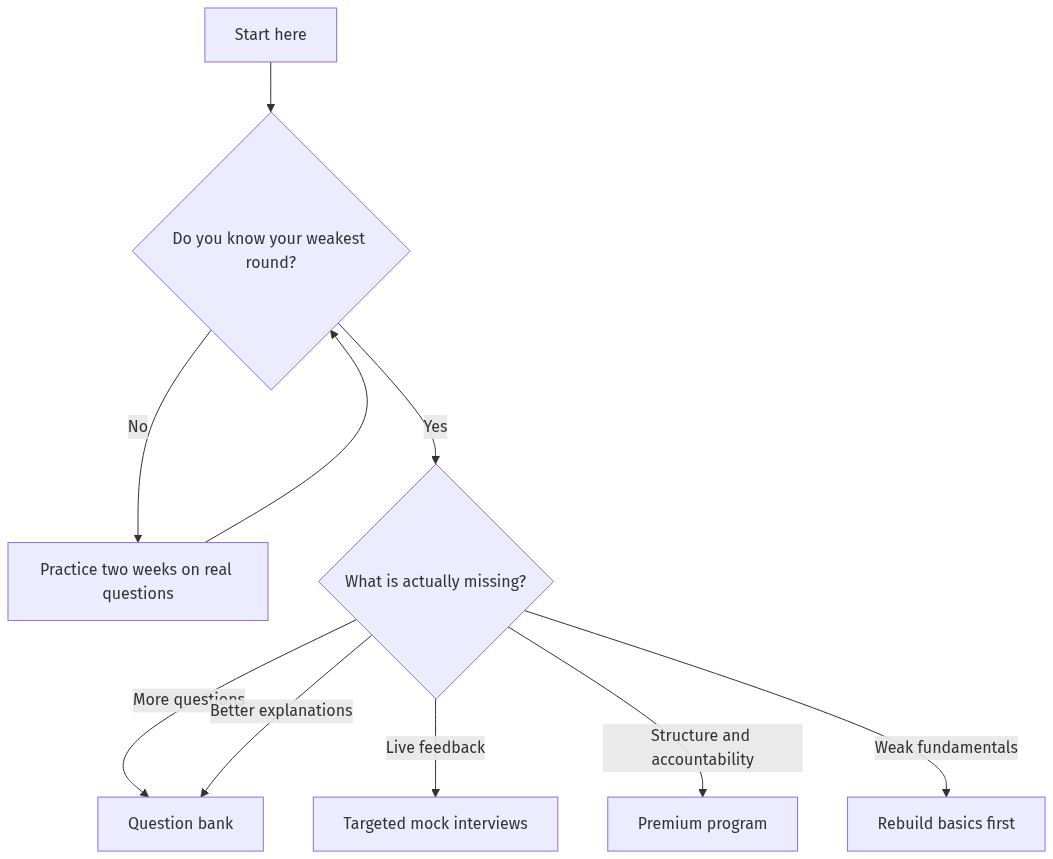
Example of the wrong diagnosis: a candidate bombs a big-tech loop, concludes "I need a bootcamp," and enrolls in a full program. The real failure was that they wrote code for ten-plus minutes without saying a word, leaving the interviewer with no idea whether they understood the constraints. That is a mock-interview fix costing a fraction of tuition, not a curriculum fix. You only know that after diagnosing the round — which means every dollar spent before the diagnosis is a guess.
What You Get for the Money
Assuming the category fits, here is what the program bundles.
Interview Kickstart's public pages describe a broad prep experience. Depending on the track, candidates may get:
- Live classes for structured, scheduled learning
- Recorded lessons for review
- Data structures and algorithms instruction
- System design training
- Domain-specific tracks for roles like machine learning, data science, product, and engineering management
- Mock interviews with feedback
- Resume and LinkedIn support
- Behavioral interview preparation
- Salary negotiation guidance
- Post-program support
The breadth is the pitch: you are not buying content, you are buying a guided system. Breadth is also how bundles hide their price. A ten-item list feels like ten times the value, but you only pay once and you only have so many evenings, so in practice you consume two or three of those items and subsidize the rest.
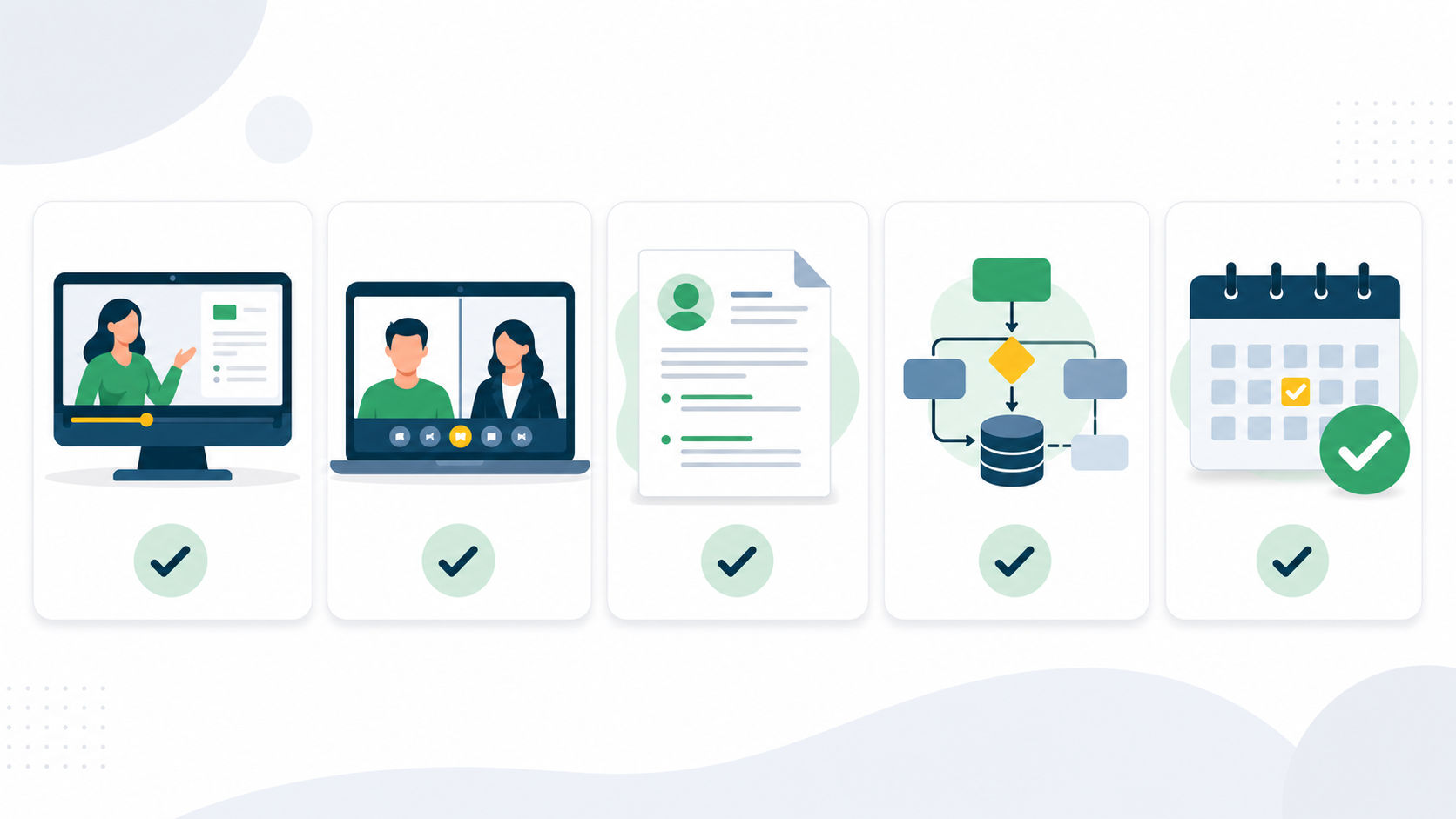
Run the same checklist against any program before you pay for it.
Price the bundle by what is genuinely scarce. Content is not scarce. Questions are not scarce. Feedback on your specific reasoning, delivered live by a human, is scarce.
| What you are buying | How scarce is it | Cheapest place to get it |
|---|---|---|
| Practice questions | Not scarce | Free question banks, including PracHub's free tier, which covers most of the question bank |
| Written solutions | Not scarce | Free or low-cost question banks |
| A study sequence | Mildly scarce | A written plan you build in an afternoon |
| Live feedback on your reasoning | Scarce | Mock interviews, paid per session |
| Behavioral and negotiation coaching | Scarce | Mocks or a coach, paid per session |
| Enforced accountability | Scarce for some people | A program, a study partner, or a deadline |
How to read this table: four of the six rows are cheap or free elsewhere. If four of the six describe your situation, you are about to pay a premium bundle price for the commodity part of the bundle. That is the whole trap, in one table.
What Alumni Consistently Praise
Public feedback on Interview Kickstart is mixed. The positive reviews cluster around the same four things, and all four are real benefits worth naming honestly — we are not going to pretend otherwise.
Structure
Most candidates do not fail from a shortage of resources. They fail from having too many resources and no sequence. A program hands you a calendar, a curriculum, and a reason to keep moving. For someone returning to interviews after five years of shipping features, that scaffolding has real value.
But: structure is the cheapest thing in the bundle to replicate. If you can sketch a twelve-week plan on one page and stick to it, you are paying four figures for a calendar.
Live Feedback
Self-study is efficient right up until you get stuck on something you cannot name. If recursion, distributed systems tradeoffs, ML fundamentals, or behavioral storytelling is where you stall, a live instructor can spot the misconception faster than another two hours of forum archaeology.
Why it is worth real money: a candidate keeps writing correct BFS solutions but cannot say why BFS rather than DFS. Reading more solutions will not surface that gap, because the code looks right. One instructor asking "why this traversal?" surfaces it in thirty seconds. This is the scarce thing. It is also available per-session, without buying a track.
Mock Interviews
This is the strongest component of almost any coaching program, because mocks expose failures that solo practice structurally cannot:
- You solve silently and make the interviewer guess your thinking.
- You start coding before clarifying constraints or input ranges.
- You miss the follow-up that the whole question was building toward.
- You describe tradeoffs in adjectives instead of numbers or conditions.
- You give behavioral answers that sound rehearsed but contain no specifics.
Common mistake: doing mocks too early. A mock before you have reps mostly tells you that you need reps, which you already knew, at the price of a mock.
Accountability
The underrated one, and the most uncomfortable. Plenty of candidates know exactly what to study and still cannot stay consistent past week two. A paid program creates social and financial pressure to show up.
Look closely at what that means, though. Sunk cost is the mechanism. You are paying thousands of dollars to buy yourself guilt, and guilt is the cheapest commodity on this list — a study partner, a public commitment, or a booked interview date manufactures the same pressure for nothing. Count accountability as a line item, then ask honestly what you are willing to pay per unit of it.
Common Complaints and Risks
The criticism follows an equally consistent pattern, and each item costs you something specific.
High Reported Cost
Price is the dominant concern in public discussion, and it should be. Third-party reviews commonly describe larger Interview Kickstart programs as landing in the thousands, with the $5,000 to $12,000 range reported repeatedly.
The structural problem is not the number. It is the shape of the bet. A program reported in the thousands concentrates your entire prep budget into one commitment, made at the moment you know the least about your own weaknesses. If the diagnosis turns out wrong — you bought curriculum and needed mocks, or you bought mocks and needed fundamentals — there is no partial rebalance. Compare that to spending in increments, where every hundred dollars buys new information about what to spend the next hundred on.
Ask, in writing:
- What is the total cost for my specific track?
- Is pricing track-dependent, and what changes it?
- Is financing available, and what does it add?
- What portion is refundable, and until when?
- What exactly does the guarantee require of me?
- What happens if I fall behind or need to pause?
Do not rely on your memory of a sales call.
Limited Pricing Transparency
Interview Kickstart's cost page says price depends on course, domain, and payment plan. There is no published number.
That asymmetry works against you, every time. You walk into a pricing conversation knowing nothing, across from people who know every number, every discount, and every objection you are about to raise. You also cannot do the one calculation that matters: comparison. "Is this worth it" is unanswerable until you know whether you are weighing it against a $200 mock package, a $2,000 short course, or a five-figure track. Those three have completely different break-even points, and only one party in that conversation currently knows which one you are in.
Our position: a prep purchase you cannot price-compare before a sales call is one you should not make on that call. Take the number away, sleep on it, and compare it against the cheapest thing that would close your diagnosed gap.
Intense Time Commitment
The program is positioned for working professionals, and working professionals are exactly the people with the least schedule slack. Public reviewers describe the pace as hard to sustain alongside a full-time job.
Here is what that costs. A live-class schedule runs on the vendor's calendar, not yours. One bad sprint at work, one on-call rotation, one sick kid, and you are behind a schedule you have already committed to paying for. The tuition is the visible cost. The weeks spent falling behind the schedule instead of doing focused reps on your actual weak round is invisible, unrecoverable, and frequently the larger loss.
Variable Experience
Any program running many instructors across many tracks produces uneven experiences, and reviewers report exactly that: some students describe excellent sessions, others find a particular instructor, topic, or format does not match how they learn.
At $50 that variance is noise. At four or five figures it is the whole risk. You are paying a premium price for an average outcome and hoping you land above it, and variance you cannot price in advance is variance you absorb.
Common mistake: reading one glowing or one scathing review as the average. With many instructors and tracks running in parallel, a single testimonial tells you about one instructor and one cohort. It tells you nothing about which one you will get.
Misunderstood Outcomes
The program can help you prepare. It cannot interview for you, cannot soften a tight hiring market, cannot make shaky fundamentals disappear in a few weeks, and cannot convert passive attendance into offers.
That last one deserves emphasis, because it is where the biggest disappointments come from. Two candidates can complete the identical track and land in completely different places, because hiring bars, market conditions, and how you perform on the day are outside what any prep product controls. If you are buying an outcome rather than a process, you are buying the wrong product at the wrong price — and any guarantee attached to it is a set of conditions you have to meet, not a refund waiting for you.
Interview Kickstart vs PracHub
These sell different things, which is worth saying plainly before the table.
Interview Kickstart is a premium coaching program. PracHub is a bank of real interview questions with written solutions, plus practice consoles for coding and SQL. One sells guidance; the other sells reps and reference material. Most candidates need both eventually — but the order is not negotiable. Reps first. Guidance where reps do not fix things.
| What you need | Interview Kickstart | PracHub |
|---|---|---|
| Real interview questions with written solutions | Curriculum practice sets | Core product, searchable bank |
| Filter by company and role | Track-level targeting | Company and role filters built in |
| Hands-on coding practice | Taught in class | In-browser coding console |
| SQL practice | Covered in relevant tracks | In-browser SQL console |
| System design and ML questions | Instructor-led modules | Questions with written solutions |
| Behavioral question practice | Coached sessions | Questions with written solutions in the interview guide |
| Live instructor feedback | Yes, core strength | No |
| Mock interviews with a human | Yes, core strength | No |
| Resume, LinkedIn, negotiation support | Yes | No |
| Enforced schedule and accountability | Yes | Self-directed |
| Cost to start | Reported in the thousands | Free tier covers most questions |
Read that table honestly and it says something specific. The two products cover overlapping subject matter — questions, coding, SQL, system design, behavioral — and that overlap is exactly where the overspending happens. Only three rows on this table are things a question bank genuinely cannot give you: live feedback, human mocks, and career-document support. If those three rows are not your problem, a $5,000-$12,000 program is solving a problem you do not have.
A concrete check before you commit anywhere: PracHub lets you filter real questions by company and by role, attempt them cold in an in-browser console, and read a written solution afterward. Whatever alternative you are considering, confirm you can do the same three things there, at a price you can see in advance.
The right sequencing: work through real questions for your target role on the question bank, narrow to your role with a hub like software engineer or a company hub like Google, and see how far that gets you. If after two weeks your problem is that you cannot explain your reasoning out loud to another human, that is when paid coaching earns its price — and you will know which kind to buy.
A Cheaper Sequence That Usually Works
That sequencing deserves to be spelled out as a process, because the order is what saves the money.

Step 1: Practice for Two Weeks Before Spending Anything
Work real interview questions for your target role and companies. Attempt each one cold first, then read the written solution. Reading solutions without attempting first feels productive and teaches almost nothing, because recognition is not recall.
A useful two-week log: twenty questions attempted cold, each marked solved clean, solved with hint, or stuck. That single column is a better diagnosis than any self-assessment quiz, and it costs you nothing.
Step 2: Name the Weak Round
Your problem is rarely "interview prep." It is one round:
- Coding speed under time pressure
- Graphs and dynamic programming specifically
- SQL edge cases such as joins that silently drop rows
- ML fundamentals
- System design tradeoffs and capacity reasoning
- Behavioral storytelling and specificity
- Communication while thinking
Common mistake: stopping at "I'm bad at coding interviews." That diagnosis is too coarse to buy against, and vague self-diagnosis is what large bundles are priced to absorb. "I solve correctly but take 40 minutes" and "I cannot get started at all" call for completely different purchases.
Step 3: Match the Gap to the Cheapest Fix
Ask what kind of help the gap actually implies:
| Symptom | Real gap | Cheapest fix that works |
|---|---|---|
| Have not seen enough problem types | Volume | Free question bank reps |
| Can code it but cannot explain why | Understanding | Written solutions, read after attempting |
| Fine alone, freeze when watched | Live performance | Targeted mock interviews |
| Know what to do, never do it | Consistency | Study partner, deadline, or a program |
| Fundamentals genuinely shaky | Foundations | Course or textbook before any interview prep |
| Strong everywhere, need a full system | Structure at scale | Premium program |
Only the bottom row justifies a program reported in the thousands. If you are in any of the other five, buying a program is buying the wrong tool at the highest available price.
Step 4: Verify the Terms Before You Sign
If you land on a premium program, confirm total cost, refund rules, guarantee conditions, track length, expected weekly workload, number of mocks included, instructor access, and the pause policy — in writing, from the contract, not the marketing page. If any of those are still unclear after asking directly, that is your answer. Walk.
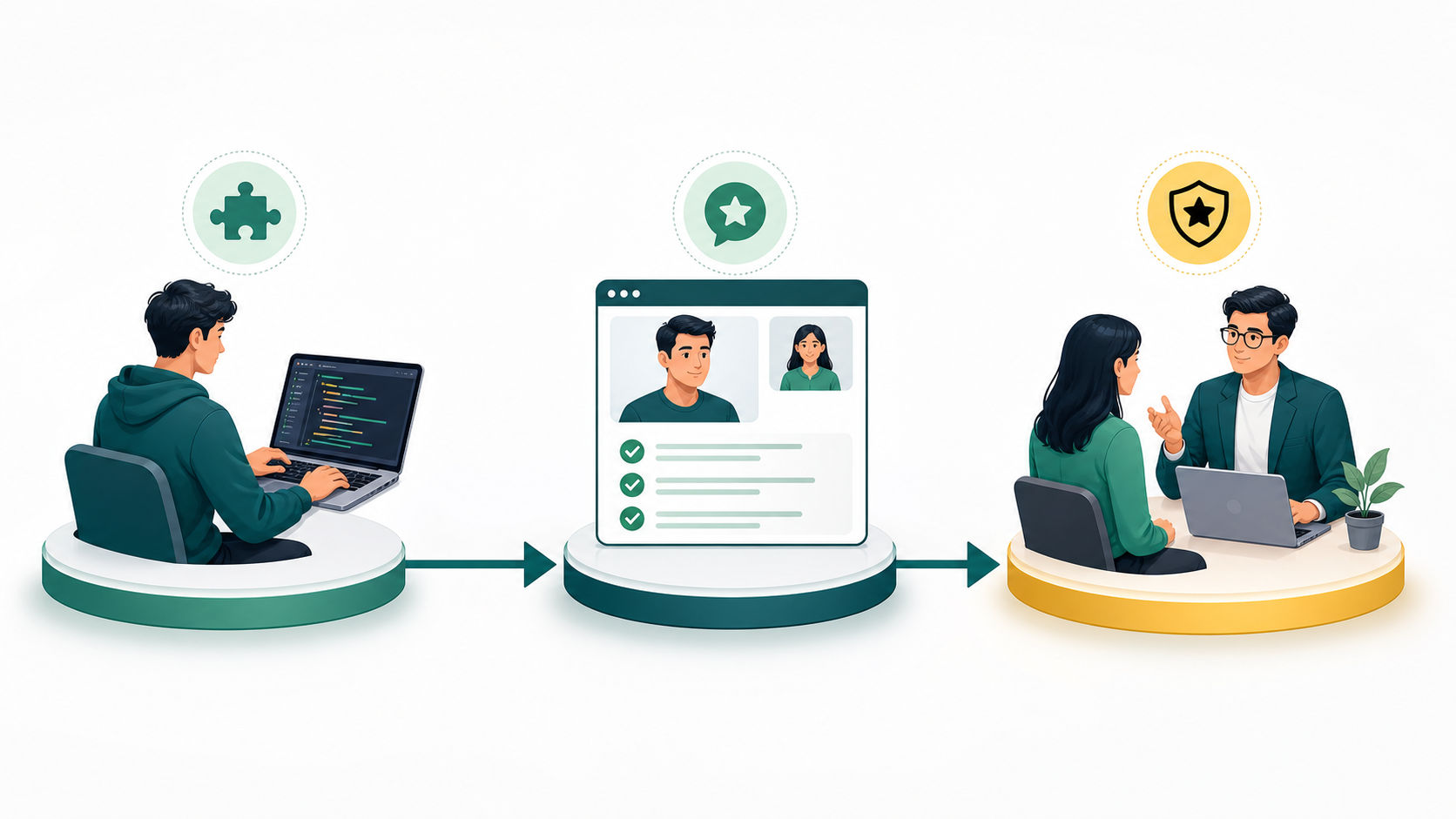
Spend in ascending order of cost, and stop as soon as the gap closes.
Who Should Still Buy Interview Kickstart
There is a real profile this program fits well, and we would be arguing dishonestly if we skipped it.
Interview Kickstart is a reasonable purchase when most of these are true at once:
- You are targeting a high-compensation role where a single offer would repay the cost many times over.
- Your fundamentals are already solid; you are optimizing performance, not learning data structures.
- You have diagnosed your weakness as live performance, structure, or accountability — not question volume.
- You can genuinely protect the weekly hours, including during a bad sprint at work.
- You have already tried self-study and can point at exactly where it stalled.
- You have the terms in writing and are comfortable with the refund and guarantee conditions.
A good fit looks like this: a senior engineer with eight years of experience, targeting staff-level roles, who has not interviewed since 2019, can carry ten hours a week, and knows from three onsites that the failure mode is system design communication rather than coding. The structure and the mocks are worth real money to that person, and we would tell them to buy.
Note how specific that is. Every clause is doing work, and most people asking "is it worth it" fail two or three of them.
Who Should Wait
The mirror image is broader than the fit.
Hold off if you are still learning basic data structures, have not settled on a target role, cannot commit consistent weekly hours, are uncomfortable proceeding without clear written pricing, expect the program to produce offers rather than preparation, or have not yet tried free practice seriously. In every one of those cases, the money buys you less than the same two weeks of focused, self-directed reps would.
Common mistake: buying a program because you feel behind. Feeling behind is a motivation signal, not a diagnosis, and it is the exact emotional state that expensive prep is sold into. Spend the two weeks first. The diagnosis it produces will make whatever you buy next dramatically more effective — or show you that you did not need to buy anything.
Pre-Purchase Checklist
Run this before joining Interview Kickstart or any expensive prep program. If you cannot answer a row, you are not ready to pay.
| Category | Question to answer |
|---|---|
| Cost | Do I know the full price for my exact track? |
| Cost | Do I understand the refund window and terms? |
| Cost | Do I know precisely what the guarantee requires of me? |
| Cost | Does financing change the total, and by how much? |
| Cost | Do I have all of the above in writing? |
| Fit | Is the track built for my target role and level? |
| Fit | Does it directly address my weakest round? |
| Fit | How many mock interviews are actually included? |
| Fit | Are sessions live, recorded, or a mix? |
| Fit | What support exists if I fall behind? |
| Readiness | Have I practiced consistently for at least two weeks? |
| Readiness | Can I name my weakest interview category in one sentence? |
| Readiness | Can I protect the weekly hours for the full track? |
| Readiness | Would targeted mocks alone solve this more cheaply? |
Related: Interview Kickstart pricing explained · Interview Kickstart vs PracHub (2026)
FAQ
How much does Interview Kickstart cost?
There is no published price. Interview Kickstart's cost page states that pricing depends on the pathway, domain, and payment plan, which means you cannot compare it to anything until you talk to sales. Third-party reviews commonly report larger programs in the $5,000 to $12,000 range. Get your specific track price, refund window, and guarantee terms in writing before paying, and do not agree to a number on the call you first hear it.
Is Interview Kickstart worth it for software engineers?
For a narrow group, yes: engineers with solid fundamentals who have diagnosed a gap in live performance, structure, or accountability. For everyone else, no. If your actual gap is practice volume or unclear explanations, you would be paying coaching prices for material available far more cheaply. Practice real questions for two weeks first, then decide — that step costs nothing and changes the answer for most people who take it.
Is Interview Kickstart better than LeetCode?
They sell different things, so "better" depends on your gap. LeetCode is primarily algorithm practice; Interview Kickstart is a coaching program with live instruction and mocks. PracHub sits between them: real interview questions with written solutions, company and role filters, and in-browser coding and SQL practice, with a free tier covering most of the question bank. The relevant question is not which is better but which one addresses the round you are actually failing.
What are the most common Interview Kickstart complaints?
Cost, limited pricing transparency, a pace that is hard to sustain alongside a full-time job, variable experience across instructors, and mismatched expectations about outcomes. The first two compound: you are asked to commit thousands without a published number to compare against. Resolve every one of these in writing before you pay.
Does an interview prep guarantee mean I get my money back if I do not land a job?
No, not automatically. Guarantees in this category carry conditions you have to meet, and they vary by program and track. Read the exact conditions in the contract rather than the marketing page, and ask specifically what disqualifies a claim. Treat any guarantee you have not read in full as worth nothing.
What is the best Interview Kickstart alternative?
It depends on your diagnosed gap. If you need live coaching and human feedback, targeted mock interview platforms cost a fraction of a full program and let you buy one session at a time. If you need real interview questions with written solutions, company and role filters, and hands-on coding and SQL practice, PracHub is the cheaper first step — browse the question bank or the interview guides and see how much of the gap closes before you spend anything.
Verify This Yourself
Do not take any review at face value, including this one. Read the primary sources and the unfiltered discussion:
- Trustpilot reviews for Interview Kickstart: https://www.trustpilot.com/review/interviewkickstart.com
- Reddit discussion, "Is Interview Kickstart good?": https://www.reddit.com/r/leetcode/comments/1bw189f/is_interview_kickstart_good/
- Reddit discussion, "Has anyone tried Interview Kickstart?": https://www.reddit.com/r/leetcode/comments/p2sjdm/has_anyone_tried_interview_kickstart/
- YouTube review, "Interview Kickstart Review 2026: Is It Worth the Price?": https://www.youtube.com/watch?v=d23fZecfIgw
Final Verdict: Buy the Cheapest Useful Signal First
Do not make a four- or five-figure prep purchase your first move. We think that is the wrong order for almost everyone who asks this question, and a purchase with no published number, attached to a live-class schedule you do not set, is one that rewards buyers who skip the diagnosis.
Prove you can practice consistently. Work through real questions cold. Read written solutions after attempting, not before. Find the one round that is actually holding you back. That diagnosis costs you two weeks and no money, and it makes every subsequent dollar land on the right problem.
That is what PracHub is built for: real interview questions with written solutions across coding, SQL, machine learning, system design, and behavioral rounds, with company and role filters and a free tier covering most of the bank. Start with the question bank or browse the written guides and resources.
If you still need live coaching afterward, you will know exactly why, you will know which kind, and you will get more out of it. If you do not, you just saved several thousand dollars.
Comments (0)