Jane Street Strategy & Product Interview: Collaborative Logic, Business Scenarios, and Changing Information
Quick Overview
Use the official S&P interview outline, then practice revising a capacity decision and proving a scheduling result without treating forum advice as a verified interview loop.
For a Jane Street Strategy & Product interview, practice making your reasoning easy to examine and revise. A clear answer identifies the objective, separates facts from assumptions, compares plausible choices, and changes when the interviewer supplies new information. Memorizing a polished business framework is less useful if it prevents you from noticing that the problem has changed.
This article pairs the official interview outline with two original exercises: a capacity-allocation case and a collaborative scheduling puzzle. To rehearse the second skill, start with PracHub's Deduce row order from logic clues. The exercises below are our preparation recommendations, not questions reported from Jane Street.
Evidence boundary: process statements are limited to Jane Street's official page. The candidate discussions reviewed do not support a detailed unofficial interview loop. We label original scenarios and inference where they begin, and do not claim an assessment cutoff, guaranteed timetable, or universal final-round count.
What does Jane Street officially confirm?
Official process facts: Jane Street describes a typical sequence of an online assessment, one or two video interviews, and an in-person final stage. The assessment combines multiple-choice and short-answer work and typically takes about an hour. Video interviews involve business hypotheticals and logic problems with S&P staff. The final stage explores more demanding qualitative and technical problems. The page emphasizes logical reasoning, clear communication, engagement, and adapting to information. It does not require finance knowledge, a particular major, or coding experience, and says the interviews are designed not to require preparation. Jane Street: S&P interviewing.
Treat “typical” as a description, not a promise about your invitation. Ask your recruiter to confirm the current format, location, scheduling, permitted materials, accessibility arrangements, and any preparation instructions. An invitation is more specific to your application than a general guide.
Our recommendation: practice reasoning habits, not a supposedly required curriculum. You can learn to explain a calculation or revise an assumption without pretending to know the firm's proprietary questions.
Which candidate reports are useful, and which are not?
The two linked community discussions have a limited role. One asks about a second round for an internship in Hong Kong. Another asks how to prepare after an assessment. They are requests for advice, not two independent, complete accounts of the same recruiting cycle. The same promotional commenter appears in both discussions, so those replies do not provide independent corroboration.
| Evidence | What it supports | What it does not establish |
|---|---|---|
| Official S&P interview page | The typical process and stated reasoning emphasis | Your exact invitation or a guaranteed sequence |
| Hong Kong internship discussion | An anonymous poster says they have a second-round invitation | A verified round duration or full interview account |
| Post-assessment preparation discussion | An anonymous poster asks about the next interview | Exact questions, scoring, or universal expectations |
Candidate-report boundary: these posts help identify questions candidates have, but they do not justify adding unofficial process details. We do not infer calendar dates from relative “days ago” labels or combine different locations into one mandatory loop.
This distinction matters when planning. An unsupported claim that everyone receives the same puzzle or needs a particular finance textbook can divert your effort from the skills the official page actually describes.
Original business case: allocate a limited review team
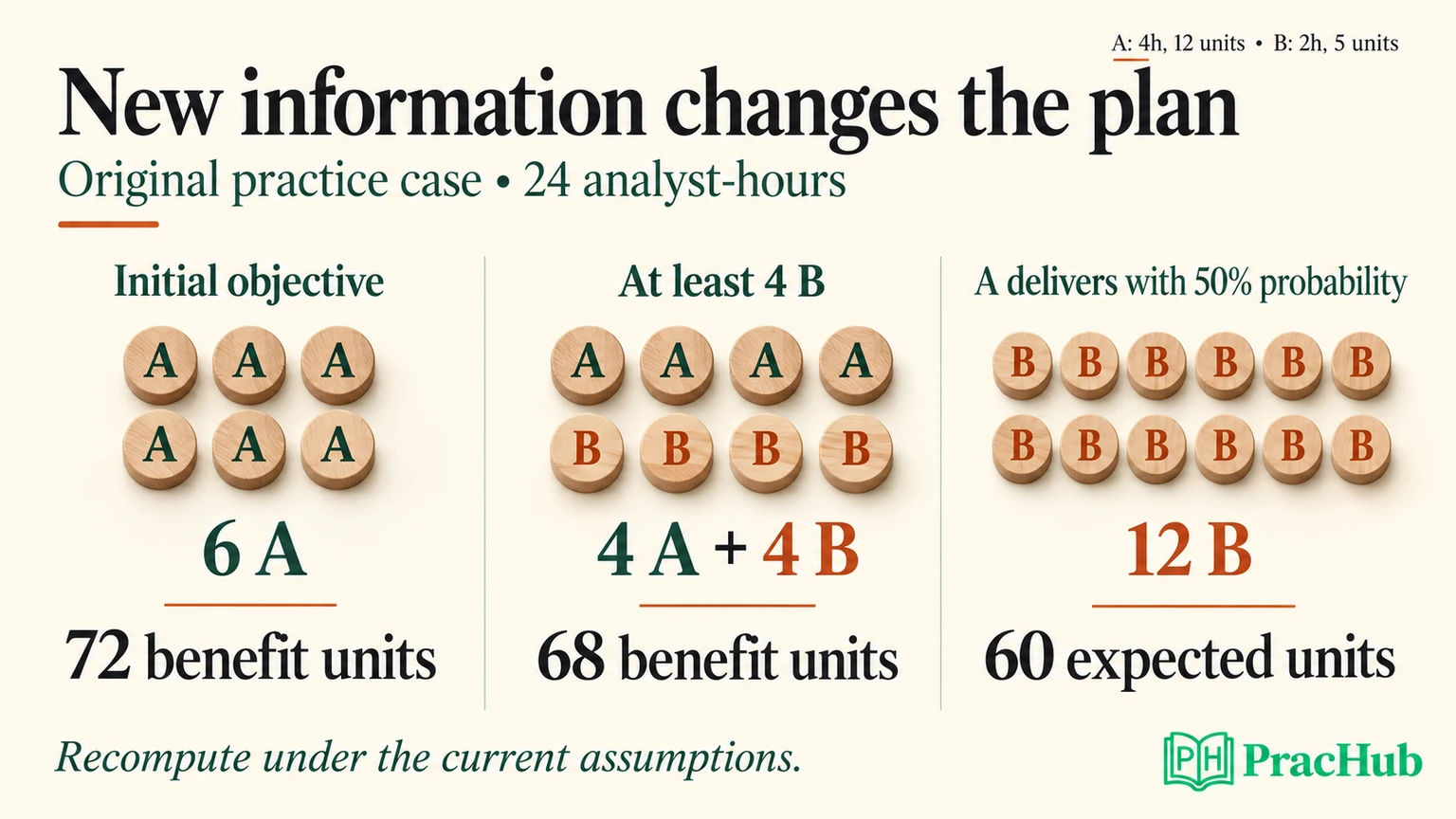
Imagine a fictional operations team with 24 analyst-hours available tomorrow. It can review two types of requests. Completing one A request takes 4 hours and yields 12 benefit units; completing one B request takes 2 hours and yields 5 benefit units. There are at least six A and twelve B requests available. Requests are indivisible, benefits are additive, and there are initially no deadlines or mandatory service levels.
The objective is to maximize tomorrow's total benefit. These units are invented for the exercise; they are not money, a forecast, or a description of Jane Street's operations.
Before calculating, restate the assumptions: “I am optimizing completed benefit within 24 hours. Partial work earns nothing, and I can choose any available requests. Are there dependencies or obligations that would change that objective?” This checks the objective before you spend time optimizing the wrong outcome.
Under the initial contract, A earns 3 benefit units per hour, while B earns 2.5. Six A requests use all 24 hours and produce 72 units. Any replacement of one A with two B uses the same four hours but reduces benefit from 12 to 10. That exchange argument explains why six A is optimal here.
The ratio is a helpful shortcut because the numbers fit neatly and the assumptions are simple. For different indivisible durations, sorting by benefit per hour may leave unusable capacity and fail to find the best combination. Explain why your method works for this case rather than presenting a greedy rule as universally correct.
New information: a minimum commitment changes the choice
The interviewer now adds: “At least four B requests must be completed tomorrow to meet an existing commitment.” Treat this as a hard constraint, not an optional preference to hide inside a scoring formula.
Four B consume 8 hours and produce 20 units. The remaining 16 hours fit four A, adding 48 units. The revised plan is four A plus four B: 68 units. It satisfies the commitment and uses the full capacity.
Compare it with nearby feasible plans. Three A plus six B also uses 24 hours, but produces 66 units. Two A plus eight B produces 64. The original 72-unit plan is no longer feasible because it fails the B commitment.
A clear revision sounds like: “My previous answer was optimal without a service obligation. With the minimum four B requirement, I reserve eight hours for B and allocate the remaining sixteen to A. The result falls to 68 units, but it meets the updated contract.” State the revision calmly; the earlier answer used different assumptions.
New information: expected completion value changes again
Next, the interviewer adds uncertainty: each A request has only a 50% chance of delivering its 12 units tomorrow. B delivers its five units reliably. Analyst time is still consumed either way. The minimum four B commitment remains, and the objective is now explicitly expected benefit by tomorrow.
An A request contributes 6 expected units for four hours, or 1.5 per hour. B remains at 2.5 per hour. Twelve B requests use the full 24 hours, meet the minimum commitment, and produce 60 expected units. The previous four-A/four-B plan now produces 24 plus 20, or 44 expected units.
This does not mean 60 is worse than the earlier 68 in a like-for-like comparison. The model of A's benefit changed. State the new assumptions next to the new number so your listener can see why the recommendation moved.
Also distinguish expectation from guarantee Practice this question. If the objective included the probability of exceeding a target, correlations and the distribution of outcomes would matter. For this additive expected-value calculation, independence is not required to sum expectations. Do not introduce a risk model the question has not supplied, but identify the question you would ask if reliability were the actual objective.
How do you explain the decision beyond arithmetic?
Use a short decision record with four fields: objective, active constraints, recommendation, and the next fact that could change it. For the last version, that record might read:
Maximize expected benefit by tomorrow within 24 hours, with at least four B completions. Choose twelve B for 60 expected units. Confirm that twelve B requests are actually available and that no new deadline or strategic obligation overrides the stated objective.
Then describe how you would validate the assumptions if this were operational work. The duration estimates could be wrong; requests might differ within each category; staff may have different skills; and benefit might depend on successful downstream work. Those are useful extensions once the original calculation is clear.
Do not bury a simple answer under a long framework. Give the recommendation first, show the controlling calculation, and name the most consequential uncertainty. If the interviewer changes one assumption, update the affected part instead of restarting with a generic list of stakeholders and metrics.
For a live exercise, a table listing A count, B count, hours used, and benefit can be enough. You are trying to make the decision inspectable, not impress the interviewer with unnecessary mathematical notation.
Original logic exercise: schedule three reviews together
Three reviews—A, B, and C—must occupy slots 1, 2, and 3, one review per slot. A must occur before C. B cannot be in slot 1. Find every feasible order, and explain whether the information determines a unique answer.
Start with the six permutations or reason directly from the constraints. If A is in slot 2, C must be in slot 3, forcing B into slot 1, which is forbidden. Therefore A must be first. The remaining feasible orders are A–B–C and A–C–B.
There is no unique solution yet. Saying “A–B–C” without mentioning the alternative gives one valid answer but misses the question about completeness. State both and identify what distinguishes them: whether B precedes C.
Now the interviewer adds: “C's reviewer is unavailable in slot 2.” Only A–B–C remains. You can explain the update in one sentence: “The added constraint rules out A–C–B because C would be second, so A–B–C is now the unique order.”
Finally, replace that added constraint with “B must occur before A.” The original rules then become inconsistent: A precedes C and B precedes A force B–A–C, but B cannot be first. The useful response is to identify the conflicting set of constraints and ask which rule should change, not force an invalid schedule.
This is an original toy puzzle. Its purpose is to practice completeness, uniqueness, and contradiction as separate claims. It does not predict the difficulty or content of a Jane Street interview.
What does collaborative reasoning sound like?
Collaboration does not require narrating every mental step. Share the parts another person needs to check: your interpretation, a useful intermediate result, and the consequence of a new clue. Leave space for the interviewer to respond.
In the scheduling puzzle, say, “I have two feasible orders; I don't yet have a reason to choose between them.” In the capacity case, say, “The commitment is a feasibility constraint, so I will satisfy it before comparing benefit.” Both statements expose the structure of your reasoning without turning the conversation into a monologue.
If you get stuck, identify the precise obstacle. “I have not checked whether an unused two-hour gap changes the optimal combination” is more actionable than “I am bad at optimization.” Ask a focused clarification, try a smaller example, or test the strongest assumption.
When corrected, acknowledge what changes and what remains valid. Updating a conclusion is part of solving the problem. Persisting with an answer after its assumptions fail makes the reasoning harder to trust.
Choose practice that matches the skill
These PracHub questions develop prioritization, logical completeness, and explanation. They are related exercises, not a Jane Street S&P question bank.
| Question | Practice focus |
|---|---|
| Deduce row order from logic clues | Enumerate feasible orders and prove completeness |
| Solve Logic Puzzles: Algorithms and Proofs Required | Explain a logical argument rather than guess |
| How do you prioritize requirements | Separate mandatory constraints from preferences |
| Prioritize competing engineering requests | Resolve competing objectives with explicit trade-offs |
| Determine Optimal Marketing Budget Allocation for Maximum Profit | Compare allocations under a fixed capacity or budget |
Save the initial case separately and have a partner reveal the capacity-case updates one at a time. Save your initial answer before each update. Afterwards, check whether you changed the objective explicitly, recomputed the affected quantities, and distinguished an infeasible plan from a feasible but lower-value one.
Then solve the scheduling exercise aloud without a memorized script. Ask your partner to challenge completeness or replace a constraint. Use Deduce row order from logic clues for another opportunity to explain why alternatives are ruled out.
Before the actual interview, return to the official page and your invitation. Confirm logistics with the recruiter and bring your own reasons for being interested Practice this question in the role. The practical goal of these exercises is to make your thinking clearer when the problem evolves, not to manufacture certainty about an interview you have not taken.
Comments (0)