JMeter Correlation Interview Questions: Dynamic Tokens, Extractors, and Request Validation
Quick Overview
Debug a local two-user login and submission flow before adding load: extract runtime tokens, preserve user state, and verify business outcomes.
A recorded login flow replays without an HTTP error, but the application rejects every submission. Increasing the thread count now would measure repeated failures more efficiently. The first job is to prove that each request carries the right user's current runtime values.
This guide uses an original local exercise, not a reported employer assessment: two users log in, receive different tokens, and submit a request using their own session cookie and token. We ran five small plans in Apache JMeter 5.6.3. The results below distinguish observed failures from official component behavior and suggested production improvements. No external service was load tested.
For a complementary exercise, use Design automated regression tests for an API. Start by defining what an accepted request means, rather than choosing a success threshold from its HTTP status alone.
Separate parameterization from correlation
Official guidance: Apache's recording guide separates replacing fixed inputs with variables from extracting dynamic response values needed by later requests. A recording captures one execution; replay needs the values appropriate to the new execution. Recording guide
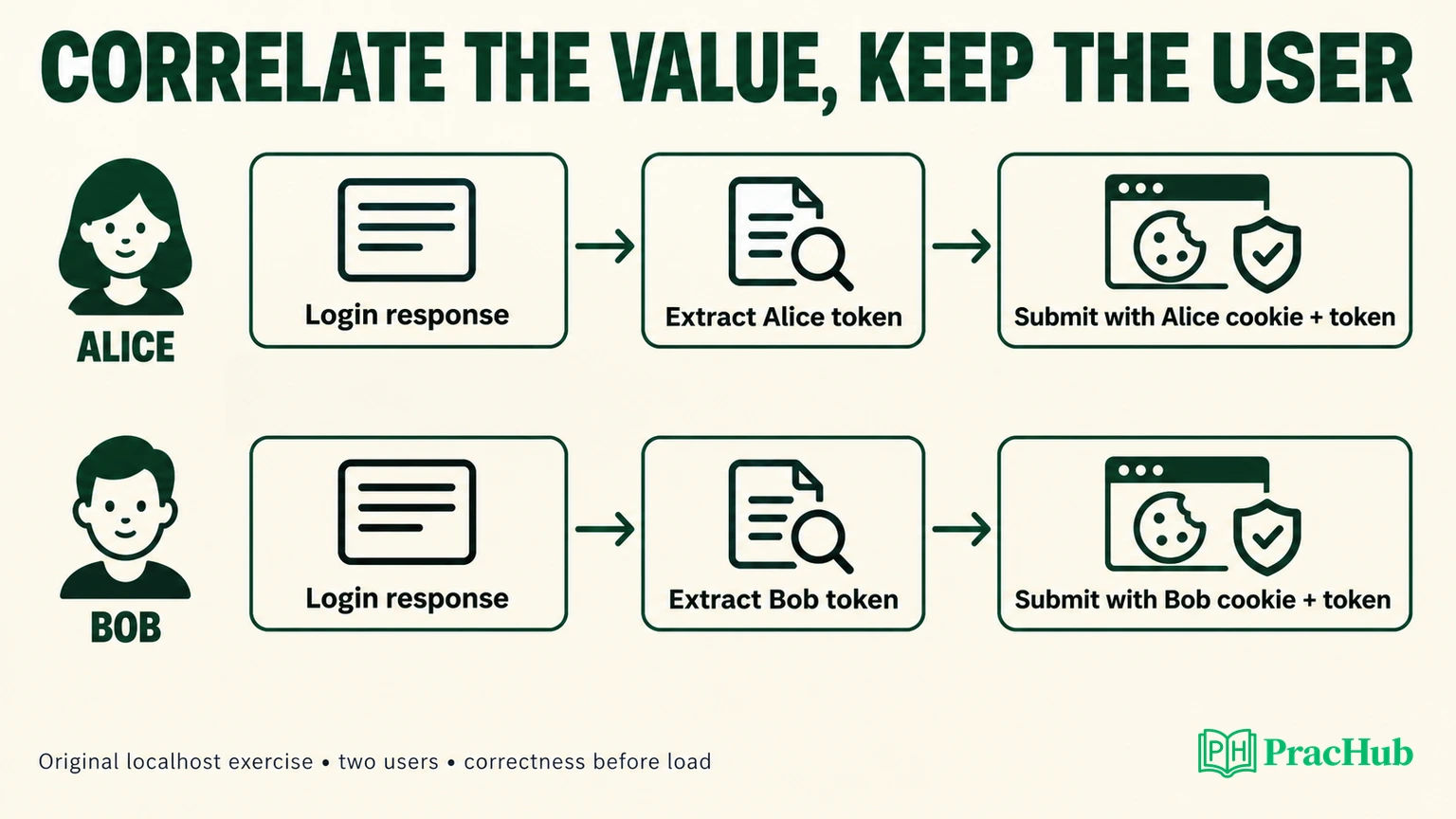
In our fixture, alice and bob are input data. They come from a two-line CSV file. The token is different: the service generates it during login, alongside a session cookie. Putting a previously observed token beside a username in that CSV would preserve the wrong thing. It would turn a runtime dependency into stale input.
The interview distinction should include an example and an ownership rule. “I parameterize the username; I correlate the token from that user's login response” is useful. “Correlation means dynamic data” leaves open where the value comes from, when it changes, and which request consumes it.
Do not assume every changing field needs the same treatment. A unique client-generated request ID, a server-issued token, and a selected product ID have different origins. Identify the producer before deciding whether the test should generate, supply, or extract the value.
Understand the deliberately small service
Our service runs only on 127.0.0.1:4191. A login request such as /login?user=alice returns a JSON object shaped like this and sets a session cookie:
{"auth":{"token":"runtime-value"},"user":"alice"}
The next request supplies the username and extracted token to /submit. The service checks that both belong to the session represented by the cookie. It returns an accepted Boolean and the session's username. A separate /ping response contains only {"ok":true}.
All responses deliberately use HTTP 200, including rejected submissions. This makes transport success insufficient by construction. It is a teaching fixture, not a recommendation for API error design. The login also omits real credential verification, and the query-string token keeps the example visible; a real application may require a protected header or body instead.
Two threads each execute one login and one submission. This is a correctness check, not a concurrency benchmark. The server records the submitted outcome separately so we can compare JMeter's green result with the application decision. We do not infer capacity, latency targets, or authentication security from this small service.
Extract the token from the response that owns it
Official behavior: the JSON Extractor uses JSONPath, creates named variables, supports a no-match default, and has main-sample versus sub-sample scope options. Place it under the response-producing sampler. Component reference
For this login response, our working configuration is:
Parent sampler: Login
Apply to: Main sample only
Variable name: token
JSONPath: $.auth.token
Match number: 1
Default: MISSING_TOKEN
The submission then references ${token}. The nested path matters: $.auth.token describes the response we actually returned, while $.auth.wrong does not. Avoid selecting a path merely because the word “token” appears somewhere in a response body.
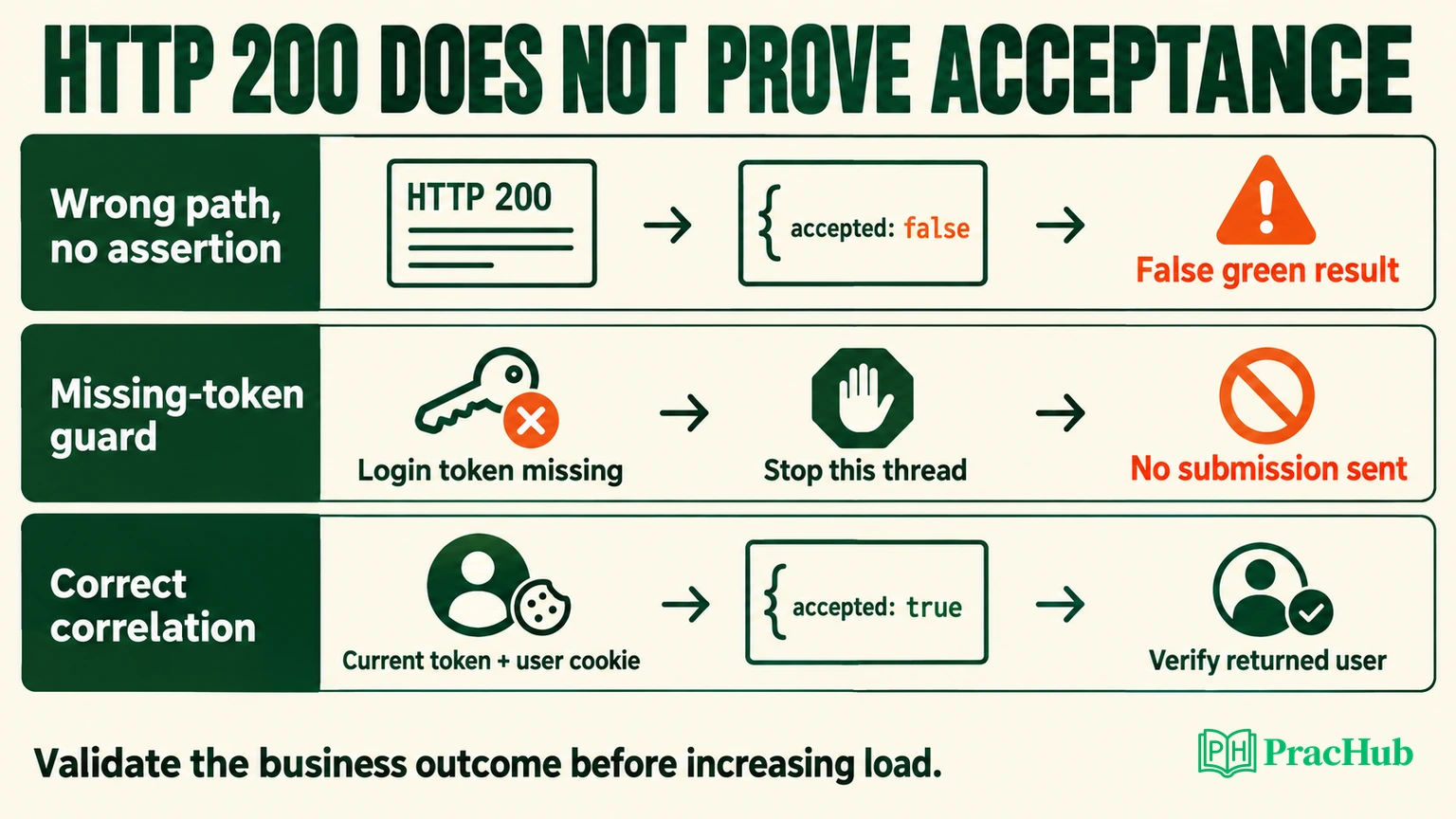
We made the path wrong in the first plan and left the default unchecked. Both login samplers returned 200. Both submission samplers also returned 200. JMeter reported four successful samples and zero errors, but the service rejected both submissions. The apparent success was an observation about the configured test, not about the business operation.
The useful debugging evidence is the chain: response shape, extracted value, outgoing request, application decision. Looking only at the last status code discards the earlier point where the test lost the correct value. At this scale, inspect those four pieces before changing any timeout or thread setting.
Fail near the missing value
The second plan kept the wrong path but added a JSR223 Assertion to the login sampler:
if (!vars.get('token') || vars.get('token') == 'MISSING_TOKEN') {
    AssertionResult.setFailure(true)
    AssertionResult.setFailureMessage('Missing login token')
}
The thread group's action after a sampler error was Stop Thread. Observed result: the two login samples failed their assertions and neither thread sent a submission. Both HTTP responses were still 200. The difference was the explicit extraction check and stop policy.
An assertion by itself is not a promise that execution stops. If the plan continues after an error, later requests can still run with an invalid value. In an interview, mention both the check and the control-flow response. That explains how the test prevents misleading downstream traffic.
Use a recognizable sentinel that cannot be mistaken for a legitimate fixture token. A default is useful diagnostic information; it is not an acceptable fallback credential. Also consider a response that changes shape only on an error path. A parser can be working correctly while finding no token because login itself was rejected.
Our guard checks presence, not freshness or ownership. A nonempty token from another login could pass it. The later submission assertion provides another layer by checking the application's acceptance and returned user. Different assertions protect different assumptions; one check should not be described as validating the whole transaction.
Diagnose overwrite and recorded-value failures
The third plan extracted the correct token during login, then ran the unrelated ping. We deliberately attached another token extractor to that ping. Because its JSON had no auth.token, the second extractor overwrote the variable with MISSING_TOKEN before submission.
This is an observed wrong-response placement example. We did not test every possible controller-level scope configuration. The specific failure was a second extractor consuming a response that never owned a token. Both submissions failed their business assertions, producing two failures among six HTTP samples.
The fourth plan sent the literal RECORDED_TOKEN instead of the extracted value. That string was a stand-in for a stale recording, not a captured credential. Both submissions failed their business assertions: two failures among four samples. A perfectly good login extractor cannot repair a later sampler that never references its output.
These failures require different fixes. Repairing JSONPath addresses a missing match. Removing the misplaced extractor prevents an overwrite. Replacing a hard-coded request value makes the consumer use correlation. Changing all three at once might make the script pass without showing which assumption was broken.
| Evidence to inspect | Specific question to answer |
|---|---|
| Token missing immediately after login | Does the path match this response, including nesting and error shape? |
| Token present after login but absent after ping | Which later processor wrote the same variable? |
| Correct variable but rejected outgoing request | Does the sampler actually reference it in the expected field? |
| Valid-looking token with the wrong session | Did user input, cookie state, or shared storage cross user boundaries? |
Keep user input and session state separate
Official behavior: JMeter variables belong to a thread, while properties are shared across threads in a JMeter instance. A property is useful for common configuration; it is a poor default home for each virtual user's runtime token. Functions and variables
In our plan, the CSV Data Set used user as its variable name, All threads sharing, no recycling, and stop on end of file. With two data rows and one iteration per thread, Alice and Bob were each consumed once. We did not depend on Alice always being assigned to thread one.
Official behavior: CSV sharing controls how threads consume file rows. The HTTP Cookie Manager stores received cookies separately per thread. Manually supplied cookies have different sharing implications. CSV and cookie configuration
Our Cookie Manager had no manually entered session cookie. It accepted each login's response cookie, then sent that cookie for the corresponding user's submission. The fixed run returned acceptance for Alice and Bob, with different runtime token values in their outgoing requests. That is evidence of the fixture's two-user path working, not a general guarantee against every state-sharing bug.
A proposed extension is to add several iterations and deliberate session renewal. State the new invariant first: a submission must use the token from the applicable login, not simply any token that once worked. That extension was not part of the five executed plans, so its outcome remains unmeasured here.
Assert the business result before adding load
The submission check parsed the response and compared both acceptance and identity:
def body = new groovy.json.JsonSlurper()
    .parseText(prev.getResponseDataAsString())
if (body.accepted != true || body.user != vars.get('user')) {
    AssertionResult.setFailure(true)
    AssertionResult.setFailureMessage('Submission not accepted for this user')
}
The fixed plan used the correct login extractor, kept it away from ping, referenced ${token}, and retained the per-thread cookie flow. Observed result: four samples, zero failed assertions, and two accepted submissions. Unlike the unchecked broken plan, the result had an explicit business-level check behind its green status.
| Executed plan | Observed outcome |
|---|---|
| Wrong path, unchecked default | Four green samples; both submissions rejected by the service. |
| Wrong path, guard and stop | Two failed login samples; no submissions sent. |
| Extractor repeated on ping | Six samples; both submissions fail business checks. |
| Literal recorded-value stand-in | Four samples; both submissions fail business checks. |
| Correct extraction and request | Four green samples; Alice and Bob both accepted. |
Official execution guidance: Apache documents non-GUI execution with -n, a plan with -t, and result output with -l. We used the following shape with JMeter 5.6.3 and Java 17. Getting started
jmeter -n -t fixed.jmx -l fixed.jtl -j fixed.log
The plans, local service, result files, and verification summary were retained with this article's project artifacts. The release archive's SHA-512 matched Apache's published checksum. The download page listed 5.6.3 when checked for this guide.
Before increasing load, explain what remains untested: realistic authentication, token rotation rules, multiple iterations, production data, and server capacity. The next experiment should answer a defined question. More threads are useful only after the transaction being repeated is the one you intended to measure.
Practice explaining the failure chain
Use these transferable exercises to practice request correctness and test design. PracHub does not host this local JMeter service, and these links are not a claim that an employer asks these exact correlation questions.
| Practice question | Focus for this topic |
|---|---|
| Design automated regression tests for an API | Define the accepted business outcome. |
| Implement CRUD API and tests | Check payloads and observable effects. |
| Fix the Password Reset Workflow | Trace token origin and consumption. |
| Improve and measure service performance | Separate correctness from capacity evidence. |
| Explain How You Would Test a System | Connect risks, assertions, and stopping rules. |
Continue with Design automated regression tests for an API. Describe the wrong request, the evidence that exposed it, and the smallest repair that makes the business assertion meaningful.
Comments (0)