Job Scheduler System Design Interview Guide: Queues, Retries, and Exactly-Once Execution
Quick Overview
Design a distributed job scheduler with durable schedules, due-time indexes, queues, leases, retries, DLQs, idempotent workers, and exactly-once trade-offs.
A strong job scheduler system design interview answer separates durable scheduling from job execution. Store job definitions and each scheduled run in an authoritative database, promote due runs into ready queues, let workers claim them with expiring leases, and assume dispatch is at least once. Retries restore availability after failures, but they also make duplicate execution possible.
The honest exactly-once answer is narrower: a scheduler cannot generally guarantee that arbitrary external side effects happen once. A worker can complete a charge or email and crash before acknowledging the queue message. The practical target is one externally visible outcome per logical run, enforced through stable execution IDs, idempotency keys, atomic writes where possible, and reconciliation when the outcome is ambiguous.
This guide is for software engineers preparing for a system design round. Use the PracHub system design interview questions to practice the same architecture under different scale, timing, and failure assumptions. PracHub question-bank records are practice material, not predictions of your exact interview.
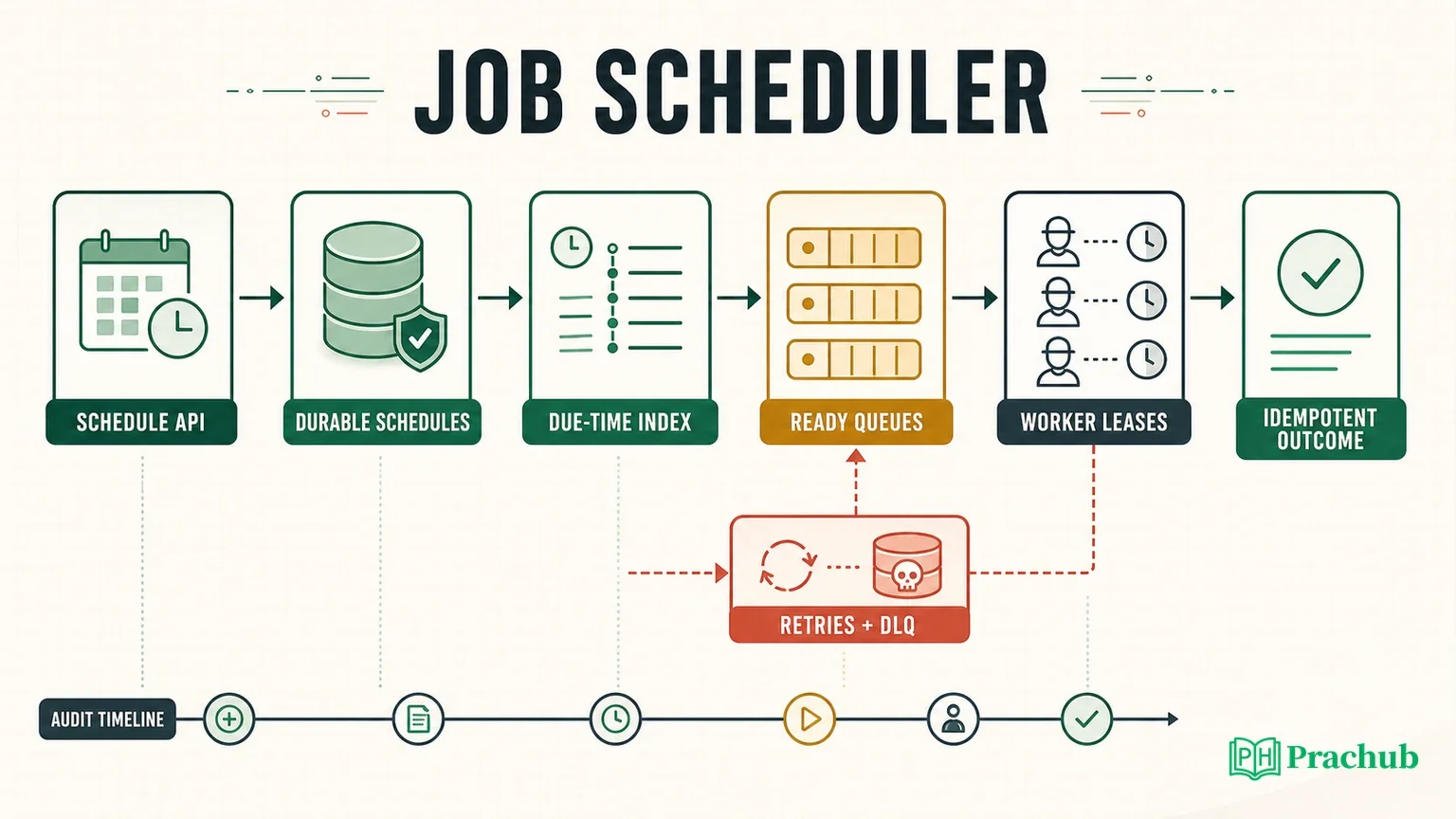
Job scheduler system design: the quick answer
Job scheduler definition: A job scheduler stores work that should run now or later, determines when each logical run becomes due, dispatches it to available workers, and tracks attempts through completion, retry, cancellation, or dead-letter handling.
The strongest baseline design uses a durable control plane and a scalable dispatch path:
| Requirement | Recommended design | Resulting guarantee |
|---|---|---|
| Create, update, pause, and cancel schedules | Versioned job definitions in an authoritative database | Auditable control-plane changes |
| Find due work | Partitioned next_run_at index or coarse time buckets | Bounded scheduling lag |
| Publish runnable work | Transactional outbox plus reconciler | No silent database-to-queue gap |
| Assign workers | Ready queue with a lease or visibility timeout | At-least-once dispatch |
| Recover failures | Bounded backoff, jitter, and dead-letter queue | Failed work is retried without looping forever |
| Control duplicates | Stable execution ID and idempotent handler | Effectively-once business outcome where supported |
| Expand recurring schedules | One immutable run per scheduled occurrence | Clear history and safe deduplication |
This architecture makes the trade-off explicit: the scheduler favors durability and recovery over pretending duplicates can never happen.
Clarify the requirements before drawing the system
Ask whether the product supports immediate, one-time, interval, or cron jobs. Clarify timing precision, maximum runtime, cancellation, priorities, dependencies, time zones, retention, multi-tenancy, and whether late runs should be skipped or caught up.
Use testable assumptions. For example: 10 million active schedules, 100,000 runs due per minute, a tenfold top-of-hour burst, and p99 dispatch within five seconds. These are interview inputs, not vendor limits; they justify sharding and explicit lag metrics.
Also ask which failure is worse for each job class. Duplicating a cache refresh may be tolerable; duplicating a payment is not. Missing a daily analytics rollup may be recoverable; missing an expiring compliance action may not be. Google’s distributed cron design emphasizes that missed-run and duplicate-run costs differ by workload.
Separate durable schedules from ready queues
A queue is part of a scheduler, not the whole scheduler. The database owns job definitions, recurrence rules, next occurrence, versions, and run history. The ready queue should contain work that is due soon enough for workers to claim; it should not be the only record of a schedule months in the future.
A practical flow is:
- The API writes a versioned
JobDefinition. - A scheduler shard creates one immutable
Runper due occurrence. - The transaction also writes an outbox enqueue intent.
- A dispatcher publishes the run to a ready queue.
- A worker leases, executes, stores the outcome, and acknowledges.
- A reconciler repairs overdue or inconsistent states.
The outbox closes a common failure window: the database commit can succeed while queue publication fails. Retrying the dispatcher is safe because the run ID is stable and the queue consumer deduplicates or processes idempotently.
Model schedules, runs, and attempts separately
A JobDefinition stores the schedule, handler, retry policy, tenant, priority, and version. A Run stores the logical execution_id, scheduled time, state, and outcome. An Attempt stores the worker, lease generation, heartbeat, error class, and retry timing.
Use a state machine such as SCHEDULED → READY → LEASED → SUCCEEDED. Failures move a run to RETRY_WAIT, then back to READY; exhausted or permanent failures move to DEAD. Cancellation should be versioned, and the worker should perform a final state/version check before an irreversible side effect.
For recurring work, use a key such as (job_id, schedule_version, scheduled_at). A unique constraint prevents two leaders from creating the same occurrence. A changed cron rule gets a new version without rewriting dispatched runs.
Find due work without scanning the whole database
For a small system, an indexed query on next_run_at plus FOR UPDATE SKIP LOCKED can let several schedulers claim different rows. PostgreSQL documents SKIP LOCKED as suitable for avoiding contention among consumers of a queue-like table, while warning that it is not a general consistent-view mechanism.
At larger scale, partition by time bucket and a stable tenant or job hash. Keep far-future schedules in durable storage and promote near-term work into a smaller horizon. A timing wheel can reduce timer overhead, but explain durability and failover before optimizing data structures.
Store the original time zone and recurrence rule, and materialize each occurrence in UTC. Define daylight-saving and downtime behavior explicitly: skip missed runs, fire once on recovery, catch up every occurrence, or expire after a deadline. Kubernetes notes that CronJob scheduling is approximate and recommends idempotent jobs because duplicate or missed creations can occur.
Use leases and fencing for worker ownership
When a worker receives a run, it should acquire a time-bounded lease rather than a permanent lock. Amazon SQS uses a visibility timeout: an unacknowledged message becomes visible again after the timeout, enabling recovery if the worker crashes.
Choose the initial lease above normal processing time but below an unacceptable recovery delay. Long-running workers send heartbeats and extend the lease. If a worker stalls, another worker may receive the run; therefore, attach a monotonically increasing fencing generation to each lease. A stale worker must not commit a final state after a newer generation owns the run.
This is still at-least-once dispatch. SQS explicitly warns that duplicates remain possible, even during the visibility window. The interview signal is recognizing that a lease reduces concurrent execution but does not prove a side effect happened only once.
Design retries, backoff, and dead-letter handling
Retry transient failures such as timeouts, throttling, and temporary unavailability. Reject or dead-letter permanent errors such as invalid payloads or revoked authorization. Google Cloud Tasks supports configurable exponential-backoff retries; production designs should add jitter so synchronized failures do not produce synchronized retry spikes.
Bound retries by attempt count and total age. A dead-letter queue is not a trash can: alert on it, preserve the execution ID and attempt history, and audit manual redrive. Keep the idempotency key unless an operator intentionally creates a new logical run.
| Failure window | Risk | Design response |
|---|---|---|
| Run committed, enqueue failed | Work is stranded | Transactional outbox and reconciliation |
| Worker dies before completion | Work remains unfinished | Lease expiry and redelivery |
| Side effect succeeds, acknowledgment fails | Duplicate side effect on retry | Destination idempotency key or transactional inbox |
| Old worker finishes after lease expiry | Two owners update state | Fencing generation and conditional write |
| Downstream outage | Retry storm and overload | Exponential backoff, jitter, retry budget, rate limit |
| Poison job | Infinite failure loop | Maximum attempts, DLQ, alert, controlled redrive |
Explain exactly-once execution precisely
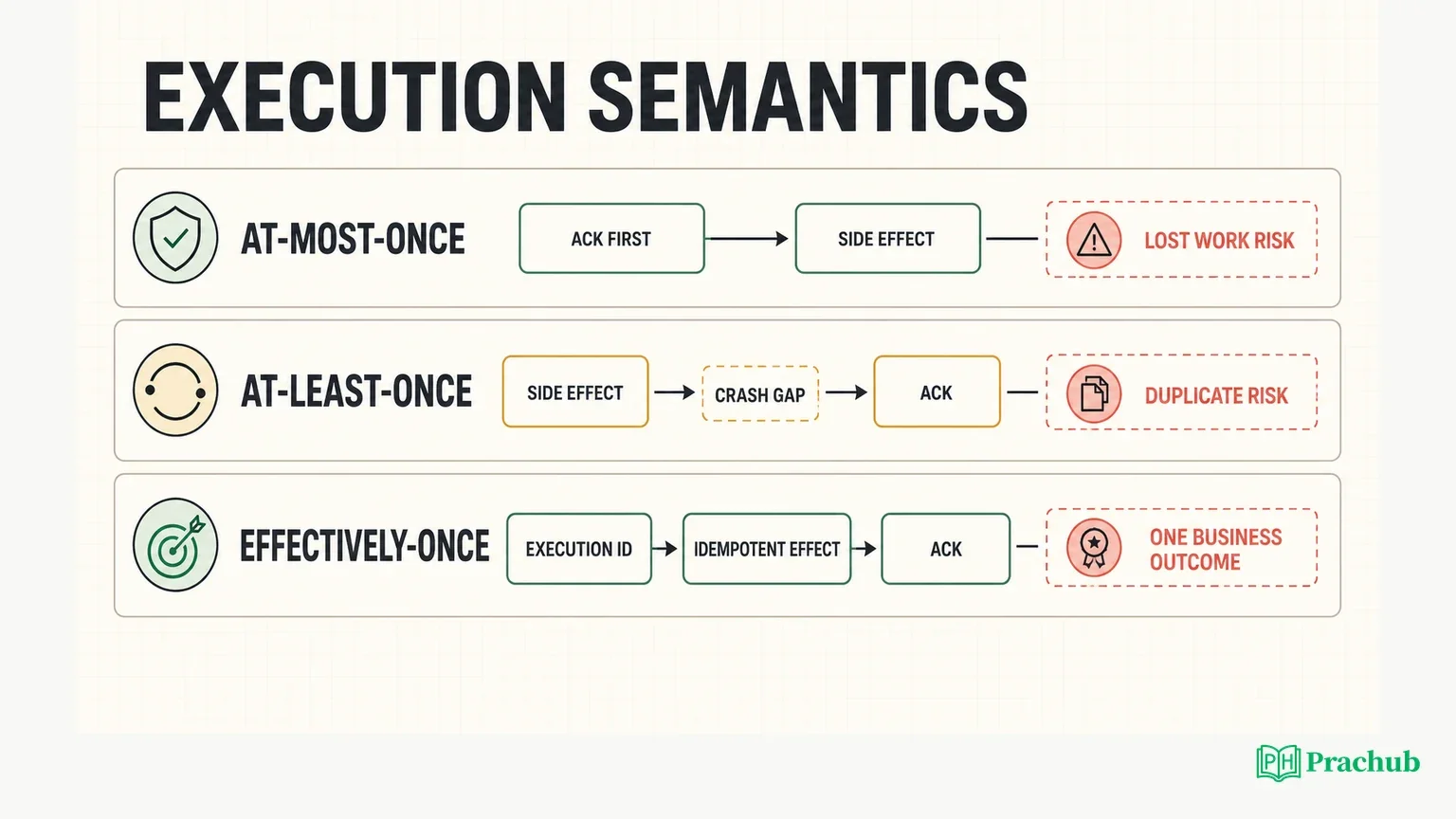
The classic failure happens between the side effect and acknowledgment. If the worker acknowledges first, a crash can lose the job. If it performs the side effect first, a crash before acknowledgment causes redelivery and may repeat the effect. The queue cannot observe what an external payment provider, email service, or database actually committed.
Therefore, promise at-least-once execution and engineer an effectively-once outcome:
- Pass
execution_idas the downstream idempotency key. - Insert an inbox or deduplication row with a unique key.
- Commit that row and the business mutation in the same database transaction.
- Use conditional updates or upserts for naturally idempotent work.
- Query or reconcile the destination after an ambiguous timeout.
- Keep the completion record and audit event durable before acknowledging.
Apache Kafka can atomically coordinate consumed offsets and Kafka output records, but its delivery-semantics documentation explains that external destinations require cooperation. That is the boundary interviewers want to hear: exactly-once is a scoped transaction property, not a universal queue feature.
Scale shards fairly and contain failures
Shard ownership by time bucket and a stable tenant or job key. Keep per-key ordering on one shard, but avoid global ordering because it destroys parallelism. Leases or consensus choose the active scheduler; the unique run key remains the final duplicate defense.
Use per-tenant concurrency limits and fair scheduling so one backlog cannot dominate worker slots. Isolate expensive job classes, reserve capacity for latency-sensitive work, and age low-priority jobs to prevent starvation.
For multi-region operation, assign each shard a home region and fail it over with fencing. Regions may accept globally unique jobs, but only one should expand an occurrence. Stronger coordination reduces duplicates at the cost of latency and partition availability.
Measure the stages, not only the final success rate
Track schedule lag, queue dwell time, oldest ready-job age, execution duration, lease expirations, retry rate, DLQ depth, duplicate suppression, and redrive outcomes. Break dwell time down by tenant to expose noisy neighbors.
Record the execution ID, attempt, worker, lease generation, prior and new states, timestamp, error class, and trace ID for every transition. Separate permissions for create, cancel, force-run, and redrive. Export the append-only audit stream asynchronously.
A 45-minute interview walkthrough
- Minutes 0-5: Clarify job types, scale, precision, lateness, and missed-versus-duplicate cost.
- Minutes 5-10: Define APIs and the
JobDefinition,Run, andAttemptmodels. - Minutes 10-18: Draw the due-time store, scheduler shards, outbox, ready queues, and workers.
- Minutes 18-25: Deep-dive on leases, heartbeats, fencing, and crash recovery.
- Minutes 25-32: Explain retries, jitter, DLQ, poison jobs, and backpressure.
- Minutes 32-38: Walk through the exactly-once failure window and idempotency design.
- Minutes 38-45: Cover recurring-run identity, sharding, fairness, multi-region failover, metrics, and auditability.
If time is tight, prioritize failure semantics over product names. Explain what happens after each partial failure and which component is authoritative.
Practice with job scheduler questions from PracHub
These PracHub question-bank records train relevant skills. They are not predictions of your exact assessment or interview.
| PracHub question | Practice focus | Why it helps |
|---|---|---|
| Design a distributed job scheduler | End-to-end architecture | Covers recurring runs, leases, retries, history, and scaling. |
| Design distributed message queue service | Dispatch semantics | Tests acknowledgment, visibility, ordering, deduplication, and DLQs. |
| Design delayed job scheduler (LLD) | Due-time data structures | Compares heaps, timing wheels, durable indexes, and cancel races. |
| Design a Reliable Job Scheduler | Reliability gaps | Exercises outbox, reconciliation, idempotency, and stage-level metrics. |
| Design a Reliable Scheduler for Payment Jobs | Exactly-once effects | Forces a precise answer for ambiguous payment outcomes and safe retries. |
Frequently asked questions
Can a job scheduler guarantee exactly-once execution?
Not for arbitrary external side effects by itself. A worker can complete an action and crash before acknowledging, which causes a retry. The practical design uses at-least-once dispatch plus an execution ID, idempotent destination, unique constraint, or shared transaction to produce one externally visible outcome.
What is the difference between a job scheduler and a message queue?
A scheduler owns when work should become runnable, including future times, recurrence, time zones, updates, cancellations, and missed-run policy. A queue distributes work that is ready now and manages worker delivery. Mature systems use both, with durable schedule metadata remaining authoritative.
How long should a worker lease be?
Set it above normal processing time but below the longest acceptable crash-recovery delay. Workers with variable or long runtimes should heartbeat and extend the lease. Add a fencing generation because an expired worker may resume after another worker has acquired the same run.
What should happen to cron jobs after scheduler downtime?
Choose an explicit misfire policy: skip missed occurrences, fire once on recovery, catch up each occurrence, or expire runs after a deadline. The right choice depends on the cost of lateness and duplication. Persist the original time zone and scheduled instant so recovery is deterministic.
How do you prevent duplicate recurring runs?
Create a deterministic occurrence key such as (job_id, schedule_version, scheduled_at) and enforce a unique constraint when materializing the run. Use an outbox to publish it safely. Workers must still be idempotent because duplicate queue delivery can occur after the run was created correctly.
Final takeaway
A credible job scheduler system design interview answer does not hide failure windows behind “exactly once.” It combines a durable schedule store, partitioned due-time discovery, transactional enqueue intent, ready queues, leases, fencing, bounded retries, DLQs, and idempotent completion. Practice the architecture and then explain exactly which guarantee ends at each system boundary.
Use the linked PracHub questions to rehearse the baseline design, then change one assumption at a time: payment side effects, strict ordering, multi-region failover, or a top-of-hour burst. That is how a memorized diagram becomes an interview-ready design.
Sources and Further Reading
- Google SRE: Distributed Periodic Scheduling with Cron
- Google SRE: Addressing Cascading Failures
- Amazon SQS standard queues
- Amazon SQS visibility timeout
- Amazon EventBridge Scheduler overview
- Amazon EventBridge Scheduler dead-letter queues
- Google Cloud Tasks overview
- Google Cloud Tasks queue configuration and retries
- Apache Kafka message-delivery semantics
- Kubernetes CronJobs
- PostgreSQL SELECT and SKIP LOCKED
Research note: This guide was checked on August 28, 2026. Product limits and defaults can change, so interview answers should state assumptions rather than copy one vendor configuration.
Comments (0)