LLDcoding Review: Concurrency Problems, Coding Workspace, and Practice Access
Quick Overview
Review LLDcoding’s visible concurrency problems and Java lazy-cache workspace. See the login boundary and a tested check for duplicate cache computation.
LLDcoding at code.lldcoding.com pairs low-level design exercises with concurrency bug fixes. A guest can browse the problem catalog and inspect an exercise with Java starter code. The lazy-cache workspace we opened also showed a dialog requiring login. This review verifies that you can choose a specific race to study before signing in. It leaves the site's actual runner, coverage and graded feedback for a working account session.
We checked the public landing page, the loaded catalog and the lazy-cache workspace on November 28, 2026. The site describes interactive coding and immediate feedback. We observed the navigation, workspace content, test-area labels and sign-in gate. The Java exercise below is an independent local program. We did not create an account, submit code, access premium interview material, complete a hosted run, or establish independent hiring outcomes. This is the product at code.lldcoding.com. It is separate from LLDCode at lldpractice.com. PracHub publishes the review and the related practice links.

Pick a concurrency exercise by its shared state
The landing page's Start Practicing control opened a loaded problem list. The catalog showed concurrency titles about a hit counter, thread-unsafe ID generation, lazy cache, queue thread safety and several rates or task execution races. It also listed low-level design and pattern exercises, including builder and singleton tasks. The topic names let you choose between describing an object model and fixing state that multiple callers read and write at once.
Choose a problem by the property you need to defend. For a counter, ask what reads and increments must observe. For a queue, state who owns buffered items and how a blocked caller is woken. For a lazy cache, one critical question is whether concurrent callers that both miss can run the same computation twice. These are distinct definitions even if both solutions use synchronization. A list that labels every exercise “concurrency” is navigable, but the code contract tells you which one will train the skill you need.
The catalog includes a Solution column and we saw “Coming soon” on a number of concurrency rows. That is a useful constraint on self-study. Do not assume a highlighted question has an available written solution. Decide how you will check the result before working through an exercise whose reference is unavailable.
| Candidate question | Where we looked | What the public visit verifies |
|---|---|---|
| Which topics are available to choose? | Loaded problem catalog. | Concurrency, LLD and pattern exercises were listed by name and difficulty. |
| Can I inspect a relevant task? | Design a Thread-Safe Lazy Cache workspace. | The description and Java starter were visible along with test-area labels. |
| Can I make a rated submission as a guest? | The workspace displayed Login/SignUp Required. | The account gate was visible. No submission or result was tested. |
| Can I compare a reference solution? | Catalog Solution column. | Several concurrency entries carried “Coming soon.” Availability must be checked for the exact exercise. |
Read what the lazy-cache workspace asks you to prove
The lazy-cache prompt asks for a value to be computed at most once for a key and for the cache to remain correct under concurrent access. Its guest view showed Java, an editor, compilation and console areas, test labels for single-thread, multithread and design, plus a Submit button. The visible feature example describes getting a key twice and returning its value. The “Please Run the Code First” result area contained no test result in our view. Behind it, the sign-in dialog said access required login. We did not attempt to operate controls behind that dialog.
The simplest sound reasoning separates two requirements. Correct return values say what the callers observe. One computation says how many times an external effect or expensive function can run. If both calls return the same deterministic string, the output can look good even when loading happened twice. A useful test should count loads under a controlled schedule and verify the results returned to each caller. If the grader only checks the end state of a map, it could miss the extra work.
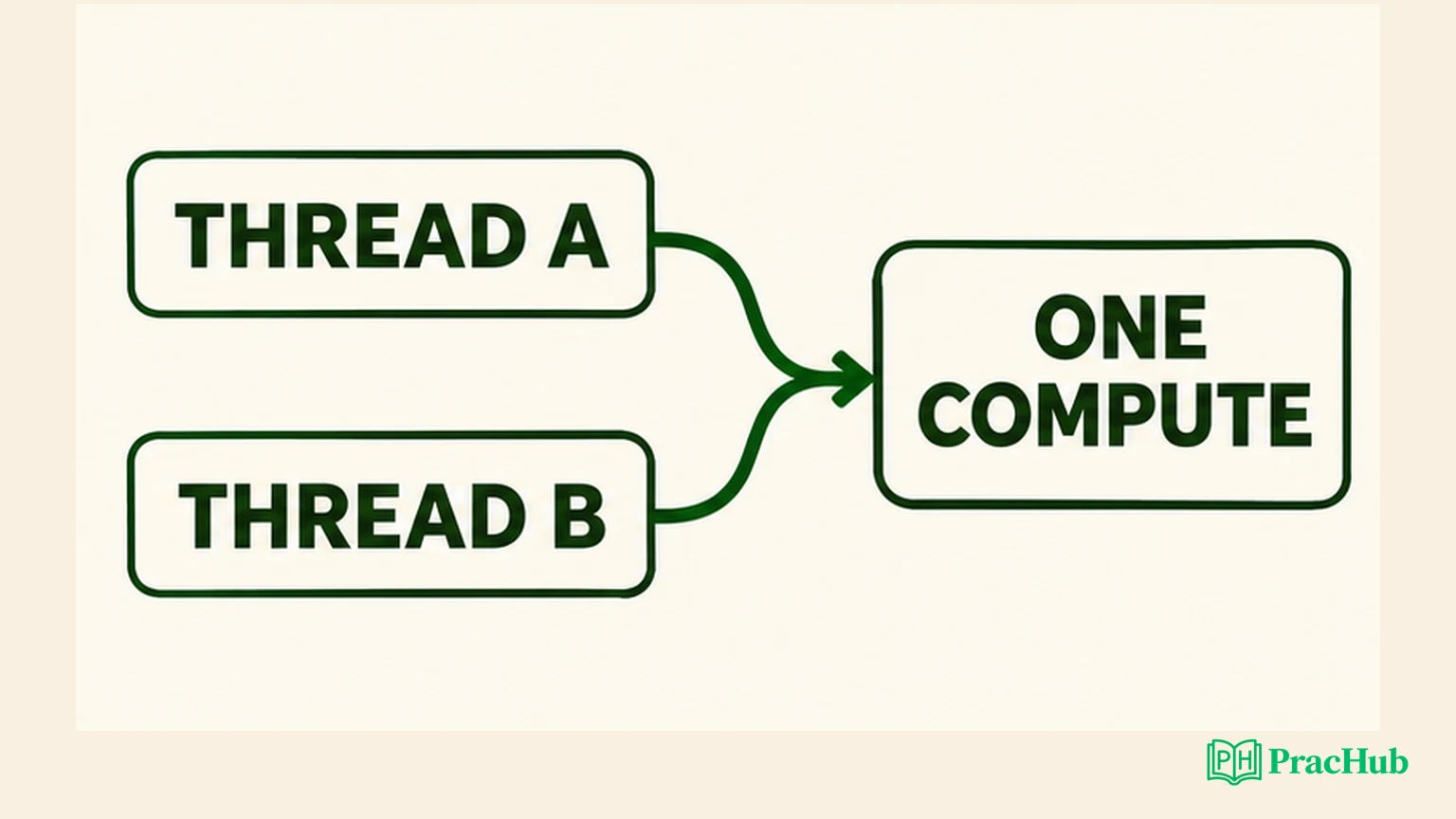
A sequential trace of the wrong design makes this concrete. A checks for the key and finds nothing. B also checks and finds nothing. Both calls compute the value, and both attempt to publish it. Which result remains in the cache is a different question from how many times computation ran. Merely substituting a thread-safe map can make each get and put safe without combining the check and computation. This is a reasoning example about the contract, not an observed execution of the site's starter code.
Build an independent Java check for duplicate work
Use a single monitor around lookup and a short deterministic computation as a baseline. It demonstrates the compound requirement if all callers use that lock. The monitor protects the decision, the value stored, and the load count. Keep the values immutable to avoid a separate sharing problem. If a load is slow or calls another service, serializing every key behind one monitor can be too expensive. That is a different workload decision after you establish the simple implementation's behavior.
Our original Java 21 fixture starts two worker calls behind a latch, asks for the same key and checks both future results. The synthetic loader's count must be one. A different-key lookup then brings the count to two. A separate instance fails once while computing its first value, leaves no successful entry, and succeeds on a later attempt. That last test defines how this local implementation treats failures. It retries after a failed attempt because failure was not cached.
| Local probe | Expected result | What the assertion isolates |
|---|---|---|
| Two workers request key k. | Both get value-k. Compute count is one. | One key's value and the loader count are separate assertions. |
| Request a different key. | Obtain its own value. Count increases to two. | The cache did not accidentally reuse the previous result across keys. |
| First load fails, second succeeds. | No cached value after the failure. Later result is published. | An unsuccessful attempt does not permanently consume a key's right to be loaded. |
| Subsequent access to the successful value. | Same value and no extra load. | The successful retry is retained. |
The latch makes workers eligible to start together. It does not force or enumerate every thread interleaving. We checked this program locally with time-bounded completion and a deterministic loader, not as a live LLDcoding test. Reason from the lock contract for correctness over all valid schedules. Use the test to catch a regression in the specific observed operations. Shell output or a green platform button does not by itself prove liveness under every possible external dependency.
Make the phrase “at most once” precise with a follow-up. In this exercise it refers to successful loading while the value remains in the cache. An initial failed attempt can lead to another call. If the interviewer requires at most one attempted computation for the lifetime of a key, you must cache a failure or otherwise refuse a later attempt. The caller-visible implications are different. If loads can throw, ask what all callers waiting for the same key observe and how a later retry is made possible.
Check what a runner and its feedback can tell you
If you can sign in and start the exact workspace, look for which kind of test was actually exercised. A single-thread test can confirm simple repeated values. A concurrent test can check the computation counter and perhaps force a particular overlap. A design review might evaluate lock scope or how failures are represented. These are different outputs. The visible test-area labels motivated the questions, but we did not inspect performed checks or receive any verdict in the app.
Before looking at a reference, write three versions of the contract next to each other. The first says all successfully initialized values are correct. The second says two requests for the same missing key must not duplicate computation. The third says what happens when the computation throws an exception. If your helper calls the loader twice and returns one stored result, it violates the second even when the first passes. If the helper retains a failed future indefinitely, it may satisfy the second in a narrow sense and violate the recovery rule you chose.
For the shortest reproducible test, instrument the function that actually does work. A counter next to the caller counts attempted lookups, so it should read two in the two-worker example. A counter inside the loader should read one if the successful result is shared. Logging both is useful when untangling an ambiguous report. That is also why two equal strings give weak evidence on their own. One cached call and two repeated pure calls may produce those same strings. Make the distinction visible in the test name and assert the counts directly.
A platform can also give suggestions without verifying your failure policy. Ask what happens when key A is loading slowly and key B is requested. A one-monitor solution may be completely correct for the original prompt and poor for that follow-up. An in-flight value per key can let one loader finish while other callers wait for the shared result, and different keys can have more opportunity to proceed. Define who removes failed in-flight work and how new calls know whether to retry. With that extension, concurrency tests should check loader count and cross-key progress separately under controlled work.
For a shorter practice session, say which thing you can currently prove. For example, “My two callers returned the same value, but my test did not count the loader, so it cannot establish that the computation happened once.” Turn that admission into a small instrumentation change. The relevant feedback is whether it points you toward that missing evidence. It need not give a universal readiness score to help with an interview.
Transfer the reasoning to separate prompts
These PracHub records give independent cache and synchronization practice. They are separate from LLDcoding and do not attest to its test coverage or match an exact employer process.
| PracHub question | What to test or explain |
|---|---|
| Cache an Expensive Service Call, Test It, Then Make It Thread-Safe | Use observable loader counts to find duplicate work. |
| Make Cache Fetch Thread-Safe and Single-Flight | Define how concurrent callers share an in-flight result. |
| Assess HashMap vs ConcurrentHashMap | Separate per-method thread safety from a compound assumption. |
| Implement an LRU Cache, Then Add TTL Expiry and Thread Safety | Keep expiry and eviction within a stated locking contract. |
| Fix Thread-Safe Trigger Synchronization | State what is already protected when a callback starts. |
Begin with Cache an Expensive Service Call, Test It, Then Make It Thread-Safe. Define success, attempts and failure visibility before selecting a locking strategy. Use LLDcoding's visible exercise and starter to identify a practice target, then confirm whether the signed-in runner can show the behavior the prompt asks you to prove.
Comments (0)