Marvell Software Engineering Intern Interview 2027: C/C++, Drivers, and Hardware Interfaces
Quick Overview
Marvell 2027 firmware roles provide current eligibility and deadline evidence; original register and driver initialization exercises make hardware-interface preparation concrete.
Marvell has live Summer 2027 firmware internship postings that explicitly mention device drivers and hardware interfaces. That makes this a useful interview-preparation target for students who enjoy the point where software changes a device's behavior: configuring a controller, interpreting a status register, or finding why initialization fails on a real board.
For a Marvell software engineering intern interview in 2027, prepare clear C/C++ reasoning alongside the interface and debugging work named in your requisition. PracHub's C++ interview questions guide can help establish the language foundation. The next step is learning when a device access behaves differently from an ordinary variable assignment.
Checked September 7, 2026: the official roles below confirm 2027 opportunities and specific application requirements. Historical candidate reports inform preparation, but they do not establish a uniform 2027 interview loop. The register and driver exercises in this article are original practice examples, not Marvell's proprietary interview questions.
The Marvell 2027 roles you can verify now
Official facts: the two Firmware Engineer Intern postings currently show an application end date of September 30, 2026. Both specify an expected graduation window from Fall 2027 through Summer 2028. Match the degree level and location to the actual requisition:
| Official Summer 2027 role | Enrollment and location | Requisition |
|---|---|---|
| Firmware Engineer Intern, BS | Bachelor's in Computer Engineering, Electrical Engineering, or a related field; Santa Clara or Westlake Village, California | 2604461: BS posting |
| Firmware Engineer Intern, MS | Master's in Computer Engineering, Electrical Engineering, or a related field; Santa Clara, California | 2604513: MS posting |
Treat that deadline as the displayed date for these two openings, not a global Marvell internship deadline. Check the application page again before submitting; an advertised end date does not guarantee the role will remain available until its final hour.
Marvell's broader university recruiting page describes internships for currently enrolled students and opportunities to work with mentors on practical projects. That general description does not override a particular role's graduation window or degree requirements.
Read the technical requirements without turning them into a syllabus
Official role evidence: the firmware postings describe possible work across compute, storage, security, and networking products. Responsibilities include embedded firmware, drivers, testing, automation, and integration. The listed interfaces include SPI, I2C, I3C, UART, MDIO, PCIe, and NVMe. The baseline language wording is Python and/or C; the postings do not establish C++ as a universal requirement for every internship. Official firmware responsibilities.
Preparation inference: choose one interface you have used, or can realistically study with a small project, and explain it deeply. Knowing what a transaction means, how an error appears, and which observation separates two failure causes is more useful than memorizing every acronym in the listing.
Keep three questions separate. What does the software request? What does the controller put on the bus? What does the target device actually do? A successful API return may answer only the first question. Your interview explanation should identify which contract it proves.
For C++, practice object lifetime, references, ownership, and copy/move behavior. For C, practice pointers, array bounds, unsigned arithmetic, and allocation cleanup. Be able to implement simple data structures in the language requested by the interviewer, even if your most polished project uses Python automation around a lower-level component.
What the historical interview evidence supports
Candidate report: an indexed Glassdoor account posted August 5, 2026 describes a Software Engineer Intern interview in Bengaluru in October 2025. The author recalls C/Python fundamentals, C++ and object-oriented concepts, and a later discussion involving IoT and HR topics. The posting date and interview date are different; this is not a 2027-cycle report. Historical Marvell interview reports.
The same company listing also contains a January 2026 Embedded Software Engineer account mentioning an online assessment, bit manipulation, linked lists, and C. That role is not labeled as an internship, so it cannot establish the intern process.
Two independent same-cycle 2027 software-intern reports were not verified. Accordingly, there is no justified claim here about an automatic OA, a mandatory platform, an exact round count, or a passing score. Ask your recruiter whether the next event involves live coding, verbal fundamentals, a project walkthrough, or a domain discussion.
Practice explaining a small solution aloud and responding to changed assumptions. If you initially misunderstand a register or buffer contract, correct the model before patching the code. That makes your reasoning visible without pretending you already know every device.
Register exercise: the bit operation can be correct and still lose an event
Original practice contract: a fictional 32-bit status register has two event flags. Bit 0 means completion; bit 1 means error. Both use write-one-to-clear, or W1C: writing a one clears that event, while writing a zero leaves it unchanged. All other bits are reserved, and software must write zero to them.
Suppose the register reads 0x3: both events are set. Your handler has processed completion but still needs to investigate the error. What should it write?
It should write 0x1. Under this exercise's contract, that clears completion and preserves the error flag, leaving 0x2 if no new event occurs. A familiar read-modify-write expression such as status |= 0x1 reads 0x3 and writes 0x3, clearing both events. The bitwise OR works as defined, but the register interprets the resulting ones as acknowledgements.
Now compare an ordinary read/write configuration word. Bits 6 through 4 contain a three-bit mode; all other bits must retain their values. The following pure C++17 function constructs a new word. It does not access hardware:
#include <cstdint>

bool set_mode(std::uint32_t old_word,
              std::uint32_t mode,
              std::uint32_t& result) {
    if (mode > 7u) return false;
    constexpr std::uint32_t mask = 0x70u;
    result = (old_word & ~mask) | (mode << 4u);
    return true;
}
With old_word = 0xA5 and mode = 3, the result is 0xB5. Setting mode 0 produces 0x85; mode 7 produces 0xF5. Mode 8 is rejected and leaves the output unchanged. Explain both properties: the selected field changes to the requested value, and every bit outside the field is preserved.
These examples should trigger questions before code: is this field read/write, read-only, W1C, or read-to-clear? Does a read have side effects? What width is legal? Can hardware update another bit while software operates? The ordinary configuration function is unsuitable for a mixed-semantics register unless the device contract explicitly permits the resulting access.
Technical reference: Linux provides device-I/O accessors and documents ordering constraints, including posted PCI writes. A plain pointer store or a C++ atomic is not a substitute for the platform's complete device-access contract. When a readback is required, its target must be suitable for that purpose; blindly reading a side-effectful register can change the device state. Linux device-I/O documentation.
Driver reasoning: initialization must also have a failure path
Original driver exercise: design a small device initialization sequence with four conceptual states: reset, identified, configured, and running. This is a teaching model, not a required Marvell driver architecture.
Before leaving reset, establish the prerequisites defined by the hardware: power, clock, reset timing, and a usable communication path. Identification checks that the device and revision are compatible. Configuration applies supported settings while normal work remains disabled. Running begins only after software state and event handling are ready.
The interesting question is what happens when the third step fails. Suppose identification succeeds, software allocates request state, and configuration times out. Returning an error is insufficient if a partially enabled event path can still invoke a callback into released memory.
Write down what has been acquired or enabled at each step. On failure, stop new work, quiesce any active event or device activity using the platform's mechanisms, then release what is safe to release. Cleanup must match the actual successful steps; it should neither free an unacquired object nor leave a partially initialized device accepting requests.
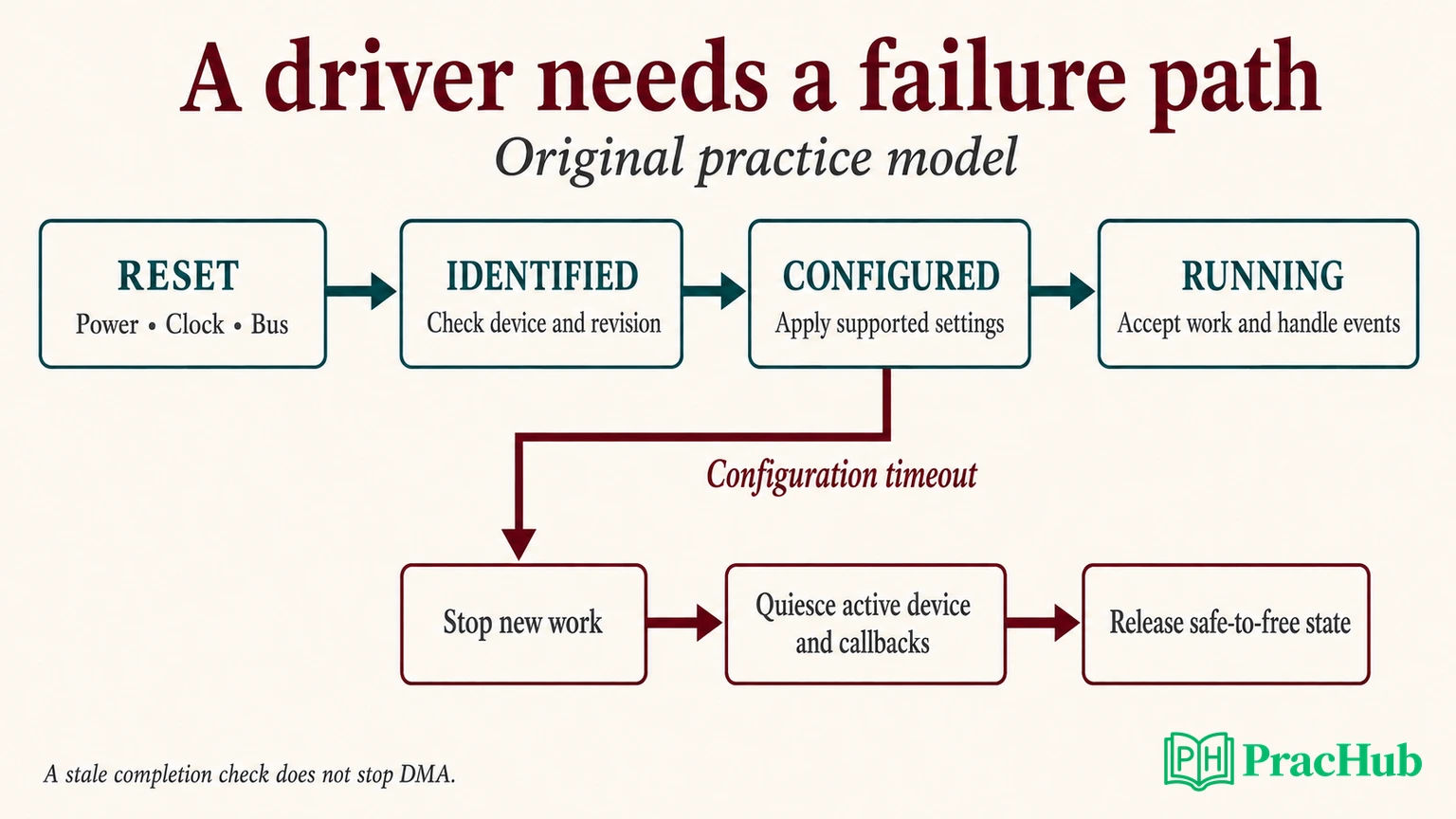
A useful follow-up is reset during an outstanding request. A generation number can distinguish an old completion from a new request, but it does not by itself stop hardware from accessing memory. Separate logical rejection of stale events from the physical requirement to stop DMA or otherwise guarantee that a buffer is no longer in use.
For an intern-level discussion, a state diagram and a clear failure trace are enough to begin. If you have never written a kernel driver, say so and demonstrate the model with a test double. Explain which behaviors the simulation reproduces and which still require target hardware.
Hardware interfaces: choose evidence that fits the bus
Technical references: I2C transactions include address and data acknowledgement, while SPI communication depends on target-specific protocol details, clock mode, word length, and chip-select behavior. Those differences change how you investigate a failed read. Linux I2C protocol overview, Linux SPI overview.
Original diagnostic comparison: an I2C target does not acknowledge its address. Confirm the expected address convention, selected controller, power/reset state, and observed signals. Do not jump directly to decoding a returned payload when the transaction has not reached that stage.
For an SPI device returning an unexpected identification value, check chip selection, clock polarity and phase, transfer length, command framing, and the timing diagram. A buffer filled with ones is an observation, not a diagnosis: several electrical or protocol conditions can produce it. Compare a known-good transaction with the failing one where possible.
For a PCIe-related task, distinguish device discovery from correct operation of its driver and command path. Seeing a device in enumeration does not prove that configuration, interrupts, or data movement work. Keep your next test attached to the failing boundary rather than reciting an entire bus specification.
When presenting a project, name the tool and the question it answered. A logic analyzer may clarify transaction framing; a debugger may expose an incorrect state transition; structured logs may connect a command to its completion. Explain why the evidence changed your next action, and avoid attributing every intermittent failure to “timing” without a measurable mechanism.
Before applying and before the interview
Save the exact requisition and submit while the relevant opening remains available. The September 30 date above concerns applications; it is not a promised interview date or offer deadline. Keep recruiter correspondence as the authority for your own next step.
Prepare one project explanation around an interface contract, one incorrect assumption you discovered, and the test that demonstrated the fix. Include a limitation: perhaps your simulator could not reproduce electrical behavior, or your test covered one device revision. Precise limits make the account easier to assess.
Official interview instruction: the MS posting prohibits AI tools that assist, record, or enhance interview responses without prior interviewer instruction. Review the invitation's permitted tools and any approved accommodations before joining. Marvell interview integrity policy in the posting.
Five questions to turn preparation into practice
The following are cross-company practice records, not predictions of Marvell's questions. Their value is the reasoning you can transfer to language boundaries, driver ownership, and debugging.
| PracHub question | Practice objective |
|---|---|
| Explain C++ memory, types, and concurrency fundamentals | Distinguish language guarantees from hardware assumptions |
| Compare C++ new, malloc, and Placement new | Explain storage allocation, construction, and lifetime |
| Fix and harden an object pool | Reason about ownership, reuse, and cleanup after failure |
| Explain C++ and GPU Tradeoffs | Practice software/hardware tradeoffs; GPU details are optional stretch work |
| How Would You Optimize a Program | Choose measurements before proposing a performance fix |
Start with one ownership question, then explain how a device callback could complicate the answer. Use PracHub's C++ interview questions guide to review the language rules you could not justify. Return to your target requisition and connect those rules to one concrete driver or interface task.
Sources and Further Reading
- Marvell: Firmware Engineer Intern, BS — Summer 2027, 2604461
- Marvell: Firmware Engineer Intern, MS — Summer 2027, 2604513
- Marvell: University Recruiting
- Glassdoor: Historical Marvell Technology interview reports
- Linux Kernel: Bus-Independent Device Accesses
- Linux Kernel: The I2C Protocol
- Linux Kernel: Overview of SPI Support
Comments (0)