Memoized Review: JavaScript Practice Answers, Premium Lessons, and Self-Graded Progress
Quick Overview
Review Memoized's public Async/Await answers, Premium lesson boundary and self-graded completion with a controlled async trace.
Memoized is a useful reading and explanation tool when you want to work through JavaScript interview questions before opening the answer. Its Async/Await page let us reveal an explanation publicly on November 11, 2026. The page describes the questions and answers as free and reserves fuller lesson walkthroughs and examples for Premium. Each question shows a completion control alongside its explanation. A candidate who needs a judged implementation should bring a separate runner and a concrete expected result.
Use the topic to answer three questions about any async loop. When does work start, who waits for it and where does a failure go? That framework makes the free examples useful even if you already know the syntax. PracHub publishes this review and links its own exercises, including a related problem for practicing asynchronous decisions. Name-Keyed Async Task Scheduler with Sequential Lanes, Cancel and Clear by Name
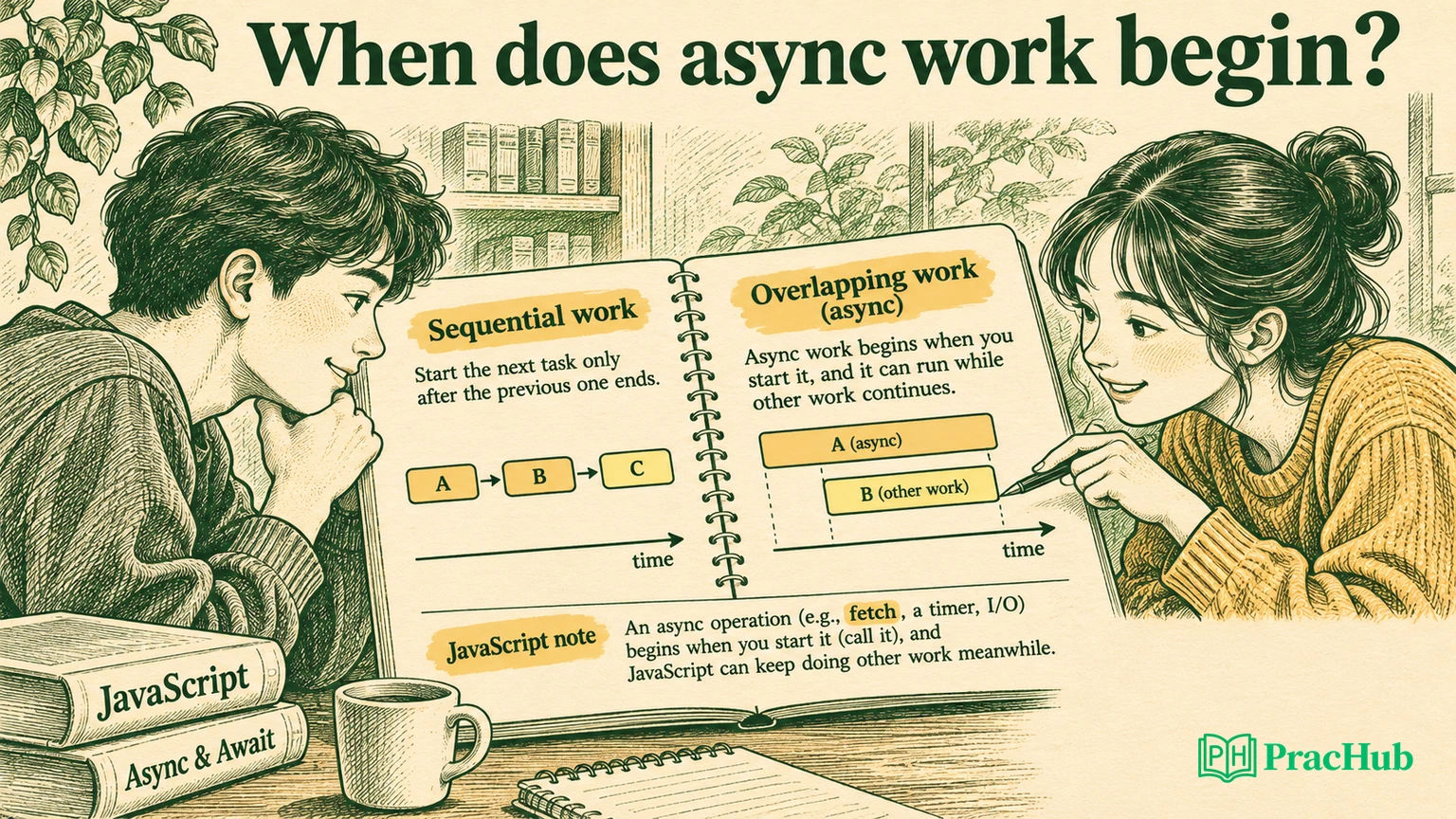
Read the question before opening the lesson
The Async/Await topic is part of the JavaScript track. The public page includes question prompts, reveal controls and a mark-complete affordance. We opened one free explanation in the public session. The page's introductory copy distinguishes those explanations from a more extensive Premium lesson with examples and implementation detail. The provider's Premium page describes a wider curriculum and progress features. Choose the access level based on the particular material you intend to use. Memoized Async/Await topic · Memoized Premium description
A useful first attempt is to say what the caller observes before you read the answer. When an async function reaches an await, its continuation is deferred until the awaited result is available. The caller can continue independently unless it waits for the returned promise. Write down which log belongs to the caller and which belongs to the continuation. If your answer mentions a yield point, name the line that gives control back and the event that eventually resumes it.
Then open the explanation and compare one assertion, such as how awaiting a plain value still affects execution order. Avoid assuming that a conceptual rewrite captures every detail of the language specification. For an interview, a minimal runnable example with an expected output can make the difference precise. You can use the explanation to select the example and the runtime to check it.
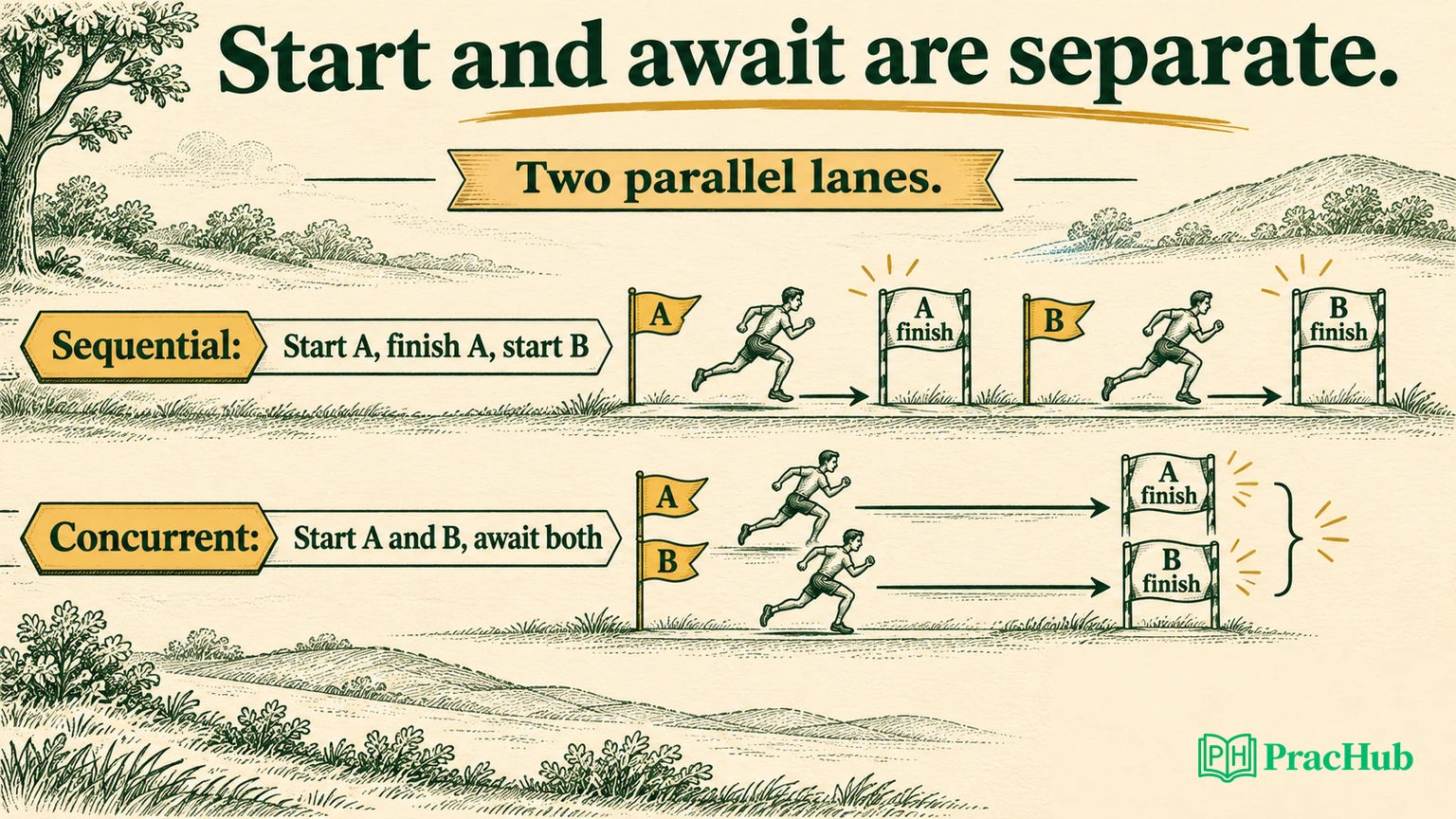
Separate start order from await order
A public question on the topic uses an async callback inside forEach to expose a common completion bug. The collection method invokes the callbacks and discards their returned promises. The outer function can reach a completion message while the callbacks are still waiting. You can repair that only after deciding whether the tasks should start one at a time or overlap. Async/Await loop question and explanation
Consider an original rehearsal involving three report exports. Each export starts when called and returns a promise. Export A waits for an external signal. B and C could finish sooner. If the next export depends on A's data, use a sequence in which B begins after A finishes. If they operate on independent inputs, start the three operations and await an aggregate. Choose the model from the data dependency and resource limits.
| Pattern | Start behavior | What the caller can wait for |
|---|---|---|
| forEach with an async callback | The method calls each callback during iteration | The callbacks' promises need an explicit collection or another owner |
| for of with await in the loop body | Later iterations wait for earlier awaited work | The outer async function covers the sequence |
| Map to promises and await Promise.all | Factories run as the array is mapped | The aggregate settles after success or when an input rejects |
| A bounded pool | New work starts as capacity becomes available | A promise representing the chosen completion and failure policy |
Our local fixture created controlled operations with observable start logs. In the sequential version, only A appeared in the log before its release. In the concurrent version, A and B were both present before either completed. In the forEach variant, the outer function reached its end before the delayed callback completed. Those are independent JavaScript observations used to explain the topic.
A subtle variation is to create both promises first and then await them in a loop. Their work may already have started before the first await. That differs from calling a factory and immediately awaiting its result inside the loop. In a verbal answer, point to the call expression that begins each operation. The word sequential can refer to starts, waits or result processing, so say which of those you mean.
Decide who owns failures
Add a rejected export to the rehearsal. When a forEach callback returns a rejected promise, the outer function has no aggregate promise that waits for it. An outer try/catch around the call only catches errors delivered through the code it actually awaits or executes synchronously. Put ownership of every promise somewhere explicit. That may be a sequential loop, a collection awaited by the caller, or a deliberately detached operation with its own error handling.
With Promise.all, decide whether one failure should end the caller's wait. If you need a result for every export, an all-settled approach keeps the outcome of each one visible. If later exports must never start after an earlier error, the sequential pattern can make that policy direct. For a bounded pool, define whether an active operation can be cancelled and whether queued work should be skipped. Then trace the failure in the same level of detail as a success.
A catch block can also conceal a failure if it records a message and then returns successfully. Ask what the caller expects. Should it receive a fallback value, a rejected promise or a result containing both successful and failed items? Write an expected outcome before choosing where to place the catch. You can then explain why a second layer of error handling is needed or unnecessary under that contract.
Turn completion into a repeatable self-check
The topic page's mark-complete control is a study affordance. In our public inspection, the control appeared alongside question and answer content after the page settled. That observation establishes the visible workflow. Retention across browsers, account sync and any detailed analytics belong to a separate access check. In your own study notes, record whether you could explain the result before reveal and whether you could implement the next example from scratch.
For a first pass, predict the output. On the second pass, change an assumption and explain the new result aloud. For example, replace an array of independent exports with a sequence that needs a token produced by the first export. Ask which starts can overlap and which dependency forces a wait. This makes a completion mark correspond to a task you can repeat rather than to the time you spent on a page.
Premium is most relevant if you want more worked lesson context than the free prompts provide. Open a representative explanation first and identify the exact missing detail. It might be how a long example handles cancellation, why a helper returns a promise, or how the provider organizes a broader learning path. Verify the current entitlement and terms when you make that decision. The public reveal and course pages are enough to choose a topic for an initial rehearsal. Memoized Premium access
Check a failure without relying on real timing
Build the report export example with functions that record their names and return promises you can release from the test. Start the function under discussion and inspect the start log before releasing anything. In a sequential variant only A should have started. Release A and inspect the next start. In an overlapping variant A and B should already be present. This lets you verify the distinction directly rather than drawing conclusions from two fast or slow runs.
Now make a result fail. In a sequential case, decide whether an error prevents the next export from starting. In an overlapping case, decide what to do with the other result when the caller receives a failure. The observed order matters. If B has started and the aggregate rejects because A failed, the implementation still needs a policy for B. An abort request is an action. A result showing B stopped or was safely ignored is a separate observation.
Record the same facts when using the Memoized question. Write the operation that starts work, the promise that represents it, and the caller that awaits or handles it. Then see whether the explanation covers the case you missed. If you need more context on a pattern such as bounded execution, identify the missing topic before deciding whether to use the fuller lesson.
Make the completion mark describe a real task
The first completion can mean you gave a correct answer with the question in front of you. A second replay tests transfer. Change the inputs from an array of exports to a request that first resolves a customer ID and then retrieves several independent records. Identify which operations depend on the ID and which can overlap afterward. Draw the boundary between the two phases.
Use the same criterion for an error-handling question. If you can explain the result when a dependency succeeds, introduce an input that rejects immediately. State whether the outer call returns a partial result, propagates the error or resolves with a fallback. Keep one expected result for each policy. Then read the answer and compare the policy it assumes with the one you chose.
If you want a practice record you can reuse, make a note with three fields. Write the question title, the smallest failing example and one sentence that explains the fix. A completion control can help you keep your place. The note gives you something to replay after a week or in a different browser. Combine them if your goal is to retain both a study sequence and concrete evidence of what you understand.
For the next practice session, start from the sentence that was hardest to explain. If you still say “await makes the work sequential,” point to where each factory is called. If you still assume a catch handles every callback, identify the promise delivered to that catch. Both observations turn an answer into a testable claim.
Practice with a changed dependency
The PracHub prompts below give you independent opportunities to trace start order, observable state and error ownership. Write a new expectation before you run a variation.
| PracHub question | What to check |
|---|---|
| Name-Keyed Async Task Scheduler with Sequential Lanes, Cancel and Clear by Name | Keep separate start and completion logs. |
| Debug a Concurrent Job Scheduler | Trace which failure reaches the caller. |
| Design async batched key-value fetcher | Identify the dependency that must finish first. |
| Implement debounced async autocomplete input | Compare scheduled launch with response order. |
| Build a Custom CompletableFuture: Async Primitive and Parallel Array Processing | Show how the aggregate represents each outcome. |
Use Name-Keyed Async Task Scheduler with Sequential Lanes, Cancel and Clear by Name to decide which operation can start immediately and what the caller observes when another fails. Then return to Memoized and compare the explanation with your recorded start log. Mark the question complete after you can explain the start log on a fresh input.
Comments (0)