Metaview Screening Interview: Explain Your Technical Experience to a Voice Agent
Quick Overview
Prepare for Metaview Screening by turning resume claims into project evidence, explaining personal contribution and handling voice follow-ups accurately. Primary references, original examples and explicit evidence limits support focused preparation.
For a Metaview Screening interview, prepare to explain your technical experience to a voice agent and answer follow-ups about what you personally did. First distinguish that screening conversation from Metaview taking notes during a human interview. Check who asks the questions; the product name alone is insufficient.
A useful answer connects a resume claim to a decision, an ownership boundary and evidence. PracHub's technical project deep-dive practice can help you rehearse those connections. You should be able to shorten the account, define a term or correct a number without changing the underlying story.

Official provider statements below were checked November 3, 2026. The queue-migration story and rehearsal methods are original editorial exercises. We did not complete a private Screening session or verify two independent same-cycle candidate reports for this exact product. Product descriptions do not establish your employer's questions, timer or scoring weights.
Establish whether the agent conducts the conversation
Official product description: Metaview describes Screening as a voice-first AI agent for early-stage candidate conversations. It says the agent adapts to the candidate and role, asks follow-up questions and provides structured information for recruiters. Its public description places the hiring decision with a human reviewer. These are vendor descriptions, not an independent validation of assessment quality. Metaview Screening overview
Metaview also describes an Interview Notes product that supports human-led interviews. A message saying Metaview will join a scheduled call can therefore mean something different from an invitation to complete an agent-led screen. Check the actual invitation's explanation rather than importing instructions from an older notetaker discussion.
The provider's workflow article says employers can place Screening at different points in their process. That is another reason not to assume a universal sequence after applying. Confirm the role, deadline, enabled language and whether there is a subsequent human conversation. Where Metaview Screening can sit
Preparation inference: if a link starts an autonomous conversation, rehearse answers that make sense without a human supplying context. If a named recruiter conducts the meeting, prepare for that person's questions. Neither case calls for memorizing a product-wide script that public evidence does not establish.
Turn one resume claim into an evidence ladder
A resume compresses a project into a result. A screening conversation can expand it again. Prepare the steps between “worked on migration” and a defensible account of your contribution: what changed, why it mattered, which decision you owned and what evidence supported the result.
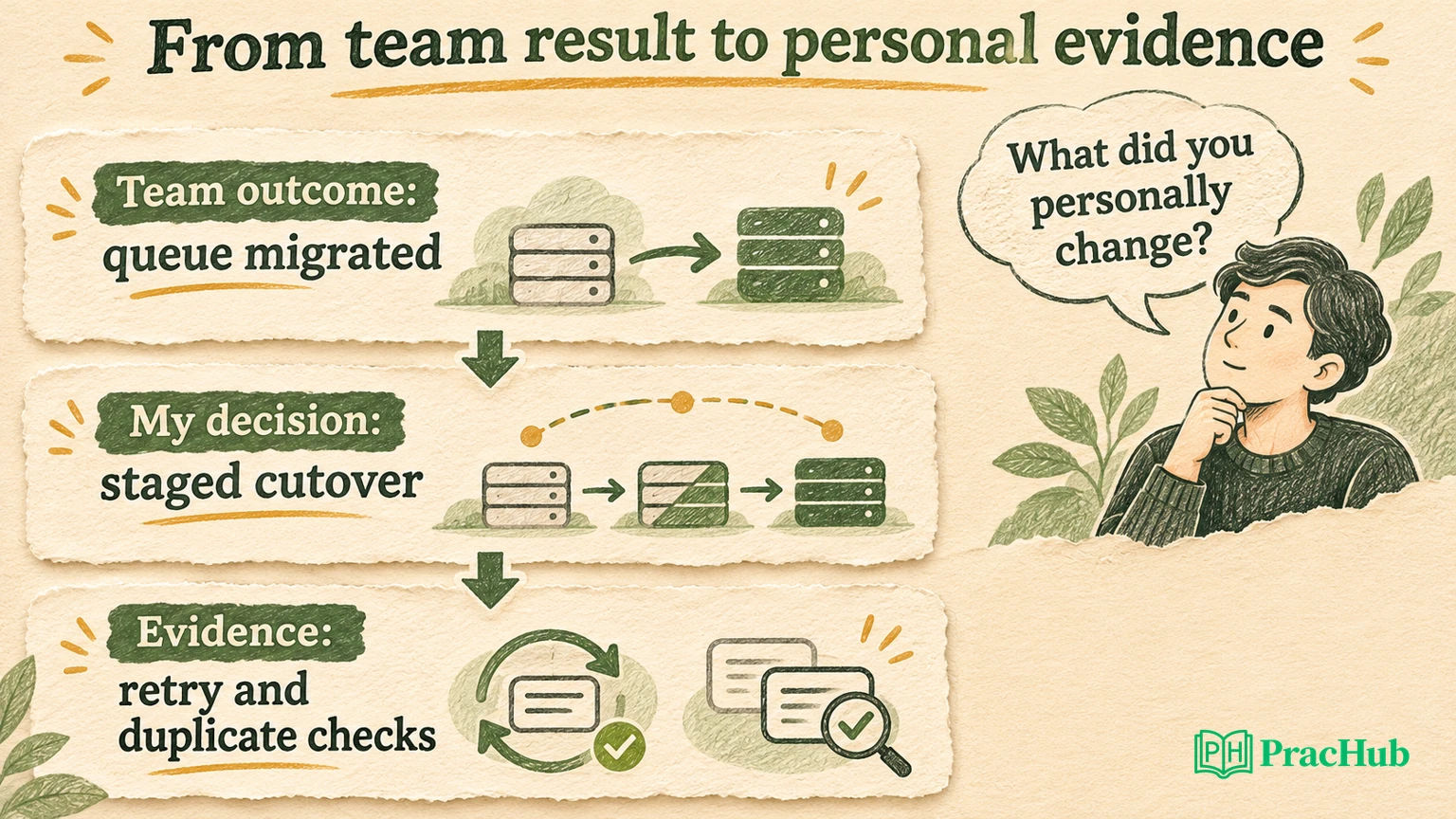
Consider an original fictional case. A team migrated background report jobs from one queue service to another. You owned the consumer cutover and the duplicate-processing checks; another engineer owned provisioning. A product partner needed reports to remain available during the transition.
A weak opening says the team modernized its stack and improved reliability. It names an activity and a desired benefit, but leaves the mechanism unclear. A stronger opening says you introduced a staged consumer cutover because retries could deliver the same logical job more than once, and you needed to distinguish duplicated delivery from duplicated output.
Technical vocabulary alone would not repair the weaker answer. The revised version gives the listener a specific decision to investigate. It also makes personal ownership visible without claiming that you designed every part of the migration or single-handedly produced the team's outcome.
| Evidence level | Original queue-migration example | What a follow-up can test |
|---|---|---|
| Team outcome | The job path moved to another queue | What changed for users? |
| Personal scope | Consumer cutover and duplicate checks | Which code or decision did you own? |
| Constraint | Repeated delivery must not duplicate output | What failure did you anticipate? |
| Decision | Staged traffic with a stable logical job identifier | Why this approach over a full cutover? |
| Evidence | Controlled retries and reconciled job/output records | What was tested or measured? |
Use this as a structure for your own experience, not as an account to present as yours. If you cannot substantiate a metric on your resume, repair the claim before practicing a more polished delivery.
Rehearse a short opening that leaves room for depth
Begin with the user's problem and your responsibility. In the fictional case, reports occasionally became difficult to reconcile during retry handling, and the migration could expose that weakness more often. Your job was to change the consumer path while preserving one logical output per job under the declared contract.
Then give the key choice. You proposed a staged cutover with reconciliation rather than switching all consumers at once. A staged path allowed a narrower failure investigation, but required extra routing and temporary operational complexity. That is a trade-off, not a free improvement.
Finish the opening with the evidence you can support. You might describe which retry and failure tests ran before the next stage. If no production outcome was measured, say so. Do not transform a test assertion into a reliability percentage or a claim about user satisfaction.
A practice partner can now ask about idempotency, rollout conditions, ownership or evidence. You have not read out a complete architecture document, but you have given enough structure for a useful technical conversation. Adjust the depth to the prompt rather than forcing a fixed answer duration.
Answer a follow-up about your contribution
Metaview's public testing guidance emphasizes evaluating follow-up behavior, including whether answers support the intended hiring criteria. It is employer-facing guidance; it does not disclose the private follow-up path or rubric you will encounter. Testing a Screening interview
Our rehearsal recommendation is to practice a question that separates your actions from the team's work: “What did you personally change when the migration became risky?” In the fictional case, answer with the consumer behavior, reconciliation signal and escalation you owned. Name provisioning as the other engineer's responsibility.
Then ask, “What would have happened without your change?” A grounded answer distinguishes a plausible failure mechanism from an observed incident. You can explain how duplicated delivery could create repeated output if processing lacks an appropriate guard. You cannot claim that a specific outage would definitely have occurred.
Now challenge the design: “Does a stable identifier guarantee exactly-once side effects?” It does not by itself. The handling of retries, persistent state and external writes must support the same logical-operation contract. If that was outside your implementation scope, explain the interface you relied on and how you checked it.
Use each follow-up to make the account more precise. Repeating “I collaborated with stakeholders” adds little unless you identify the disputed decision, the evidence exchanged and the agreement that changed the work. State the action that another participant could recognize.
Keep metric definitions stable across the conversation
Suppose your actual resume says processing failures fell after a rollout. Before rehearsal, define a failure. Is it an unsuccessful attempt, a logical job that never completed, an output requiring manual repair or a user support ticket? Retries can make those measures move in different directions.
In the fictional case, imagine 100 logical jobs and 112 delivery attempts. Twelve additional attempts are not automatically twelve failed jobs or twelve duplicated outputs. A retry can be harmless and still increase attempt count. The example illustrates denominator discipline; it is not a measured result from Metaview or an employer.
If asked for a number you cannot recall, state the limit. Explain which measure you tracked and say you would need the original record for an exact figure. An approximate range should be identified as approximate, with its scope intact. Avoid replacing uncertainty with an impressive number.
Rehearse a correction explicitly. If you accidentally call repeated deliveries “duplicate jobs,” clarify that you mean attempts for the same logical identifier. Explain whether any duplicate output occurred. This correction changes the technical interpretation and should happen before you build another conclusion on the mistaken wording.
Handle voice ambiguity without changing your story
A spoken prompt may contain an unfamiliar acronym or refer to a project in an unexpected way. If the interaction permits clarification, ask a specific question about the missing term or intended scope. If clarification is unavailable, state the interpretation you are using and answer within it.
Keep corrections short and local. “I said five services; I owned two of them” is easier to interpret than restarting the entire story. For a misunderstood name, use a functional description such as “the report-processing queue” rather than repeatedly emphasizing an internal codename.
Use ordinary speech, with one technical term defined when it first matters. A listener should understand what information crossed a boundary, where a decision was stored and what failure you handled. Acronym density is not evidence of depth.
Follow the actual equipment and session instructions. This article does not establish a universal retry, pause or transcription-editing control. If the session fails technically, save the visible error and tell the recruiting contact what happened, including whether you had begun the assessed portion.
Prepare questions about the employer's configuration
Ask which role and responsibilities the screen evaluates, what assistance is permitted and what support route applies. An employer may configure additional requirements for a voice-first product. Do not infer that camera, note-taking or resource rules are the same for all customers.
For recording, retention or accommodations, consult the employer's notice and contact. The provider's general description cannot resolve every organization's policy. Avoid inferring what happens to your data from an unrelated candidate's account of the Interview Notes product.
When preparing a project account, remove confidential customer details while keeping the decision understandable. You can explain a retry boundary or rollout disagreement without naming a private client. State when a number is anonymized or rounded so it does not appear to be a precise production measurement.
Finally, map one job requirement to one supported project example. If the role emphasizes operations, prepare the failure and recovery account. If it emphasizes collaboration, prepare the disagreement and ownership boundary. This is role-aware preparation, not a claim about undisclosed Screening weights.
Practice technical experience under active follow-up
These cross-company PracHub records support project explanation, metrics and audience changes. They are preparation material, not Metaview's private prompt bank or a prediction of an employer's assessment.
| PracHub question | Rehearsal focus |
|---|---|
| Deep-Dive into a Technical Project | Give a project account that can expand under questions. |
| Present a Technical Project Under Active Follow-Up | Answer a redirected prompt without restarting the whole story. |
| Present a Metrics-Driven Technical Project | State a metric denominator and evidence boundary. |
| Present a Technical Project to a Cross-Functional Audience | Explain one system at both technical and partner-facing depth. |
| Explain What You Would Change When Rebuilding a Technical Project | Identify a changed decision and its supporting evidence when rebuilding. |
Use the technical project deep dive, then ask a partner to challenge one metric and one ownership claim. Rehearse the corrected answer until its scope stays consistent. The aim is a project account that remains accurate when the conversation changes direction.
Sources and Further Reading
- Metaview: AI screening interviews and Screening
- Metaview: where Screening can sit in a hiring process
- Metaview: testing an AI screening interview before rollout
Sources checked November 3, 2026. Public provider claims and original preparation examples are separate; no private session or candidate outcome was independently tested.
Comments (0)