Mianling AI Review: Company Interview Aggregation, Source Links, and Practice Boundaries
Quick Overview
Review Mianling AI’s interview aggregation, collection dates, source-link limits, truncated reports and an original kth-largest duplicate-value exercise. Dated public observations and original exercises distinguish official descriptions, tested behavior and unverified capabilities.
Mianling AI’s interview aggregation site, 面灵面经 at mj.mianlingai.com, offers publicly readable company and role collections. Its preparation material needs careful separation: a collection header can have a different date from the reports inside it, and a “reference analysis” section is separate from the reported questions. We inspected both a nine-report collection and a page explicitly disclosing that part of its original source was truncated.
Start with PracHub’s kth-largest occurrence question. The distinction between a ranked occurrence and a distinct value provides a small, verifiable way to turn a reported algorithm topic into your own preparation.
Checked November 3, 2026: official site descriptions, aggregator-attributed candidate reports, our public observations and original exercises are identified separately. We did not verify the original authors, complete a mock or use the parent product’s real-time assistance. PracHub publishes interview-preparation content and is the publisher of this review.
Identify the aggregation site before evaluating its claims
The aggregation site organizes interview material by company, role and technical topic. It links to the parent 面灵AI product, which is promoted as an interview assistant. That relationship matters, but reading the aggregation site does not establish that the parent product’s transcription, suggested answers or mock functions work as advertised.
This review concerns preparation using the public collections. We did not use assistance during an actual interview or assess whether a particular employer permits such tools. Keep any practice tool within the rules of your real assessment.
The footer also linked a public GitHub repository associated with the aggregation site. Its description and README discussed collecting material from platforms such as Nowcoder and Maimai. Source availability can help establish project identity, but it does not independently verify every account in the index.
The repository distinguishes its code licensing from the rights of original content authors. Do not assume that an open-source code license gives permission to republish every interview narrative. For preparation, retain short topic notes, source context and your own worked answers rather than copying long accounts into another public guide.
A month label did not date all nine reports
We inspected “小红书大模型算法岗面经合集(三),” a Xiaohongshu large-model algorithm collection. Its header displayed September 2026, described multiple rounds and named Nowcoder as the source platform.
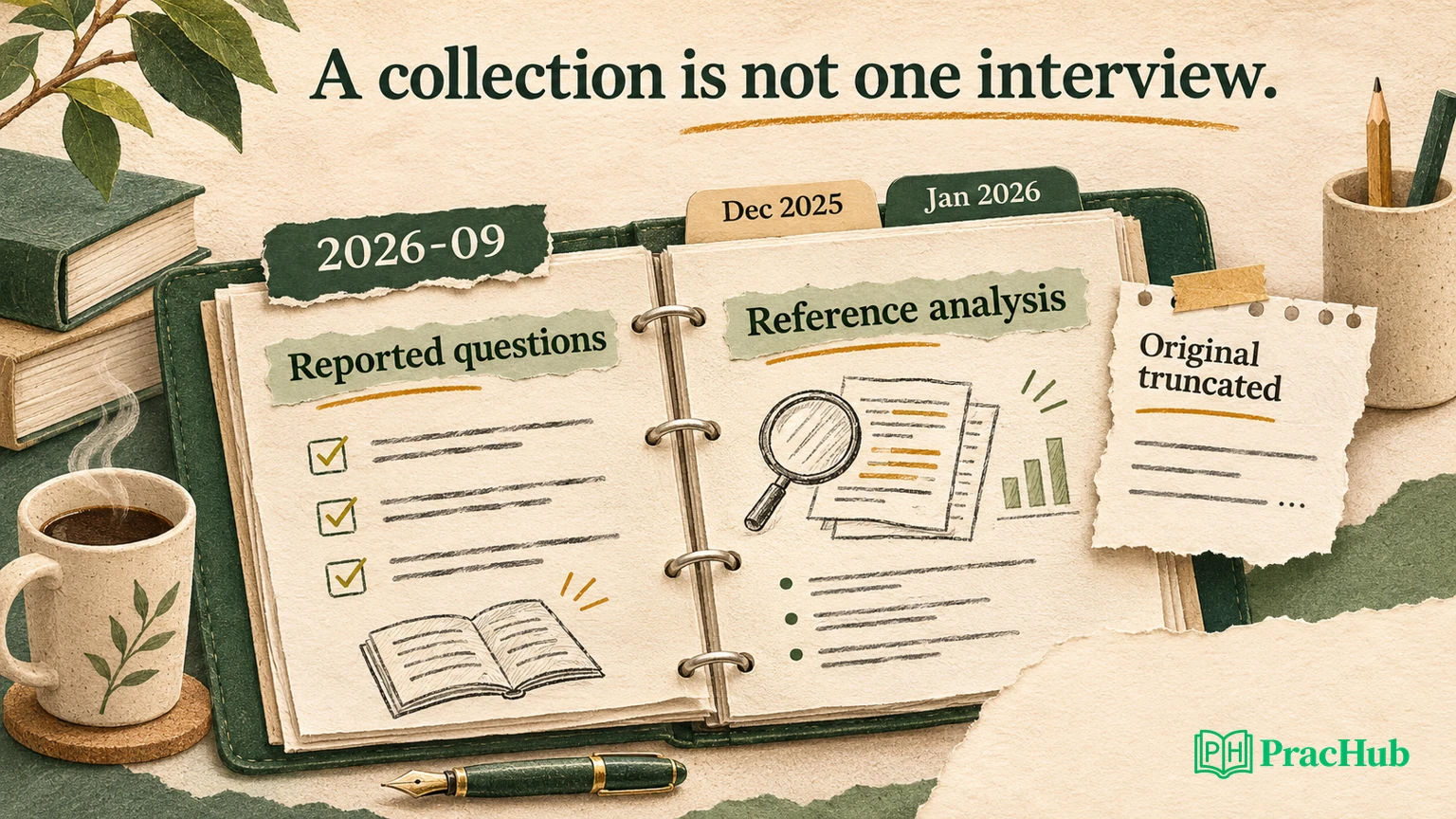
Inside, the nine numbered reports carried dates ranging from December 2025 to January 2026. The first was January 29,2026; others included January 10 and several December dates. A reader who treats the September header as the interview date for every item would make those accounts appear more recent than their own body text supports.
The collection also contained varied technical material. One section included frontend-related JavaScript, Vue and React Native details despite the broad large-model algorithm label. That does not make the material unusable, but it limits how confidently a candidate should treat the collection as a uniform role-specific sequence.
Repeated topics also need interpretation. Kth-largest selection appeared in more than one numbered report, while square-root questions had different precision requirements. Keep the individual prompt and its constraints attached to the report. A shared topic name does not make two tasks identical.
| Collection field | What we observed | Safe interpretation |
|---|---|---|
| Header time | September 2026 | Collection-level metadata |
| Numbered account dates | December 2025 through January 2026 | Dates attributed within individual reports |
| Source | Nowcoder label | Named source platform |
| Original source URLs | None visible in inspected anchors | Original account comparison unavailable through these links |
| Reference analysis | Separate labeled section | Site-provided explanation layer |
We did not confirm whether any original source page remained accessible elsewhere. The bounded finding is that the inspected public collection did not expose clickable original Nowcoder or Maimai links in its visible anchors.
An explicit truncation notice is useful evidence
A second inspected page covered Baidu AI Agent development and grouped four accounts. Its header again used a month-level date, while individual sections identified September 16,15,10 and 8,2026.
The fourth section contained only a short start, followed by an explicit notice: the original was a serialized collection, the fourth report’s body was truncated on the source server, and only the published portion was retained. We observed that disclosure directly on the public page.
Preserve that truncation notice in your source notes. A reader cannot reconstruct the missing interview from surrounding reports or reference explanations. If an article uses this sample, it should say which published questions are available and leave the missing material unknown.
The page’s reference analysis discussed topics including architecture migration, evaluation sets, member-service availability and KV cache. Those explanations may provide study starting points, but they are not evidence that an original candidate gave those answers or that an interviewer endorsed them.
For technical study, verify a reference explanation independently. Some statements depend on framework versions, runtime configuration or workload assumptions. A polished paragraph that sounds plausible is still a claim that needs a technical source or a reproducible example when you plan to rely on it.
Use occurrence rank as an independent answer check
Our original exercise takes the repeated kth-largest theme and makes one ambiguity explicit. Given [9, 9, 3] and k = 2, the second-largest occurrence is 9. The second-largest distinct value is 3. Both are sensible operations, but they answer different questions.
We checked these results independently in local Python using sorted values and sorted unique values. The fixture is not a reconstruction of a Mianling hidden test or a validation of its full reference analysis.
values = [9, 9, 3]
k = 2
occurrence_answer = sorted(values, reverse=True)[k - 1]  # 9
distinct_answer = sorted(set(values), reverse=True)[k - 1]  # 3
Sorting supplies a simple oracle for the small exercise. It does not satisfy a prompt that prohibits full sorting or requires a particular complexity. Establish the result contract first, then choose an algorithm that meets the required bounds.
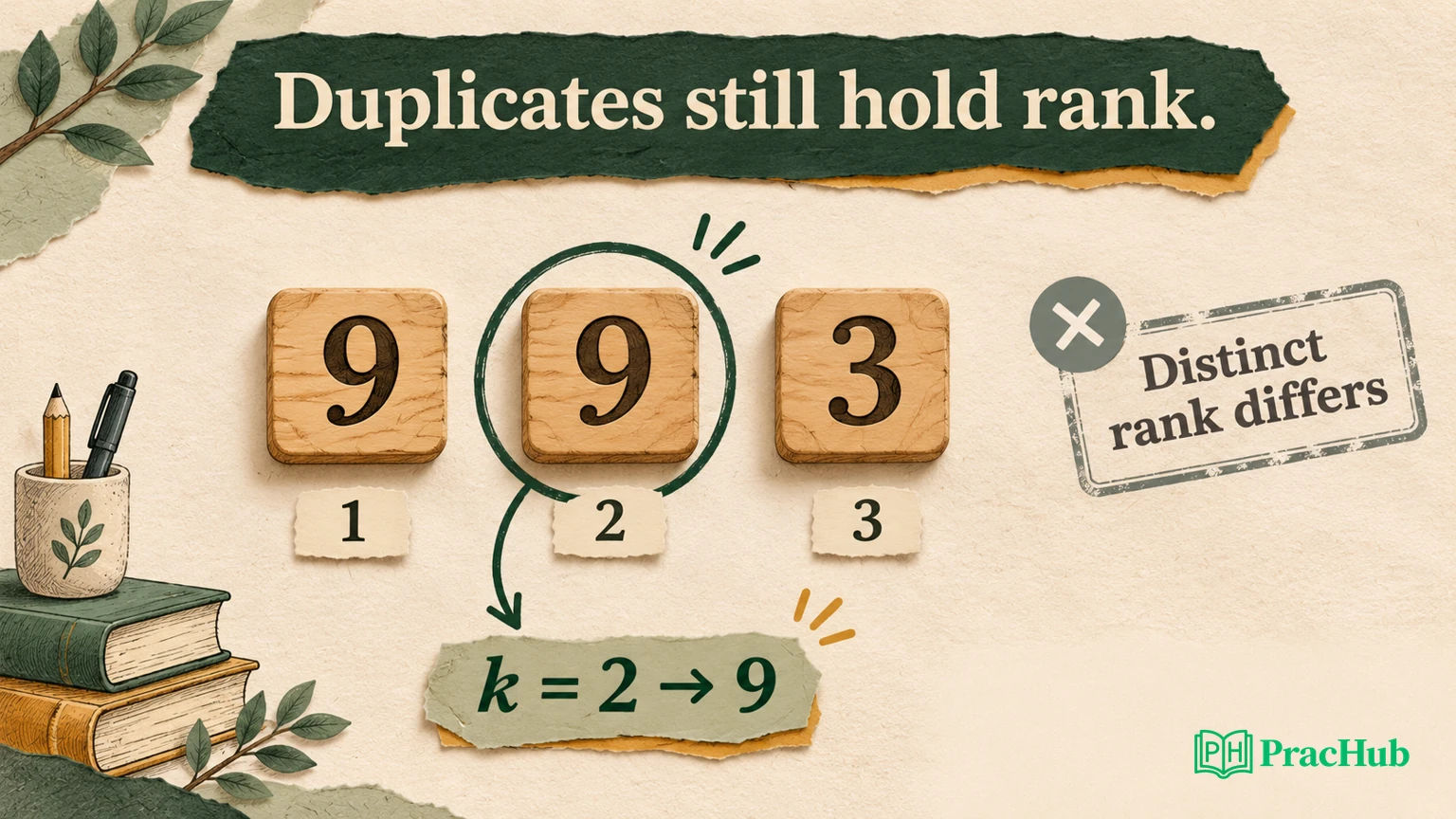
A heap solution that retains the largest k occurrences must preserve duplicates. A selection algorithm must also define partition behavior around equal values. If you silently convert the input to a set, you may produce elegant code for the wrong problem.
Validate k as part of the contract. For three occurrences, zero and four are invalid ranks. For distinct rank, the valid upper bound is the number of distinct values instead. State whether invalid input raises an exception or returns a sentinel; do not leave the caller to infer it from an indexing error.
Map a report to a practice artifact
A useful collection-reading session ends with something you produced. For the selection example, retain the exact rank definition, a duplicate-heavy input, an independently calculated answer and a short argument for the algorithm you chose.
Then change one constraint. A stream prevents you from assuming random access to a complete array. Two sorted arrays create an opportunity to use their ordering. A distinct-rank request changes how repeated values are counted. These variations reveal whether the concept transfers beyond the wording of the collected account.
The same principle applies to systems topics in the Baidu page. If you choose evaluation-set design, state the task, expected outcome and failure definition for one fictional scenario. If you choose priority scheduling, show how low-priority work avoids starvation under sustained high-priority arrivals. Keep these as your own exercises rather than presenting them as missing candidate answers.
Avoid trying to rehearse every topic in a long collection at once. Select the topic that matches your target role and exposes a known weakness. A role label can guide discovery, but your actual job description and assessment invitation should determine the final practice format.
Source labels and current process require different evidence
The site’s company organization can make reports easy to find. It cannot, on its own, establish that a named company still uses the same rounds or questions. Hiring processes can vary by team, location, seniority and recruitment cycle.
When describing a report to another candidate, use precise language: “This indexed account says…” followed by its attributed date and role. For a current process statement, seek current official hiring information and independent same-cycle accounts. We did not obtain that evidence floor for this product review and do not present a company process guide.
Keep repeated copies from becoming artificial corroboration. Two aggregators can reproduce the same original account. Even two numbered sections may need closer source inspection before being treated as independent authors. An original URL, author context and date improve that assessment; a source-platform label alone leaves it unresolved.
The open repository can be another clue, but an ingestion description is not an authenticity guarantee. A pipeline that reliably collects pages can still collect older material, incomplete excerpts or ambiguous role tags. Separate successful collection from verified provenance.
Where this review places the access boundary
The inspected collections were publicly readable without an account. We could read their questions, reference-analysis sections and truncation disclosure. That supports a practical recommendation to inspect one role-relevant collection before investing in a larger study routine.
We did not verify complete catalog coverage, update frequency, WeChat mini-program behavior or the parent product’s paid and free entitlements. Promotional claims about popularity or offer outcomes remain unverified. None is needed to use a public question as a starting point for independent practice.
A good fit is a candidate who can read Chinese technical accounts and wants to discover follow-up themes while maintaining their own source notes. A candidate who needs verified current employer sequencing or an assessed coding environment will need additional evidence beyond these public pages.
If you already use another question bank, compare the exact practice gap. This site’s distinctive material is the report collection and its context. It does not replace a runner, an independent technical reference or a reviewer who can challenge your answer.
For a stronger selection rehearsal, explain how equal pivot values are handled before coding a partition. A duplicate-heavy input can stall or miscount an implementation that only worked on distinct values. Keep the sorted occurrence oracle for small random fixtures, then separately inspect whether your chosen algorithm meets the interview’s time and space constraint. Correct results on tiny inputs and a valid complexity argument are complementary evidence. Neither follows automatically from recognizing a topic in a collection.
Five PracHub questions for selection follow-ups
These verified prompts extend the kth-largest theme into streams, sorted inputs and distinct values. They are independent of the aggregation site and do not establish an employer’s future question set.
| PracHub question | Focused follow-up |
|---|---|
| Kth Largest Values in a Stream | Preserve repeated occurrences while maintaining a bounded streaming structure. |
| Select a Kth-Largest Occurrence without Full Sorting | Define occurrence rank and handle invalid k explicitly. |
| Find the Kth Largest in Two Sorted Arrays | Use sorted-input structure without silently changing duplicate semantics. |
| Find kth largest element in array | Defend the selection invariant with a duplicate-heavy input. |
| Find Kth Unique Maximum | Explain why a distinct maximum request has a different contract. |
面灵面经 can supply a useful starting topic when you preserve its date and provenance limits. Finish with the occurrence-selection question, explain why duplicates retain rank and then change the input model. Your solved artifact should remain defensible even when the original report cannot be traced further.
Comments (0)