Millennium Criteria Assessment 2027: Work Preferences, Games, and What Comes Next
Quick Overview
An evidence-led guide to Millennium's 2027 Criteria assessment, including reported aptitude and work-preference sections, possible game formats, pacing, and next steps.
An email from Criteria can create more questions than it answers. Did you pass a resume screen? Is this a personality test, an IQ test, or a set of games? And if the timer says 15 minutes, are you expected to finish all 50 questions?
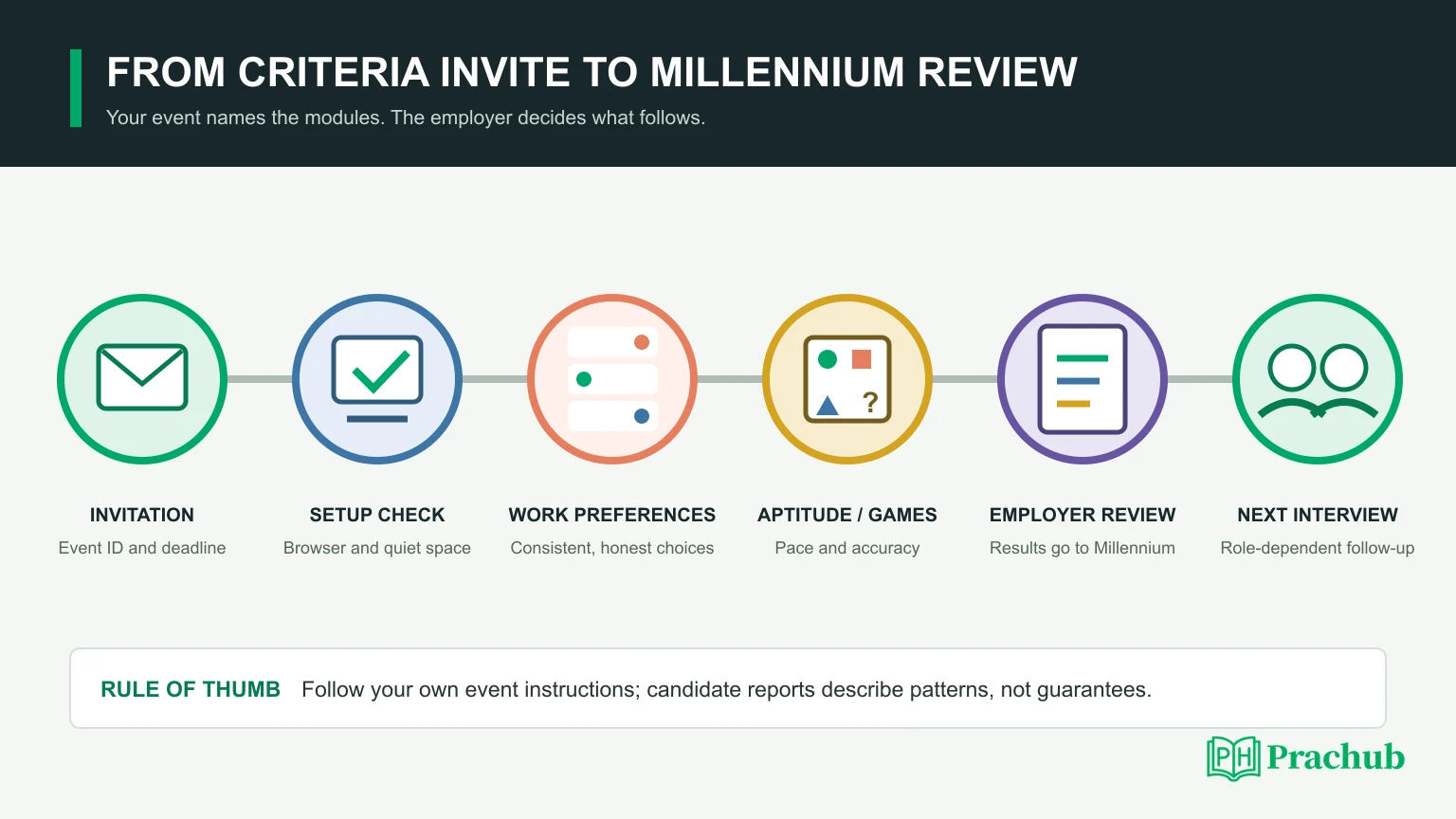
For Millennium's 2027 recruiting cycle, the safest answer is that "Criteria assessment" names the platform, not one universal test. Current candidates describe different sequences by role: some received Criteria after a technical assessment, some received it first, and others report receiving only Criteria. Your invitation page is therefore more reliable than another applicant's exact sequence.
Use this guide to identify your module, manage the timer, and understand the likely next step. For the technical rounds around it, start with Millennium Software Engineer questions on PracHub instead of preparing from format rumors alone.

Quick answer
Recent Summer 2027 candidate reports point to a separate Criteria screening stage that may include cognitive aptitude and work-style or behavioral items. Several candidates describe 50 multiple-choice questions in 15 minutes, which closely matches Criteria's official CCAT format. That is a strong clue, but Millennium has not publicly confirmed that every 2027 applicant receives the CCAT.
Criteria also sells work-preference and game-based assessments. Do not assume you will see all of them; read the module names, timer, calculator rules, and device requirements in your event.
| Signal | What is verified | What remains uncertain |
|---|---|---|
| 50 questions in 15 minutes | Criteria says the CCAT uses this exact structure | Millennium has not publicly named the CCAT for every applicant |
| Work-preference items | Criteria offers workplace-alignment and personality assessments | The exact work-style module used for each Millennium role |
| Games | Criteria offers Cognify and GAME | Whether your specific Millennium event includes either product |
| Next step | Criteria sends results to the employer | Millennium's review order, cutoff, and response time by role |
What candidates are reporting in the 2027 cycle
The freshest public discussion is concentrated around Millennium's Engineering, AI, software, quantitative development, and research applications. Reports are not perfectly consistent, which is itself useful evidence: the assessment path appears role- and batch-dependent.
Some applicants received a HackerRank-style technical assessment and then a Criteria event. Others say Criteria arrived immediately after applying or without a technical link. Several describe 50 aptitude questions in 15 minutes covering math, verbal reasoning, and patterns; other comments mention logic plus work-preference items.
Treat those comments as candidate evidence, not a promise. They support a Criteria stage in the current cycle, but do not prove human resume review, a score cutoff, or one fixed next round.
If your email also mentions HackerRank, repository work, Python, data tasks, or an AI-assisted coding environment, use the separate Millennium Management Engineering and AI OA guide. That article covers the technical assessment; this one covers the Criteria screening layer.
Criteria is a platform, not a single assessment
Criteria's catalog includes aptitude tests, workplace-behavior assessments, work-alignment rankings, and game-based tests. Employers choose the modules, so two applicants can both say "I got Criteria" while seeing different tasks.
The 50-question aptitude format
Criteria officially describes the Criteria Cognitive Aptitude Test (CCAT) as 50 questions with a 15-minute limit. It measures verbal ability, math and logic, spatial reasoning, critical thinking, and learning ability. Criteria also says very few people finish all 50 items.
That description aligns closely with current Millennium candidate reports. The responsible conclusion is not "Millennium definitely uses CCAT for everyone," but rather: if your event shows 50 questions and 15 minutes, Criteria's CCAT preparation materials are the most relevant official reference.
Work-preference formats
Criteria's Workplace Alignment Assessment asks candidates to rank 20 factors that describe an ideal workplace. Those preferences can be compared with an employer profile. Criteria also offers broader personality and workplace-behavior products, so a work-style section may look different from a simple ranking exercise.
These items capture priorities such as autonomy, recognition, advancement, training, and security. Respond consistently and honestly rather than reverse-engineering the answer you imagine a hedge fund wants.
Game-based formats
Criteria's Cognify product uses three short games to measure problem solving, numerical reasoning, and verbal accuracy. Its GAME product uses brief mobile-friendly mini-games for cognitive aptitude. These are official Criteria products, but public evidence does not confirm that every Millennium 2027 event includes either one.
If your invitation uses words such as Cognify, GAME, Grid Lock, Numbubbles, or Proof It, review the matching official instructions. If it instead shows a 50-question multiple-choice timer, prepare for the CCAT-style format rather than generic hiring games.
How to handle the work-preference section
Selecting whatever sounds most competitive or finance-oriented can create an inconsistent profile. Answer from your actual work behavior and interpret each choice in context.
Valuing autonomy does not mean rejecting collaboration; it may mean preferring clear outcomes with room to choose the implementation. Valuing structure can simply mean you work best with explicit responsibilities and risk limits.
Use three rules:
- Answer for sustained behavior, not your best day. Think about how you prefer to work across a normal semester, internship, or project.
- Do not manufacture a Millennium persona. Trying to make every answer signal ambition or pressure tolerance can create contradictions.
- Keep the role in mind without becoming dishonest. A software or quantitative role can require independent judgment and careful teamwork at the same time.
There is no useful way to memorize a work-preference answer key. The practical preparation is to clarify your own priorities before the event so you do not overthink every forced choice.
How to approach the aptitude or game section
The cognitive portion rewards controlled pace more than perfectionism. Criteria's own CCAT candidate guide says the 50 questions share a 15-minute limit and that fewer than 1% of candidates finish all of them. That makes getting stuck especially expensive.
Use a time-boxed first pass
At 15 minutes for 50 questions, the average budget is under 20 seconds per item. Some questions will take longer, so the goal is not an identical timer for every question. Move quickly through obvious verbal, numerical, and pattern items, then make an educated choice when a question starts consuming the rest of the test.
Criteria's official advice is to avoid spending more than about a minute on one problem. Practice that decision before test day. The skill is recognizing when another 30 seconds is unlikely to change your answer.
Protect accuracy from panic
Fast does not mean random. Read the exact question being asked, estimate before calculating, eliminate impossible options, and check units. On spatial items, look for rotation, reflection, count, fill, and movement rules before inventing a complicated pattern.
For game-based modules, complete every tutorial and use the practice interaction until the controls feel automatic. The tutorial is where you learn whether speed, accuracy, or both matter. A mouse or keyboard can be more comfortable than a phone even when the module supports mobile devices.
What the invitation does and does not mean
A Criteria invite means Millennium has placed your application into an assessment workflow. It does not, by itself, prove that a recruiter has approved your resume, and it does not prove that every candidate received the same screen.
Current applicants report both immediate invitations and assessment sequences separated by a business day. That is consistent with automation, batching, or role-specific routing, but those are inferences. Only Millennium can tell you how your application was screened.
A strong aptitude performance is not a job offer. The employer can combine it with resume fit, technical results, availability, location, and later interviews. Do not turn a portal delay into a theory about your score.
What comes after the Millennium Criteria assessment
Criteria's official candidate FAQ says results go to the employer and that Criteria cannot provide candidacy updates. Millennium's exact next step is not publicly standardized. Depending on the role, the process may continue with resume review, a technical assessment, a recruiter conversation, or interviews with the relevant team.
The most useful response after submitting is simple:
- Save the completion confirmation and the Event ID.
- Check spam and the application portal, but do not refresh them all day.
- Record the role, submission date, and assessment modules you saw.
- Continue technical and behavioral preparation while applying elsewhere.
- Follow up with the recruiter only when a stated timeline has passed or after roughly one to two business weeks without guidance.
Candidate reports in August 2026 include people waiting several days after Criteria. Silence during a new recruiting wave is not enough evidence to declare rejection.
A five-day preparation plan
A short plan can improve familiarity while preserving time for technical stages that are more directly related to the job.
| Day | Focus | What to do |
|---|---|---|
| Day 1 | Identify the module | Open the event instructions without starting the timed test. Record names, timer, device rules, deadline, and calculator policy. |
| Day 2 | Baseline | Take Criteria's official mini practice test once. Note whether verbal, math, logic, spatial, or interface speed causes the most misses. |
| Day 3 | Targeted speed | Run two short timed sets on your weakest type. Practice skipping before one problem absorbs a full minute. |
| Day 4 | Work preferences | Write your genuine top workplace priorities and two examples showing how you work under ambiguity, pressure, and collaboration. |
| Day 5 | Test and transition | Complete the event rested and distraction-free, save confirmation, then switch to Millennium technical and behavioral practice. |
Do not spend all five days drilling aptitude questions. The Criteria stage can be one part of a larger funnel, and current Millennium technical reports emphasize practical codebases, APIs, Python, data work, debugging, and communication.
Practice with Millennium questions from PracHub
These question-bank records are not predictions of your Criteria event. They prepare you for the technical and behavioral stages that may follow, and every title below opens the complete question page.
| PracHub question | Practice focus | Why it helps |
|---|---|---|
| Design a data structure to store anagrams | Hashing, canonical keys, complexity | Builds clear implementation reasoning for a technical screen. |
| Debug missing output in Python async HTTP flow | Python async, execution, failures | Trains practical debugging and explanation rather than pattern memorization. |
| Implement paginated API ingestion | APIs, retries, parsing, tests | Matches the applied engineering style seen in current technical reports. |
| How do you explain work to non-technical partners? | Communication, risk, stakeholder fit | Prepares a credible behavioral answer for a trading environment. |
After each problem, record one assumption, one missed edge case, and one trade-off you would explain. That review turns a question bank into interview preparation.
Frequently asked questions
Is the Millennium Criteria assessment automatic?
Possibly for some roles or batches, but it is not confirmed as universal. Current candidates report invites arriving almost immediately, after a technical OA, and without a HackerRank link. An invite alone should not be treated as proof of human resume approval.
Is the Millennium Criteria assessment the CCAT?
Reports of 50 questions in 15 minutes closely match Criteria's official CCAT format. However, Millennium has not publicly confirmed one assessment for every 2027 role. Check the module name and instructions in your event.
Does it include personality or work-preference questions?
Some candidates describe behavioral or work-preference items, and Criteria offers several assessments in that category. The exact product and item count can vary. Answer consistently from your normal work behavior rather than trying to guess a preferred personality.
Are there games on the Millennium Criteria assessment?
Criteria offers Cognify and GAME, but a Criteria invitation does not automatically mean those modules are included. If your event shows a 50-item multiple-choice test, it is more consistent with CCAT. Follow the labels in your invitation.
Do I need to answer all 50 questions?
Criteria says very few CCAT candidates finish all 50 questions in 15 minutes. Prioritize accurate progress, skip strategically, and do not sacrifice many easier questions to rescue one difficult item.
What is a good Millennium Criteria score?
There is no verified public Millennium cutoff for the 2027 cycle. Criteria can report raw and percentile scores for aptitude tests, but employers decide how to use them. Any precise cutoff circulating without a recruiter or official document should be treated as speculation.
How long does Millennium take to respond?
There is no dependable universal timeline. Current candidates report waiting days after completing Criteria, and the cycle is still active. Follow any timeline in your email; otherwise, a concise follow-up after roughly one to two business weeks is reasonable.
Final takeaway
The Millennium Criteria assessment is best understood as a separate screening signal, not the whole interview process. Identify the exact module, practice the official interface, manage the aptitude timer without chasing all 50 questions, and answer work-preference items consistently.
Then move on. The next meaningful advantage comes from being ready if Millennium sends a technical or behavioral round. Use Millennium Software Engineer questions to practice company-specific prompts with written solutions while the recruiting team reviews your results.
Sources and Further Reading
- Criteria Candidate FAQs
- Criteria Candidate Practice Tests
- Criteria CCAT Candidate Guide
- Criteria Cognitive Aptitude Test
- Criteria Workplace Alignment Assessment
- Criteria Cognify Game-Based Assessment
- Current Millennium Engineering and AI Candidate Discussion
- Current Millennium Quant Research Assessment Discussion
Research note: This guide was checked on August 23, 2026. Millennium can change assessment modules, timing, and review order by role, location, and recruiting batch. Your invitation remains the source of truth.
Comments (0)