Mistral Applied AI Engineer Interview: Customer Use Cases, Evaluation, and Deployment
Quick Overview
Use official Mistral role evidence to prepare customer discovery, application delivery, multilingual evaluation, deployment acceptance, and stakeholder communication.
A Mistral Applied AI Engineer interview deserves a preparation plan built around customer outcomes. You should be able to explain what a customer needs, implement a useful application, measure whether it works, and defend how it reaches production. Connect explanations of model architecture to the decisions they help you make.
This guide follows one original example: an English–Korean support assistant that drafts answers from approved product documentation. The central question is whether the evidence justifies a customer rollout. For implementation practice, start with PracHub's small agent or RAG tool using the Mistral API, then apply the acceptance checks below.
Evidence boundary: Official job descriptions support the role's customer-facing responsibilities. They do not establish a universal interview loop. Candidate material reviewed did not provide two sufficiently verified, independent same-cycle accounts for this exact role. The customer brief, scores, acceptance criteria, and rehearsal prompts below are original preparation exercises, not Mistral interview questions or company benchmarks.

What the official Mistral role actually covers
Official role evidence: Mistral's Seoul Applied AI Engineer posting describes customer work from pre-sales through implementation, including prompting, evaluation, fine-tuning, and integration with application interfaces. It names Python, deployed LLM or NLP applications, and communication with technical and nontechnical stakeholders. This location-specific posting also requires English and Korean; those language requirements should not be generalized to every Mistral opening. Seoul Applied AI Engineer posting
A separate official Palo Alto/San Francisco opening uses the title Applied AI, Forward Deployed Machine Learning Engineer and likewise emphasizes customer adoption and production integration. Titles can overlap while location, seniority, and expectations differ. US Applied AI posting
Preparation inference: Bring an example that links discovery, implementation, evaluation, and handover. Ask your recruiter whether the technical exercise involves existing code, a small application, ML fundamentals, or a customer case. Confirm allowed tools and the expected environment. A posting's Python requirement does not prove a particular coding-round format, and a neighboring software-engineer interview sequence does not establish yours.
Customer discovery: write a brief before choosing a model
Imagine a software vendor whose support agents answer questions in English and Korean. Its documentation changes weekly, and some pages are restricted to internal staff. The customer asks for a chatbot. Your first job in this fictional case is to identify the workflow worth improving.
Is the intended user a support agent or an external customer? Are answers drafts requiring approval? Which errors create extra work, and which expose information? Who can decide that a response is good enough? How are agents answering these questions today? These questions determine whether a prototype should search documents, generate text, or perform an action.
Use a brief that makes those answers inspectable:
- User and task: Internal support agents draft answers in English or Korean, then review before sending.
- Baseline: Search the approved knowledge base manually and compose a reply.
- Initial scope: Product setup and troubleshooting; no account changes or automatic customer messages.
- Source boundary: Current, approved documents the requesting agent is authorized to access.
- Success evidence: Correct, supported answers in each language, useful abstention, and reduced review effort.
- Owner: Support lead judges usefulness; engineering owns service operation and access enforcement.
Notice what the brief excludes. The assistant does not need an autonomous action loop to draft a supported answer. Adding write-enabled tools would create a new permission and recovery problem without first proving that drafting saves work.
Make business value measurable without inventing ROI. Propose measuring total handling time, including reading, correcting, and escalating drafts. A quick first response is not valuable if the agent spends longer repairing it. Record a baseline on comparable tasks before attributing any change to the assistant.
Build the smallest application that can answer the customer question
For this case, a first prototype could accept a question and language, retrieve authorized document passages, and produce a draft with citations or an explicit request for human help. Keep the retrieved source identifiers and document versions attached to the result so a reviewer can inspect the evidence.
For Mistral-specific implementation practice, connect the selected Mistral model to a small application with a clear input and output contract. Explain request validation, timeouts, failures, and how the UI distinguishes an unfinished response from a completed draft. You do not need to memorize a currently fashionable model name to demonstrate that reasoning.
Before adding fine-tuning, identify the actual failure. Missing source material suggests an ingestion or retrieval problem. A correct passage followed by an unsupported answer suggests a generation or instruction-following problem. Inconsistent output structure may justify a narrower prompt or output contract. Fine-tuning is a candidate intervention to evaluate, not an automatic next step whenever a demo disappoints.
If the interviewer permits coding assistants, retain ownership of the result: inspect generated code, run tests, and explain the behavior. Useful test cases include an empty retrieval result, a timeout, an unauthorized document, and a Korean question whose relevant source is English. These are practice recommendations, not claims about Mistral's allowed interview tools.
Evaluation: do not let the aggregate hide a language failure
Create a held-out set that represents the proposed workflow. For the exercise, use 120 answerable questions: 60 English and 60 Korean. Have qualified reviewers define which source supports each answer and what a successful draft must contain. Keep development examples separate from the held-out set.
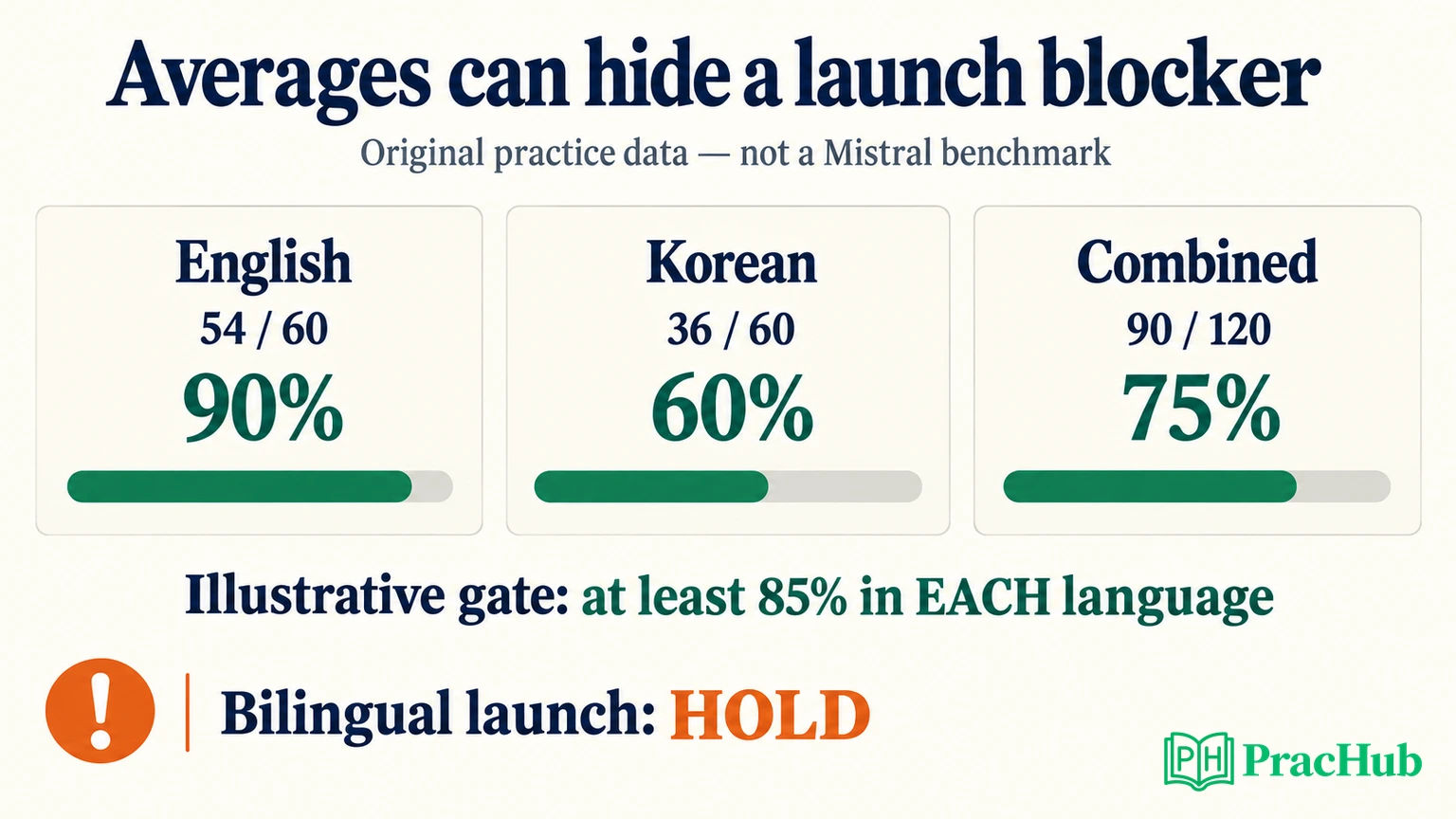
Now suppose the prototype produces these invented results:
| Evaluation slice | Correct and supported drafts |
|---|---|
| English | 54 of 60: 90% |
| Korean | 36 of 60: 60% |
| Combined | 90 of 120: 75% |
The combined score is arithmetically correct but insufficient for a bilingual release decision. It hides a 30-percentage-point language gap. If the customer had agreed to an illustrative minimum of 85% in each language, the prototype fails that quality gate. A combined target alone would leave the weaker user experience obscured.
These small samples demonstrate a decision method, not a reliable estimate of all future traffic. Before launch, expand coverage across real topics, document formats, language patterns, and customer usage. A paired translation set can isolate some language differences; naturally occurring questions can reveal different needs. Neither replaces the other.
Diagnose the gap before changing the model
Inspect the Korean failures by stage. Did ingestion preserve the relevant text? Did retrieval find the correct source? Was the source current? Did the answer preserve a product name, number, or procedural condition? Was the reference answer itself wrong? Record one primary failure cause and any contributing causes rather than labeling everything a hallucination.
Add separate tests for unanswerable questions, permission boundaries, and obsolete documents. Those are not part of the 120 answerable-question denominator above. Correct abstention needs its own denominator; otherwise a system that refuses everything can appear safe while doing no useful work.
If you use a model judge, compare its decisions with bilingual human review and inspect disagreements. A confident judge score is not independent proof of correctness. Preserve the rubric, model configuration, source snapshot, and outputs so the next experiment can be compared fairly.
Deployment: state the acceptance contract and the operating owner
Official product context: Mistral's AI Studio announcement describes tooling for building, evaluating, and operating AI, including hybrid and self-hosted deployment options. That establishes product direction, not a promise that every model, feature, or contractual arrangement supports every environment. Mistral AI Studio announcement
For the original customer case, write a provisional acceptance contract before proposing deployment. The following numbers are illustrative customer choices, not Mistral thresholds:
- At least 85% correct-and-supported drafts in each language on the agreed evaluation set, plus review of serious failure categories.
- No unauthorized-document disclosure observed in the permission test suite; any observed violation blocks rollout.
- A 95th-percentile completed-draft latency below four seconds under the agreed workload.
- A documented human fallback, rollback procedure, and named operational owner.
Passing a finite permission suite does not prove leakage is impossible. Explain how access checks operate in the application and how you will detect regressions. Likewise, the latency criterion needs a defined load, output length, timeout policy, and measurement window. A number without those conditions is not an operational contract.
Choose deployment boundaries from the customer's constraints. A managed service may reduce the infrastructure the customer must operate; a self-hosted option shifts capacity, updates, and incident response toward the operating team. Check the selected model's availability and terms, data handling, network access, and support requirements. “We need control” is an opening question, not a complete architecture.
The toy bilingual result does not justify a broad bilingual launch. You could propose an English-only, human-reviewed pilot only after its other gates pass and the customer agrees to that narrower scope. Label Korean support as unfinished rather than quietly leaving it enabled behind an encouraging aggregate score.
Handover: make the next failure diagnosable
Official documentation: Mistral's observability guidance describes tracing retrieval, ranking, context assembly, and generation, with attention to model or prompt versions, latency, token use, and errors. Observability integrations
For this exercise, decide which events reveal a failure without retaining unnecessary customer content. Track the request identifier, authorized source references, relevant versions, timing, and outcome category. Define who may inspect stored examples and how long those examples remain available. If review time rises while response latency stays stable, investigate answer usefulness rather than celebrating a fast endpoint.
Official documentation: Mistral's model lifecycle policy distinguishes version identifiers and recommends a specific major/minor identifier for precise control. Model lifecycle policy
Preparation recommendation: Treat a model or prompt update as a change requiring regression evidence. Record the old configuration, rerun language slices and permission cases, and make rollback possible. A deployment plan should explain who responds when the customer reports that yesterday's working answer is now wrong.
Explain the decision to three different stakeholders
Practice presenting the same evidence at different levels. To the support lead: “English drafts are promising, but Korean quality is below our agreed target, so bilingual release is not ready.” To an engineer: identify which pipeline stages account for the failures and the experiment that could distinguish retrieval from generation defects.
To a business sponsor, connect scope to the next decision: a constrained pilot can test whether review effort decreases, while the team investigates Korean failures. Do not promise a launch date based only on a model swap. Explain what evidence would change the recommendation and what work must happen first.
Use a real project story to show that you can handle disagreement. What did the customer initially request? What did you learn from their workflow? Which implementation choice changed, and what was your personal contribution? If the result was only a prototype, say so. A clearly bounded outcome is stronger evidence than an unsupported claim of production impact.
Five PracHub questions to rehearse the full workflow
These are topic-matched practice records, not a verified list of questions for the current Applied AI hiring loop. The set combines a Mistral API exercise with cross-company customer, evaluation, and deployment practice.
| PracHub question | Preparation focus |
|---|---|
| Build a Small Agent or RAG Tool with the Mistral API | Implement a narrow customer-facing slice and explain failure behavior. |
| Demonstrate Customer-Centric Judgment About AI | Compare the customer outcome with a non-AI baseline. |
| Build and Evaluate a Minimal Embedding-Based RAG Pipeline | Keep retrieval implementation and evaluation inspectable. |
| Evaluate a Retrieval-Augmented Generation System | Separate retrieval, supported answers, abstention, and permissions. |
| Review an inference API design for scale | Defend operating limits, versioning, and rollback. |
Return to the Mistral API exercise with a one-page customer brief and acceptance criteria. After implementing it, present one reason to proceed and one reason to hold deployment. That is a useful way to practice technical delivery alongside customer judgment.
Sources and Further Reading
- Mistral Applied AI Engineer, Seoul — official role and local language requirements; checked September 8, 2026.
- Mistral Applied AI, Forward Deployed Machine Learning Engineer — official US role context, not a universal interview sequence.
- Introducing Mistral AI Studio — official product announcement.
- Mistral observability integrations — official tracing guidance.
- Mistral model lifecycle policy — official version-control context.
Comments (0)