Mock Interview Pro Review: Company-Round Rehearsal and Feedback Boundaries
Quick Overview
Review Mock Interview Pro’s public role/company setup, voice/video offers and feedback claims, plus an original rubric for evaluating a quoted diagnosis. Dated public observations and original exercises distinguish official descriptions, tested behavior and unverified capabilities.
Mock Interview Pro presents company- and role-specific rehearsal with spoken follow-ups and feedback tied to an answer. We inspected its public setup flow through timing, role, company targeting and an optional job-posting step. We did not complete a personalized mock, so the homepage’s scores, testimonials and improvement claims remain provider presentation rather than observed coaching results.
Start with PracHub’s ownership-and-project deep dive and prepare one truthful decision you can explain under follow-up. A mock becomes useful when it exposes a missing fact or weak inference in that answer, rather than simply making it sound more polished.
Checked November 3, 2026: this review covers mockinterviewpro.com, not every service using the generic phrase “mock interview.” Official descriptions, public browser observations and our fictional feedback exercise are separated below. No account was created, media permission granted, payment made or private application material uploaded. PracHub publishes interview-preparation content and is the publisher of this review.
What the product says it rehearses
The official site describes practice tailored to a company, role and interview round. It presents voice and video options, follow-up questions based on an answer, story-building support and company research. Its feedback presentation emphasizes identifying a specific answer moment and one improvement to make next.
These features target a common gap: explaining a project decision when a follow-up challenges its rationale. Check whether the follow-up responds to the evidence and uncertainty in the answer.
The public demo used a marketing-role example, displayed voice and video entitlements and showed changing score graphics. Those are product demonstrations. We did not provide the displayed answer, receive that feedback or reproduce the score. A demo can explain the intended interaction without establishing its accuracy.
The site also displayed testimonials, rating claims and an improvement statistic. We did not independently verify their sampling, methodology or relationship to hiring outcomes. They do not substitute for a transcript-level assessment of a real practice session.
What the public setup flow established
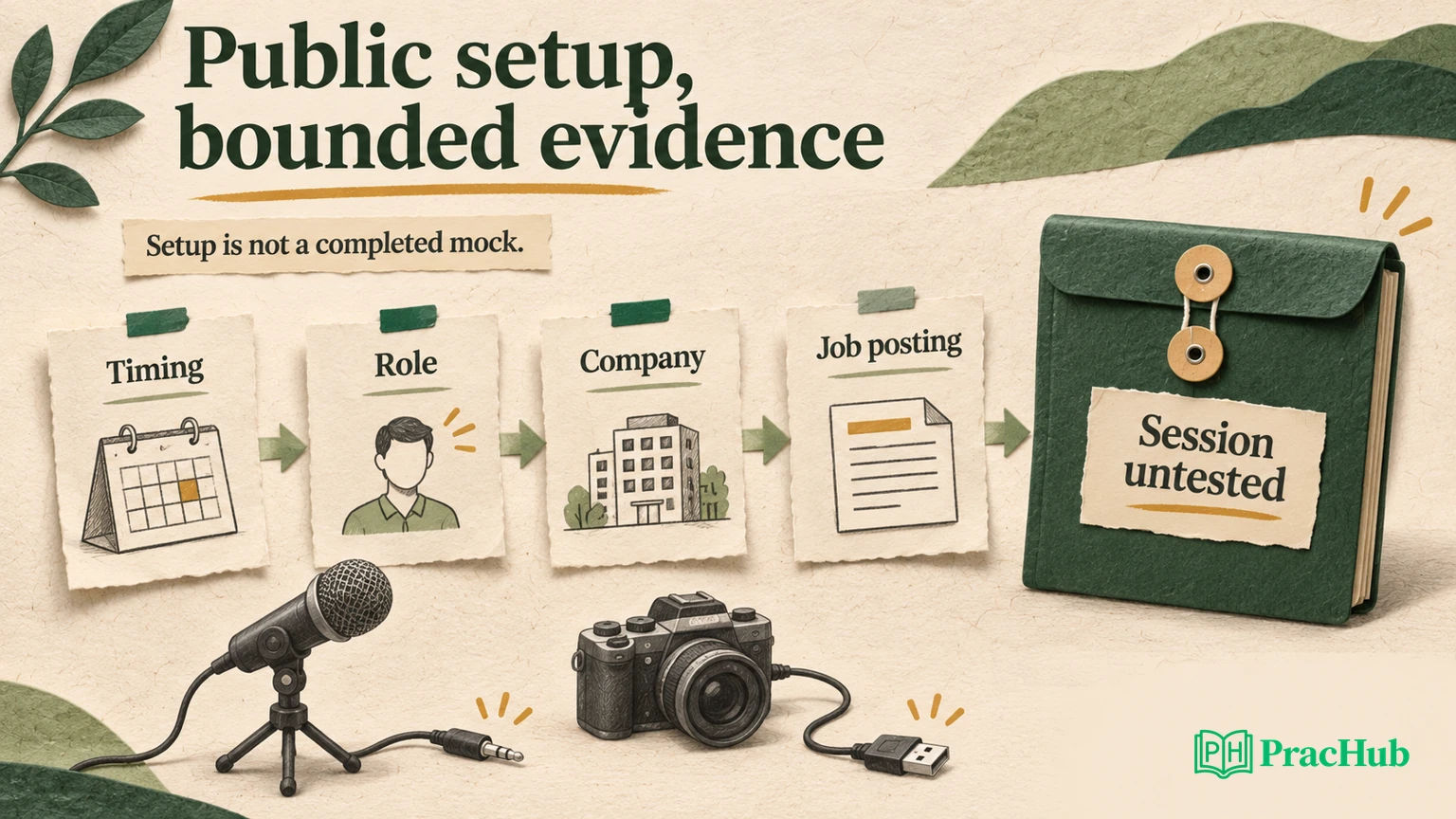
We opened “Set up my mock interview” and selected “No date yet” in a fictional review context. The role search returned several software-related choices; we selected Software Engineer.
The next stage asked where we were interviewing. We used the option for no specific company target. The flow then offered an optional job-posting field, which we skipped without entering a real posting. A later screen asked about years of Software Engineer experience. We stopped there.
This verified a public personalization sequence, not the quality of generated questions. We did not complete the remaining setup, reach an actual voice session or establish the exact later account or payment boundary. The page’s claim that adding a posting makes practice much closer to the real interview remains promotional language.
| Setup input | Public observation | What still needs a session check |
|---|---|---|
| Interview timing | No-date option available | How timing changes a practice plan |
| Target role | Software Engineer selectable | Technical relevance of resulting prompts |
| Target company | No-specific-company option available | Quality and freshness of company research |
| Job posting | Optional field could be skipped | Whether tailoring reflects actual requirements |
| Experience | Public experience question reached | Appropriate seniority and follow-up depth |
A setup form can collect relevant fields while still producing generic output. Evaluate personalization by the questions and debrief it generates, with the input context retained for comparison.
Voice and video entitlements are official descriptions
The homepage displayed a one-payment offer of$67 for 12 months, including unlimited voice practice,90 minutes of video, a Practice Pass and a Prep Kit. It also presented a$27 Practice Pass for focused single-answer practice. These were dated public offers, not purchases we completed.
The distinction between a full mock and single-answer practice matters. Rehearsing one answer can help with a specific story; a follow-up sequence tests whether the reasoning survives challenge. Read the actual selected plan carefully rather than assuming every feature named on a pricing page belongs to every offer.
We did not test quota enforcement, what consumes video minutes, cancellation behavior or the advertised refund process. Recheck the current offer and terms before payment. The presence of a guarantee is a provider commitment, not evidence that a refund request was successfully handled.
For a preparation decision, choose the missing loop first. If your main weakness is clarifying a technical trade-off, repeated isolated answers may be less useful than a conversation that changes the assumptions. If you need to shorten a truthful introduction, a single-answer drill may be enough.
A quote in feedback still needs a valid diagnosis
A debrief that quotes your answer is easier to inspect than a score with no supporting example. But the quote and the interpretation must both be correct. The following incident story is our fictional exercise, not a Mock Interview Pro transcript.
A deployment is followed by a rise in timeout errors. The candidate stops the rollout, compares versions and coordinates a rollback. Service behavior improves, while the precise root cause remains under investigation. The candidate can truthfully describe mitigation and evidence without claiming the comparison proved a single causal mechanism.
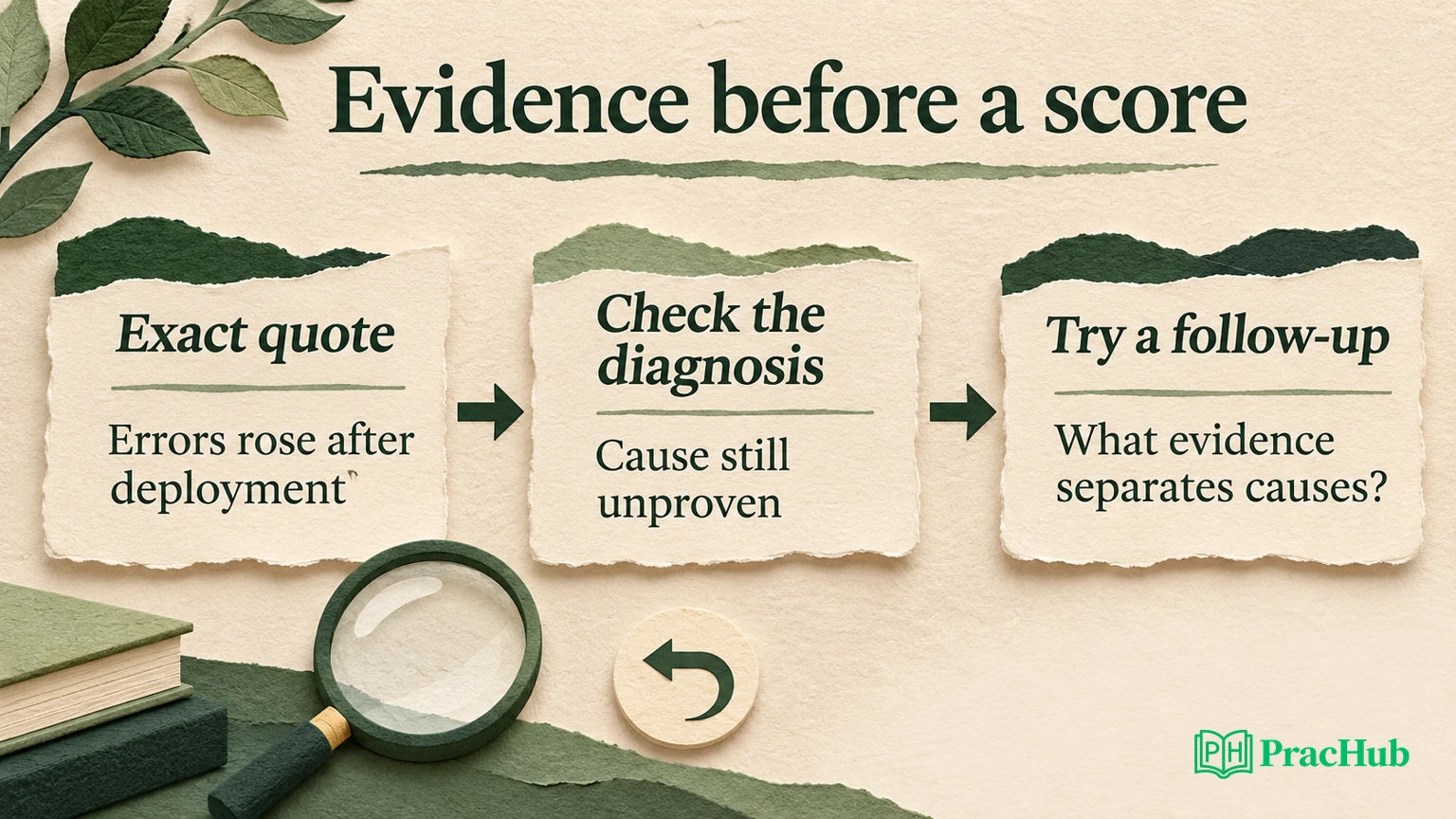
Now imagine feedback that quotes “errors rose after deployment” and recommends saying “I proved the new cache caused the outage.” The quotation may be accurate, but the proposed conclusion exceeds the evidence. More confidence would make the story less reliable.
A useful correction would instead ask what comparison was made, which alternative explanations remain and why rollback was justified despite incomplete diagnosis. That separates a sound operational decision from a completed root-cause investigation.
An original rubric for evaluating a debrief
Use four checks when reviewing feedback. First, verify that the quoted sentence matches what you actually said. Second, check whether the diagnosis follows from the prompt and available evidence. Third, look for a follow-up that changes a relevant condition. Fourth, identify a concrete action you can test in the next attempt.
| Rubric check | Useful evidence in our fictional incident | Warning sign |
|---|---|---|
| Quote fidelity | Exact mitigation or uncertainty statement | A paraphrase changes what you claimed |
| Diagnosis | Distinguishes correlation from root cause | Rewards an unsupported causal claim |
| Follow-up | Asks what happens if rollback fails | Repeats a question already answered |
| Next attempt | Add the comparison and remaining hypothesis | Generic advice to sound more confident |
This rubric is independently authored. We did not apply it to a completed vendor session and do not assign the product an invented score. It supplies a concrete standard for a later trial.
The rubric also helps distinguish a weak answer from a weak prompt. If the question supplies no scale, deadline or ownership context, a good candidate may need to clarify before giving a detailed design. Feedback should not penalize reasonable clarification merely because it interrupts a preferred script.
Follow-ups should test ownership and changed information
For the fictional incident, ask who authorized the rollback, what the candidate personally did and which evidence changed the team’s view. The answer should distinguish individual contribution from a team outcome without minimizing collaboration.
Then change the situation. Suppose rollback is unavailable because a schema migration is incompatible. What containment option remains? Suppose only one customer segment is affected. What comparison would distinguish a rollout effect from a traffic-pattern change? These follow-ups reveal decision-making under constraints.
A company name alone does not make such a question company-specific. Useful tailoring should connect the role’s responsibilities and interview format to the depth of the challenge. A senior engineer may need to discuss coordination and risk; an early-career candidate may focus on the investigation they personally performed.
Keep hypothetical answers labeled as hypothetical. If you have never led an outage response, do not turn the fictional incident into a career story. Use a real project decision for behavioral practice and a clearly framed scenario for technical reasoning.
Spoken fluency and answer quality can move separately
Repeated voice practice can make an answer smoother. That is useful when pauses or an unclear structure prevent the listener from following the facts. It does not automatically make the facts stronger.
For our incident, a concise structure might be: observed symptom, immediate risk, personal action, evidence after the action and unresolved cause. You can improve the sequence without adding an unsupported recovery-time metric or claiming sole ownership of the result.
A second attempt should test whether the explanation remains accurate under interruption. If asked why the rollback was chosen, connect the reversible action to the observed risk. If asked for proof of root cause, state the remaining uncertainty. The ability to preserve those distinctions is more valuable than reciting a polished paragraph uninterrupted.
We did not assess Mock Interview Pro’s speech recognition, interruptions, latency or memory across questions. Those remain session-level evaluation needs. A future review should retain the actual prompt, answer and debrief rather than reporting only an overall score.
How to assess company research without inventing a process
The product advertises company-oriented preparation. Before relying on a generated process summary, compare it with current official hiring information and your actual invitation. Interview formats can differ by team, role, location and cycle.
If a generated question is a plausible technical scenario, it can still be useful practice even when its company attribution is uncertain. Label it as a rehearsal scenario. Do not turn a plausible prompt into a claim that the employer asks it or uses a particular scoring rubric.
Candidate reports require the same care. Preserve their dates and role context, and avoid counting copied accounts as independent evidence. We did not gather an official-plus-independent-report evidence floor for any company process in this product review.
A useful company-research feature should make it easier to inspect where a claim came from. Without traceable sources, treat the summary as a starting hypothesis and verify consequential details before organizing your preparation around it.
A bounded trial should leave an evidence packet
Before a future session, prepare one real project story and one specific weakness to test. For example, you may know the implementation detail but struggle to explain why the team rejected an alternative. Keep the facts and any real metrics in your own notes.
During the trial, retain the prompt, your actual answer and the resulting feedback. Choose one suggested improvement and verify that it preserves the facts. Then answer a changed follow-up without copying the previous phrasing.
The useful outcome is a clearer, defensible answer or a newly identified gap. A higher score can be supporting tracking information, but it does not independently establish readiness or predict an offer. Compare the substance of the two attempts.
The public setup we observed is enough to assess the intended personalization inputs. Purchase value and coaching quality remain unresolved until a completed session demonstrates that those inputs lead to relevant questions and accurate, actionable feedback.
Five PracHub questions for a fresh rehearsal
These verified prompts develop ownership, mistakes and follow-up depth. They are independent of Mock Interview Pro and do not imply product integration or a guaranteed company question set.
| PracHub question | Focused follow-up |
|---|---|
| Behavioral: ownership, team play, and a deep dive on a project you led | Keep personal ownership, team action and technical depth distinct. |
| Ownership Behavioral: Recovering From a Technical Call of Yours That Went Wrong | Explain a mistaken decision without inventing a cleaner outcome. |
| Behavioral Stories on Ownership, Ambiguity, Deep Dives and Conflict | Answer changed assumptions while preserving the original story facts. |
| Prepare Behavioral Stories for Stakeholders, Mistakes, and Ownership | Support stakeholder and mistake claims with concrete evidence. |
| Answer Backend Behavioral Questions with Follow-up Depth | Practice follow-ups that expose an omitted constraint in a backend story. |
Mock Interview Pro offers a clear public concept for targeted rehearsal, with actual session behavior still unverified in this review. Finish with the project-ownership deep dive, preserve your facts and ask a changed follow-up. Use the same evidence standard when deciding whether an automated debrief improves the answer.
Comments (0)