MongoDB Technical Support Engineer Interview: Troubleshooting and Customer Communication
Quick Overview
Prepare for MongoDB technical support interviews with an original Atlas connection incident, evidence-driven diagnosis, and separate internal and customer updates.
A MongoDB Technical Support Engineer interview is worth preparing for as a conversation about evidence: what the customer cannot do, which layer is failing, and what you would check next. Practice explaining a connection failure without jumping from “the application timed out” to “the database is down.” Your customer response should be as precise as your technical reasoning.
This guide develops one original support ticket from first contact through recovery checks. For adjacent database knowledge, use PracHub's MongoDB backend interview questions guide, then practice translating a diagnosis into a clear next action.
Evidence boundary: Current official role information supports the skills discussed here. Public candidate material reviewed does not establish a universal TSE interview sequence. The ticket, observations, and responses below are fictional preparation exercises, not MongoDB hiring materials or actual customer logs.
What the MongoDB TSE evidence actually supports
Official role evidence: MongoDB's Palo Alto Technical Services Engineer posting describes Linux troubleshooting, networking fundamentals including DNS and TLS, security concepts, basic scripting, and clear, empathetic communication. These are role requirements, not a list of guaranteed interview questions. Match your preparation to your own requisition because specialization and seniority can differ. MongoDB TSE role
Historical official context: Alex Bevilacqua's employee profile describes reproducing customer issues, analyzing diagnostics, and sometimes building tools to test a hypothesis. It was originally published in 2020 and later updated; its account is useful context, not a current hiring policy. Do not turn an older comment about programming expectations into a promise that your interview excludes code. Technical services profile
Candidate material: A recent public TSE discussion asks whether Linux, networking, scripting, and live troubleshooting appear. Asking those questions does not establish that any of them were actually assessed. Two independent, same-cycle completed-interview accounts were not established in this review, so this article does not prescribe round counts, timers, or passing standards. Candidate preparation discussion
The practical recommendation is narrower: rehearse a support case in which each diagnostic action has a reason, an expected observation, and a follow-up decision. Confirm the actual interview format and permitted tools from your invitation.
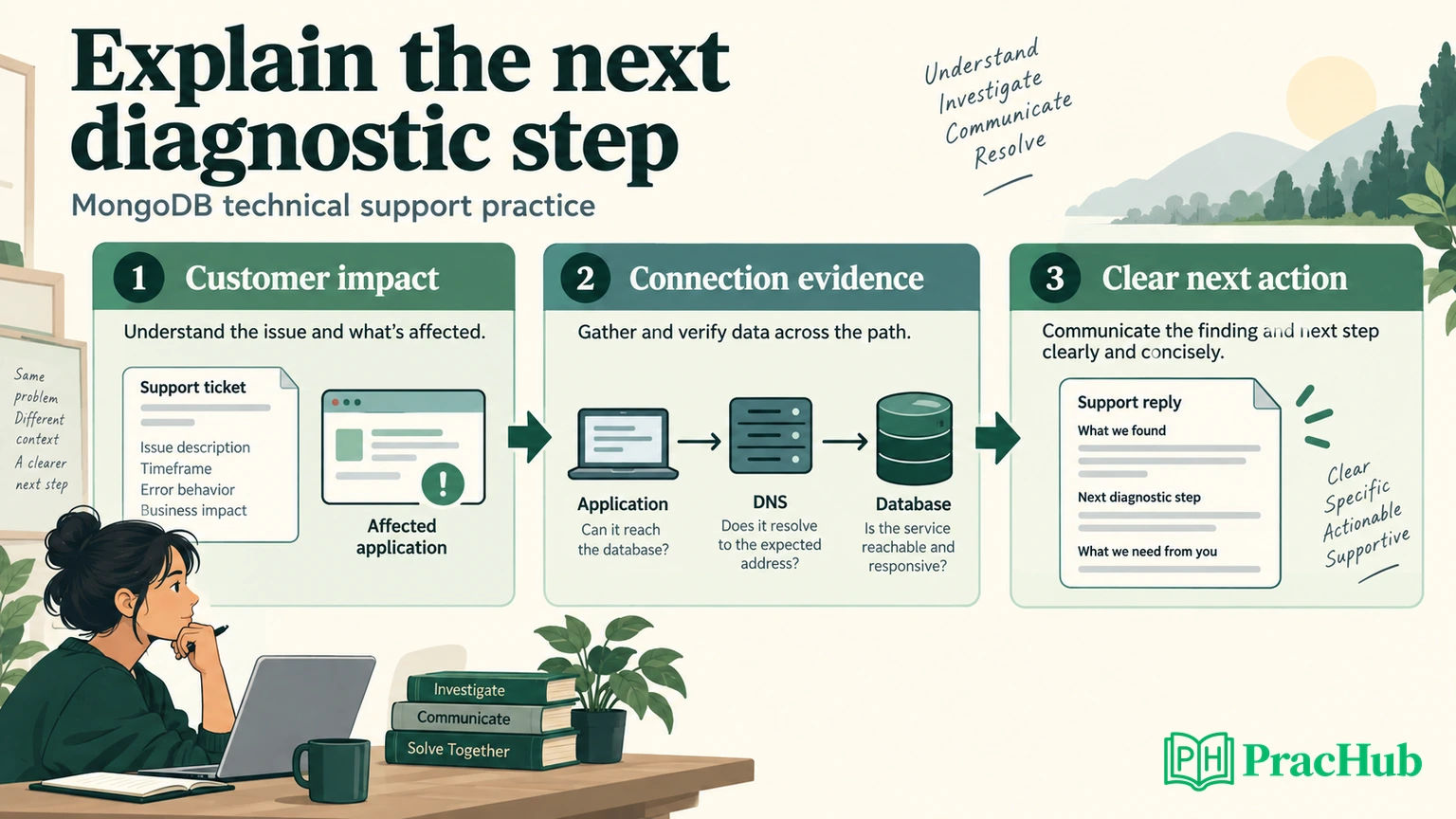
Start with the customer impact, not a command list
Original ticket: “After this morning's application deployment, new workers cannot connect to our Atlas database. Older workers still serve requests. We think MongoDB is unavailable. Can you restart it?”
Your first response should establish the affected service, deployment time with timezone, observed errors, and whether reads, writes, or both are failing. Ask whether failures affect every worker or only a new image, region, or network path. The distinction between existing connections and fresh connections is especially useful here.
Request the driver and runtime versions, the exact error class with secrets removed, and relevant connection options. A redacted URI must preserve diagnostic structure: scheme, database path, and option names can matter even when credentials and sensitive hostnames are omitted.
Do not ask the customer to paste passwords, private keys, or an unrestricted production data dump. Request the smallest artifact that can distinguish the leading hypotheses. A request for “all logs” shifts your investigation burden onto the customer and often produces too much irrelevant material.
In this exercise, old workers succeeding narrows the scope but does not prove the cluster is completely healthy. Their existing connections may avoid a discovery step that new workers must perform. State that distinction before you recommend any change.
Separate the connection layers in your explanation
A MongoDB connection involves several distinguishable concerns: discovering server addresses, reaching the endpoints, establishing any required TLS session, authenticating, and finding a server suitable for an operation. A failure reported at the application boundary may summarize an earlier problem. Read the nested cause and driver context before naming a root cause.
Official documentation: MongoDB supports SRV connection strings beginning with mongodb+srv:// and standard strings beginning with mongodb://. SRV discovery and individual node-name resolution are separate checks in the Atlas troubleshooting procedure. A successful lookup of one ordinary hostname is not sufficient evidence that SRV discovery works. Connection strings, Atlas connection troubleshooting
For an interview, describe the result you need before naming the tool: “From the failing worker's network context, I want to know whether the configured resolver returns the cluster's SRV targets.” Testing from your laptop alone does not establish what the deployed worker can reach.
If DNS succeeds, examine reachability to the returned hosts and ports. A successful TCP connection does not establish valid TLS or successful database authentication. Likewise, a blocked ICMP ping does not by itself prove that the database's TCP endpoint is unreachable.
Work through the ticket as evidence arrives
The following observations are synthetic notes, deliberately simplified rather than presented as verbatim driver output. The cluster uses a public Atlas connection path in this exercise; a private endpoint would require its own DNS and routing analysis.
| Observation in the exercise | What it supports | What remains unknown |
|---|---|---|
| New workers fail; existing workers serve requests | Investigate differences in fresh connection setup | Whether every cluster member is healthy |
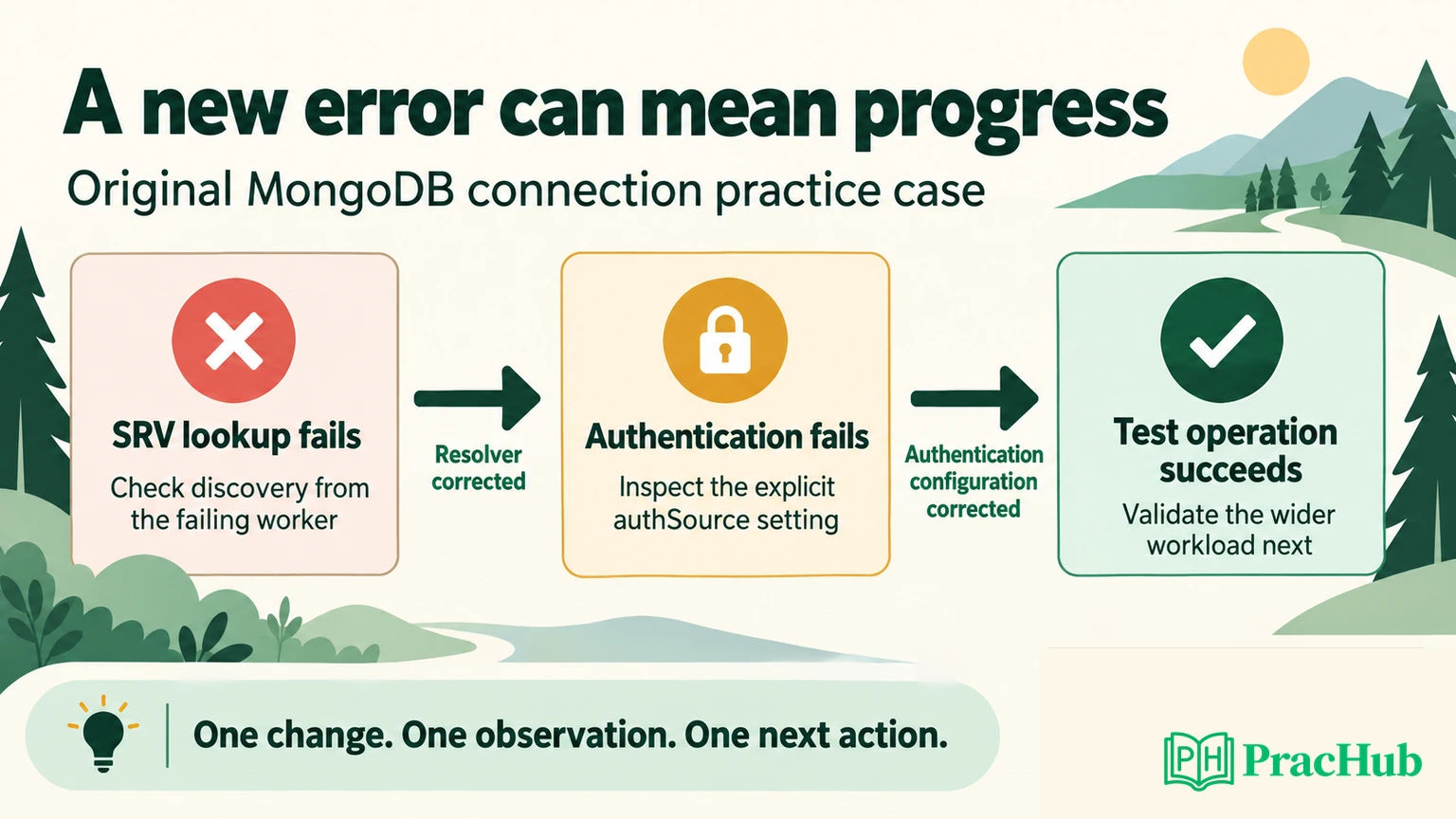
| SRV lookup fails from the new worker | Discovery is a current blocker | TLS, authentication, and operation success |
| Approved resolver configuration restores SRV answers | The discovery blocker has been removed | Whether later connection steps succeed |
| The fresh connection now reports authentication failure | Investigation has progressed beyond the original discovery symptom | Credential correctness and authentication database |
| Corrected authentication configuration allows a representative operation | That operation succeeds in the tested context | Full workload recovery and remaining failures |
Do not announce two unrelated incidents merely because the visible error changed. Removing the first blocker can reveal a second configuration defect. Conversely, do not claim that DNS caused the authentication failure; those are separate findings in the same deployment investigation.
To make the exercise concrete, assume the new image introduced an incorrect resolver setting and explicitly set authSource=appdb, while the relevant database user authenticates against admin. Treat both as facts supplied by the fictional case, not defaults you can infer from any customer's URI.
Your proposed sequence is to verify the resolver difference, apply the approved correction in a controlled test, and then inspect the new error. Only after observing the authentication failure do you test the authentication-source hypothesis. This preserves the causal explanation of each change.
Read the URI without guessing its authentication meaning
Official option behavior: MongoDB documents authSource as the database associated with a user's credentials. When it is omitted, defaults depend on the other connection-string fields. Do not assume that the application database named in the path is necessarily the authentication database. TLS is enabled by default with the SRV connection format. Connection string options
In the original ticket, the explicit authSource=appdb is a testable configuration difference because the exercise tells you where the user authenticates. In a real investigation, verify the database user and authentication mechanism before changing this value.
Also distinguish an Atlas account used to access the website from the database user used by the application. If authentication fails, inspect the intended user, target cluster, mechanism, and any URI encoding issue rather than repeatedly resetting a password without evidence. MongoDB's troubleshooting page addresses these as separate checks.
Keep TLS validation enabled while investigating certificate failures. Diagnose trust configuration, hostname matching, and the relevant client environment. A connection that works only after disabling certificate verification is evidence of an unresolved validation problem, not a satisfactory production repair.
Reproduce one hypothesis with a useful comparison
For this preparation exercise, create a comparison record for the old and new worker: image identifier, driver version, resolver configuration, connection options, and observed failure. Mark which fields are measured and which are still assumptions.
The strongest comparison changes one relevant factor while preserving the others. If you simultaneously replace the driver, change the URI, alter network policy, and restart the service, success will not tell you which change mattered. You also make rollback harder to explain.
Where a test requires access you do not have, say what an authorized operator should collect and how you will interpret it. That is more credible than inventing command output. The supplied observations in this article are reasoning inputs; they are not a claim that we reproduced an Atlas outage.
Define success before testing. For the DNS correction, success means the failing context can resolve the required discovery records. For the complete repair, success includes a new connection and a representative application operation with the intended user. Neither a green status page nor a successful port check substitutes for that final operation.
Write an internal handoff another engineer can use
An internal handoff should preserve enough detail for a colleague to continue without restarting the investigation. Include the customer impact, timeline, affected environment, observations, changes already tested, and the next unresolved question.
Original internal summary: “New-image workers fail during fresh Atlas connection setup; old workers continue serving. Initial observation was failed SRV resolution from the new worker context. A controlled correction to the resolver configuration restored discovery. The next connection attempt exposed authentication failure. The new deployment explicitly selected appdb as authSource; the test user authenticates against admin. Correcting that setting allowed the agreed representative operation. Workload-wide validation remains pending.”
Attach the sanitized comparison and timestamps rather than a long transcript of every attempted command. Record who owns the next validation and what will trigger escalation. Avoid writing “fixed” while the customer's actual workload still fails.
If the next test contradicts your hypothesis, preserve that result too. A useful handoff explains why an attractive explanation was rejected; otherwise the next engineer may spend another hour repeating it.
Give the customer a shorter, actionable update
A customer reply needs the impact, the confirmed finding, the next action, and the remaining uncertainty. It does not need every internal implementation detail. Avoid blaming the deployment team or promising a recovery time that the evidence cannot support.
Original customer update: “We isolated a connection-discovery problem affecting the new workers and verified a resolver correction in the test environment. That allowed us to identify a separate authentication configuration mismatch. With both corrections, the agreed test operation succeeds. Please validate the new configuration on the selected worker group and confirm application error rate and read/write behavior. We will review those results before treating the incident as resolved.”
If you have committed to a follow-up time, include it and keep it. If another team owns a network change, identify the dependency plainly rather than describing the case as merely “waiting.” The customer should know what happens next without translating your technical notes.
To practice, explain why you omitted raw credentials, detailed topology, and speculative causes from this reply. Concision is useful when it preserves the decision the customer needs to make.
Five questions for troubleshooting and communication practice
These PracHub records develop related skills across employers. They are not a dedicated MongoDB TSE assessment bank or predictions of your interview.
| PracHub question | Practice action |
|---|---|
| Resolve a Customer Problem | Explain impact, ownership, and a useful response. |
| Troubleshoot a Host That Rejects SSH Connections | Separate reachability from later connection failures. |
| Troubleshoot a production server outage | Prioritize evidence and recovery checks. |
| Troubleshoot CPU, latency, and DNS issues | State what each observation can and cannot establish. |
| Teach a networking concept to a beginner | Adapt an explanation to the listener's knowledge. |
Return to the customer-problem exercise and write two versions of your answer: an internal handoff and a customer update. Check that both preserve the same facts while serving different readers.
Sources and Further Reading
- MongoDB: Technical Services Engineer, Palo Alto — current role context, not a fixed interview syllabus.
- MongoDB: Technical Services Engineering profile — historical engineering and customer-support context.
- MongoDB: Troubleshoot Connection Issues — Atlas discovery, connectivity, and authentication checks.
- MongoDB: Connection Strings — standard and SRV formats.
- MongoDB: Connection String Options — TLS and authentication options.
- Candidate TSE preparation discussion — a request for information, not verified assessment coverage.
Research checked September 9, 2026. Follow your own job posting and interview invitation for role-specific requirements.
Comments (0)