Mshiku Review: Company Interview Reports, Source Links, and Question Rankings
Quick Overview
Review Mshiku company reports with two source/date samples, role-tag gaps and ranking counts that need normalization before they become preparation evidence. Dated public observations and original exercises distinguish official descriptions, tested behavior and unverified capabilities.
Mshiku, or 面试库, is useful for finding reported interview topics, but a report’s source label, collection date and interview cycle need separate reading. In our public sample, a newly listed Shopee page explicitly concerned the 2022 graduate recruitment cycle. The detail pages we inspected named a source platform but exposed no clickable original-report URL. That limits what we can verify about provenance and current relevance.
Use PracHub’s processes-and-threads question to turn a frequent topic into an explanation you can defend. Recognizing a familiar title in a ranking is only the starting point; you still need to explain memory boundaries and what changes under a concrete workload.
Checked November 3, 2026: this review covers mshiku.com and its public report and question-index pages. Catalog counts are provider displays. Individual interview accounts remain aggregator-attributed reports, not independently confirmed employer policy. Our normalization examples are original teaching models. PracHub publishes interview-preparation content and is the publisher of this review.
What Mshiku helps you discover
The native site presented company, report and question totals, alongside company and question navigation. These counts describe the indexed collection as displayed during our visit. We did not audit whether every item was unique, accurately categorized or traceable to an independent author.
For a candidate, the practical benefit is discovering concrete topics within a role context. A report can connect an algorithm prompt with a project discussion or systems follow-up. That context can help you choose what to rehearse next, provided you keep the role, stage and date attached.
An aggregator may normalize, summarize or reformat an account. A source-platform name identifies where the material is said to come from; it does not establish that the original wording, date or author is available for inspection. A polished reference answer can also be a separate editorial layer.
Our review therefore used two public report details and the question ranking. We did not register, submit a report, test paid functionality or validate a company’s current hiring process. The goal was to establish how much source and practice evidence a public reader could actually obtain.
Sample one: role in the title, missing structured role
The first inspected report was titled “快手 · 推荐系统后台开发 一面(实习),” describing a Kuaishou recommendation-system backend internship first round. Its source label read 知乎-20261104, while the displayed publication time was November 3,2026 at 09:22. Its body referred to an interview on 3.6 without a verified year in the material we inspected.
The topics included C++ smart pointers, read-write locks, gRPC/Protobuf and reversing linked-list nodes in groups. Those are reported topics within that account. They do not establish a mandatory Kuaishou interview sequence or predict which language and questions another team will use.
The detail page also said that no specific position had been tagged, despite the role information in its title. This creates a practical search limitation: a role filter based on structured metadata may not capture every relevant title. It does not prove that all role filters fail; it identifies a mismatch in this sample.
We inspected the visible links. An external regulatory registration link was present, but no clickable original Zhihu report URL appeared. We therefore could not compare the indexed content with the original author’s account through that page. The source label’s future-looking date string also should not be silently substituted for the interview date.
Sample two: a recent listing can describe an old cycle
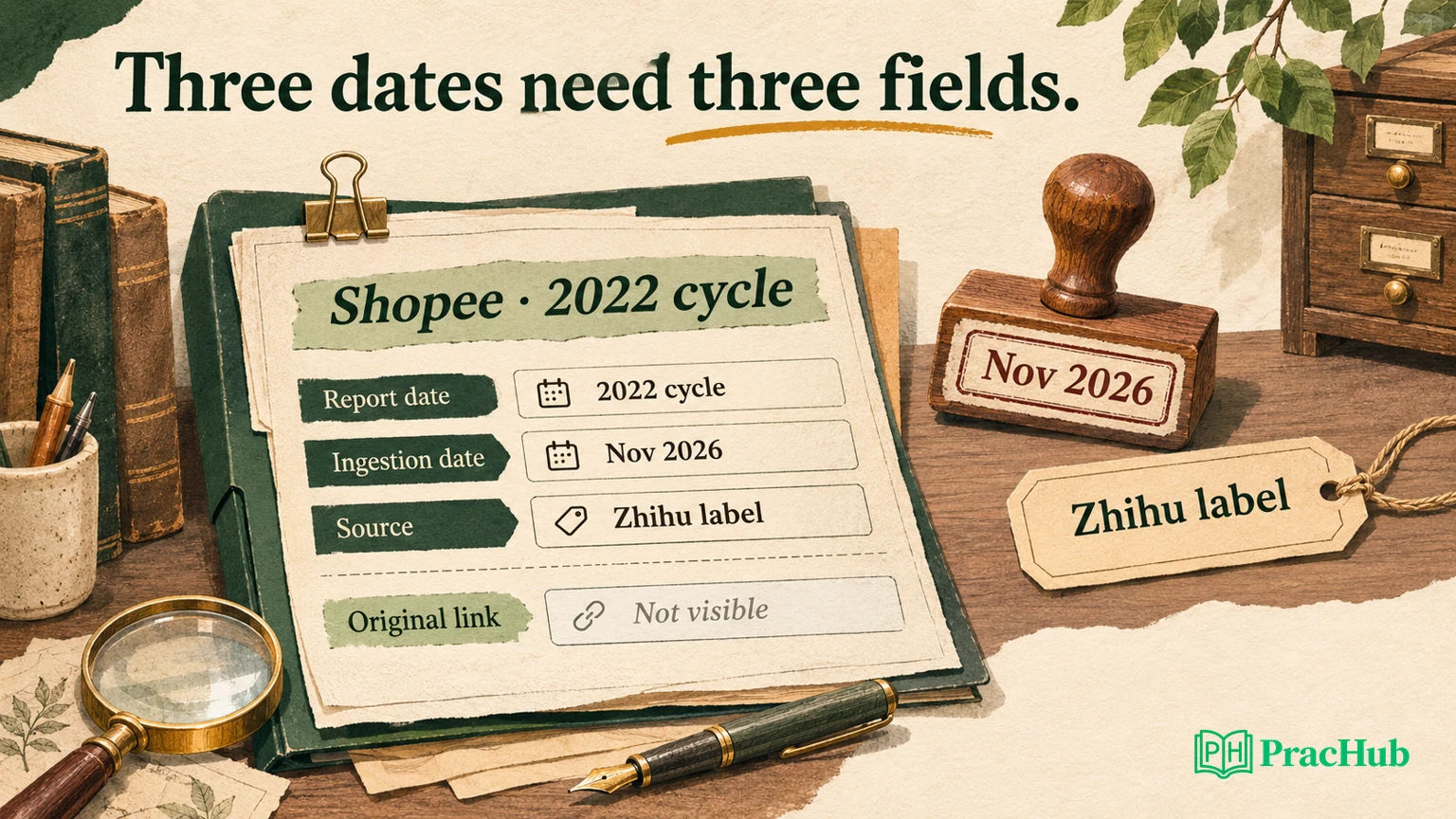
The second report was titled “Shopee · 产品经理 一面/二面(2022秋招提前批,深圳).” The title explicitly dated its recruitment context to 2022. It appeared with the same source-label pattern and a 2026 publication display during our visit.
This date separation changes how a candidate should read the report. A new collection or publication date can mean an older account has been indexed recently. It does not make the underlying interview current. A candidate researching a 2026 or later opportunity should preserve 2022 as the report’s cycle rather than presenting the page as recent process evidence.
| Field | Kuaishou sample | Shopee sample | What it establishes |
|---|---|---|---|
| Title context | Backend internship, first round | Product manager, first/second rounds | Claimed role and stage in the indexed title |
| Interview timing | Body says 3.6; year unverified | Title explicitly says 2022 cycle | Different levels of date certainty |
| Publication display | November 3,2026 | 2026 listing context | Collection/publication information |
| Source label | Zhihu label | Zhihu label | Attributed platform, without original URL |
| Structured role | No specific role tagged | No specific role tagged | A sample metadata limitation |
Historical material can still be useful. A product scenario can train requirement clarification even when the hiring cycle is old. The preparation value comes from the decision the exercise teaches; the process claim remains historical and attributed.
What the question ranking actually displays
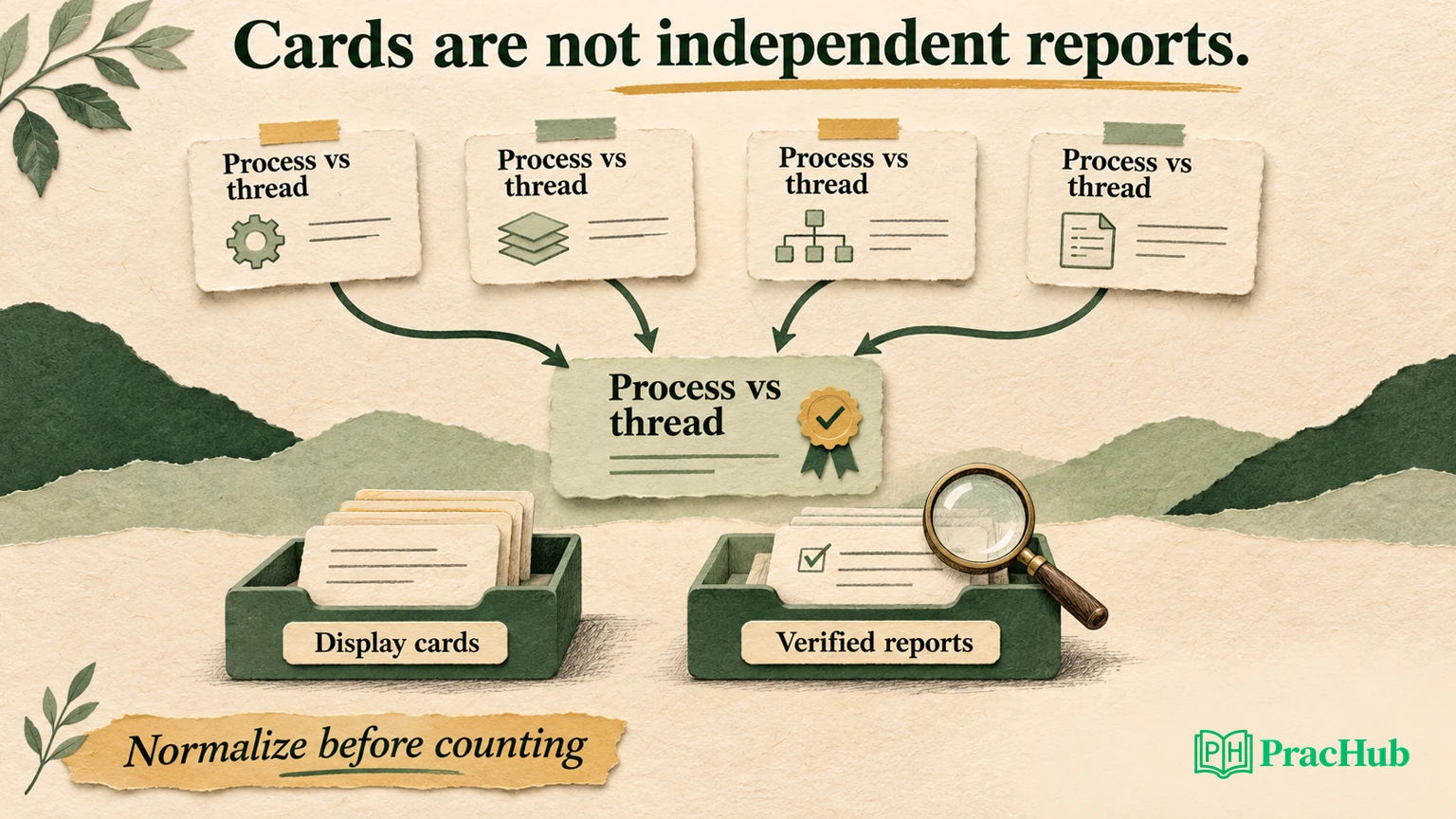
The public question page described a ranking order based on the number of companies first, then the number of times asked. We observed repeated cards titled “进程和线程的区别,” with 14-company and 14-occurrence badges and different company-associated answer text.
This makes the counting unit important. Several displayed cards can refer to one canonical topic. Repeated display of the same badge does not justify multiplying the figures to estimate independent interviews. Nor does a company label establish that every associated report has been independently verified.
The cards included internal “出处面经” entrances. An internal link to an indexed report can improve navigation, but it is different from a link to an external original author. Follow both layers when available and record which one you actually reached.
We did not reproduce the ranking from an underlying dataset or establish how duplicates are resolved internally. Our observation concerns the visible presentation and its stated sort order. Any claim about Mshiku’s exact ingestion or deduplication algorithm would go beyond that evidence.
A small normalization model prevents inflated confidence
Consider our original four-card example. Two cards repeat the same process-versus-thread topic from sourceA. A third uses the same topic from sourceB. A fourth concerns thread safety but has no identifiable source. This model is synthetic and unrelated to Mshiku’s 14-company badge.
You have four displayed cards, two canonical topics and two identified sources. You do not have four independent reports supporting one topic. The unidentified card may still contain a useful prompt, but its provenance remains unresolved.
| Object you count | Question it answers | Common reading error |
|---|---|---|
| Displayed card | How many entries are on this screen? | Treating repeated cards as new evidence |
| Canonical topic | How many different concepts appear? | Merging related but distinct questions |
| Original account | How many independent reports can be traced? | Counting copies as independent authors |
| Company-role-stage context | Where was a topic reportedly discussed? | Generalizing one account across all teams |
Normalization also needs judgment. “Processes versus threads” and “Python multiprocessing versus async I/O” overlap but do not have identical answer contracts. Keep a broad topic tag for discovery while preserving the exact prompt for practice. Otherwise, a high-level ranking can hide the follow-up you actually need to prepare.
Use frequency as one input alongside role fit, recency and your own weakness. A common topic you can already explain may deserve less practice time than a less frequent systems question that repeatedly exposes a gap.
Turn a reported topic into an original rehearsal
Take the processes-and-threads topic and create a fictional image-processing service. It accepts independent images, performs CPU-heavy transformations and returns results. Ask what memory is shared between workers and how failures should be isolated.
A useful answer first names the runtime and workload. Python threads, separate processes and asynchronous I/O have different trade-offs; saying “threads are lighter” does not decide the architecture. CPU work, blocking libraries, serialization cost and shared-state requirements all matter.
Then change one condition: the transformation library releases the GIL, or image objects are expensive to serialize, or one malformed input can crash a native extension. Explain which previous argument changes. These are our preparation variations, not claims that Mshiku or a named company asked them.
Record an invariant, such as one input yielding one attributable result or failure. Add a reproducible example with two jobs and a worker failure. This turns a remembered definition into evidence of reasoning. You can use a reported topic to choose the starting point without pretending the report guarantees your interview format.
A practical source-reading sequence
When opening a report, copy the title context, claimed interview date, collection date and source identity into separate fields. If a date is missing, write “unverified” rather than inferring it from a page timestamp. Preserve internship versus graduate versus experienced-hire context.
Next, identify whether the page is a firsthand account, a rewritten summary or a collection of accounts. Look for an original URL and compare it when available. If the public page offers only a platform label, keep that limitation beside any process statement you repeat.
Finally, separate the reported question from an answer you plan to study. A reference explanation should be checked against technical documentation or a small independent example. Its usefulness does not depend on the original candidate having given that answer, and the page should not be cited as proof that they did.
This reading sequence also helps you avoid unnecessary copying. Keep a short topic note and your own solved artifact instead of reproducing a candidate’s personal details or long interview narrative. You need the engineering question and its context, not an unsupported biography or outcome claim.
One compact source note could read: “Shopee product-manager report; title says2022 recruitment; indexed in2026; original URL unavailable in the inspected detail.” Keep that note attached when you share the practice theme. If a later original source supplies a different date or role, update the note rather than quietly treating the old inference as confirmed.
For ranking research, record the exact card title and the underlying report entrance separately. Two cards with different answer paragraphs can still represent one topic. Conversely, two prompts that share a keyword can require different demonstrations. This preserves useful detail without claiming access to Mshiku’s internal counting rules.
Five PracHub questions for deeper systems answers
These verified destinations supply independent process, thread and runtime follow-ups. They are not a Mshiku export or evidence of the current Kuaishou or Shopee process.
| PracHub question | Focused follow-up |
|---|---|
| Explain OS processes, threads, and memory | Connect memory ownership and isolation with a concrete workload. |
| Threads vs Processes, the Python GIL, Multiprocessing and Async I/O | State Python runtime assumptions before comparing CPU work with I/O waiting. |
| Threads vs Processes, Concurrency vs Parallelism, and Multicore Multithreading | Separate concurrency, parallelism and the unit of scheduling. |
| Explain process vs thread and memory-sharing risks | Demonstrate a shared-state failure rather than reciting a definition. |
| Compare processes and threads in Linux and Python | Explain when serialization or native-library behavior changes the trade-off. |
Mshiku can help you discover what to practice, especially when you preserve the report’s role and time context. Finish with the processes-and-memory prompt, choose a concrete workload and defend the trade-off. Keep source traceability and practice quality as separate criteria when deciding how much confidence to place in the index.
Comments (0)