Neuraprep Review: ML Coding, Written Questions, and Reference-Based Feedback
Quick Overview
Review NeuraPrep’s reference-informed written feedback, coding and quiz distinctions, and current credit units. One public noisy-data demo and an original imbalanced-classification rubric separate concept coverage from supported technical decisions.
NeuraPrep is relevant if you want written ML answers, coding exercises and quizzes within one preparation product. Its no-account demo returned specific concept feedback for our deliberately incomplete answer. The returned feedback identified omissions while leaving an overbroad preprocessing recommendation unchallenged. Use reference-based feedback to locate omissions, then independently check the proposed action and the decision your answer supports.
PracHub publishes this review and owns the complementary practice links. Our classification-metric mismatch question provides another explanation task. The synthetic metrics case and independent rubric below are original work, separate from NeuraPrep’s score, reference answer or coding judge.
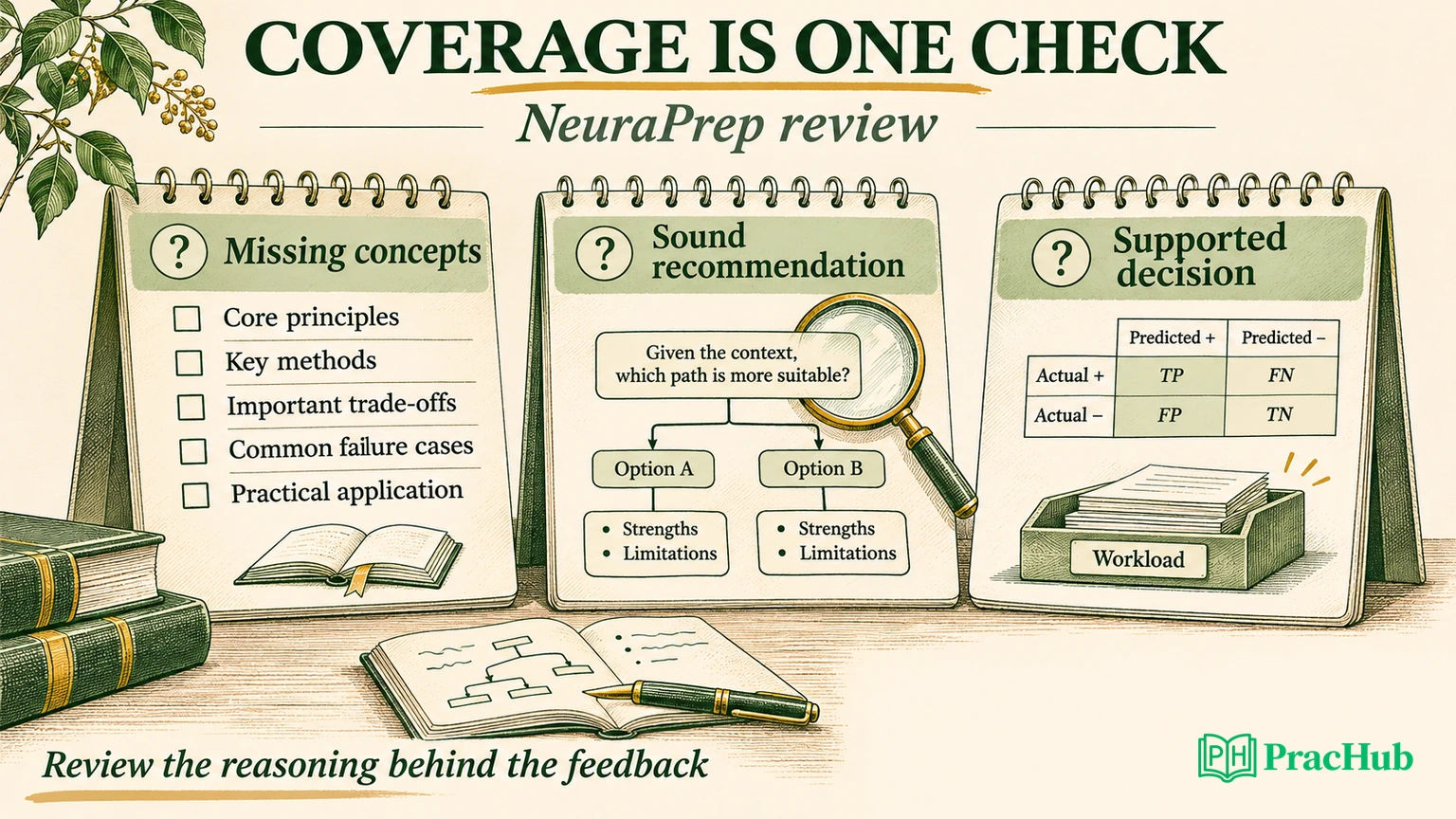
The product uses different evaluation methods
Provider description, checked November 3, 2026: NeuraPrep offers written ML and data-science practice, coding, quizzes and system design. It advertises more than four hundred practice items; we did not count or audit the collection.
Its FAQ distinguishes problem-specific coding tests, quiz answer keys and AI feedback for written responses against references and core concepts. Check each result against its stated evaluation method. Passing code tests does not establish that a written explanation is complete, and matching concepts does not prove that every recommendation in the explanation is sound.
The provider also limits company attribution: an item needs supporting provenance before being treated as a verified employer question. We did not establish such provenance for the sampled demo. No independent candidate reports or hiring outcomes support this product review.
Our scope covers public pages and one unsigned written-answer submission. We did not create an account, buy a plan, test code execution or complete a quiz, multi-turn assessment or Voice interview.
The demo loaded and returned a specific result
Direct observation: the public demo initially displayed a loading indicator. It later rendered a question about challenges in training with noisy data. The early indicator was transient, so it would be inaccurate to report that the demo never loaded.
We submitted this original, deliberately incomplete response: “Noisy data lowers accuracy, so I would delete outliers before training.” The demo marked it Not Accepted and credited two of four core ideas. Its reasoning identified generalization and interpretation as missing, while recognizing an accuracy concern and preprocessing.
This single response establishes what the demo returned in this attempt. We used one question and one answer, with no repeated trials or calibrated human comparison. The demo’s result does not establish how a paid assessment, another question or a later model version would behave.
The main application and coding routes showed login screens in our unsigned check. We did not use an existing identity or register to extend access. A working written demo therefore should not be expanded into a claim that we tested the coding environment or full item library.
Concept coverage and recommendation quality are separate
Our editorial concern is specific: the demo feedback recognized preprocessing in the submitted sentence but did not qualify its blanket proposal to delete outliers. The question asked about noisy-data challenges; a broad action statement can still deserve scrutiny even when it mentions a relevant concept.
An unusual observation is not automatically an invalid record. First identify the type of noise, the evidence for it and the information available to investigate it. Feature corruption, unreliable labels and unusual but valid examples call for different reasoning.
This is our independent critique of the answer and the returned response. It does not show that NeuraPrep always misses questionable recommendations. It shows why a concept checklist and a technical review can produce different conclusions about the same sentence.
A better revision would name the suspected data problem, propose a check and evaluate any correction against a suitable baseline. It would avoid presenting deletion as the default remedy for every form of noise. You can use those conditions to review a suggestion before incorporating it into your own answer.
The scikit-learn pitfalls guide supplies another important boundary: preprocessing choices learned from data must respect the training and evaluation split. A fluent cleaning recommendation should still explain how it avoids using held-out information to choose the model or transformation.
Original case: ninety-nine percent accuracy can miss every positive
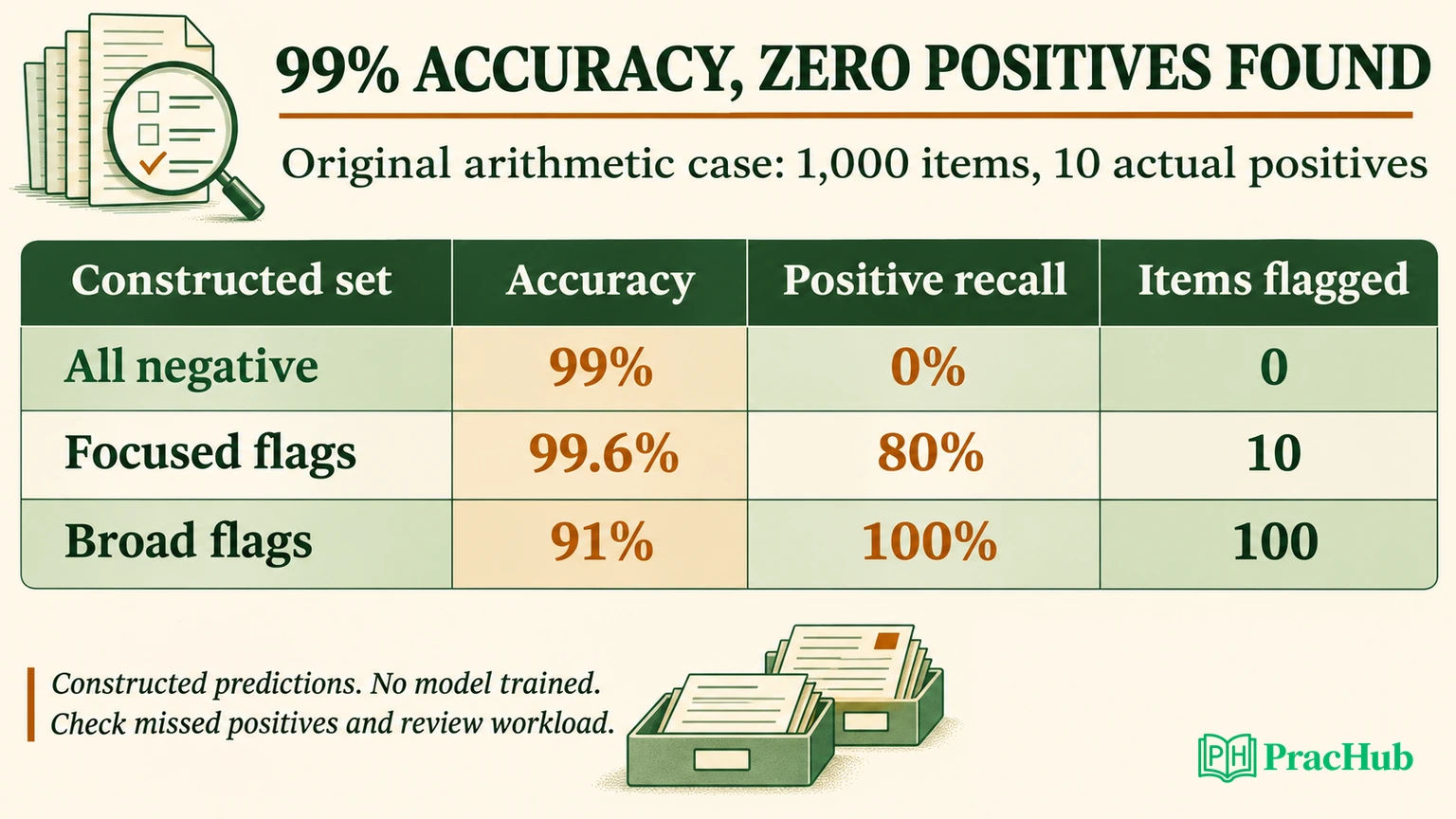
Consider an invented inspection dataset with one thousand items, ten of which carry a positive defect label. We constructed three prediction sets. These are arithmetic examples, not trained models, real inspection results or NeuraPrep submissions.
The first set predicts every item negative. It is correct on nine hundred ninety items, giving ninety-nine percent accuracy, but finds none of the ten positives. Its positive-class recall is zero. Precision has no positive predictions in its denominator, so we report it as undefined rather than silently assigning a favorable value.
The second set flags ten items: eight true positives and two false positives. It misses two positives. The third flags one hundred items, covering all ten positives but also ninety negatives. These choices illustrate different workloads and errors without claiming which operating point is appropriate for a real application.
The official scikit-learn metric reference defines precision, recall and F measures and discusses their interpretation. We used exact fractions to calculate the following original results.
| Constructed prediction set | Accuracy | Precision | Recall | F1 | Items flagged |
|---|---|---|---|---|---|
| All negative | 99% | Undefined: no positive predictions | 0% | 0 | 0 |
| Focused flags | 99.6% | 80% | 80% | 0.8 | 10 |
| Broad flags | 91% | 10% | 100% | 2/11, about 0.182 | 100 |
The local calculation checked the constructed confusion counts, metric values and flag totals. All expected checks passed. No probability scores, ranking curve, data split or deployment were generated, and no model was fitted. The analysis establishes the arithmetic for these prediction sets only.
Define the positive class before interpreting the result. An answer that quotes accuracy without defining the target event can obscure the result that matters to the task. Likewise, stating recall without the associated review load can hide what achieving it requires.
A deliberately incomplete answer and an independent rubric
Our original incomplete answer to this case is: “The classifier reaches ninety-nine percent accuracy, so it is ready.” It mentions a metric but gives no comparison, minority-class behavior, workload constraint or validation design. We did not submit this metrics answer to NeuraPrep.
A reference answer might reasonably expect several terms. Our independent rubric also asks whether the conclusion follows from them. Naming precision and recall is insufficient if the candidate cannot explain the counts or the action each flagged item triggers.
| Independent review question | Evidence a defensible answer supplies |
|---|---|
| What is being predicted? | Positive class, unit of analysis and population |
| What does the baseline do? | All-negative behavior and the missed positives |
| Which error matters to the decision? | False-positive and false-negative consequences |
| What workload follows? | Number of flags and available review capacity |
| How trustworthy is the estimate? | Split design, leakage checks and relevant uncertainty |
This rubric is an educational review tool. It is not NeuraPrep’s hidden reference, a certification standard or a numerical grade of the product. Its purpose is to make your own correctness conditions explicit before reading generated feedback.
A stronger answer would reject the all-negative readiness claim, compare the constructed alternatives and ask about the relative costs and capacity. It would also state that these arithmetic results cannot establish generalization because the example has no actual training or evaluation procedure.
Turn feedback into a changed explanation
When feedback identifies a missing concept, add the mechanism rather than only the word. In the noisy-data demo, mentioning generalization should lead to an explanation of how you would assess performance on appropriate unseen data. Adding the term alone does not define a valid comparison.
For the metrics case, adding recall should lead to the ten-positive denominator and the number found. Adding workload should lead to the ten-versus-one-hundred flags. Each addition changes what a reader can verify in the answer.
Next, change the review-capacity constraint. Suppose reviewers can inspect only ten items in the relevant period. The broad flag set’s one hundred alerts no longer fit that capacity without another prioritization policy. That does not prove the focused set is universally best; it identifies a requirement the decision must address.
If missed defects are extremely costly, the preferred trade-off may change again. You need an explicit objective and validated data to choose an operating point. Neither a high accuracy number nor a concept-coverage score supplies that objective automatically.
Save the original answer and feedback beside your corrected reasoning. This lets you see whether a later attempt actually repaired the omission or merely adopted more polished wording. We did not test delayed learning outcomes or score stability in NeuraPrep.
Coding, quizzes and written answers need separate trials
For a future coding trial, inspect the input contract, visible cases and failure output. The FAQ’s statement about problem-specific tests does not establish their coverage. An accepted submission may still need independent edge cases and an explanation of the algorithm’s assumptions.
For a quiz, an answer key can establish the expected option within that item. It does not automatically establish that you can derive the result without choices. For written practice, inspect whether the feedback recognizes the reasoning rather than just relevant vocabulary.
We tested only the written demo described above. We did not observe a coding runtime, a completed quiz or a system-design evaluation. Keep those capabilities as separate evaluation questions when deciding whether to use the broader product.
Read submission and multi-turn allowances as different units
Current public monthly prices were $12.99 for Premium and $25.99 for Premium Plus. The displayed written allowances were one thousand submission credits and fifteen multi-turn response credits for Premium, and 9,999 of each for Premium Plus. Those are dated provider offers, not verified account balances.
The FAQ says a graded written answer, complete coding submission or submitted quiz uses a submission credit; each multi-turn response uses another type, and final grading also uses a submission credit. A multi-turn conversation therefore should not be counted as a single interchangeable unit.
It also describes limits on new author-solution unlocks and notes that older subscriptions can retain different allowances. Check the actual billing period and plan in an account rather than assuming every user receives the current public offer. We did not test credit deduction, renewal or solution-view enforcement.
Written subscriptions, Voice balances and company offerings are separate products. We did not evaluate Voice or company enrollment, and the consumer demo is not evidence about either. The observed feedback does not establish a hiring decision or predicted interview performance.
Practice the gaps the product leaves open
These independent PracHub questions extend the metrics and decision themes. They are complementary prompts, separate from NeuraPrep’s reference answers, coding tests, quiz keys and submission credits.
| PracHub question | What to examine |
|---|---|
| Resolve a Mismatch Between Regression and Classification Metrics | Check that the metric answers the actual prediction task. |
| Choose Classification Metrics Under Asymmetric Costs | Connect false positives and false negatives to a decision cost. |
| Write the Cross-Entropy Loss and Compute Precision, Recall and F1 | Compute the quantities before interpreting a model’s reported quality. |
| Tune metrics for imbalanced classification | Compare an imbalanced classifier with the appropriate baseline. |
| Explain bias-variance and evaluate a classifier | Explain the validation setup and the limits of the resulting estimate. |
Who should consider NeuraPrep next
NeuraPrep merits a focused trial if you want ML written practice with concept-level feedback alongside separately described coding and quiz formats. Our single demo response identified omissions, while leaving room for an independent check of the proposed preprocessing action.
Answer the classification-metric prompt, compute the all-negative baseline and explain which additional evidence a readiness decision needs. Compare any feedback against the original rubric before adopting its suggestions. Save one correction whose effect you can demonstrate with the constructed counts.
Comments (0)