NexternAI Review: Job-Matched Mobile Practice, Voice Mocks, and Coding Claims
Quick Overview
Review NexternAI’s mobile job-matched study claims, coding and voice boundaries, store availability and developer privacy disclosures without invented usage. Dated public observations and original exercises distinguish official descriptions, tested behavior and unverified capabilities.
NexternAI presents a mobile preparation workflow built around a job posting: identify the role, organize study, rehearse spoken answers and practice coding where the role calls for it. Its App Store listing and developer policy provide enough detail to assess that intended workflow, but we did not install the app or complete a session. Coding execution, voice follow-ups and exam scores remain advertised capabilities in this review.
Start with PracHub’s project-ownership prompt and identify what evidence a target role requires. A personalized study plan is useful only if it leads to work and explanations you can defend.
Checked November 3, 2026: this review concerns the exact iPhone/iPad app listed as “NexternAI: Mock Interview Prep,” from developer Umar Muzaffar. Store descriptions and privacy disclosures are provider claims. Our requirement mapping is fictional and independently authored. No purchase, resume upload, microphone permission or device-level privacy test was performed. PracHub publishes interview-preparation content and is the publisher of this review.
What the current store listing establishes
The native App Store page showed version 1.0.10, an October 8 update, iPhone and iPad availability, and free download with in-app purchases during our visit. It described the app as designed for iPad and not verified for macOS. We use that current native listing rather than older cached version information.
Those details establish product identity and distribution context. They do not establish that every advertised feature is free or supported equally on every device. We did not install on an iPhone or iPad, inspect a purchase screen or test offline behavior.
The listing did not have enough ratings to display a review overview. That prevents a meaningful conclusion about aggregated user satisfaction from this sample. It also means that marketing language about readiness or progress should not be treated as independent customer evidence.
For a candidate, the first practical question is whether mobile preparation fits the task. Reading a short concept, recording an explanation and reviewing a plan can fit a phone session. A multi-file coding assignment, dependency failure or database setup may require a desktop environment even if a mobile app offers related lessons.
How job-matched preparation is described
The official description says a job posting can guide a role-, stack- and language-relevant preparation plan. Coding is described as relevant when the role requires it, while a separate coding area remains available for practice.
Role-specific practice is a useful goal. A backend engineer, analyst and engineering manager may share communication practice but need different evidence. Whether the app correctly interprets a real posting, avoids irrelevant tasks and updates the plan after a weak answer would require an actual session.
Do not evaluate personalization from the presence of a role label alone. A plan headed “Backend Engineer” could still contain generic questions. Useful tailoring should connect a requirement to a task, an observable result and a follow-up that tests the same capability under changed conditions.
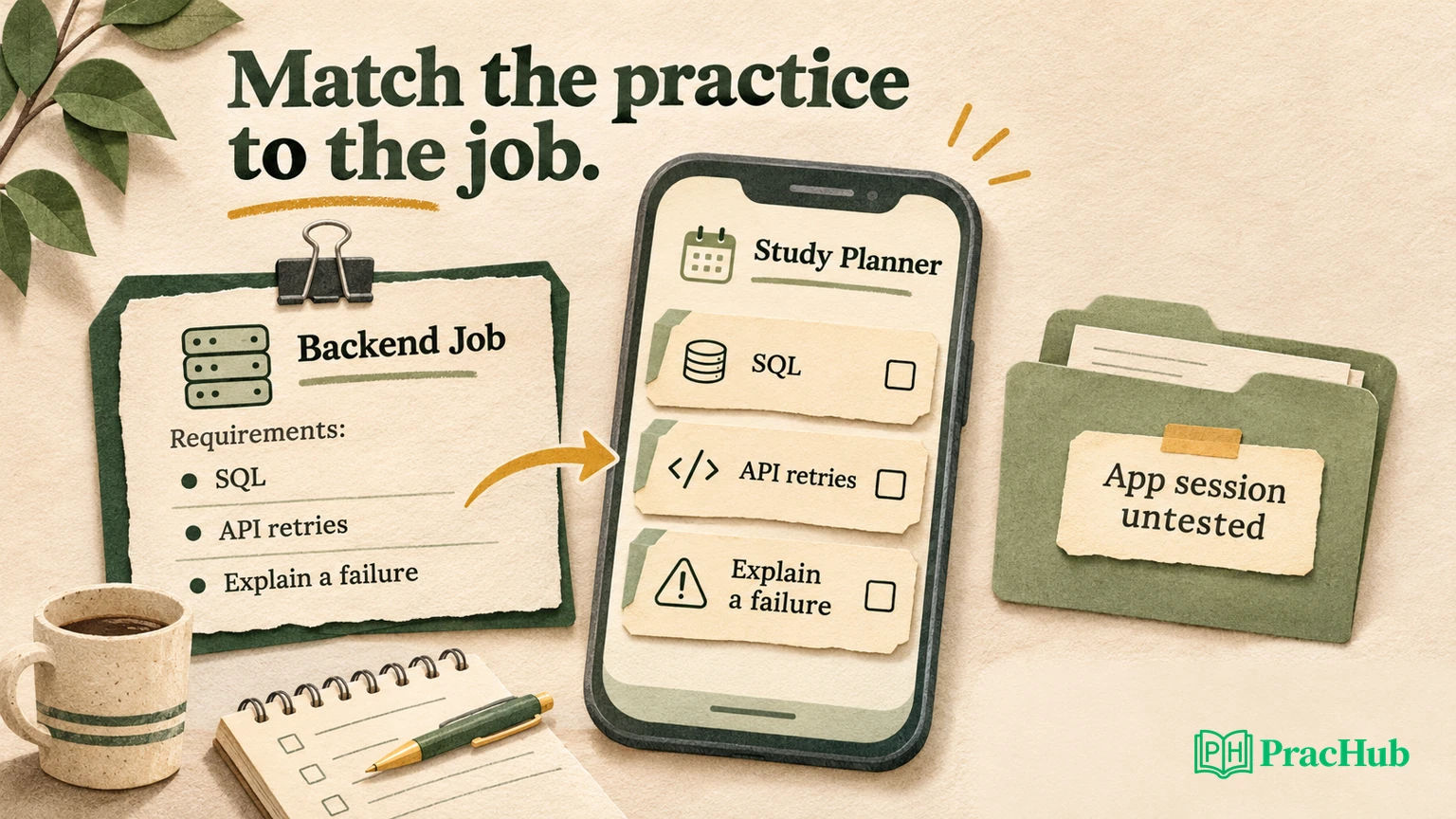
Our fictional backend posting asks for SQL analysis, retry-safe APIs and clear incident communication. The following mapping is a review aid, not an output generated by NexternAI.
| Job requirement | Practice artifact to produce | Evidence that would make tailoring useful |
|---|---|---|
| SQL with business data | Query plus exact expected rows | Join grain, NULL policy and metric definition are tested |
| Reliable APIs | Small retry scenario | Repeated operation identity produces one intended effect |
| Incident response | Spoken account with a timeline | Personal actions and causal uncertainty stay accurate |
| Cross-functional delivery | A changed-requirement discussion | Dependencies, owner and decision are explicit |
Judge the plan by whether it helps you produce these artifacts. Completing a sequence of cards can organize effort, but it does not by itself verify the underlying skill.
Coding samples and hidden submissions need separate checks
The store description distinguishes running public samples from submitting against hidden checks. It lists several coding languages, including Python, JavaScript, Swift, Kotlin, Dart, Java, C and C++. These are advertised language and workflow capabilities; none was executed in our review.
If you later evaluate the coding area, begin with a valid but wrong implementation whose failure you understand. A syntax error only tests parsing or compilation. A logically wrong answer can reveal whether the runner checks the requirement rather than merely displaying output.
Then repair the defect and change the input. For a retry-safe API exercise, two requests with the same logical operation key should not create two effects under the declared contract. A different key should still be allowed to create a separate effect. Checking only one repeated request would leave that second behavior untested.
A sample run and a hidden submission also have different explanatory value. Sample outputs help you inspect a known case. A hidden verdict can expose an omitted condition, but without a useful failure category you may still need your own small fixture to diagnose the mistake.
We cannot assess NexternAI’s execution environment, hidden-test breadth, runtime isolation or mobile editor ergonomics from the store listing. Those should remain explicit unknowns when comparing it with a browser tool you have actually run.
Voice mocks should preserve truthful project evidence
The official description advertises spoken interview practice and follow-ups. For our fictional role, a suitable rehearsal might ask why a service used an idempotency key and what happened when a request timed out after the effect had already committed.
A useful explanation identifies the ambiguity: a client timeout does not prove the server failed to apply the request. The candidate should explain how a repeated logical operation can retrieve or reuse the prior result. They should also name remaining boundaries, such as concurrent requests or an operation record that commits separately from its effect.
This is an original preparation example. We did not observe the app asking it or evaluating an answer. Its purpose is to give you a concrete standard against which to assess a future voice session.
For project stories, keep personal and team contributions distinct. “We improved reliability” needs a follow-up about what you changed, what evidence you collected and what remains uncertain. Feedback that encourages a more dramatic result without supporting evidence would weaken the answer, even if it sounds more confident.
Rehearse a changed audience too. Explain the same incident to an engineer and a product partner. The technical facts should remain consistent while the level of detail changes. A useful voice coach would help with that translation without inventing a metric or ownership claim.
Exam points are progress signals until validated otherwise
The listing describes weekly exams with 100-point scoring. That supplies a product format, not a validated measure of hiring readiness. We did not complete an exam, compare repeated attempts or inspect a scoring rubric.
Before using any score as a study decision, ask what it measures. A technical correctness score, response-completeness score and communication score can change for different reasons. Combining them into one number may hide a serious defect behind fluent delivery.
For our fictional SQL requirement, a candidate can speak smoothly while double-counting revenue after a one-to-many join. A useful evaluation should identify the grain error. For the API requirement, a confident statement that retries are always safe should receive a challenge about operation identity and atomicity.
Track a score alongside the concrete correction. “I now distinguish a client timeout from an unapplied request” is actionable learning. A higher total without an identifiable change gives you less evidence to transfer into a new prompt.
Read the store and developer privacy disclosures together
The App Store privacy section listed identifiers, usage data and diagnostics as not linked to identity. Its notice is a developer-provided declaration, not an independent privacy audit.
The linked developer policy, dated September 3,2026, described personal material such as profile information, resumes, job postings, interview responses and preparation data. It claimed AI generation uses on-device processing where available or a built-in offline question bank, with no third-party AI service receiving that feature content. It also named Firebase analytics, crash reporting and messaging as other services, and said most personal content is stored locally.
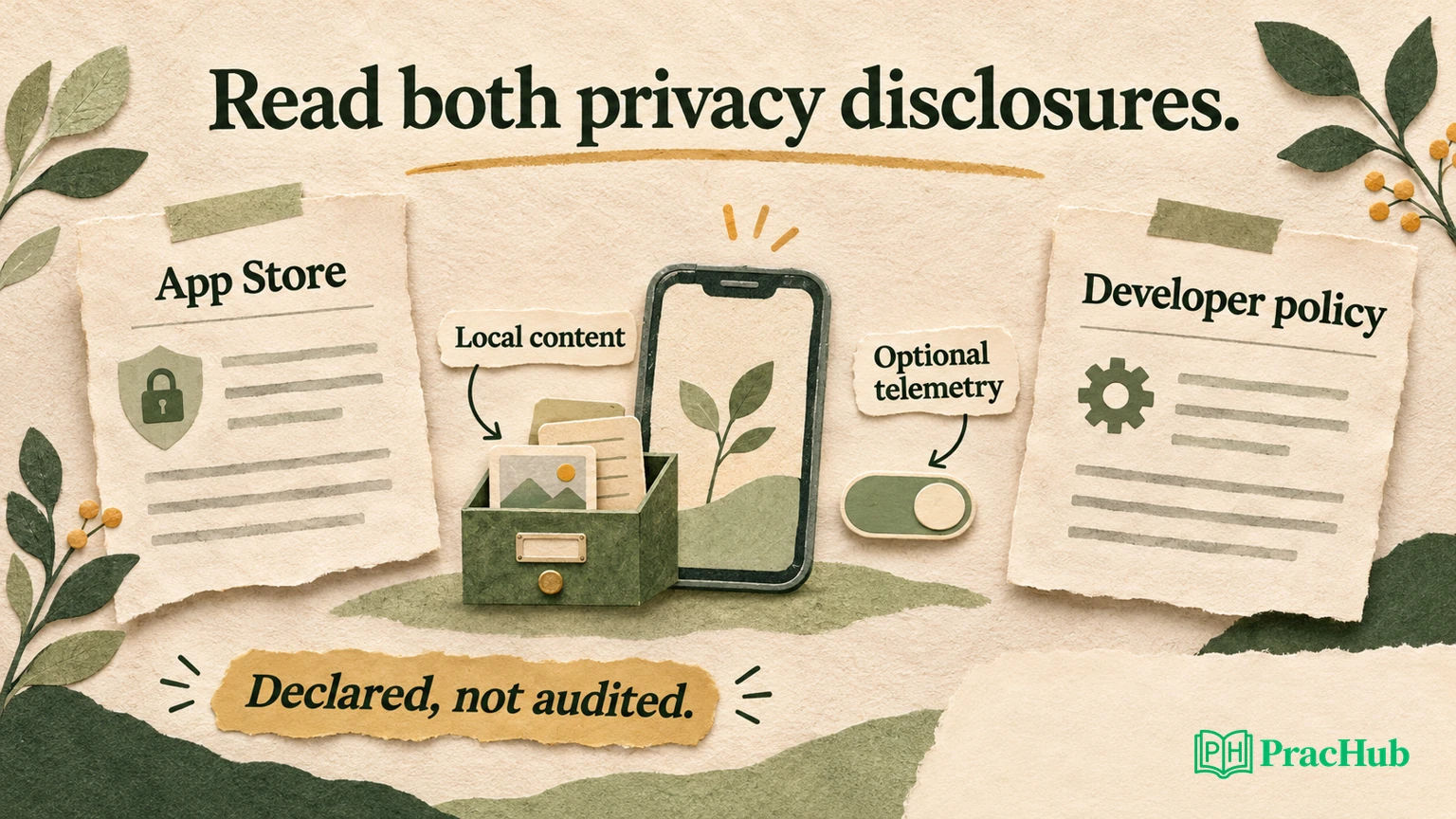
These statements should be read with their qualifiers intact. “Most content stored locally” is narrower than “nothing ever leaves the device.” Optional telemetry and notification services also deserve their own consideration. We did not inspect network traffic, device storage or settings enforcement.
The policy described microphone and speech recognition access when actively starting a voice feature, with typing available instead. We did not verify that permission timing. No media permission was granted during this review, and no personal application material was sent to the app.
Free download does not define the full entitlement
The current listing showed in-app purchases. We did not expand and validate a selected purchase offer or buy access, so this review does not quote an unverified monthly or annual price. Store availability can vary by region and change over time.
Before paying, identify the specific feature you need: a coding submission allowance, a voice session, a study plan or a resume workflow. Then verify the selected offer’s limits, duration and renewal behavior in the current app. A free download and a broad feature description do not establish unlimited use.
It is also reasonable to begin with fictional material when evaluating tailoring. Use a short invented posting and a nonpersonal project scenario, then check whether the resulting practice matches the requirements. You can assess relevance without uploading a real resume during the first exploration.
A mobile tool may be useful as a companion for short review sessions. If your interview requires a desktop repository, retain a separate practice loop that includes reading files, running tests and presenting a reviewable change. The app’s study plan cannot substitute for observing yourself perform that format.
Device capability also needs a direct check before you rely on the advertised workflow. The policy qualifies its on-device processing description with availability and mentions an offline bank. We did not test which devices use which path or whether their feedback differs. If you later evaluate the app, retain the device and app version with the session result so a successful attempt is not generalized across every supported device.
Five PracHub questions for evidence-driven preparation
These verified prompts help connect role requirements with project decisions and ownership. They are independent practice destinations, not NexternAI integrations or predicted employer questions.
| PracHub question | Focused follow-up |
|---|---|
| Explain resume projects and behavioral responses | Keep real project evidence separate from an invented practice scenario. |
| End-to-End ML Project Deep Dive: Decisions, Evaluation Design and Career Goals | Connect a model project decision with its evaluation design and limitations. |
| Discuss an Interesting Project and a Deployment Mistake | Explain a deployment mistake using personal actions and observed evidence. |
| Explain Project Impact from Prototype to Shared Ownership | Distinguish prototype contribution from ownership after other teams depend on it. |
| Demonstrate Project Ownership and In-Depth Investigation | Defend your decision under a changed project follow-up. |
NexternAI’s store description outlines a coherent mobile preparation workflow, with important execution and feedback details still untested here. Finish with the project-ownership question, state your personal decision and the evidence behind it, then use that same standard to evaluate any job-matched plan or voice debrief.
Comments (0)