OpsResolve Review: SRE Question Drills, Incident Challenges, and Practice Limits
Quick Overview
Review OpsResolve’s public networking drill and certificate incident debrief. An original OpenSSL experiment and observation rubric show how to check explanations while keeping recall, self-rating and troubleshooting evidence separate.
OpsResolve is useful to inspect when you want short SRE interview answers linked to deeper explanations and incident practice. Its public networking drill revealed an answer without sign-in, and a certificate challenge exposed evidence plus a written debrief. Interpret the access carefully: reading a solution and rating your recall do not establish independent troubleshooting competence.
PracHub publishes this review and owns the complementary practice links. Our TLS handshake and certificates question gives you an independent explanation task. The certificate experiment and first-three-observations method below are original educational work, separate from OpsResolve’s assessment or solution.
What we could inspect publicly
Provider positioning, checked November 3, 2026: OpsResolve’s interview area connects concise responses with fuller explanations across DevOps, SRE and platform subjects. It displayed 489 questions in nineteen categories; we did not count or audit the complete collection.
Direct observation: the unsigned drill opened a twenty-card deck. Selecting Networking changed the first card to a browser-request-path question. Revealing the answer exposed a multi-stage explanation and a link to more detail. The three confidence buttons became available afterward.
The drill describes browser-local ratings with account synchronization after sign-in. We did not rate a card, inspect storage, test synchronization or establish how repeated ratings change scheduling. A visible feature description is not a persistence test.
The review covers these public surfaces. No candidate reports, employer-specific interview evidence or measured preparation outcomes support it. We used no account, payment, private configuration or production credentials.
Keep recall drills and incident decisions separate
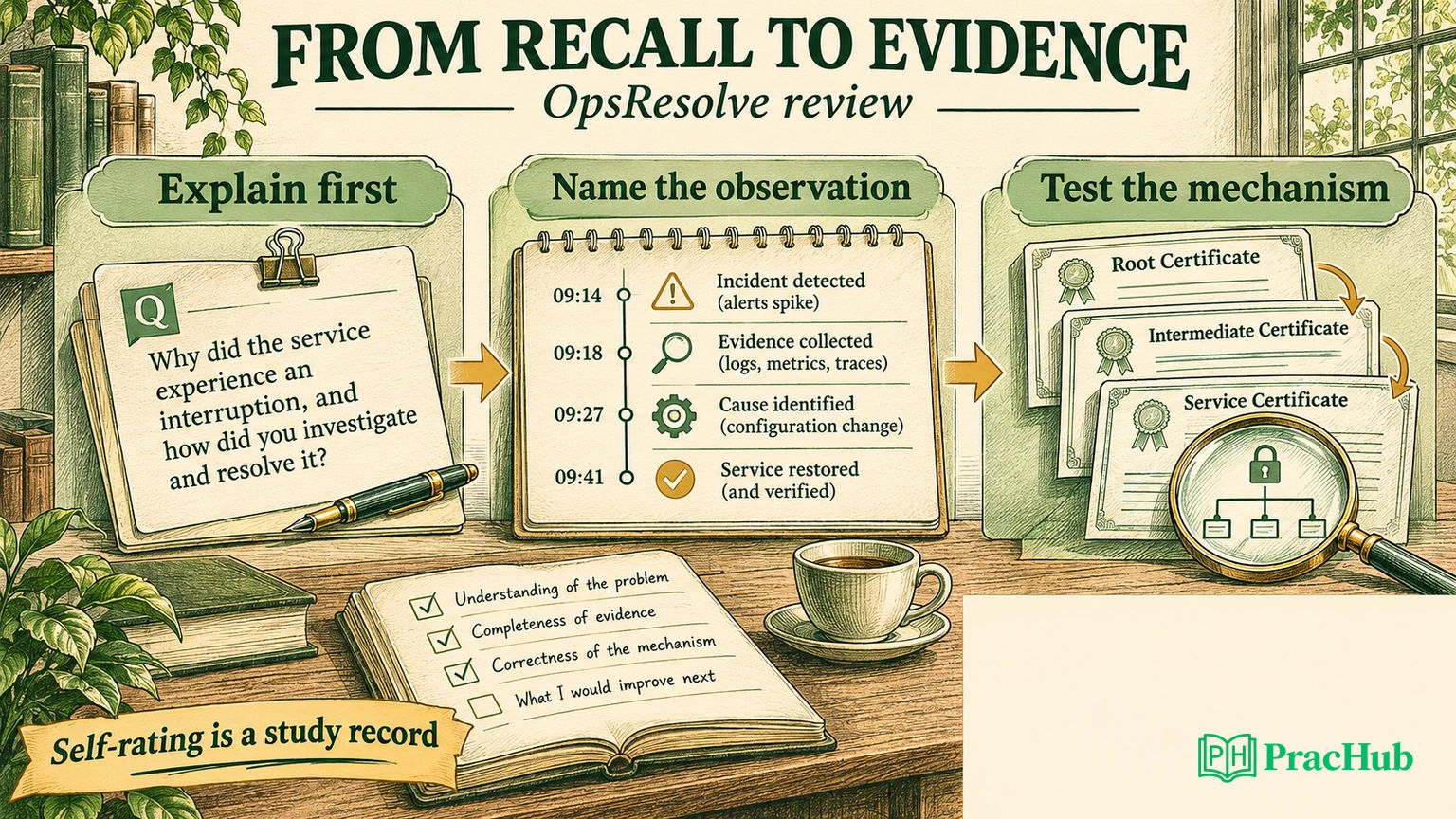
Use a card to explain the answer before revealing it. An incident exercise asks a different question: can you decide what the available evidence supports, and what to inspect next?
We opened a public certificate challenge. It showed six evidence entries, constraints and tasks, followed by cause, evidence, confidence and reasoning controls. The page explicitly described confidence and written reasoning as unscored. We used its answer-reveal option; we did not submit a cause or written response, run commands there or complete an independently graded exercise.
The revealed debrief connected a missing intermediate certificate with differences in local trust material. It was substantive reading rather than an empty success message. That observation supports evaluating the explanation; it does not establish that the site supplied a live operating system or judged our troubleshooting.
For practice, make the two modes produce different records. A recall attempt should preserve what you could explain unaided. An incident attempt should preserve the evidence that changed your mind. Combining both into a single confidence number hides where the improvement occurred.
Original certificate case: a successful client can hide a dependency
Our invented service is api.practice.invalid. A leaf certificate is issued by a test intermediate, which is signed by a test root. The root is explicitly trusted for the experiment. All names and certificate material are synthetic.
The experiment asks one question: what happens when the verifier receives the leaf but lacks the intermediate needed to build its chain? This is more precise than asking whether HTTPS is generally working. It also creates a counterexample to the assumption that success from one machine proves every client has equivalent verification inputs.
The official OpenSSL verify reference distinguishes trusted certificate inputs from untrusted certificates used for chain building. In this terminology, an intermediate supplied through the untrusted option can help construct a path; that option does not make the intermediate an independently trusted root.
The Python ssl documentation separately explains certificate-loading choices and client verification defaults. A Python process’s effective context and application configuration therefore deserve inspection. Do not assume that an operating-system directory listing completely describes every application’s trust configuration.
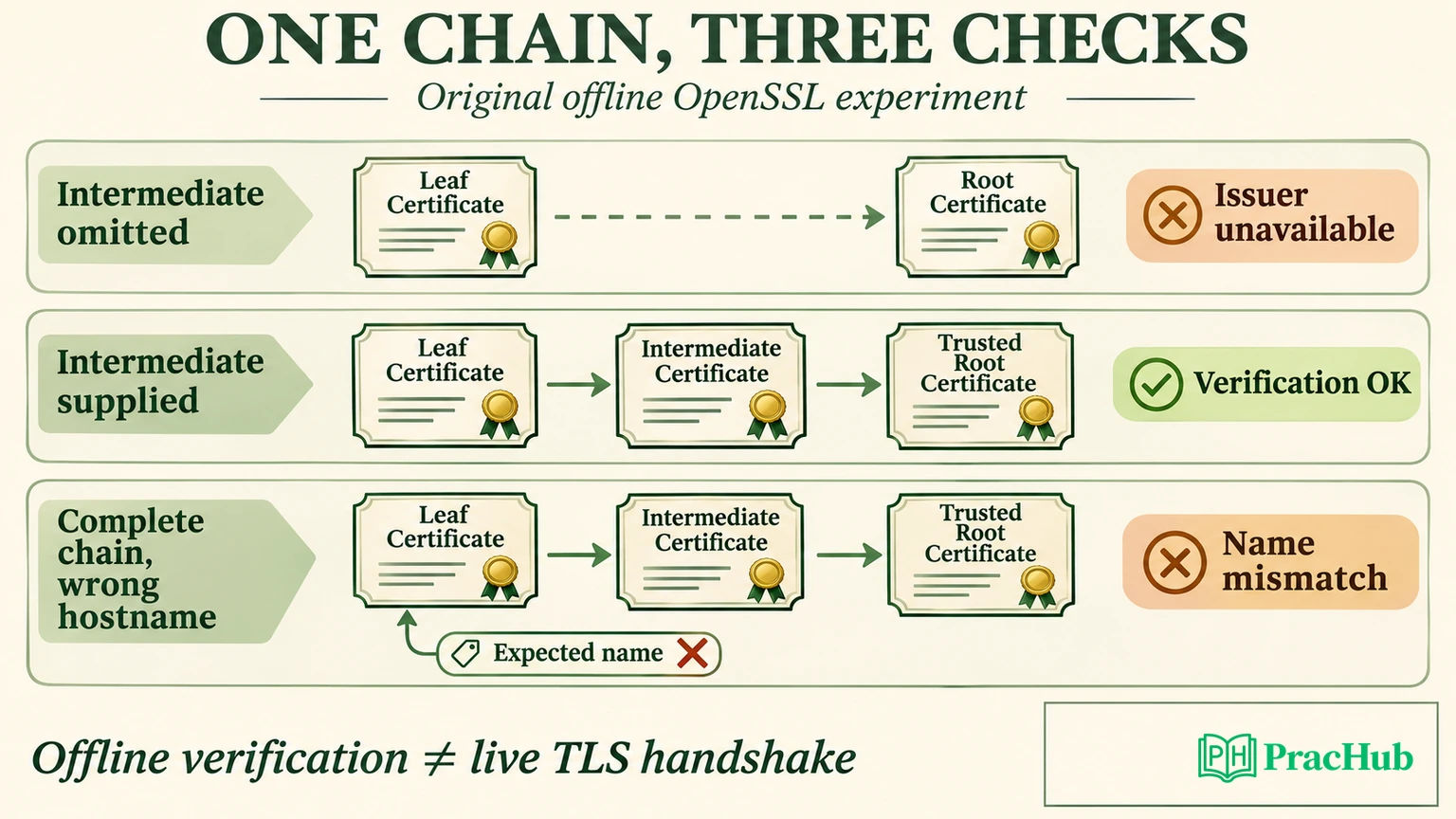
We generated a temporary root, intermediate and leaf, then ran three offline verification cases with OpenSSL 4.0.3. The fixture passed its three expected-result checks. Temporary keys and certificates were removed when the script exited; nothing was installed into a system trust store.
| Original offline case | Observed verification result | What the result establishes |
|---|---|---|
| Trusted root and leaf, intermediate omitted | Error 20: issuer unavailable locally | These supplied inputs did not build the needed chain |
| Same root and leaf, intermediate supplied | Verification succeeded | The generated chain passed this verifier configuration |
| Complete chain, different expected hostname | Error 62: hostname mismatch | Chain material alone did not satisfy the name check |
The relevant command shape for the successful case was:
openssl verify -CAfile root.pem -no-CApath -no-CAstore -purpose sslserver -untrusted intermediate.pem -verify_hostname api.practice.invalid leaf.pem
The fixture isolates chain material from the expected name. That separation matters when reviewing a sample answer: a proposed fix should change the input responsible for the observed failure, while preserving the checks that protect other requirements.
This experiment did not perform a TLS handshake, fetch a server chain, inspect a container image or reproduce the product’s environment. It demonstrates specific certificate-verification differences using controlled inputs. It is not evidence that any particular real incident has the same cause.
Build the causal graph before choosing a fix
Use three nodes for the invented failure: material presented by the server, issuer material available to the client and the client’s verification configuration. Keep hostname and validity checks as additional requirements rather than collapsing every failure into a missing CA.
A server that omits an intermediate can appear healthy to a client that already has that issuer available. Another client may fail because it lacks the same material. Success on the first client is compatible with a server-side omission; it is not proof against that hypothesis.
The reverse mistake is to blame the server after seeing a single error string. A client may use an unexpected bundle, a different endpoint or a proxy presenting another certificate. You need evidence that the two observations concern the same name, route and effective configuration before comparing them.
For this original case, draw arrows from missing issuer material to an incomplete verification path, then to the observed error. Draw a separate branch from a wrong expected hostname to a name failure. The third experiment shows why adding chain material cannot resolve that second branch.
Use the causal graph to check a recorded or written explanation. If an answer recommends changing a trust store, ask which branch it addresses and which assumption makes that change appropriate. Avoid recommending broader trust merely because it makes one request succeed.
A first-three-observations rubric for interview practice
Our recommendation is to plan three observations before naming three commands. A command is useful only when you can say which uncertainty its output reduces. The rubric below is an original practice aid, not an OpsResolve grading rule.
First, capture the exact failure context: client process, target name, error, time and relevant change. This separates certificate verification from connection refusal, DNS failure or an application response. It also prevents an old success from being compared with a different request.
Second, establish what certificate material was actually presented for that target and how it differs across the failing and successful contexts. Separate the presented list from a verified chain. Counting certificates can expose an omission, but a count alone cannot demonstrate a valid path.
Third, inspect the failing application’s effective trust and verification settings. Compare the issuer inputs, expected name and validity context. If the application uses its own bundle, a healthy system-level test may not test the same configuration.
Connect each observation to the next decision. If the target differs, correct the comparison. If the issuer is absent from both presented and available material, investigate the chain. If the complete chain verifies but the name fails, pursue the hostname branch rather than repeatedly adding certificates.
Score your own reasoning in words: which observation was missing, which conclusion was too broad, and which action would have changed prematurely? That record is more informative than calling the entire answer correct because the final cause happened to match.
Judge a debrief by what you can transfer
A useful debrief should let you solve a changed case. After reading the certificate explanation, alter one condition: supply the intermediate but change the expected hostname. Can you explain why the original fix no longer addresses the failure? Our local result gives a concrete check on that transfer.
Change another condition: the server presents the necessary chain, but an application loads an unexpected trust bundle. The next evidence request should move toward application configuration. Repeating the original server fix without checking that condition would show memorization rather than diagnosis.
These variations do not require claiming that every detail of the platform answer was independently audited. They let you evaluate a specific mechanism. If you find an unclear sentence, resolve it against the relevant primary reference and preserve the condition under which the statement holds.
For a spoken interview, explain the observation, hypothesis and next check in that order. Then state the narrow conclusion. “This verification succeeded with these inputs” is defensible; “all clients are fixed” requires separate evidence about deployment and actual application behavior.
Access limits that remain open
Our unsigned check demonstrated a revealed networking answer and a public incident debrief. It did not establish an unrestricted allowance for every question, challenge, tool or future visit. We did not verify paid entitlements, account history, browser-to-account synchronization or retention.
Use the displayed catalog total to navigate; it does not measure answer quality. Evaluate the depth of a relevant topic rather than dividing your study time by a promotional question count. A small set of explanations you can challenge and apply may produce a clearer study record than a large number of revealed cards.
If persistence matters to you, test it with non-sensitive practice notes before relying on it. Keep your corrected explanation independently until you understand what the product actually saves. This is a recommendation for a future account trial, not a claim that we performed one.
Practice the gaps the product leaves open
These independent PracHub questions extend the certificate and evidence-ordering themes. They are separate exercises, not exports from OpsResolve’s question bank or incident challenges.
| PracHub question | What to examine |
|---|---|
| Explain How TLS Secures a Connection: Handshake, Certificates and Keys | Explain certificate authentication separately from encryption and connection establishment. |
| Design a PKI for internal mTLS and certificates | Define trust distribution and rotation instead of treating a copied CA as an unexplained fix. |
| Does a Successful Ping Mean Port 443 Is Reachable? Diagnosing Server Connectivity | Choose the observation that tests the specific protocol and destination. |
| Debug a cache incident end-to-end | Turn a symptom into a sequence of discriminating checks and a safe recovery decision. |
| Diagnose distributed database inconsistency | Keep competing hypotheses until the evidence distinguishes their consequences. |
Who should try OpsResolve next
OpsResolve deserves a focused trial if you want to connect SRE recall with evidence-based incident discussion. The public surfaces we inspected contained usable explanations. Its self-rated cards and revealed solutions still need your own technical reference and an honest account of what you could answer before revealing them.
Start with the TLS question, explain a missing-issuer case and then change only the expected hostname. Save the first observation you would request for each version. Use the difference between those plans as the next practice target, rather than treating a confidence click as proof of competence.
Comments (0)