PaddySpeaks Interview Studio Review: Data Engineering Questions, Mock Loops, and Evidence Limits
Quick Overview
Review PaddySpeaks Interview Studio with tested Python feedback, simulated-company provenance, self-scoring, browser runtimes and optional BYOK AI limits. Dated public observations and original worked examples distinguish tested behavior, author descriptions and unverified capabilities.
PaddySpeaks Interview Studio connects coding, SQL, design and leadership practice for data-engineering preparation. Its most important boundary is provenance: the company-loop area explicitly presents original simulations, not questions taken from employers’ interviews. In our inspected Databricks loop, a Python runner detected most failures in an intentionally wrong answer, while the final competency scores were self-assessments against reference notes.
Start with PracHub’s warehouse-log ingestion question and define what a rerun must preserve. It gives you a concrete pipeline problem to explain across coding and design discussions. Use the bank to practice an invariant you can explain and test.
Checked November 3, 2026: official descriptions, anonymous browser observations and an original local replay fixture are separated below. We did not use an Anthropic key, complete a five-loop mock, or validate a hiring-readiness score. No independent candidate reports establish that the simulated company prompts reproduce a current hiring process. PracHub publishes this review and provides the linked preparation questions.
Separate the bank, reports and company simulations
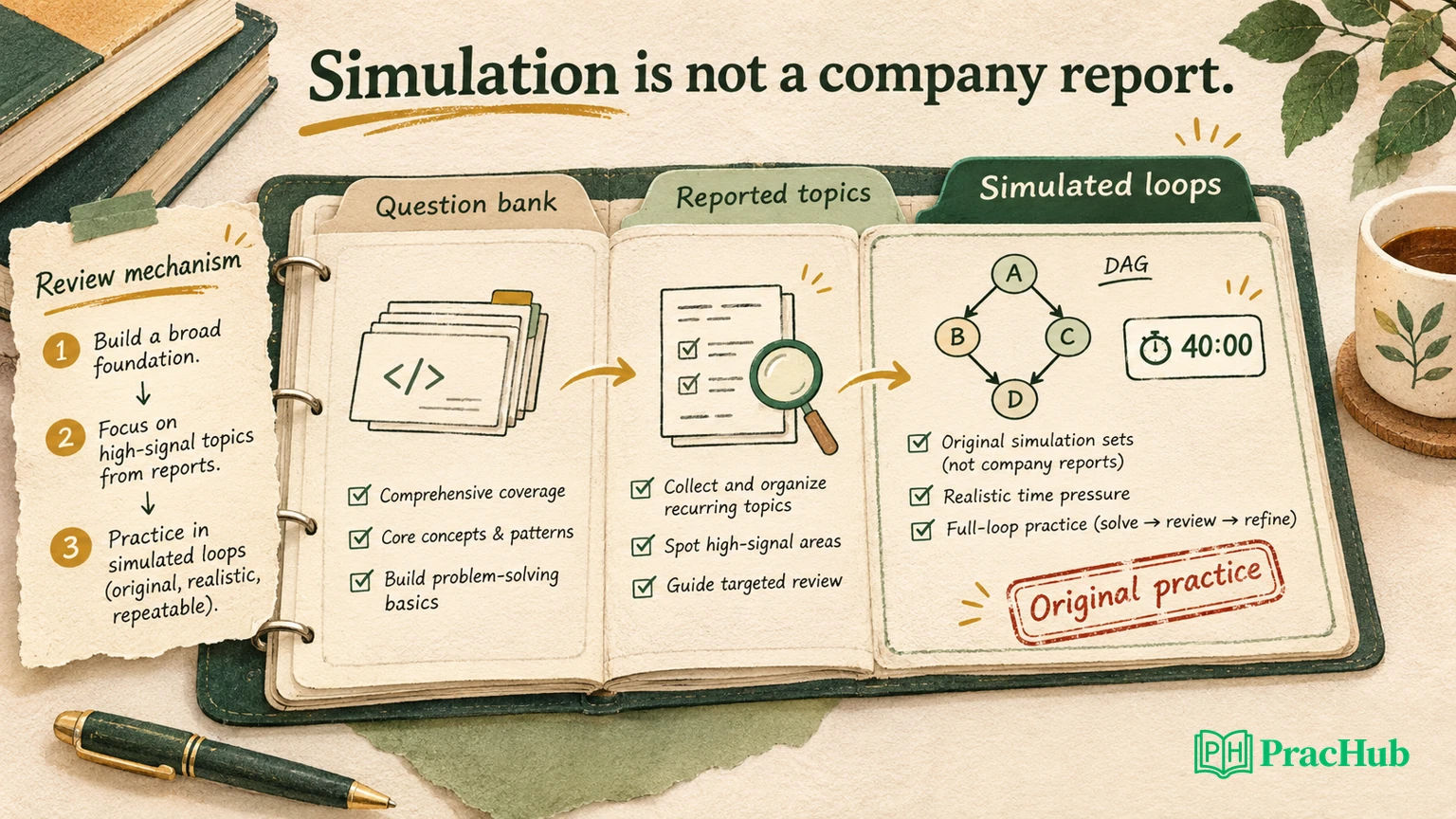
The Interview Studio homepage described SQL, Python, data-engineering and design material, with large question and company counts. Those totals are provider inventory claims; we did not audit every record or runnable example.
The company-loop area is more specific about what its company names mean. It says the questions are original practice scenarios set in public product domains, that their numbers are hypothetical, and that they neither come from the companies’ interviews nor describe their internal systems.
A separate reported-topics area exists for sourced interview intelligence. In the Databricks company detail we inspected, the public reported-topics section said none had yet been collected for Databricks. That empty report section limits what the company label establishes. It prevents a reader from treating the presence of a company button as evidence of a bank of verified employer questions.
Our editorial judgment is that this separation is useful when respected. A lakehouse-themed exercise can be good preparation for graph or pipeline reasoning without being a leaked or faithfully reconstructed interview. The value comes from the task and discussion, not an implied guarantee that the employer asks it.
When reading a company page, ask where each statement comes from. An official role description, a sourced candidate account, and an original exercise serve different purposes. If a source card says it was verified but also notes the underlying page was not fetched, keep that limitation rather than upgrading it to a direct official-source read.
What the loop configuration actually offered
The public configuration offered role, experience, difficulty and mode choices. We inspected a Senior Data Engineer setup and a Databricks practice session. Modes included practice, timed mock, a full five-loop sequence and focused alternatives. Their presence in the menu does not mean we completed or evaluated each mode.
The five-loop structure covered SQL and algorithms, advanced algorithms and core data engineering, modeling and low-level design, high-level design, and leadership. This gives a way to organize different kinds of preparation. It is the product’s practice structure, not a verified Databricks interview schedule.
Language and dialect choices also had an important distinction. Python was the executable coding option in the inspected loop. Java, Scala and C++ were described as written answers. PostgreSQL was the executable SQL option there, while other listed dialects were written-answer choices.
The loop footer identified Python through Pyodide and PostgreSQL through PGlite in the browser. Other parts of a broad site may use different SQL environments; do not transfer a SQLite playground description to this loop automatically. A dialect label and a runnable dialect are not interchangeable.
| Loop feature | Evidence from our visit | Preparation implication |
|---|---|---|
| Company and role configuration | Public controls were available. | Choose a relevant domain and seniority without treating it as employer provenance. |
| Python code execution | A deliberately wrong answer received per-check results. | Use failures to inspect coding behavior. |
| Competency scoring | Radio controls appeared after revealing reference notes. | Scores are self-review, not an independently measured evaluation. |
| Optional AI interviewer | BYOK description and connection path were present. | Actual AI feedback was not tested. |
Our negative Python test: three passes out of eighteen
The first simulated coding question involved a stage dependency graph and executor slots. It asked for critical-path reasoning and a schedule under a declared priority rule. We are paraphrasing its purpose here, rather than reproducing the complete proprietary task and reference answer.
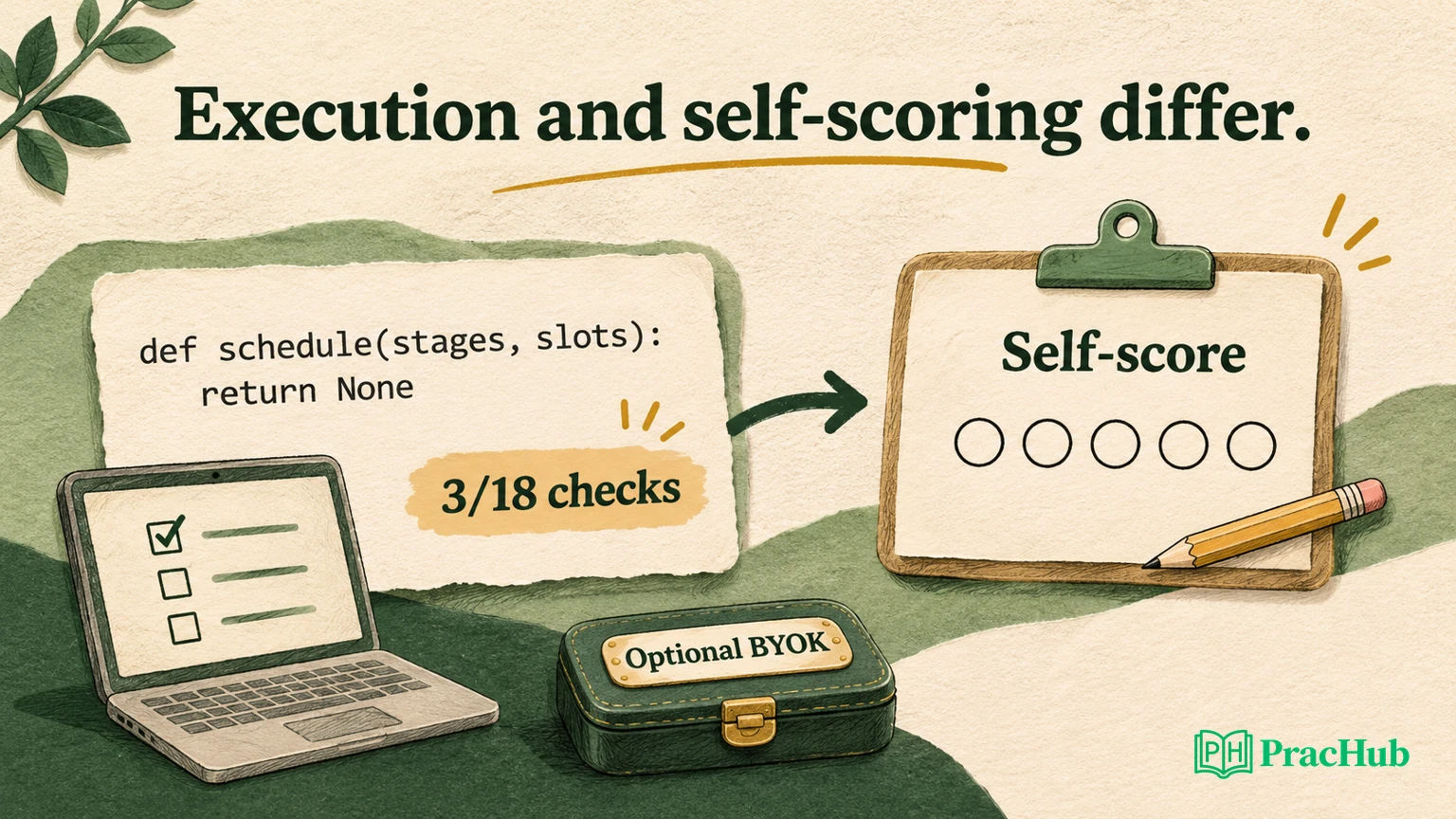
We submitted a minimal implementation that always returned None. The public runner reported three passes out of eighteen checks. The passing checks were invalid-graph cases whose declared result was None: a cycle, a self-dependency and an unknown dependency. Ordinary valid schedules and the empty valid input failed.
That result is educational because three green checks did not make the answer partly useful for scheduling. The implementation simply matched one family of error outputs. Looking at which cases passed matters more than reading the aggregate fraction as a competency score.
The runner displayed expected and received outputs for failures, including ordinary samples and a large timing case. We did not implement a correct scheduler, reproduce its reference performance measurements, or verify every complexity claim. Our native observation establishes that the wrong-return control was run and meaningfully rejected on valid inputs.
Revealing the reference exposed explanation, edge cases and competency anchors. It also exposed controls for scoring correctness, time complexity, space complexity, edge handling and clarity. The footer explicitly described the scores as the learner’s own assessments and said they do not predict a company’s hiring decision.
Keep the two results separate in your notes: “three of eighteen automated checks passed for this wrong implementation” and “I reviewed my explanation against the reference.” Neither is an AI interview score, and neither establishes completion of the broader practice loop.
An original replay case for data-engineering discussion
We built a separate local example to connect coding and design. Assume events contain full order snapshots, with a logical event key and a monotonically increasing version for each order. These are hypothetical inputs, not PaddySpeaks questions or a real employer’s system.
The arrivals are order A at version 2 with amount 70, then version 1 with amount 50, then a duplicate of the first event. If the goal is the current order snapshot total, simply adding all arriving amounts produces 190. Keeping the newest version per order and ignoring the duplicate produces 70.
| Arrival | Original decision | Current amount for A |
|---|---|---|
| e1, version 2, amount 70 | First event; install version 2. | 70 |
| e2, version 1, amount 50 | Older snapshot; do not replace version 2. | 70 |
| e1 again | Duplicate logical event; do not apply again. | 70 |
Our local Python fixture executed these decisions and checked the final result. The example deliberately combines two different concerns: event duplication and out-of-order state. Deduplicating event keys alone does not prevent the older, distinct e2 event from replacing newer state. Comparing versions alone does not provide a complete audit of repeated event identities.
The contract “full snapshots” is essential. If the amounts were additive line items, keeping only the latest version would discard legitimate contributions. Explain the event’s meaning before choosing a deduplication rule. The same data shape can require a different aggregation under a different business contract.
A senior discussion can extend this case to conflicting reuse of an event key, version ties, deleted orders and replayed historical data. A staff discussion can ask which system owns version ordering, how state is rebuilt and how a schema change affects old events. Those are original follow-ups, not claims about a named company’s interview rubric.
Make a mock loop produce evidence you can review
Use a practice mode to expose one weak boundary rather than trying to collect a high self-score immediately. For the replay case, write the input contract and expected table before coding. Then explain the result as if a reviewer has just asked why the total is not 190.
If you move to a design loop, keep the same invariant but change the proof. Show where event identity is stored, where version comparison happens and which atomic operation prevents two workers from installing inconsistent state. A diagram without those decisions does not demonstrate that the coding behavior survives concurrency.
If you move to a leadership discussion, explain who needed the change, what evidence established the defect and how you communicated the remaining limitation. Do not invent a production story around our synthetic fixture. A learning exercise can support a technical explanation, but it cannot become a project achievement on your resume.
After using reference notes, attempt a small variation without them. Change arrival order or add a second order. Predict the final state and then check it. This distinguishes understanding of the rule from recognition of the original table.
The value of a multi-loop workspace is this movement between implementation, architecture and explanation. Its limitation is that a learner may score a fluent explanation generously without detecting a wrong invariant. Use executable counterexamples or a human reviewer where practical rather than treating self-scoring as independent validation.
Optional AI access and browser-only progress
The AI mock page offers an optional bring-your-own Anthropic key workflow. The loop footer says it sends the question, your answer and reference notes from the browser to Anthropic. We did not supply a key or observe an AI interviewer’s follow-up or feedback.
This is a separate access and data-flow decision from opening a free browser exercise. “Free practice” does not establish free model usage under your own provider account. Check the current provider and product instructions before using an optional integration; our review does not measure its cost or security controls.
The company-loop footer says answers, attempts and scores are saved in the current browser and can be exported, imported or cleared. We observed that description, not a cross-device persistence test or a privacy audit. If the notes matter to your preparation, verify export and recovery before treating browser state as your only copy.
Five questions for data-engineering transfer
The following PracHub records are independent practice prompts. They extend the specific coding, warehouse and pipeline reasoning discussed here, rather than claim that PaddySpeaks or Databricks uses these exact questions.
| PracHub question | Focused follow-up |
|---|---|
| Load Daily JSONL LLM Chat Logs Into a Warehouse: Schema, Validation, Dedup, Idempotency | Define logical event identity, replay behavior and schema validation. |
| Describe ETL and pipeline challenges | Explain one observed pipeline failure and the evidence for its repair. |
| Answer SQL And Data Warehouse Fundamentals For A Data Engineering Interview | Separate executable SQL mechanics from warehouse design decisions. |
| Model Data for Analytics, Reporting, and Applications | Name who owns each model and how downstream consumers change the contract. |
| Single-Pass Python Cleaning Pipeline for Million-Document Web Crawl Parquet Files | Discuss bounded memory and a reproducible local cleaning check. |
Choose the ingestion task for event identity and replay, the pipeline question for operational failure explanation, or the modeling question for ownership and consumers. A large local cleaning task adds memory and iteration constraints that the tiny replay fixture does not test.
PaddySpeaks is a reasonable public starting point when you want linked kinds of data-engineering practice and can maintain the distinction between simulations, sourced reports and self-review. Use its executable feedback where available, then explain one changed case from PracHub’s Data Engineer collection. The result you want is a defensible decision and a reproducible counterexample, not an assumed employer score.
Comments (0)