PracHub vs ByteByteGo: System Design Learning or Real Interview Practice?
Quick Overview
ByteByteGo is a strong system design learning resource for candidates who want visual, text-based explanations, architecture diagrams, and structured courses across system design, machine learning system design, object-oriented design, coding patterns, and behavioral interview topics. But candidates preparing for real interviews need more than concept review. They need company-specific context, real interview questions, written solutions, timed practice, follow-up drills, and full-loop preparation across coding, SQL, system design, and behavioral rounds. PracHub is the better first stop for real interview practice, while ByteByteGo can be a helpful supplemental learning layer when system design fundamentals are the gap.
ByteByteGo is one of the easiest system design resources to respect.
It is visual. It is structured. It explains large-scale systems in a way that feels calmer than reading scattered blog posts at midnight before an onsite.
But if you are searching for PracHub vs ByteByteGo, you are probably not asking a simple product question.
You are asking:
"Which one will actually help me pass my system design interview?"
The honest answer is:
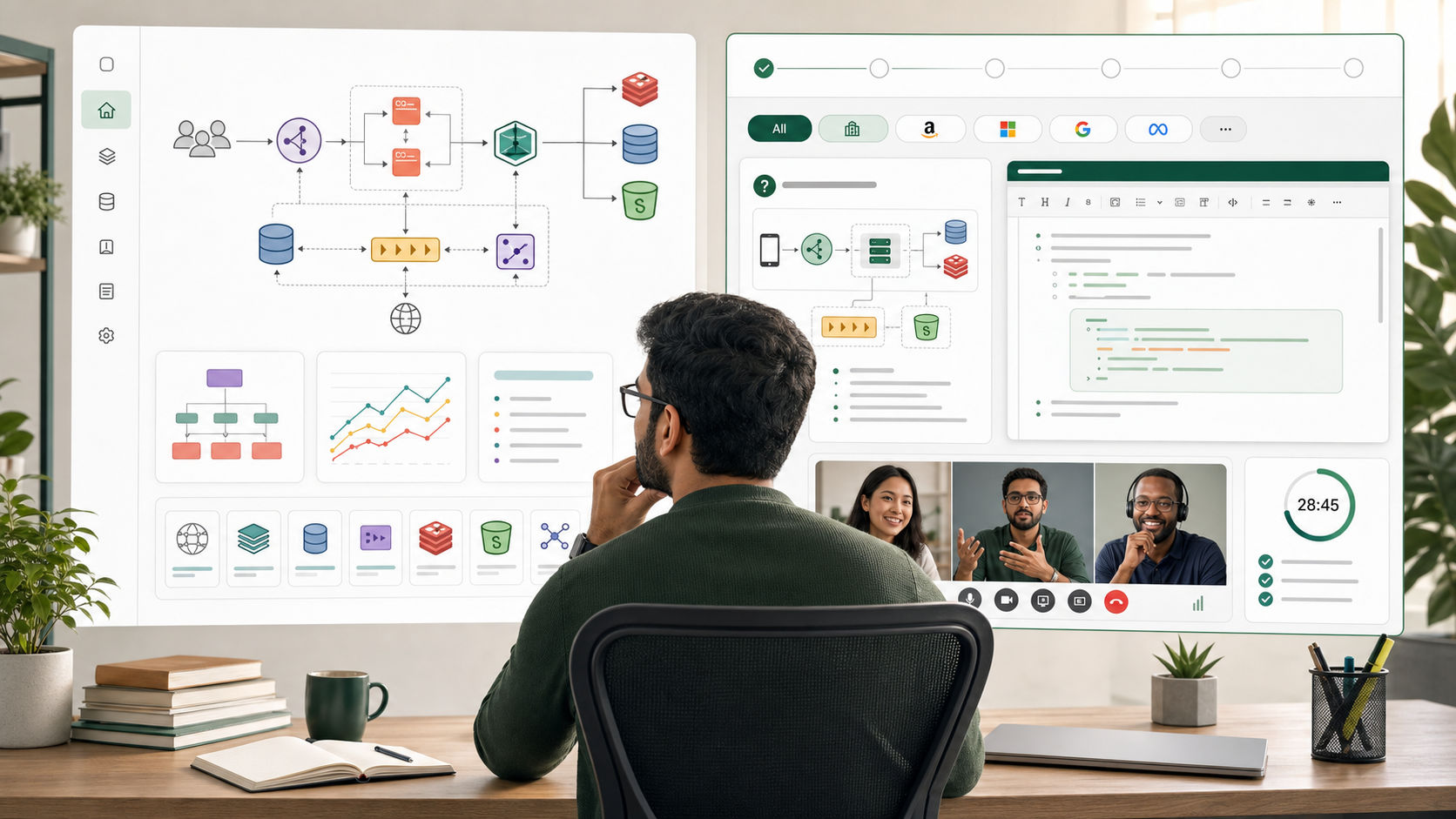
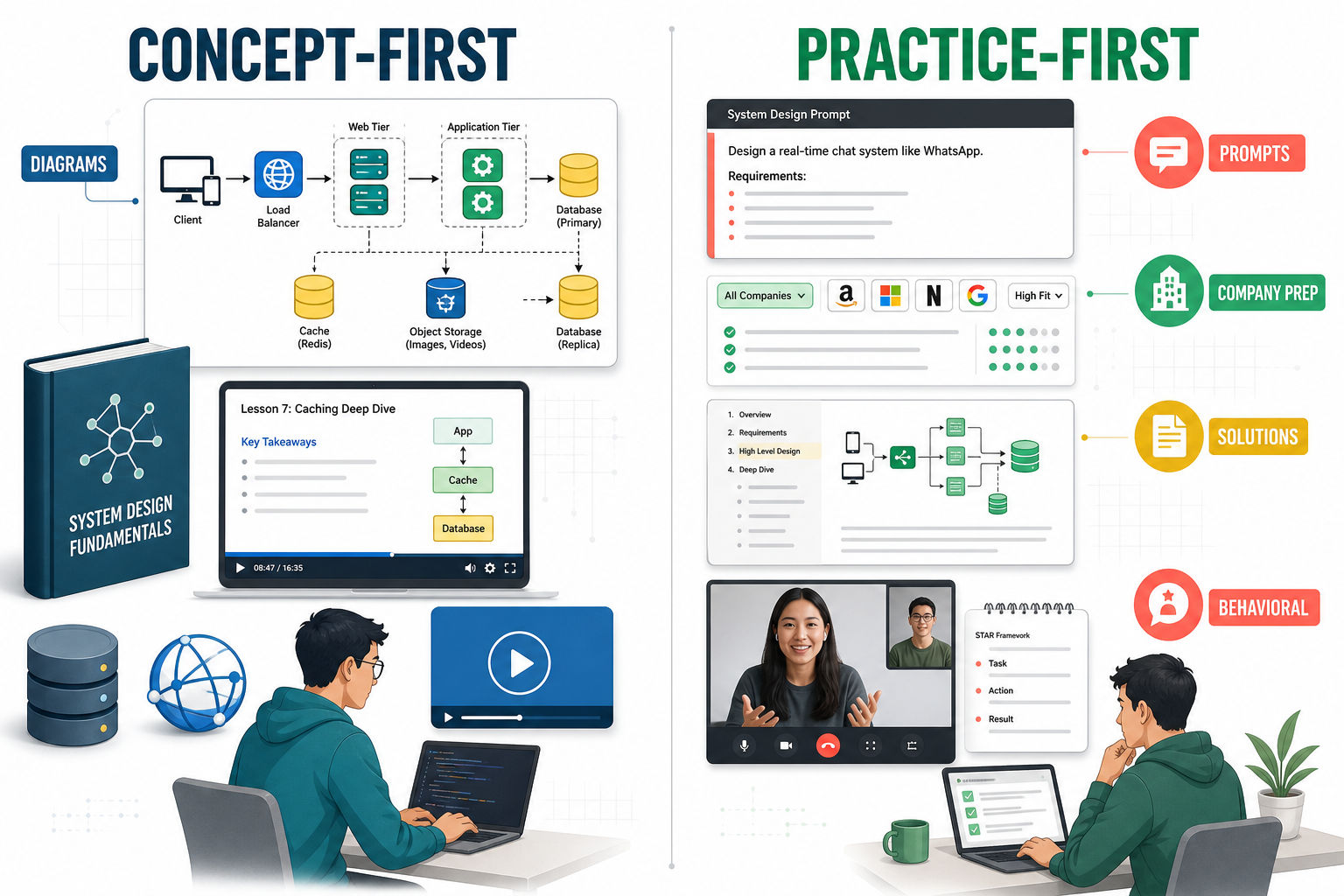
ByteByteGo is better for learning system design concepts. PracHub is better for practicing real interviews.
That difference matters.
A candidate can understand caching, sharding, queues, CDNs, indexes, and load balancers and still struggle when an interviewer asks messy follow-ups. Another candidate can watch a beautiful architecture breakdown and still freeze when asked to make tradeoffs for a specific company, role, scale, or user behavior.
That is why your prep should start with practice.
Use real interview questions with written solutions to get close to interview reality. Use company-specific interview prep to target the company you actually care about. If your loop includes architecture rounds, drill system design questions. If your role touches data or full-loop evaluation, add SQL interview practice and behavioral interview practice early.
Then use ByteByteGo as a concept layer when you find a gap.
That order is usually stronger than reading another course and hoping it turns into interview readiness.
Quick Verdict: ByteByteGo Teaches, PracHub Trains
ByteByteGo is best for candidates who want structured system design learning.
PracHub is best for candidates who want practical interview preparation built around real questions, written solutions, and company context.
Choose ByteByteGo if:
-
You want visual explanations of system design concepts.
-
You like text-based learning with diagrams.
-
You need a structured system design course.
-
You are preparing for mid-level, senior, or staff-level architecture interviews.
-
You want coverage beyond classic system design, including ML system design, generative AI system design, object-oriented design, coding patterns, and behavioral topics.
-
You have time to study before converting knowledge into interview reps.
Choose PracHub if:
-
You want to practice real interview-style questions.
-
You want written solutions you can review quickly.
-
You are preparing for a specific company.
-
You need system design practice, not just system design reading.
-
You want to cover coding, SQL, system design, and behavioral prep in one workflow.
-
You are not sure which round is your real weakness.
The practical recommendation:
Start with PracHub to diagnose the interview loop. Add ByteByteGo if system design fundamentals are the bottleneck.
What Is ByteByteGo?
ByteByteGo is a technical interview prep and engineering education platform created around visual explanations of complex systems.
Its homepage says the platform has over 5 million people learning on ByteByteGo, over 1,000,000 subscribers, and an all-in-one bundle for end-to-end interview prep. The site also says its courses are text-based and include detailed illustrations that explain interview concepts step by step.
ByteByteGo is especially known for system design.
Its System Design Interview course includes chapters on:
-
Scaling from zero to millions of users
-
Back-of-the-envelope estimation
-
A framework for system design interviews
-
Rate limiter
-
Consistent hashing
-
Key-value store
-
Unique ID generator
-
URL shortener
-
Web crawler
-
Notification system
-
News feed
-
Chat system
-
Search autocomplete
-
YouTube
-
Google Drive
-
Google Maps
-
Distributed message queue
-
Metrics monitoring and alerting
-
Hotel reservation system
-
S3-like object storage
-
Payment system
-
Digital wallet
-
Stock exchange
That curriculum is useful because many candidates do not know how to structure open-ended design problems.
ByteByteGo gives them a vocabulary.
PracHub helps them turn that vocabulary into interview practice.
What ByteByteGo Does Well
ByteByteGo is strong because it makes hard engineering concepts easier to see.
That is a real advantage in system design prep.
System design is not like a coding problem where the answer can fit in a function. It involves architecture, scale, bottlenecks, tradeoffs, reliability, data modeling, APIs, storage, observability, and communication.
Visual explanations help candidates build mental models faster.
Strong Visual Learning
ByteByteGo's biggest strength is visual explanation.
Instead of giving you only text, it shows systems as diagrams, flows, and components.
That helps with topics like:
-
Load balancing
-
Caching
-
Sharding
-
Replication
-
Message queues
-
CDNs
-
Rate limiting
-
Consistent hashing
-
Video streaming
-
Search indexing
-
Notification fanout
-
Metrics pipelines
-
Payment flows
For candidates who learn by seeing architecture, ByteByteGo can be very useful.
Strong Concept Coverage
ByteByteGo covers more than classic web system design.
Its pricing page lists interview prep areas such as coding interview patterns, system design, behavioral interview, object-oriented design, machine learning system design, mobile system design, and generative AI system design.
That breadth matters in 2026.
More interviews now blend software architecture with AI systems, ML infrastructure, product constraints, or role-specific design expectations.
If you need to understand what a modern architecture conversation can include, ByteByteGo is a good learning resource.
Strong for Candidates Who Feel Lost in System Design
Some candidates do not need more practice yet.
They need the basics.
They need to understand:
-
What requirements to clarify
-
How to estimate scale
-
How to define APIs
-
How to choose storage
-
How to split services
-
How to identify bottlenecks
-
How to discuss tradeoffs
-
How to avoid over-engineering
ByteByteGo can help with that foundation.
But once the foundation is in place, you need something else:
reps.
Where ByteByteGo Falls Short for Interview Prep
ByteByteGo's weakness is not content quality.
Its weakness is that learning content does not automatically create interview performance.
A real system design interview is live, ambiguous, and interactive. The interviewer changes the prompt. They push on your assumptions. They ask why you chose one database over another. They test whether you can communicate, adjust, simplify, and defend tradeoffs.
You cannot build that skill by reading alone.
It Can Become Passive Learning
Reading a polished system design explanation feels productive.
You understand the diagram. You follow the flow. You nod along when the article explains why a cache or queue helps.
Then the interview starts.
Suddenly you must decide:
-
Which requirements matter first?
-
Which scale assumptions are reasonable?
-
Which API should you expose?
-
Which data model is flexible enough?
-
Which bottleneck should you address now?
-
Which tradeoff should you mention without over-talking?
-
Which follow-up should you expect?
That is a different skill.
ByteByteGo helps you learn the pieces.
PracHub helps you practice using them.
It Is Not Company-First
Most candidates are not preparing for "a system design interview" in the abstract.
They are preparing for a specific company.
That company may care more about:
-
Distributed systems
-
Product tradeoffs
-
APIs and backend ownership
-
Data infrastructure
-
ML systems
-
Mobile architecture
-
Payments
-
Search
-
Ads
-
Messaging
-
Behavioral signals
-
Leadership and ambiguity
Generic system design learning can help, but it should not be the whole plan.
Use company-specific interview prep early so your system design practice matches the company and role.
It Does Not Replace Real Question Practice
The closer you get to an interview, the more your prep should look like the interview.
That means:
-
Start from a prompt.
-
Clarify requirements.
-
Estimate scale.
-
Propose a high-level design.
-
Define APIs and data models.
-
Identify bottlenecks.
-
Make tradeoffs.
-
Handle follow-ups.
-
Review your answer.
-
Try again without notes.
That is where system design questions are more useful than another passive lesson.
A 2025 research paper on technical interview preparation surveyed 131 software engineering candidates and found that candidates rarely train in authentic settings, while courses often fail to fully support preparation needs. That matches what many candidates feel: studying is easier than simulating the real interview.
Why PracHub Is Better for Real Interview Practice
PracHub is stronger when the goal is not "learn system design" but "prepare for my interview."
That is an important distinction.
The interview does not reward you for recognizing a diagram.
It rewards you for solving the prompt in front of you.
PracHub Starts With Real Questions
PracHub is built around real interview questions with written solutions.
That changes the workflow.
Instead of asking, "What course should I finish?", you ask:
"What would I do if this question came up tomorrow?"
Use this practice loop:
-
Pick a real interview-style question.
-
Attempt the answer before reading the solution.
-
Explain your assumptions out loud.
-
Sketch APIs, data model, and architecture.
-
Compare against the written solution.
-
Write down one missed tradeoff.
-
Re-answer the prompt the next day.
That is how system design knowledge becomes interview skill.
PracHub Connects Practice to Company Context
System design prep gets much sharper when you know the company.
An Amazon design answer may need stronger ownership and operational thinking. A Meta design answer may emphasize scale, ranking, feeds, and experimentation. A fintech company may care about consistency, auditability, payments, and failure handling. A startup may care about simplicity, scope, and speed.
Use company-specific interview prep before choosing your questions.
That helps you decide:
-
Which systems to practice
-
Which tradeoffs to emphasize
-
Whether the loop includes coding, SQL, or behavioral rounds
-
How much system design depth your level requires
-
Which topics are likely distractions
This is where PracHub has the clearer interview-readiness advantage.
PracHub Covers the Full Loop
Even if ByteByteGo helps with system design, your hiring loop may include more.
Many software engineering loops include:
-
Online assessment
-
Coding interviews
-
System design
-
Low-level design
-
Behavioral interview
-
Hiring manager conversation
-
Project deep dives
Some roles also include SQL, data modeling, analytics, debugging, frontend architecture, ML system design, or product tradeoffs.
PracHub helps you avoid over-preparing one round while ignoring the rest.
If the role includes data, use SQL interview practice. If the role is mid-level or senior, drill system design questions. If you are heading into an onsite or final round, use behavioral interview practice before the last week.
The goal is not to become busy.
The goal is to cover the loop.
ByteByteGo vs PracHub by Use Case
Here is the simple decision framework.
If You Need to Learn System Design Fundamentals
Use ByteByteGo.
If you do not understand caching, sharding, replication, queues, CDNs, rate limiting, API design, or back-of-the-envelope estimation, a visual course can help you build the base layer.
But do not stop there.
After each concept, practice one related PracHub question.
For example:
-
Learn rate limiting, then practice a rate limiter prompt.
-
Learn feed design, then practice a news feed or notification question.
-
Learn storage tradeoffs, then practice a file storage or media system prompt.
-
Learn queues, then practice messaging, delivery, or event aggregation.
Concept first. Prompt second. Review third.
If You Need Real System Design Interview Practice
Use PracHub first.
A system design interview is not a memory test. It is a live reasoning test.
You need to practice:
-
Clarifying vague prompts
-
Asking useful questions
-
Choosing scope
-
Explaining tradeoffs
-
Handling pushback
-
Recovering when your first design is too broad
-
Knowing when to simplify
-
Speaking clearly under pressure
Those skills improve through real prompts and review.
If You Are Preparing for a Specific Company
Use PracHub first.
Company context should shape the plan.
A generic "Design YouTube" answer is useful, but it is not enough if your target company is known for payments, infrastructure, AI systems, mobile design, data pipelines, or operational incidents.
Start with company-specific interview prep, then choose the question types that match your target.
If You Are a Senior Engineer
Use both, but sequence them carefully.
Senior candidates often need two layers:
-
Concept refresh for architecture patterns
-
Live practice for tradeoffs, ambiguity, and leadership signals
ByteByteGo can help refresh architecture ideas.
PracHub helps you practice answers that sound like an experienced engineer, not a course summary.
Senior-level system design answers should show:
-
Requirements judgment
-
Scope control
-
Failure handling
-
Data consistency tradeoffs
-
Operational awareness
-
Cost awareness
-
Team communication
-
Follow-up adaptability
Those qualities need practice.
If You Have Less Than Two Weeks
Start with PracHub.
When time is short, you need targeted reps.
Do not spend the whole week reading a course from start to finish unless your fundamentals are truly missing.
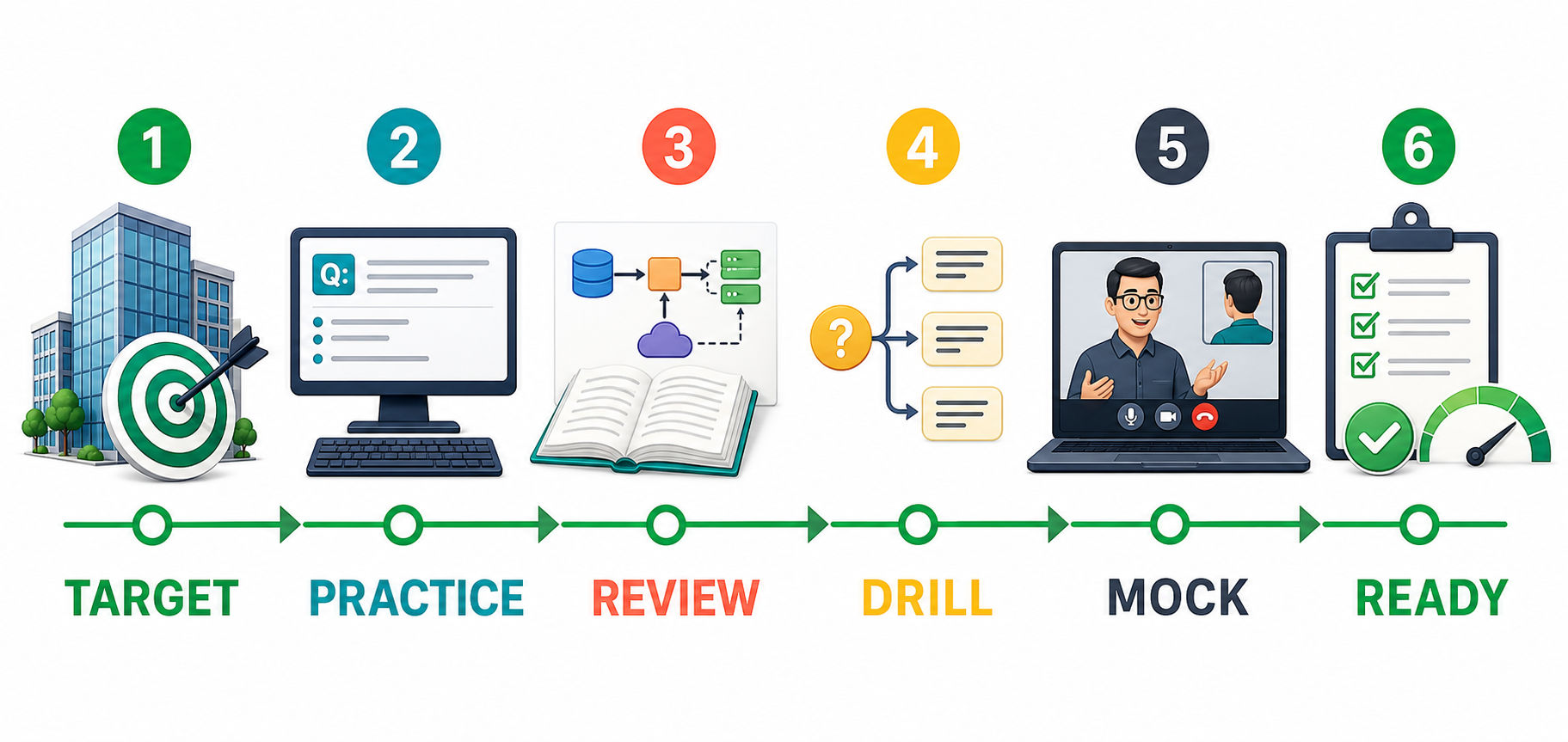
Instead:
-
Map the company and role.
-
Pick the likely round types.
-
Practice real questions.
-
Review written solutions.
-
Patch the biggest concept gap with ByteByteGo.
-
Return to practice.
That sequence keeps you close to the interview.
A Better System Design Prep Workflow
The best workflow is not "PracHub or ByteByteGo forever."
It is:
PracHub for diagnosis and practice. ByteByteGo for concept repair. PracHub again for interview reps.
Here is how to run it.
Step 1: Map the Interview Loop
Start with the basics:
-
Company
-
Role
-
Level
-
Interview date
-
Expected rounds
-
System design or low-level design
-
Coding difficulty
-
Behavioral expectations
-
Recruiter notes
Then open company-specific interview prep and shape your plan around the target.
Step 2: Take a PracHub Diagnostic
Practice one question from each likely round.
For a backend SWE loop, that might include:
-
One coding question
-
One system design question
-
One behavioral prompt
-
One debugging or architecture discussion
For a data-heavy SWE or infrastructure role, add SQL interview practice or data modeling practice if needed.
The point is to find the weak link.
Step 3: Use ByteByteGo Only Where the Concepts Are Weak
If you miss the rate limiter question because you do not understand distributed counters, read the relevant concept.
If you struggle with news feed design because fanout tradeoffs are fuzzy, review that.
If ML system design is on the loop and you have not seen feature stores, online serving, or recommendation pipelines, use a concept resource.
But keep it focused.
Do not turn a single weakness into a month-long content binge.
Step 4: Return to Real Questions
After concept review, go back to practice.
Try a new prompt without notes.
Then ask:
-
Did I clarify requirements faster?
-
Did I estimate scale more clearly?
-
Did I pick the right storage model?
-
Did I discuss tradeoffs instead of naming tools?
-
Did I handle follow-ups calmly?
-
Did I finish in time?
If yes, the concept review worked.
If no, keep drilling.
Step 5: Add Behavioral Practice Before the Final Week
System design interviews also test communication.
If your answer is technically correct but hard to follow, the interviewer may still lose confidence.
Use behavioral interview practice to prepare stories around:
-
Ownership
-
Ambiguity
-
Conflict
-
Failure
-
Technical disagreement
-
Cross-team communication
-
Tradeoff decisions
-
Leading without authority
Senior system design performance is not only architecture.
It is judgment under pressure.
7-Day PracHub-First System Design Plan
If your interview is soon, use this plan.
Day 1: Company and Loop Mapping
Use company-specific interview prep to identify likely rounds.
Write down the systems, topics, and behaviors that matter for your target company.
Day 2: First System Design Diagnostic
Pick one system design question.
Answer it out loud for 35 to 45 minutes.
Review the written solution and write down three misses.
Day 3: Concept Repair
Use ByteByteGo only for the missing concepts.
If you missed sharding, read sharding. If you missed queues, read queues. If you missed CDN or storage tradeoffs, review those.
Keep the session focused.
Day 4: Second Design Prompt
Try a different system design question without notes.
This time, focus on structure:
-
Requirements
-
Scale
-
APIs
-
Data model
-
High-level design
-
Bottlenecks
-
Tradeoffs
-
Follow-ups
Day 5: Full-Loop Patch
Do not let system design consume everything.
Practice one coding question, one behavioral answer, and one role-specific question. If the role includes data, add one SQL question.
Day 6: Mock Interview Simulation
Run one timed system design mock.
Record yourself or speak to a peer. The goal is not a perfect diagram. The goal is a clear, adaptable answer.
Day 7: Review and Re-Answer
Re-answer the two prompts you struggled with most.
Do not read the solution first.
If the answer is smoother, you are improving. If it still feels scattered, narrow the concept gap and practice again.
Common Mistakes to Avoid
Mistake 1: Reading Instead of Practicing
Reading system design content is useful, but it is not enough.
The interview requires you to produce an answer, not recognize one.
For every concept you study, practice at least one prompt.
Mistake 2: Memorizing Famous Systems
It is tempting to memorize YouTube, Twitter, Uber, Google Drive, or WhatsApp designs.
But interviewers can change the constraints.
They may ask about scale, latency, consistency, cost, failure handling, abuse prevention, ranking, data retention, or regional availability.
Memorized diagrams break under follow-ups.
Practice reasoning.
Mistake 3: Ignoring Company Context
System design is not the same everywhere.
The strongest candidates adapt the answer to the company, product, role, and level.
Use company-specific interview prep before deciding which systems to drill.
Mistake 4: Over-Engineering Too Early
Many candidates jump straight to microservices, Kafka, Kubernetes, multiple databases, global replication, and elaborate failover.
That can hurt you.
A good system design answer starts with requirements, then adds complexity only when the problem needs it.
ByteByteGo can teach the components.
PracHub practice helps you decide when to use them.
Mistake 5: Skipping Behavioral Prep
System design is partly behavioral.
You are showing how you think, collaborate, explain ambiguity, receive feedback, and make tradeoffs.
If you cannot tell a clear story about past architecture decisions, prepare that too.
FAQ
Is ByteByteGo worth it for system design interviews?
ByteByteGo can be worth it if you need structured system design learning with visual, text-based explanations. It is especially useful for candidates who lack architecture fundamentals. But it should not replace real interview practice. Use PracHub to practice prompts, review written solutions, and prepare by company.
Is PracHub a ByteByteGo alternative?
PracHub is a ByteByteGo alternative if your main goal is real interview practice. ByteByteGo is stronger as a learning resource. PracHub is stronger for practicing real questions, preparing for specific companies, and covering the broader interview loop across coding, SQL, system design, and behavioral rounds.
Should I use PracHub or ByteByteGo first?
Use PracHub first if you have an interview scheduled or do not know your weak area yet. Practice real questions, identify gaps, and prepare by company. Use ByteByteGo after that if the gap is system design fundamentals, architecture patterns, or visual concept review.
Does ByteByteGo cover more than system design?
Yes. ByteByteGo's pricing page lists coding interview patterns, system design, behavioral interview, object-oriented design, machine learning system design, mobile system design, and generative AI system design. Its core reputation is still strongest around visual system design and architecture learning.
Can ByteByteGo prepare me for real interviews?
ByteByteGo can help you understand the concepts that appear in real interviews, but it does not remove the need for live practice. Real interviews test communication, tradeoffs, follow-ups, scope control, and company-specific judgment. Pair ByteByteGo learning with PracHub practice for stronger readiness.
How should I practice system design questions?
Practice system design by answering full prompts out loud. Clarify requirements, estimate scale, define APIs, choose data models, sketch architecture, identify bottlenecks, and discuss tradeoffs. Then compare your answer with a written solution, re-answer the same prompt later, and repeat with company-specific questions.
Related Resources
-
Technical interview preparation research paper: https://arxiv.org/abs/2507.02068
-
PracHub questions: /questions
-
PracHub company prep: /companies
-
PracHub SQL interview practice: /questions?category=SQL
-
PracHub system design questions: /questions?category=System%20Design
-
PracHub behavioral interview practice: /categories/behavioral-and-leadership
Final Verdict: Use ByteByteGo to Learn, Use PracHub to Practice
ByteByteGo is a strong system design learning resource.
If you need visual explanations, architecture walkthroughs, and structured concept review, it can help.
But passing a system design interview requires more than understanding diagrams.
You need to answer real prompts, explain tradeoffs, handle follow-ups, target specific companies, and prepare for the full loop.
That is where PracHub should come first.
Start with real interview questions with written solutions. Use company-specific interview prep to focus your plan. Add system design questions, SQL interview practice, and behavioral interview practice based on the interview loop.
Then use ByteByteGo when you know exactly what you need to learn.
That is the best order:
Practice first. Patch concepts second. Practice again.
Comments (0)