Product Design Interview Questions: Explain Product Decisions, Trade-Offs, and Validation
Quick Overview
An original workshop-rescheduling case connects product design interview questions to scope, alternatives, confirmed and unknown outcomes, critique and validation.
Product design interview questions ask you to explain why a product should behave a certain way, which trade-offs you accept, and how you would test the decision. Make the user problem, constraints, alternatives, and evidence easy to follow alongside the screen.
This guide uses primary design guidance and an original fictional workshop-rescheduling case. The questions and sample answers are preparation exercises, not a company’s current interview loop. No user study or booking service was executed. Use PracHub’s Product Design & Strategy questions to practice explaining a decision, then let a follow-up change one assumption and see whether your reasoning still holds.
How do you clarify an unfamiliar design prompt?
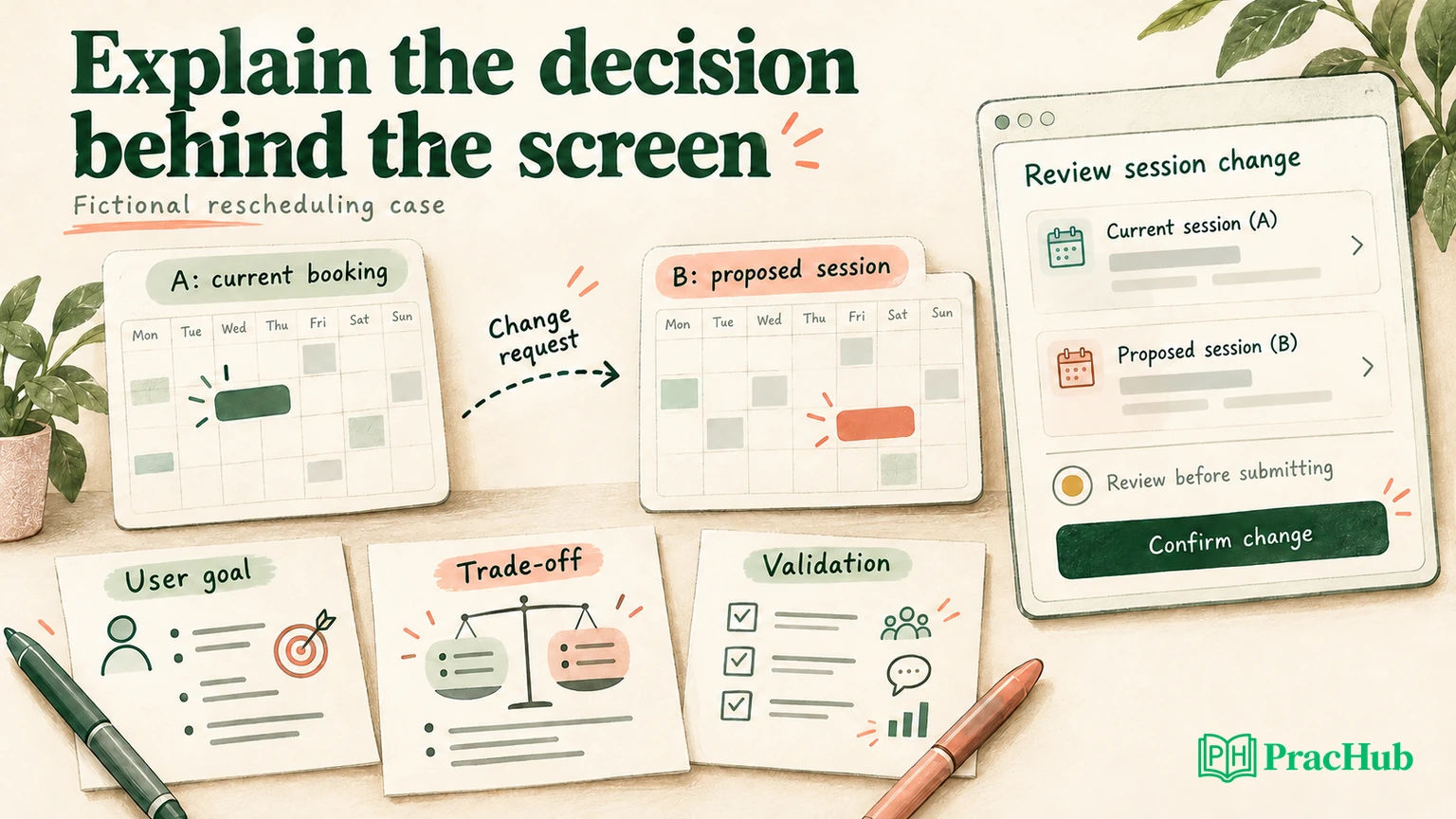
Start with the person, their task, and the consequence of failure. In the original fictional case, a participant already holds a place in workshop A and wants to move to workshop B. The organization wants fewer support-assisted changes, but the participant’s immediate concern is knowing whether the new place is confirmed without unexpectedly losing the existing one.
An opening answer could be: “I would clarify who can change a booking, the cutoff, whether a price difference exists, and how the service handles capacity. I would focus first on a participant changing one confirmed booking to another session.” Those questions define the scope. They do not require inventing a full marketplace or designing every administrative workflow.
If the interviewer cannot supply details, state bounded assumptions and continue. For this exercise, assume no payment difference and a backend that can report whether one change operation committed. Availability shown during selection may become stale. Those premises shape the interface; they are not properties of a real booking product.
NNGroup’s interview-answer guidance, published in 2022, distinguishes past behavioral accounts from hypothetical situational answers and encourages clear reasoning. Apply that distinction here: say “I would investigate” for a proposed action, and “we observed” only when you have an actual observation.
How do you choose the problem to solve first?
Explain the uncertainty with the greatest consequence for the chosen task. In the workshop case, the central issue is the commitment state: does the participant still have A, now have B, or need to wait for confirmation? A visually attractive calendar does not resolve that question on its own.
Consider the alternatives. One design cancels A before attempting B. That is simple to describe but can leave the participant without either place when B is full. Another creates B as a separate booking and later cancels A, potentially leaving two bookings or a confusing partial result. A coordinated change operation could better preserve the intended outcome, but its behavior must be agreed with engineering.
For this exercise, the proposed interaction uses that coordinated change operation. The design shows a review of A and B, submits one change request, and presents the confirmed result returned by the service. If that backend capability is unavailable, revise the flow and disclose the limitation. Do not draw a reassuring confirmation that the system cannot reliably support.
Prioritize the consequence of getting the commitment state wrong. Explain what you deferred: browsing recommendations, multi-person changes, and administrator overrides are outside the initial task. They may matter later, but they do not need to obscure the commitment question in the first answer.
How would you explain the interaction trade-off?
A review step adds effort before submission, but it can make the old and new session explicit. Show the workshop name, date, time, location, and relevant change conditions. Avoid a generic “Are you sure?” dialog that makes the participant remember which session they selected.
GOV.UK’s official check-answers pattern gives users an opportunity to review information before submitting it. It supports the purpose of a review step. It does not establish the fictional booking service’s capacity or transaction behavior, and it should not become a reason to add confirmation screens to every low-consequence action.
In a sample answer, explain what would change your choice: “If research shows that participants already understand the change and the action is reliably reversible, I would examine a shorter path. If the cost of a mistaken change is high or the reversal is uncertain, I would retain explicit review.” The decision depends on the task and evidence rather than a personal preference for fewer screens.
Keep control labels tied to the action. “Confirm change” is more specific than “Continue” at the commitment point. Before that point, a participant should be able to return to selection without changing the existing booking. Whether a completed change can be reversed is a separate product and system question; a back button cannot promise that reversal.
What should happen when the system cannot finish?
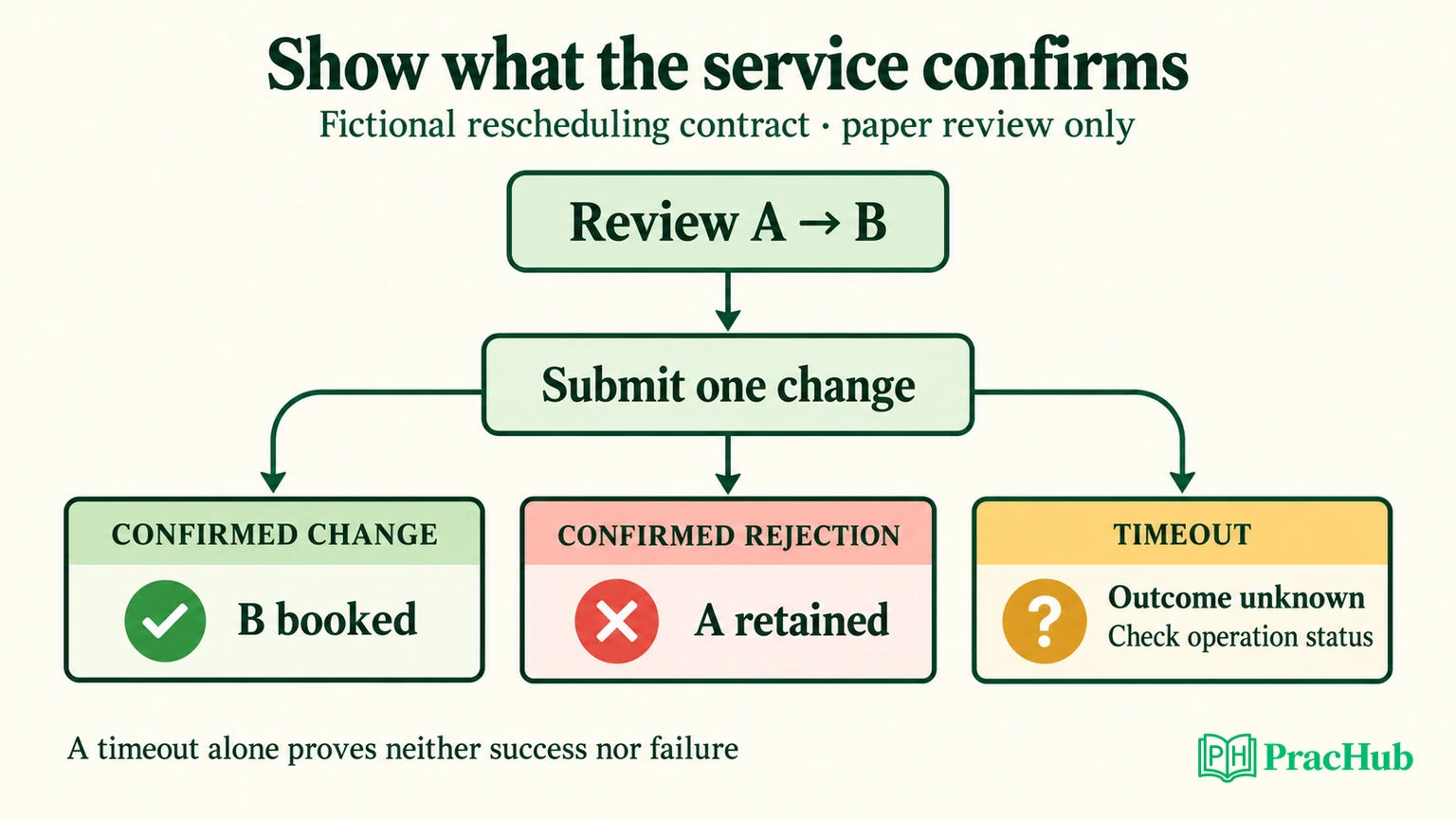
Define the states before polishing the success screen. In the fictional flow, the participant reviews A-to-B, submits a change, and waits for a result. The interface then needs distinct treatments for a confirmed change, a confirmed rejection, and an unknown outcome. These states are a proposed interaction contract, not a tested implementation.
If the service confirms success, show B and the updated booking reference or record. If it confirms that B is unavailable and no change occurred, show that A remains booked and offer another selection. The wording depends on an authoritative result. A stale availability label is not sufficient evidence to promise B.
If the request times out, the change may have committed even though the browser did not receive the response. Do not announce “A is safe” or “B is booked” while the outcome is unknown. Show that the result is being checked and use the operation reference to retrieve its status. Ask engineering how repeated submissions are handled before offering an unrestricted retry button.
An interviewer might ask, “What if the participant closes the tab?” Explain how they would return to a trustworthy booking record and see the current result. The product may need a notification, but a notification is not the underlying source of truth. Do not rely on an email arriving to determine whether the booking changed.
Make the uncertainty understandable and give the participant a recovery path. Engineering must define the operation and consistency guarantees, while support needs enough context to help a participant whose outcome remains unresolved. Use the mockup to identify which guarantees engineering must establish.
How would you validate the proposed design?
Separate comprehension, usability, system behavior, and product outcome. A participant may understand the review screen while the service still mishandles a concurrent booking. A technically correct change may still leave users uncertain about which workshop they hold. One check cannot stand in for the others.
For comprehension, propose tasks that ask participants to identify their current booking at selection, review, confirmation, rejection, and pending-result states. Avoid leading them with the answer. Include people who use assistive technology or need support relevant to the service. These are proposed research tasks here, not observations from a study.
For interaction, examine keyboard access, focus after a result, date and location clarity, error recovery, and the ability to leave without an unintended change. A screen reader should receive the relevant status information through an appropriate implementation. Do not declare accessibility based only on the visible wireframe or a checklist of intended labels.
For system behavior, agree on scenarios with engineering: B fills after selection, the request commits but its response is lost, a status check is delayed, and the participant returns later. The important question is whether each visible claim matches the authoritative state. This article reviewed the proposed states on paper; no concurrency or service test was run.
For product outcome, define successful rescheduling as a confirmed change to the intended session, not a click on the submission button. Consider unresolved outcomes, mistaken changes, support contacts, and loss of an existing place as possible guardrails. Measure a defined cohort and time window. A prototype task study cannot establish the deployed service’s operational result.
How do you respond to design critique?
Restate the goal and the concern before defending the screen. If the interviewer says the flow feels slow, ask which step creates unnecessary effort and whether they are challenging the review step, the waiting state, or the backend assumption. Those concerns lead to different changes.
NNGroup’s design-critique guidance, published in 2016, frames critique around agreed objectives and a clear scope. Use that principle to keep the discussion about the user task. “I prefer a modal” is a taste statement; “participants may miss the old-session details on this layout” is a claim you can investigate.
You can accept a useful idea without pretending the original design was validated. For example, show the A-to-B summary on the selection page and evaluate whether a separate review is still needed. Preserve the commitment-state protections while exploring a shorter interaction. If the proposed change depends on stronger backend behavior, state that dependency rather than silently assuming it.
Atlassian’s official design interview handbook is one employer’s example of discussing product thinking, craft, and specific contributions. It supports preparing to explain decisions. This article does not generalize its interview structure to other companies or use it as evidence of a universal scoring rubric.
How should you discuss a past design decision?
For a past project, start with the actual problem and your role. Identify the input that changed your approach, an alternative you considered, the choice the team accepted, and the result you can substantiate. Credit research, product, engineering, content, and other designers where their work shaped the outcome.
Do not replace a missing outcome with a confident narrative. If the project reached a prototype but did not ship, say so. If a feature shipped differently from the design, explain the constraint and what you learned from the implementation. If a business metric moved, distinguish the observation from your attribution of the change.
A portfolio case can supply the artifact behind the answer. The separate Product Designer resume guide focuses on packaging contribution and release evidence. In an interview answer, use that evidence to explain the decision instead of walking through every portfolio slide in order.
What makes a practice answer specific enough?
Try removing the product and user from your answer. If the explanation still works unchanged for any app, it may be too abstract. In the workshop case, capacity can change between selection and commitment, an existing reservation has value, and a timeout leaves the visible outcome uncertain. Those facts should shape the interaction and the validation plan.
Select the screens that reveal the decision and its consequences. It needs a clear decision, a reasoned trade-off, an honest evidence boundary, and a next check. Be ready for a changed assumption: a price difference, a group booking, or a backend that cannot coordinate the change. Explain how that affects scope rather than adding unsupported behavior to the original design.
Practice product decisions with concrete follow-ups
These PracHub questions include design and adjacent product or engineering perspectives. They are transferable exercises, not a prediction of a particular company’s interview. Keep the original context visible when adapting them to your design practice.
| PracHub question | Decision to explain |
|---|---|
| Children’s Bookshelf Product Design | Identify the user, environment, and consequence before choosing features. |
| Supermarket Experience Design | Connect an interaction choice to a specific journey problem. |
| Indeed job marketplace critique: choose a user segment and design an upgrade | Choose one segment and explain what you deliberately defer. |
| Describe a Trade-off Design Change | Show how a constraint changed the accepted solution. |
| Remittance app retention: diagnose churn, prioritize fixes, and design validation tests | Separate an observed symptom from a hypothesis and an appropriate test. |
Choose one question from the Product Design & Strategy collection. Explain the user decision and sketch the success, rejection, and uncertain-result states. Ask a practice partner to change one constraint, then revise the reasoning while preserving what the existing evidence actually establishes.
Comments (0)