Product Designer Resume Examples: Show Decisions, Collaboration, and Shipped Work
Quick Overview
Original product designer resume examples and a bulk-archive interaction case show attributable decisions, partial-failure states, collaboration and release evidence.
Product designer resume examples should explain a product decision you made, the people you worked with, and what reached users. “Designed screens in Figma” describes a tool activity. Connect an interface choice to a user problem, show the constraint behind it, and state whether the work remained a concept, reached engineering, or shipped.
This guide uses primary portfolio guidance and an original fictional bulk-archive case. The resume excerpts are illustrations, not successful applications, and the interface was not implemented or tested with users. Use PracHub’s Product Design & Strategy questions to rehearse the reasoning behind your own portfolio evidence rather than memorize a polished account you cannot defend.
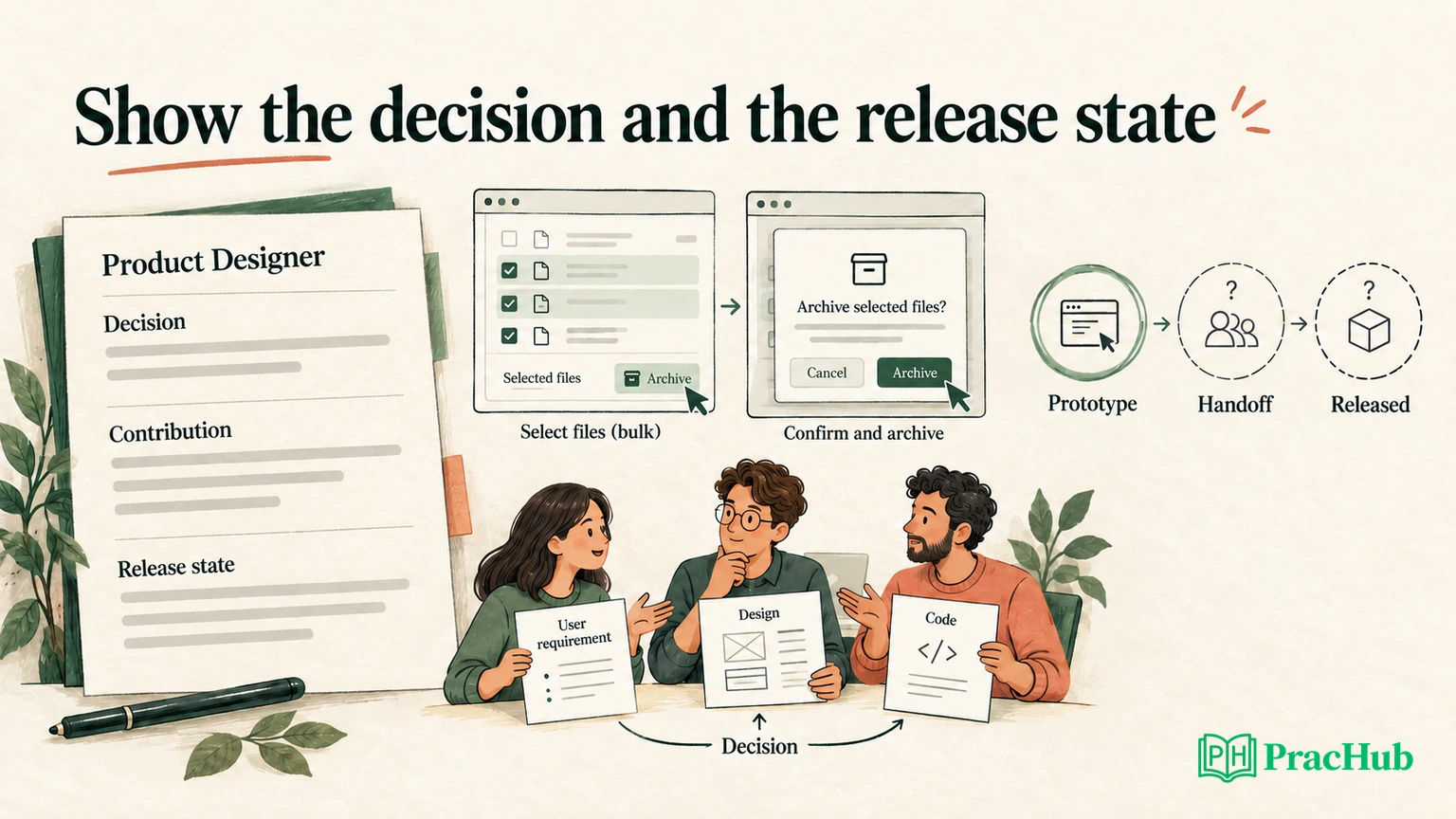
Select evidence for the product design role
Product design openings vary in emphasis: interaction craft, complex workflows, discovery, visual systems, prototyping, or cross-team direction. Read the actual job requirements and choose work that demonstrates the relevant judgment. A broad title does not make every capability yours, and attending research sessions does not mean you owned the research.
NNGroup’s UX-design portfolio guidance recommends showing the problem, personal role, constraints, and iteration rather than only finished screens. Published in 2019, it is professional portfolio guidance, not a report of a current employer’s interview loop. Its relevance here is the evidence behind the application, not a mandatory presentation template.
Use each resume bullet as an entry point into a specific portfolio decision. State what kind of product problem you work on, then use a few specific contributions to substantiate it. Put tools in a concise skills section when they matter to the role. Do not let a list of components or software names replace the decision a reviewer needs to understand.
Three examples with honest delivery states
The following excerpts are fictional demonstrations. Replace their projects and responsibilities with your own verified work. The wording is useful only when the supporting artifact exists and its status is accurate.
Early-career example: “Designed an independent file-archive concept that distinguishes visible-page selection from all matching results; documented confirmation, partial failure, and retry states.” The independent-concept label prevents a reviewer from mistaking an exercise for shipped customer work. The portfolio should show the decision and the untested assumptions, not invent a launch metric.
Experienced designer example: “Owned the interaction specification for a bulk-archive workflow; aligned selection scope and partial-failure behavior with product and engineering, then delivered annotated states for implementation.” That supports a handoff claim. It does not establish that the released product matched the specification or that the workflow improved customer outcomes.
Lead example: “Coordinated design review and release follow-up for an administrative workflow across two product teams; documented the accepted interaction contract and tracked deviations through rollout.” In real use, support this with the review record and release evidence. If rollout was cancelled or involved only a pilot group, name that boundary rather than calling it a general launch.
Each example names a different responsibility and delivery state. They are not a progression in which every candidate should claim all three. A focused contribution can be strong evidence when it reveals real judgment. An expansive ownership claim becomes fragile if the interviewer asks which decision was yours, who approved it, or what users actually received.
Build a case around a decision that changes behavior
Consider an original fictional file-management product. An administrator sees twenty-four files on one page out of 184 matching a filter. Three visible files are locked and cannot be archived. Product wants a faster bulk action, while support worries that “Select all” could imply every matching result rather than the current page.
The design decision is to select only eligible files on the visible page and label that scope explicitly. In this example, twenty-one files become selected. The 160 results on other pages remain outside the selection. The three locked visible files remain excluded with a reason. Those counts are demonstration inputs, not measurements from a real product.
A portfolio should explain the rejected alternative. Selecting all 184 matching results could help a high-volume administrator, but it needs an explicit change of scope, a trustworthy eligibility count, and an appropriate confirmation. Quietly expanding the selection after a page-level click would change the user’s action without clear consent. The page-only scope limits the first iteration while the team resolves eligibility across all results.
GOV.UK’s official checkbox guidance describes multiple-option selection and the need for clear labels and grouping. It supports explaining the selection control. It does not define this product’s bulk-action scope, server authorization, or archive policy; those remain decisions the product team must specify.
Show selection, failure, and recovery states
The fictional interaction starts with no selection. After the visible-page action, the interface says “21 files selected on this page.” A review step repeats the scope and explains that locked files are excluded. Before confirmation, cancelling returns to the list without changing any file. Do not describe that cancellation as an undo of a completed server operation.
After submission, the server must recheck eligibility. Suppose eighteen files are archived and three fail because their state changed. The result should distinguish the eighteen completed actions from the three remaining failures. The three files locked at the start were never attempted; they are not the same set as the three that failed after confirmation.
The retry action targets the failed files only. An undifferentiated “Try again” message may leave the administrator unsure whether eighteen completed actions will run twice. The design needs a clear result and a recovery route, while engineering must define the actual retry and idempotency behavior. A designer should ask that question rather than promise a backend guarantee in a mockup.
Accessibility belongs in this state discussion. Explain the control’s accessible name, keyboard operation, focus after cancellation, and how a result becomes available without forcing a user to search the page. W3C’s official status-message guidance concerns programmatically conveying qualifying status changes without moving focus. A visual toast alone does not demonstrate that behavior.
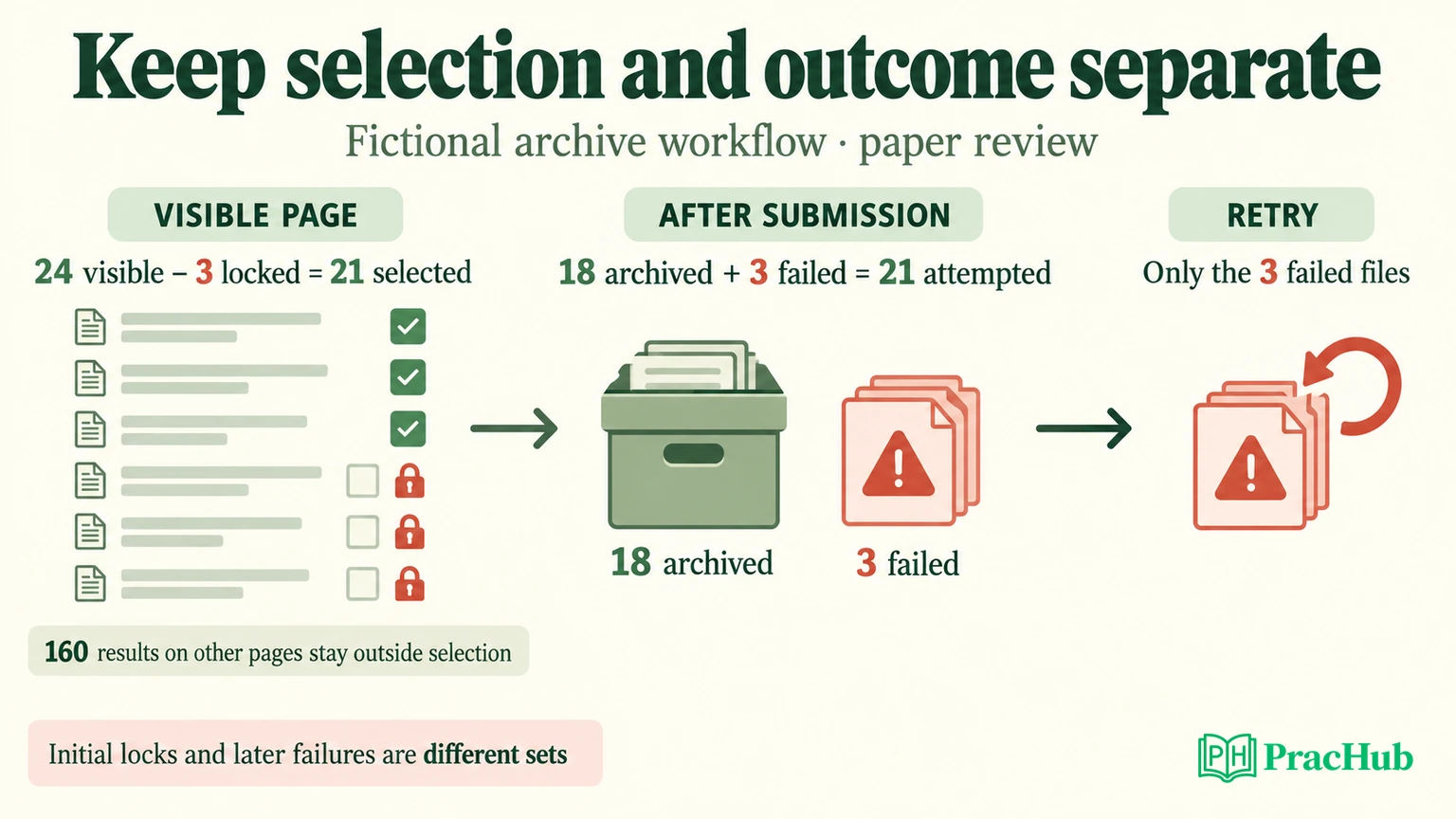
For this article, the sequence was reviewed on paper: twenty-four visible minus three initially locked equals twenty-one selected; eighteen successes plus three later failures accounts for the attempted selection. No browser prototype, server, screen reader, or usability study was executed. Your own portfolio should identify which of those checks you actually performed.
Make collaboration attributable
Explain what each function contributed to the decision. In the fictional case, product defines the administrative task and scope, design makes selection and recovery understandable, engineering establishes eligibility and retry behavior, and support contributes common misunderstanding patterns. Research may investigate how administrators interpret the labels. Those are possible responsibilities to agree, not assumptions about every team.
A useful collaboration artifact is a short decision note with the disputed choice, alternatives, rationale, and owner. For example: “We retained page-only selection for this iteration because eligibility across filtered results was not available reliably; engineering will evaluate an explicit all-results action separately.” That gives the interviewer a concrete trade-off to question.
Replace “worked cross-functionally” with the input that changed your design. Say which input changed your design. If an engineer showed that a proposed undo could not restore every archived item, explain how you revised the recovery language. If product chose a broader scope than you recommended, describe your reasoning and the accepted decision without rewriting the disagreement as unanimous enthusiasm.
For a lead role, show how you helped others reach a decision or maintain a coherent interaction across teams. Do not claim authorship of every screen produced under your direction. A review rubric, resolved inconsistency, or agreed contract may better represent the contribution than a large screenshot montage.
Prove what shipped and what did not
Create a small release record behind a resume claim. It should distinguish the prototype version, implementation review, rollout audience, and observed production behavior. Record deployment evidence separately from approval of the design file. A developer saying “done” is not evidence that all eligible users received it. A pilot can be valuable without becoming a general release in the resume.
For the fictional archive case, the honest current state is a paper interaction concept. To claim a handoff, there would need to be an actual accepted specification. To claim shipment, there would need to be release evidence and a defined audience. To claim improvement, there would need to be appropriate observation or measurement after the change. Each stronger verb needs additional evidence.
Figma’s official early-career portfolio advice, published in 2024, explicitly allows exploratory and unshipped work when candidates explain their thinking. It also discusses measurement plans when results are unavailable. That is advice in Figma’s early-career context, not permission to present a proposed metric as an achieved outcome elsewhere.
If a project shipped differently from your design, show the difference and explain the constraint. Perhaps the team released page-only selection but deferred the detailed failure view. Your application can describe the portion delivered and the unresolved issue. Hiding that gap makes the portfolio less useful for a technical follow-up.
Use outcomes with a defensible denominator
Product results can strengthen a resume when you can explain their definition and your contribution. If administrators completed a task faster, state what task, who was included, how time was measured, and what comparison supports the claim. If support contacts declined, consider changes in usage volume, policy, and product behavior before attributing the movement to your interface.
A usability observation supports a different statement from a production experiment. A small moderated task study may reveal a recurring scope misunderstanding; it does not automatically establish a population-wide error reduction. A shipped feature may be useful even when instrumentation is incomplete, but incomplete instrumentation does not justify inventing a percentage.
When outcome evidence is unavailable, describe the documented change and a measurement plan. For the archive case, useful future questions include whether administrators understand the selection scope, recover from partial failure, and avoid unintended actions. These are proposed evaluation questions here. They are not findings, acceptance scores, or a claim that the design is safe to ship.
Make the application itself easy to inspect
Link each major project to its relevant case rather than requiring a reviewer to browse a general gallery. Give the case a clear problem statement, your role, dates or phase, and release status. Use authorized material. A product screenshot can expose customer names, unpublished features, or internal workflows even after the company logo is removed.
Keep the portfolio readable on a narrow screen and check image loading, link access, and text size. Include text explanations for decisions that a screenshot cannot convey. If you cannot share employer work, use an independent concept and label it. Do not reconstruct restricted material and rely on a fictional name to make the disclosure acceptable.
Practice the follow-up behind the resume bullet
These PracHub questions include product-design and adjacent product or engineering perspectives. Use them as practice for explaining decisions, not as a guaranteed product-designer interview syllabus. Keep the original role context in mind when adapting an answer.
| PracHub question | Evidence to explain |
|---|---|
| Enterprise Process Management Tool Design | Define the administrative task and the cost of an ambiguous bulk action. |
| Favorite App – New Feature Design | Explain which problem your proposed feature addresses and what remains untested. |
| 45-Minute Rapid Product Design Exercise | Prioritize the interaction states that make the concept understandable. |
| Explain a past product's design system: principles, components and trade-offs | Show why a reusable component still needs a product-specific scope rule. |
| Partnering with Product and Design: Roadmaps, Priority Trade-offs and Multi-Team Delivery | Separate your decision, the accepted team choice, and actual delivery. |
Pick one resume bullet and open its case. Rehearse a follow-up from the Product Design & Strategy collection, then identify the strongest claim you cannot yet substantiate. Replace it with the actual design, collaboration, or release evidence before submitting the application.
Comments (0)