Python contextvars Interview Questions: Async Tasks, Threads, and Request State
Quick Overview
Understand Python contextvars through original task-capture, shallow-copy, token restoration and thread-propagation exercises, with version-specific boundaries.
Two requests share one event-loop thread. Request A sets a logging ID, suspends while awaiting I/O, and later prints request B's ID. A thread-local value cannot separate work that overlaps on the same thread. Python contextvars provides context-local bindings, but it does not automatically make every value private or every background operation safe.
For Python contextvars interview questions, start with three boundaries: when a context is captured, which execution context receives a binding, and who owns the object stored in that binding. These boundaries explain task inheritance, thread propagation, cleanup, and surprising request-state leaks more accurately than “it's a global variable for async code.”
Evidence boundary: Python documentation establishes the API behavior cited below. The traces and exercises are original examples; their saved checks ran on CPython 3.12.14. Python 3.14 additions are documented separately and were not executed in that runtime. No candidate report supports a claimed interview frequency. For related practice, use PracHub's Software Engineer questions.

What problem does contextvars solve?
Official rationale: PEP 567 introduces context variables for context-sensitive state in asynchronous execution and explains why thread-local storage is insufficient for overlapping tasks. PEP 567.
Consider an original service with two requests. Each request must carry a correlation ID through several helper functions. Passing it explicitly is a valid design, especially at public interfaces. A context variable becomes useful when logging or tracing helpers need that ID without adding a parameter to every internal call.
from contextvars import ContextVar

request_id = ContextVar("request_id", default="unset")

def log_label():
    return request_id.get()
The declaration is shared. The selected value depends on the current context. Do not confuse one variable object with one process-wide value.
A useful interview follow-up asks whether a database session should also live there. Separate convenience from ownership: finding a session through context does not establish its transaction lifetime, close it, or make it safe for parallel use. Explain the resource's actual contract instead of assuming the storage mechanism solves it.
For the correlation ID, a missing default may expose an integration mistake immediately. An innocuous default can also be reasonable for startup logs. Choose intentionally: silently falling back to another tenant's identity would be a serious design error. Logging context should describe an operation; it should not replace explicit authorization.
When does a child Task receive the parent's value?
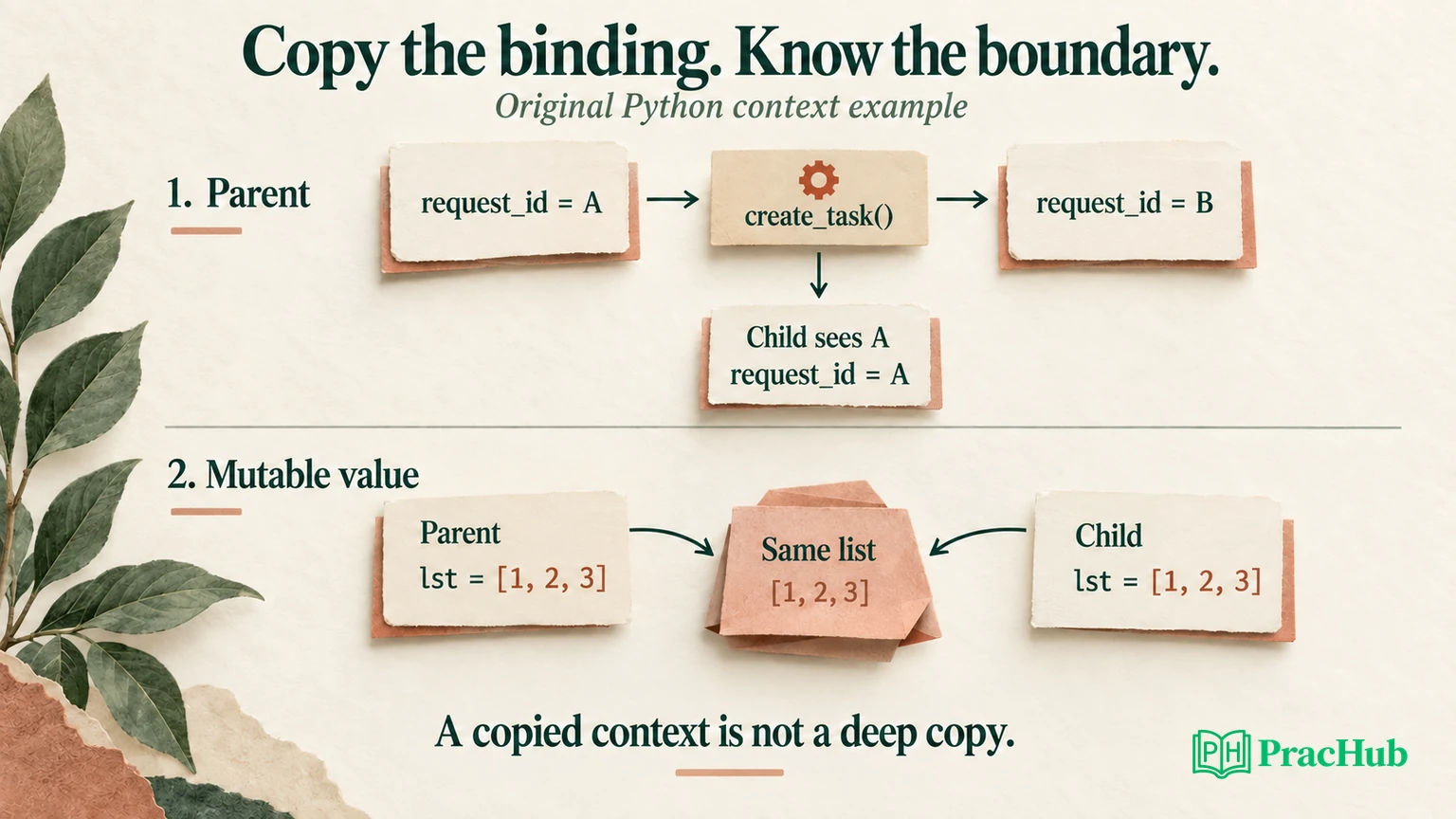
Official task behavior: asyncio.create_task() copies the current context when no explicit context is supplied. A custom context= argument is available from Python 3.11. Python asyncio documentation.
Now predict this original example before running it. The event forces the child to read only after the parent changes its binding.
import asyncio

async def child(gate):
    await gate.wait()
    seen = request_id.get()
    request_id.set("child")
    return seen

async def capture_example():
    token = request_id.set("A")
    try:
        gate = asyncio.Event()
        task = asyncio.create_task(child(gate))
        request_id.set("B")
        gate.set()
        seen = await task
        return seen, request_id.get()
    finally:
        request_id.reset(token)
The saved local check returns ("A", "B"). The child observes the binding captured at creation. Its later set("child") does not replace the parent's B binding.
| Event | Parent binding | Child binding |
|---|---|---|
| Set A | A | No child yet |
| Create task | A | Captures A |
| Parent sets B | B | Still A |
| Child reads, then sets child | B | A, then child |
Calling an async def function produces a coroutine object; that alone does not create a Task. If you later await that coroutine directly, reason about the context in which its body executes. If you wrap it in a Task, reason about Task creation. Naming both events prevents a common “captured when called” mistake.
The await inside a Task is not an instruction to adopt whatever another Task most recently set. The context follows the running Task across suspension and resumption. This is the distinction that makes concurrent request logging useful.
Why can a copied context still share mutable state?
Official value boundary: Context.copy() is a shallow copy. Python also documents an O(1) copy_context() operation. Python contextvars documentation.
A shallow binding copy can retain a reference to the same list. Here is an original counterexample:
from contextvars import copy_context

items = ContextVar("items")
token = items.set([])
try:
    copied = copy_context()
    copied.run(lambda: items.get().append("shared"))
    assert items.get() == ["shared"]
    copied.run(items.set, [])
    assert items.get() == ["shared"]
finally:
    items.reset(token)
The first operation mutates the shared list. The second assigns a new list only within the copied context. Mutation and rebinding are different operations, even though both can look like “changing context state.”
The local fixture confirms these outcomes. A copied context is not a defensive deep copy of an arbitrary request object graph.
Prefer immutable identifiers or immutable request metadata when they satisfy the job. If a mutable value is necessary, allocate it at the correct request boundary and define whether child tasks may share it. A mutable default, such as default=[], is particularly easy to reuse across otherwise unrelated contexts that have not set their own value.
Do not respond by deep-copying every database session, lock, or client. Those objects often represent resources whose identities matter. Choose explicit ownership or synchronization, and use context only as the lookup mechanism when appropriate.
How should request middleware restore state?
Official API contract: set() returns a token; reset(token) restores the previous binding, including absence. Tokens are single-use. Python 3.14 adds token context-manager support. Python contextvars documentation.
For versions before that convenience, bracket the scope explicitly:
async def handle_request(identifier, operation):
    token = request_id.set(identifier)
    try:
        return await operation()
    finally:
        request_id.reset(token)
Restoring the previous value is better than hardcoding set(None) at exit. A nested operation might temporarily replace an outer correlation ID; its exit should restore the outer ID rather than erase it.
In the saved exception fixture, the outer scope contains outer, a directly awaited helper sets nested, and the helper raises. Its finally restores outer. Resetting an already-used token raises RuntimeError in the local check. Cleanup should run once at the boundary that created the token.
For cancellation, preserve the same cleanup structure. Official cancellation guidance: asyncio recommends try/finally for cleanup and generally propagating CancelledError after cleanup. Python asyncio documentation.
Also distinguish request cleanup from child lifetime. Resetting the parent's binding does not erase a value already inherited by a child. A background task can outlive the request while retaining its captured metadata. Decide whether that retention is desirable; do not assume the middleware's exit changes every descendant.
An intentional background job should receive the minimum metadata it needs. Durable jobs need an explicit serialized envelope across the queue boundary. An in-process context variable does not magically propagate to another process or a remote consumer.
What changes when work moves to a thread?
Official propagation: asyncio.to_thread() propagates the current context into its worker. Python asyncio documentation.
Capture timing still matters because to_thread() returns a coroutine. These original local checks deliberately differ:
request_id.set("A")
deferred = asyncio.to_thread(request_id.get)
request_id.set("B")
assert await deferred == "B"
Here the to_thread coroutine executes when awaited under B. Compare a Task wrapper:
request_id.set("A")
worker = asyncio.create_task(asyncio.to_thread(request_id.get))
request_id.set("B")
assert await worker == "A"
The wrapper Task already captured A. Both checks pass in the saved fixture. This is a stronger explanation than memorizing “threads inherit context.” Specify the adapter and capture event.
For an executor, PEP 567 gives an explicit propagation recipe using copy_context().run. In the original test, a fresh one-worker ThreadPoolExecutor receives run_in_executor(pool, request_id.get) and returns unset; wrapping the callable in a freshly copied context returns request. Do not turn that observation into a universal promise about every framework's executor wrapper. PEP 567.
ctx = copy_context()
result = await loop.run_in_executor(pool, ctx.run, request_id.get)
Use a separate context copy for concurrently entered worker calls. Official entry rule: entering a context that is already entered, including in another thread, raises RuntimeError. Python contextvars documentation.
Version-specific thread behavior: Python 3.14 adds Thread(context=...). With the default None, sys.flags.thread_inherit_context controls inheritance; the default flag differs between free-threaded and other builds. Explicit Context() or copy_context() makes intent visible. These 3.14 constructor options were not part of our 3.12 execution checks. Python threading documentation.
How do you debug incorrect request labels?
Create a small trace with request ID, task identity, and the boundary where each value was set. Avoid logging secrets or full request payloads. A deterministic event or barrier is more useful than hoping random sleeps reproduce an interleaving.
If the wrong value appears only in worker logs, compare to_thread, the executor wrapper, and any explicit context passed by the framework. If unrelated tasks mutate one shared dictionary, inspect object identity and allocation. If only nested operations lose the outer label, inspect token ownership and restoration.
Return worker results explicitly. Setting a new binding in a copied worker context is not a response channel that updates the caller's binding. If the worker needs to return a generated span ID or status, return it as data and let the caller choose how to use it.
An interview answer should also separate logging correctness from thread safety. Context isolation is useful for finding metadata. A counter, cache, or transaction shared through that metadata still needs its own concurrency contract. This distinction stops the same mistake from recurring in a different form.
Trace two requests and one delayed job
Use this original interview variation to connect the rules. Request A enters middleware, sets A, and creates a child that waits for a signal. Request B enters a different Task and sets B. A's child resumes after B has logged. Under default Task context copying, the child should still read A. A thread-local implementation that stores one ID on the shared event-loop thread cannot express those separate task bindings.
Now let request A finish before signaling its child. The parent resets its token, but the child still has the previously captured A binding. That can be correct for a related tracing operation. It can also be unwanted retention if the child carries a large mutable request object. Describe the intended lifetime before calling the behavior a leak.
Finally, submit a durable job to another process. Store a deliberately selected correlation ID in the job message, validate its envelope, and establish a new scope in the consumer. Do not treat the producer's context as a security credential. This variation tests three distinct outcomes: task isolation, retained child metadata, and explicit cross-process transfer. One blanket statement about inheritance cannot answer all three.
Practice the execution-boundary explanation
These verified PracHub questions exercise related Python and concurrency skills. They are not claimed to be contextvars-specific employer prompts.
| PracHub practice question | Focus for this topic |
|---|---|
| Debug missing output in Python async HTTP flow | Separate coroutine creation from actual execution. |
| Compare Python Generators, Decorators, and Context Managers | Explain scoped state and deterministic cleanup. |
| Code Review: Thread Safety of a Python Compute-and-Cache Function | Distinguish context-local lookup from shared-object safety. |
| Python Language and Runtime Fundamentals | State runtime and version assumptions precisely. |
| From Take-Home Script to Production: Python Trade-offs and Hardening a Data Job | Carry deliberate metadata across worker boundaries. |
For each exercise, answer four concrete questions: what creates the context, when is it captured, what object is shared, and what restores the previous binding? If you cannot name those events, a correct-looking log line may be accidental.
Comments (0)