Q-Learning Interview Questions: Bellman Targets, Terminal States, and Off-Policy Updates
Quick Overview
A Q-learning interview guide with original one-transition and two-state chain exercises. Compute off-policy targets, distinguish terminal states from external cutoffs, test negative and masked action values, and explain the assumptions behind tabular convergence.
A Q-learning answer can contain the right equation and still implement the wrong update. Common mistakes include bootstrapping after a true terminal state, cutting off value at an external time limit, or using the next action chosen by the behavior policy where the target requires a maximum. A one-transition numerical check can expose these errors before a training run.
The central distinction is between the policy collecting experience and the target used to learn from it. This guide uses original tabular exercises, grounded in primary Q-learning research and current Gymnasium documentation. It does not claim a particular employer's interview format or question frequency; no corroborated candidate-report set establishes those claims.
Begin with Explain the Bellman Equation, then calculate the update below before writing code.

What is the Q-learning Bellman target?
Primary research: Watkins and Dayan's Q-learning paper describes learning action values from experienced transitions without requiring a known transition model. In the tabular discounted case, the target uses the best estimated action value in the next state.
For a nonterminal transition (s, a, r, s_next), calculate:
target = r + gamma * max_b Q(s_next, b)
TD error = target - Q(s, a)
Q_new(s, a) = Q(s, a) + alpha * TD error
Here r is the observed immediate reward, gamma discounts future reward, and alpha controls the update size. The maximum ranges over permitted next-state actions. The table entry estimates return after taking a in s and then following the target policy; it is not simply the next reward.
State the sign convention. This guide maximizes reward. If an interviewer formulates the problem in costs, convert the objective consistently or use the corresponding minimization. Copying a maximum into a cost-minimization problem without changing the interpretation reverses the intended preference.
Also distinguish a Bellman optimality equation from one sampled update. The equation involves the transition and reward distributions. The observed reward and next state provide one sample used to improve an estimate. One favorable transition does not establish that an action has the highest expected return.
Original calculation: Q-learning versus the next behavior action
Suppose the current entry is Q(s,a) = 2, the observed reward is 1, gamma is 0.9, and alpha is 0.25. The next state has two permitted actions with estimated values 4 and 1. The behavior policy chooses the action valued at 1 to explore.
Q-learning still uses the greedy next-state value of 4:
target = 1 + 0.9 * 4 = 4.6
TD error = 4.6 - 2 = 2.6
new value = 2 + 0.25 * 2.6 = 2.65
If you instead use the next selected action valued at 1, the target becomes 1.9 and the new value becomes 1.975. That is a SARSA-style sampled next-action target for this transition, not the stated Q-learning target. Both calculations can be meaningful under their own algorithms; confusing their contracts is the error.
The off-policy distinction does not mean exploration is optional. The behavior policy determines which state-action pairs produce experience. A maximum over an inaccurate, never-visited action value is still inaccurate. Explain how actions are sampled and how that sampling supports the learning objective.
A useful interview follow-up is: “If the explorer takes the lower-valued action next, does today's target change?” For this ordinary one-step Q-learning update with the same next-state table, it does not. If the question asks for SARSA or another target, it may.
When should a transition stop bootstrapping?
Official API contract: Gymnasium's environment documentation returns separate terminated and truncated flags from step. They express different reasons a rollout may end. Do not erase that distinction before constructing the learning target.
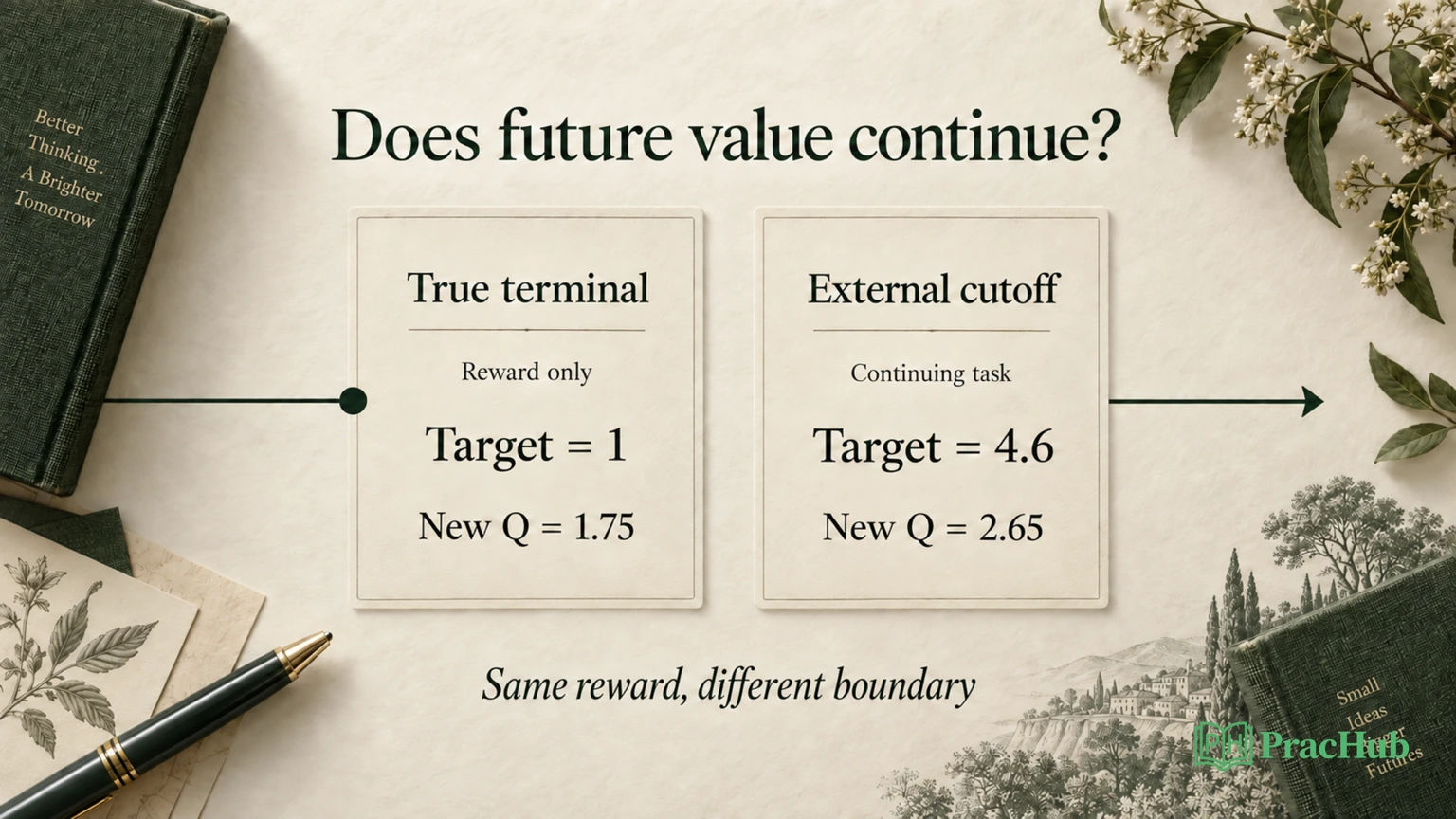
Official time-limit guidance: Gymnasium's handling-time-limits tutorial explains that genuine termination removes future-value bootstrapping, whereas an external cutoff of a continuing task generally retains it. A finite-horizon task is a different model: remaining time must be represented when needed to preserve the Markov property.
Using the original numbers, a true terminal transition has target 1, because the episode's reward is complete and no future return follows under the model. The updated entry is 2 + 0.25*(1-2) = 1.75. An external collection time limit, without true termination, retains the target 4.6 and update 2.65.
| Transition interpretation | Bootstrap value | Target | Updated Q |
|---|---|---|---|
| Nonterminal Q-learning | 4 | 4.6 | 2.65 |
| True terminal state | 0 | 1 | 1.75 |
| External cutoff of continuing task | 4 | 4.6 | 2.65 |
| Next behavior action used instead | 1 | 1.9 | 1.975 |
The last row is a comparison, not an alternative terminal rule. If both flags indicate termination and truncation, true termination still establishes the no-future-return boundary in this model. Always explain what the environment means rather than guessing from an episode length.
How would you implement a bounded tabular update?
This original helper consumes the next-state values explicitly. It avoids accessing a nonexistent terminal row and rejects an empty set of permitted actions for a nonterminal transition.
def q_update(old, reward, next_values, *,
             alpha, gamma, terminated):
    if not 0 < alpha <= 1:
        raise ValueError("alpha must be in (0, 1]")
    if not 0 <= gamma <= 1:
        raise ValueError("gamma must be in [0, 1]")
    if terminated:
        target = reward
    else:
        if not next_values:
            raise ValueError("nonterminal state needs actions")
        target = reward + gamma * max(next_values)
    return old + alpha * (target - old)
For the terminal case, pass next_values=None; the helper deliberately never reads it. For an external truncation of a continuing task, pass the values of the actual final next observation and terminated=False. The rollout collector may reset afterward, but the update should not borrow values from an unrelated reset state.
The helper checks only the stated scalar contract. Production code would also define numeric types, nonfinite-value handling, action masks, table ownership, and observation extraction. Its gamma validation accepts one for appropriate episodic formulations; that does not establish the discounted infinite-horizon convergence assumptions for gamma equal to one.
If a vectorized or auto-reset collector supplies a reset observation in place of a final observation, inspect that collector's contract and recover the correct transition boundary. Do not assume every wrapper or Gymnasium version uses the same information key. Store a transition record that preserves the evidence required to reconstruct its target.
Which small tests expose target bugs?
Run independent tests for the four numerical rows above. Keep the initial value at 2 in every test so that one update does not contaminate the next. Reusing one mutable table can quietly change the starting point of the next test.
Add a negative-value case: let the next permitted action values be -3 and -1. Their maximum is -1, giving target 1 + 0.9*(-1) = 0.1, and the updated entry becomes 1.525. A maximum accumulator initialized to zero would create a nonexistent zero-valued next action and produce the wrong target.
Then test an empty next-action set. If the transition is truly terminal, no maximum is needed. If it is declared nonterminal, an empty set should expose a contract problem rather than silently produce zero. When actions are masked, compute the maximum over valid actions only. A high value assigned to an unavailable action is not an attainable future return.
Finally test alpha and gamma boundaries. With alpha equal to one, the entry becomes the target. With gamma equal to zero, the next-state values have no effect. With a fixed target and alpha in the allowed interval, the updated value lies between the old value and target. That interpolation property is a useful arithmetic check, not a proof of long-run policy quality.
These fixtures were executed as local Python scalar calculations. They verify the stated arithmetic, not convergence in a simulated environment, robustness to noisy rewards, or performance of a neural Q-network. Match the claimed verification to the experiment actually performed.
Why does update order matter in a tiny chain?
Consider a second original case with states A and B plus terminal T. There is one action per nonterminal state. A moves to B with reward zero; B moves to T with reward two. Initialize both action values to zero, set alpha to one, and gamma to 0.9.
Process A→B first: B's current value is zero, so A stays zero. Then process B→T: B becomes two. On a later A→B update, A becomes 1.8. If you replay B→T before A→B, the value two is already available and A becomes 1.8 during that pass.
The intermediate results use different current values for B: zero in the first order and two in the second. They are not contradictory Bellman targets. State whether an exercise updates entries immediately or computes a batch of targets from a frozen snapshot. Use independent row copies when a test requires a frozen snapshot; copied references still share mutable values.
This chain also exposes terminal handling. Assigning T an arbitrary optimistic value must not inflate B's target after a genuine terminal transition. The final reward two belongs to B→T; adding it again on a fictitious transition out of T double-counts the task's payoff.
Does off-policy Q-learning always converge?
Primary theorem boundary: the original paper and proof establishes convergence under a tabular finite-state/action setting with bounded rewards, repeated coverage, and appropriate learning-rate conditions. The per-pair learning rates must keep accumulating learning while their squared sum remains finite. These are substantive assumptions, not a promise attached to any loop called Q-learning.
A fixed alpha of 0.25 is useful for our visible one-step examples, but it does not satisfy the usual diminishing-step-size condition over infinitely many updates. A finite training run also does not demonstrate infinite visitation. If exploration decays before important actions are observed, correct target code may still learn a poor table.
Replacing a table with a neural network changes the approximation and optimization problem. Replay buffers and target networks may be useful design choices, but they do not make the tabular theorem apply automatically. Keep theoretical assumptions, implementation checks, and empirical learning evidence separate.
Discuss initialization in that same disciplined way. Optimistic values can influence early exploration, but they can also distort maxima until corrected by observations. Ties require a selection rule. The interview answer should explain the mechanism and its failure case rather than claiming one initialization always works.
Five PracHub questions for reinforcement-learning reasoning
These verified links provide related Bellman, RL-component, and application practice. They do not certify a particular employer's syllabus, and an LLM-agent question may use a different optimization method from tabular Q-learning.
| PracHub practice question | What to connect to this guide |
|---|---|
| Explain the Bellman Equation | Separate expectation and optimality equations from sampled targets. |
| Explain core components of reinforcement learning | Define states, actions, rewards, and episode boundaries. |
| Derive and compare core ML and RL methods | Justify the learning rule and its assumptions. |
| Apply reinforcement learning to product decisions | Evaluate whether the reward and environment model fit the decision. |
| Explain NLP/RL concepts used in LLM agents | Identify the actual behavior policy and training objective. |
Continue with Explain the Bellman Equation. Give one terminal example, one external-cutoff example, and one exploratory next action. A strong answer computes each target and names the evidence that selects its rule.
Comments (0)