QALadder Review: SDET Coding Challenges, Python Tests, and Browser Practice Limits
Quick Overview
Review QALadder with observed Python 0/5-to 5/5 feedback, a log-parser counterexample, SDET study fit and the ungraded multilingual scratchpad boundary. Dated public observations and original exercises distinguish official descriptions, tested behavior and unverified capabilities.
QALadder gives an SDET candidate a useful small test: can you turn a testing requirement into Python that survives assertions? In our guest-browser attempt, a valid but wrong log-summary function received 0/5, and a correction received 5/5. That establishes a working feedback loop for one task. Its multilingual free-practice editor has a different purpose and did not expose the same grading control.
Start with PracHub’s test-logging design question and define what one failure record means. That decision connects a short parser exercise to the larger engineering work of storing, querying and explaining test evidence.
Checked November 3, 2026: this review separates QALadder’s official descriptions, our anonymous browser actions and independently authored examples. We did not complete its roadmap, audit every challenge, test account synchronization or measure hiring outcomes. PracHub publishes interview-preparation content and is the publisher of this review.
What the public playground lets you practice
The official playground presented 27 challenges during our visit, including tasks grounded in QA and SDET work. We selected “QA: parse failures from a test log.” The task required a function named failure_summary(lines) that returns a dictionary from failed test names to their occurrence counts. The input used lines such as test_login FAILED; sorting the output was unnecessary.
The task is small enough for a focused practice attempt. You can describe the contract, write a deliberately inadequate implementation, inspect feedback and revise the logic without first setting up a repository. The task also creates an immediate explanation question: are you counting failed events, distinct failed tests or failed runs? Those quantities differ once repetitions appear.
The site also describes a 24-week path from manual QA toward senior SDET work, with lessons and take-home preparation. Treat that as the provider’s curriculum framing. Reading a roadmap or passing a small function does not establish senior-level capability. A production testing role can also require system diagnosis, maintainable automation, useful failure reporting and decisions about what deserves coverage.
Our editorial judgment is that the playground is most useful when you bring a specific weakness. For example, “I can name boundary tests but struggle to implement a small parser” leads to an actionable exercise. “I want to become interview-ready” is too broad to evaluate from one green result.
The wrong answer was executable and still failed
Our first clean negative control returned an empty dictionary for every input:
def failure_summary(lines):
    return {}
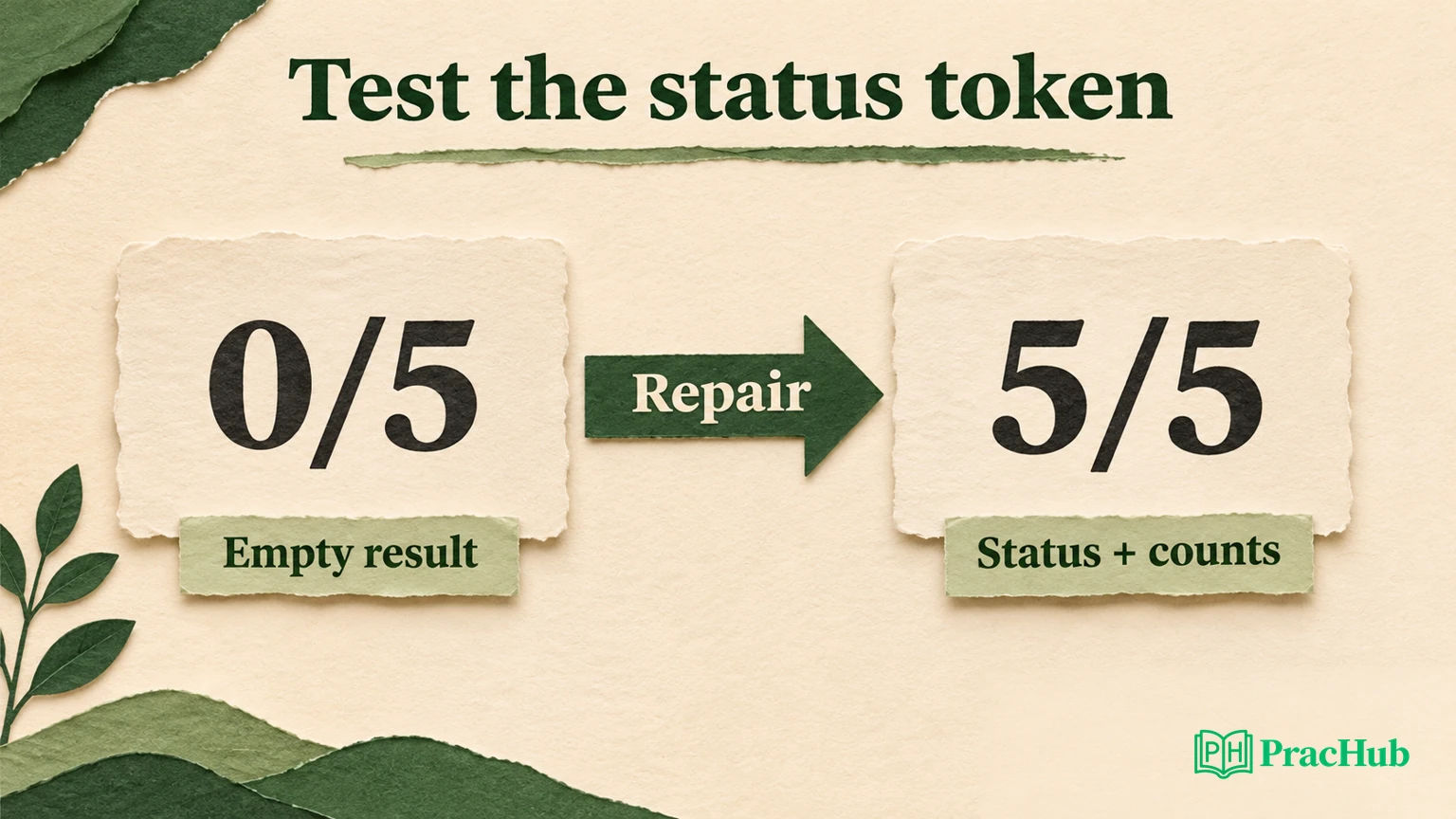
The browser accepted the Python syntax, then displayed FAIL · 0/5 with a failed check about counting repetitions. This matters because syntax execution and requirement checking answer different questions. A function can run successfully while returning the wrong data.
The displayed fraction does not tell us whether the runner evaluated every assertion independently or stopped after an early failure. We therefore describe the visible result rather than claiming to know its internal checking strategy. We also did not inspect private test implementations.
During browser entry, one earlier attempt accidentally inserted text into the existing editor buffer and caused a syntax error. We corrected the input method before running the clean control above. That editor-entry artifact is excluded from the product verdict; it would be misleading to count our malformed paste as evidence that the platform rejected a logically wrong solution.
We then entered a clean correction:
def failure_summary(lines):
    counts = {}
    for line in lines:
        parts = line.split()
        if len(parts) == 2 and parts[1] == "FAILED":
            name = parts[0]
            counts[name] = counts.get(name, 0) + 1
    return counts
The browser reported All 5 tests passed and PASS · 5/5. This verifies one implementation against that task’s visible result on the review date. The product’s accompanying readiness language remains its own assessment; five passing checks do not validate a candidate’s whole interview preparation.
Build a parser matrix before adding more code
The following matrix is our original extension of the exercise. It defines exactly two whitespace-separated fields, an uppercase FAILED status and an ignore policy for malformed lines. Those choices make the example reproducible; they are not a claim about undocumented QALadder requirements.
| Input or change | Expected result under our contract | Mistake it exposes |
|---|---|---|
| No lines | Empty dictionary | Assuming at least one event exists |
Two test_login FAILED lines | test_login: 2 | Counting unique names instead of events |
test_FAILED PASSED | No failure counted | Searching for the substring FAILED anywhere |
Spaces and a tab around t FAILED | t: 1 | Depending on one literal space |
t FAILED extra | Ignore the line | Accepting an undeclared third field |
t failed | Ignore the line | Silently changing case rules |
We ran this matrix independently in local Python. The exact-token parser produced the declared results. A substring shortcut incorrectly counts test_FAILED PASSED, because the test name contains the status word. That counterexample is more useful than adding several ordinary failed lines: it distinguishes two competing interpretations.
Malformed input deserves an explicit discussion. Ignoring a line can be reasonable in a short exercise, but a real reporting pipeline may need a rejected-record count or a separate error stream. Otherwise, damaged input can make the failure rate look better simply because some failures disappear during parsing.
Likewise, changing lowercase statuses to uppercase may be acceptable if the producer contract permits case-insensitive values. It is a behavior change, not a universally correct cleanup. State the rule before implementing normalization, and add a test that would fail if the normalization were accidentally removed.
Repeated events are not automatically duplicate events
Suppose a log contains the same test name three times. One interpretation is that three executions failed. Another is that a collector delivered one failure three times. The text format alone does not let you decide which happened.
Our small function counts occurrences, so it returns three. A deduplicating system would need an identity such as a run identifier and event identifier. Deduplicating by test name would erase legitimate retries or failures from different builds. This is where a coding answer can become an engineering conversation without adding unnecessary infrastructure to the original function.
Consider a fictional build with run-17/test_login/attempt-1 and run-17/test_login/attempt-2. If both attempts failed, the event count is two and the distinct failed-test count is one. If attempt one is delivered twice, an idempotent collector should still retain one logical event for that attempt. Explain which number the dashboard needs before choosing storage keys.
A useful follow-up asks how you would query failures in the last ten minutes. Now timestamps, ordering and late arrivals enter the contract. Keep the original parser small, then describe the additional fields and invariants needed by the larger system. This makes your scope control visible to the interviewer.
Python challenges and free scratchpad have different evidence
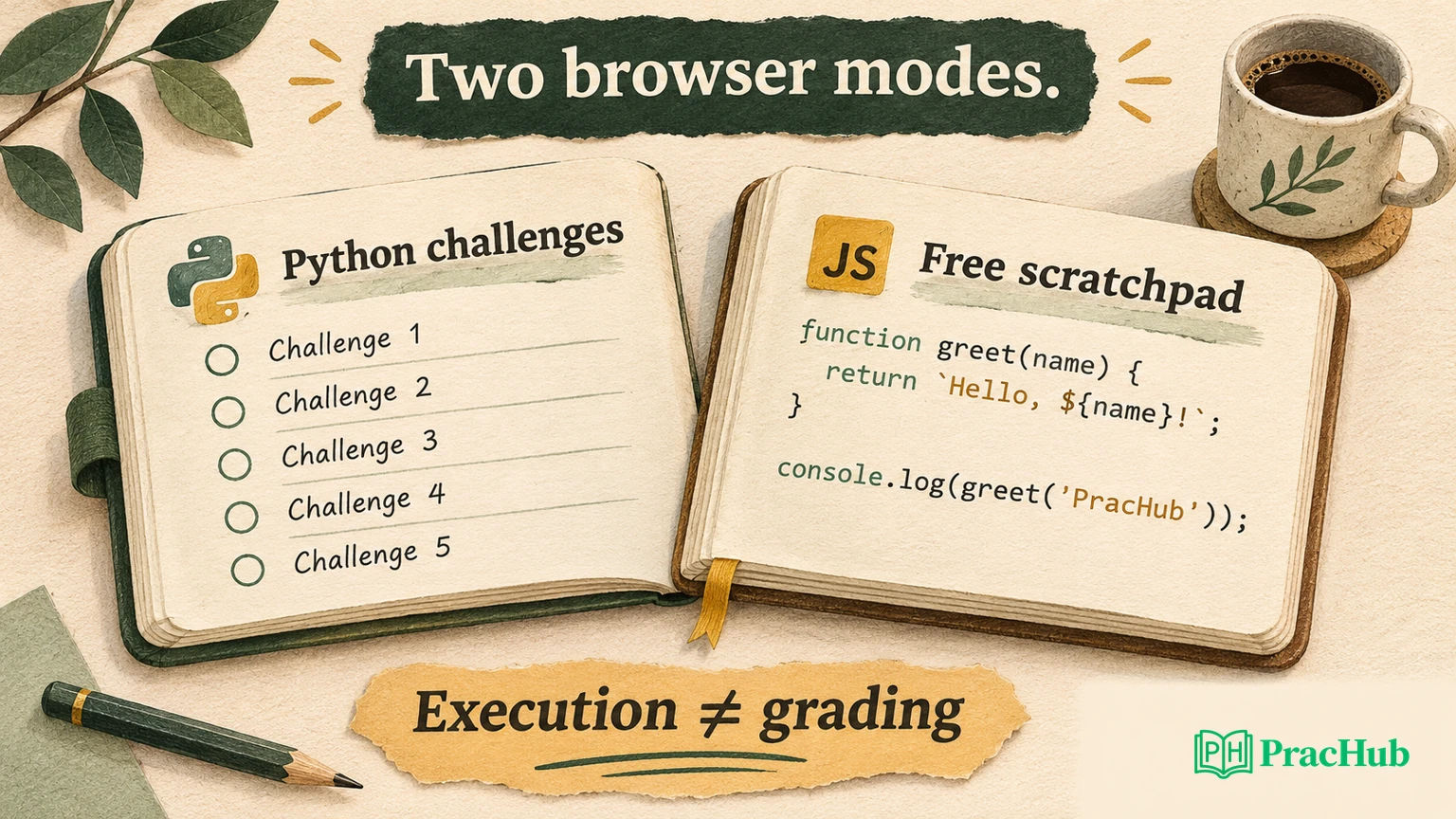
We also switched to the playground’s free-practice mode and selected JavaScript with a Node label. A Run control was present, while the challenge’s Run tests control was absent. We inspected that mode but did not execute a JavaScript program in it.
| Surface we inspected | What we observed | What remains unverified |
|---|---|---|
| Python log challenge | Wrong answer 0/5, correction 5/5 | Breadth and independence of private checks |
| Free-practice JavaScript mode | Editable scratchpad and Run control | Actual execution in that language during this review |
| Roadmap and lesson entrances | Public study structure | Completion quality across the curriculum |
| Optional account synchronization | Provider description | Cross-device persistence and recovery |
For a learner, this distinction changes the next action. Use an assertion-backed challenge when you need feedback against a stated task. Use a scratchpad when you already know the expected result and want to test a language construct. An ungraded workspace requires you to supply the oracle.
For example, printing a dictionary is useful only if you can explain why its keys and counts are correct. Keep the expected mapping beside the input before running the program. Then change one condition deliberately, such as repetition or a misleading test name, and predict the new output.
How much does free access establish?
The site describes its offering as free forever, without a Premium tier or card requirement. Our observed Python attempt was available without creating an account or entering payment details. That supports a narrow access conclusion: this public task could be attempted and checked during our visit.
We did not test a long sequence of attempts, every language runtime or persistence across devices. The absence of a purchase step in one exercise cannot establish future availability or every account feature. Recheck the current page if a particular capability becomes essential to your preparation.
The practical cost is also your attention. A free catalog can still lead to passive repetition if you keep choosing tasks whose answers you remember. A useful session should leave a small artifact: the contract, one failed assumption, the correction and a fresh case you can explain without looking at the solution.
If you need a repository-style assignment, inspect the separate take-home material and compare its deliverable requirements with your interview instructions. A single-function browser exercise does not rehearse dependency setup, multiple files, test commands or a reviewer-friendly submission. Choose that larger format when those are the skills you need to demonstrate.
Turn a passing task into an SDET explanation
After the five-check result, close the implementation and explain the behavior aloud. Name the input grammar, the status comparison and the meaning of the counter. Then describe one condition your code intentionally ignores and why that policy was chosen.
A second attempt should change the requirement. Suppose the output must include passed and failed counts for each test. The dictionary shape changes; a single integer no longer captures the contract. Suppose malformed lines must fail the batch. The ignore branch becomes an error path that needs its own test. These changes reveal whether you understand the model or remember a short solution.
Also distinguish correctness from operational usefulness. A parser that processes the whole input correctly can still consume too much memory if it first loads an enormous log. The loop itself can consume an iterable incrementally, but the output still grows with distinct test names. State those bounds instead of promising constant space for the whole operation.
Finally, explain how another engineer would investigate a failure in your automation. Include the smallest relevant input, the expected mapping and the actual mapping. A clear reproduction is part of testing skill; a screenshot of a red badge supplies less information about the defect.
Five PracHub questions for a fresh attempt
These verified destinations extend log parsing into test evidence and maintainable automation. They are separate from QALadder’s catalog and do not predict a particular employer’s next question.
| PracHub question | Focused follow-up |
|---|---|
| Design test logging and failure-window queries | Define event identity, timestamps and the failure window before choosing a storage shape. |
| Design test-run logging and query functions | Explain which test-run records support each query and which events can repeat. |
| Test Severity Filtering with Contract-Distinguishing Cases | Distinguish exact status matching from substring and normalization policies. |
| Extend a Log-Processing Codebase: Priority Classification, Tests, Time-Window Query | Retain a small failing input when changing priority or time-window behavior. |
| Extend and optimize an existing CLI tool | Make the test command and smallest reproduction clear to another reviewer. |
QALadder’s public Python challenge demonstrated a useful correction loop. Make the next attempt harder by changing the contract, then use the test-logging design prompt to explain how event identity, time windows and query requirements change your design. Keep the small passing function as evidence of one completed task, with its limits attached.
Comments (0)