QAM Labs Review: Probability Games, Expected Value, and Quant Interview Practice
Quick Overview
Review QAM Labs’ timed-game catalog, observed account requirements, question-provenance statements and score limits. Original payoff-contract and finite stopping-rule examples separate rapid choices from reasoning, with exact arithmetic and an independent explanation rubric.
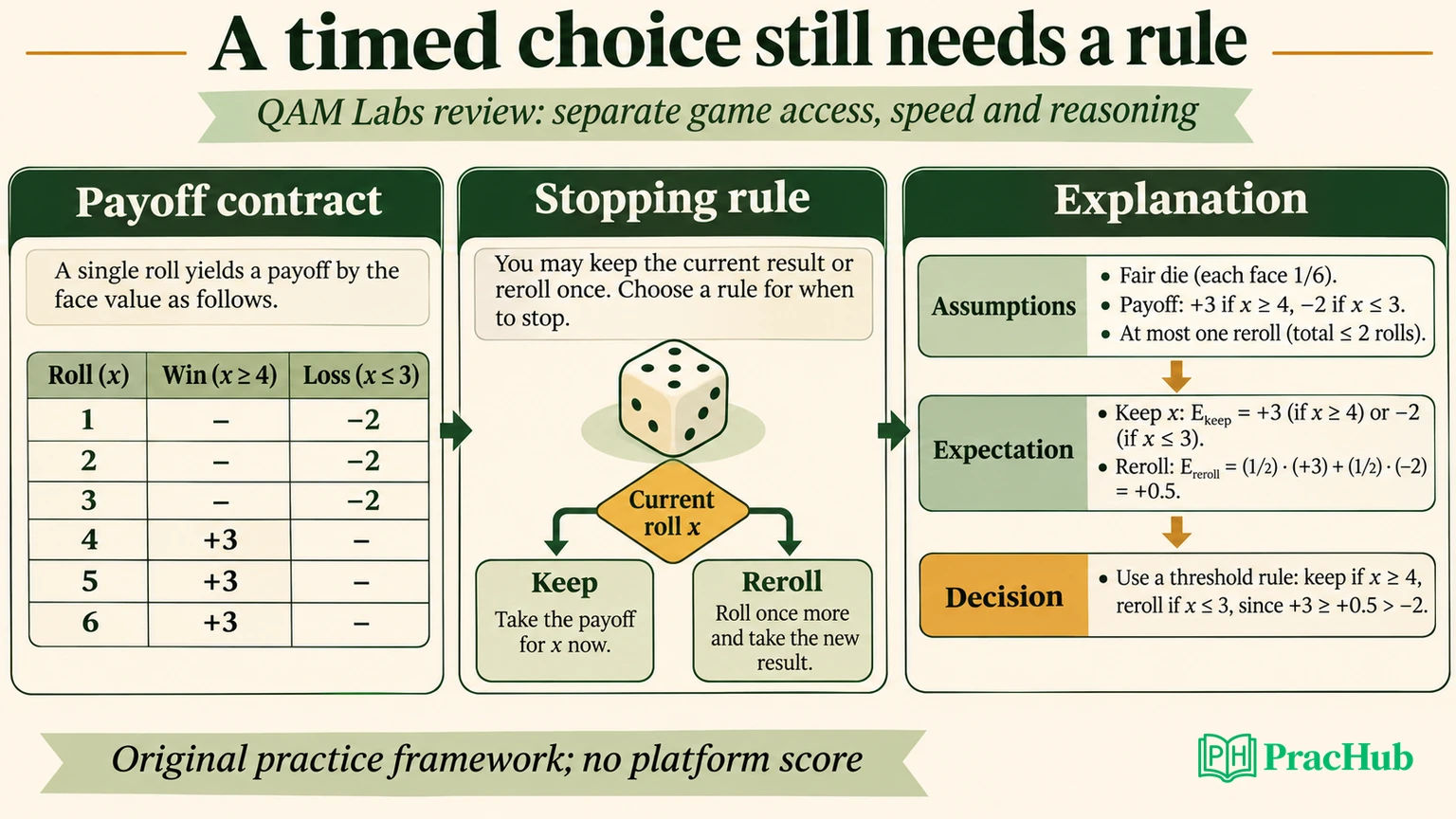
QAM Labs organizes probability, expected-value and arithmetic practice around timed games. Its public catalog is easy to inspect, but our Expected Value Challenge entry required an account. The question bank did too. Check account requirements separately from price, and keep the payoff and decision rules beside any score.
PracHub publishes this review and owns the complementary practice links. Our dice-payoff question offers an independent task. The payoff-contract comparison and one-reroll model below are original educational work, separate from QAM Labs questions, simulations or rankings.
The catalog puts probability before arithmetic
Provider positioning, checked November 3, 2026: QAM Labs advertises twenty-three free, unlimited games. The visible groups include probability and expected value, arithmetic and recall, market concepts, reasoning and combined challenges. We did not execute or audit the whole collection.
The homepage’s Expected Value Challenge description asks for a quick take-or-pass decision from a probability and win/loss amounts. Other cards describe Bayesian updating, conditional probability and mixed assessments. Those descriptions establish intended formats, not the quality of their generated questions or grading.
We found no independent candidate reports or outcome studies supporting the product’s effectiveness. Our review concerns a preparation tool, not an employer’s assessment process. A timed format can be relevant to practice without reproducing the instructions of a particular invitation.
Free does not mean unsigned play
Direct observation: opening the Expected Value Challenge displayed an Account required message. It explained that a free account associates scored runs with rankings and a profile. We did not register, answer a game item or receive a score.
The homepage’s daily-challenge area also settled into an account requirement after its initial loading message. The early loader was transient. It would be inaccurate to describe it as either a playable guest challenge or a permanently broken loading screen.
The question bank advertised ninety-eight original questions across sixteen topics, with hints and solutions, but required an account to use them. We did not open a full question or inspect its worked solution. Those counts are provider statements, not a collection audit.
Plan the trial around this access boundary. You can inspect the catalog and product explanation publicly. Testing a scored game, progression or question-level feedback requires a different step. We did not create an identity or accept account terms to extend the review.
| Intended action | Surface we reached | What remains untested |
|---|---|---|
| Compare game categories | Public catalog | Complete question coverage |
| Play an EV item | Account-required page | Timing, acceptance and grading |
| Use the daily challenge | Account-required panel | Run, streak and ranking |
| Read bank solutions | Account-required bank | Hints, derivations and follow-ups |
| Interpret a percentile | Public descriptions only | Cohort, calculation and stability |
Original questions are different from employer attribution
The bank page explicitly says QAM Labs writes its questions and does not present them as questions from a particular company. Its About page reinforces that positioning. This is a provider provenance statement, not an independent originality audit we performed.
The About page also describes question generators and career tracks, says there is no paid tier and identifies advertising as support. We did not audit monetization, future access commitments or the complete generator library. No payment or subscription was involved in this review.
The About page says its scores do not predict an interview outcome. Keep that boundary when reading readiness or best-fit-track language elsewhere in the catalog. We did not validate those indicators against actual hiring decisions or a representative candidate population.
A ranking can still motivate repeated practice. Its meaning depends on who played, what counted and how the score was calculated. A percentile within a practice service is not automatically a percentile among applicants to an employer.
Original contract check: what does the win amount mean?
Before making a rapid EV choice, define net payoffs. Consider an invented prompt with a forty-percent win probability, a displayed win amount of twelve and a loss of eight. The wording alone may leave an important distinction unresolved.
If twelve is net profit on a win and negative eight is net loss otherwise, expected payoff is 0.4 times twelve minus 0.6 times eight, or zero. If twelve is the total return including an eight-unit stake, the winning net payoff is four. With the same losing payoff, expectation becomes negative 3.2.
These are two different contracts, not two answers to one fully specified question. We did not observe ambiguous wording in a QAM item because the game was gated. The example defines what to check in a future trial; it does not allege a product error.
| Constructed reading of twelve | Winning net payoff | Losing net payoff | Expected net payoff |
|---|---|---|---|
| Twelve is profit | 12 | −8 | 0 |
| Twelve includes an eight-unit stake | 4 | −8 | −3.2 |
State the objective before choosing take or pass. Maximizing expected net payoff under a fixed model is not the same as satisfying a risk constraint or choosing a stake. If the game supplies a zero-EV convention, follow it; if it does not, ask whether indifferent choices count differently.
Original stopping case: one fair-die reroll costs one
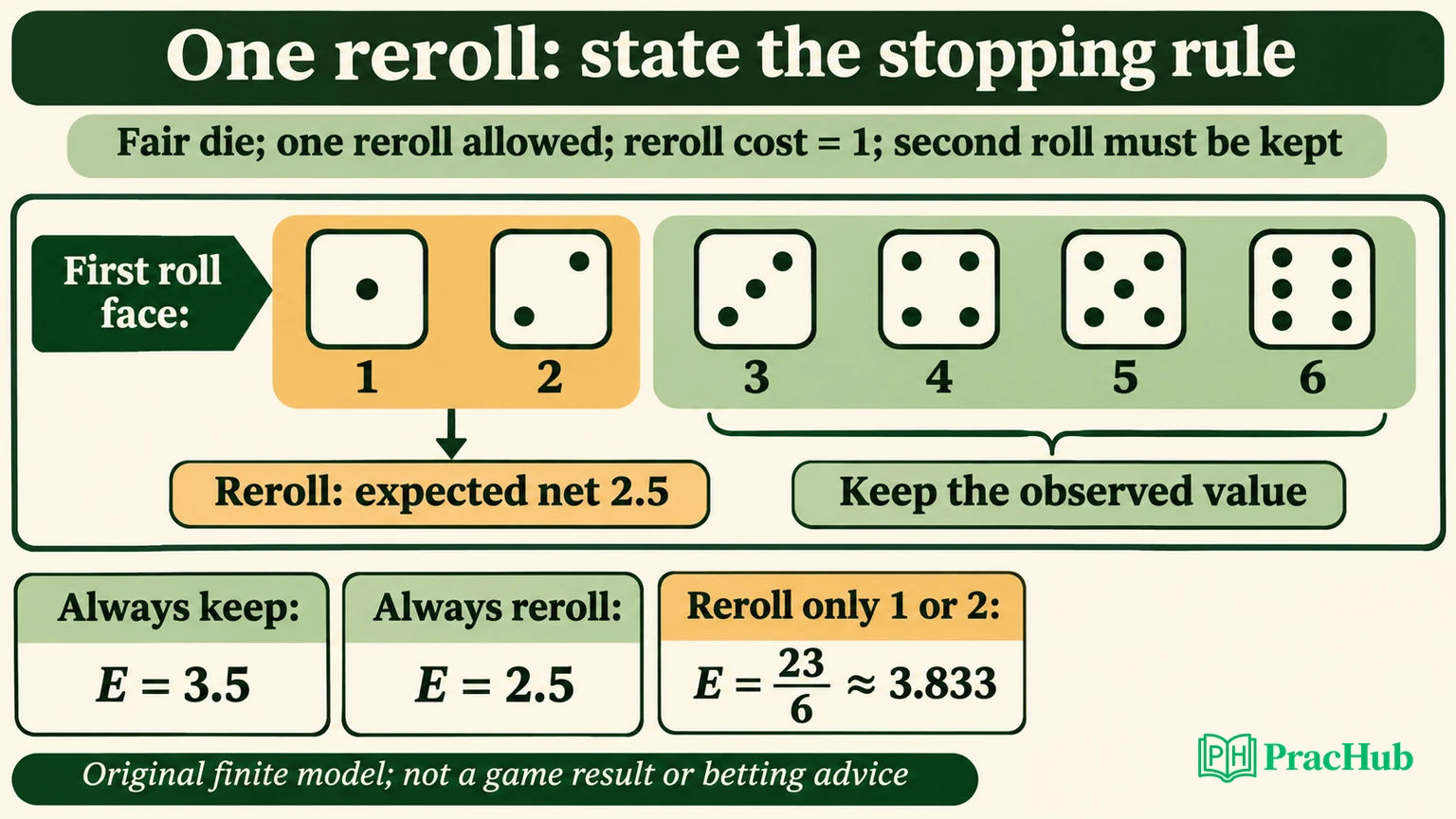
Now consider a separate invented exercise. Roll one fair six-sided die and observe its value. You may keep it or pay one unit for exactly one independent reroll. If you reroll, you must keep the second value. The objective is to maximize expected final value minus any reroll cost.
The second roll has mean 3.5. Paying one makes the reroll option worth 2.5 in expectation at the decision point. Compare the observed first value with that continuation value. Reroll one or two; keep three, four, five or six.
The rule is conditional on what you observed. Always rerolling has expectation 2.5, worse than always keeping at 3.5. The selective policy is better than either: its expected value is the average of 2.5, 2.5, three, four, five and six, which is 23/6, about 3.833.
| Policy under the constructed rules | Expected net value | Reason |
|---|---|---|
| Always keep | 3.5 | Mean of the first fair die |
| Always reroll | 2.5 | Mean of the second die minus one |
| Reroll only one or two | 23/6, about 3.833 | Choose the better action after observing the first die |
We enumerated all thirty-six equally likely pairs of first and second rolls with exact fractions. Even when a policy keeps the first die, the unused second value is simply a latent outcome in the enumeration. The calculation confirmed each expectation and the selected actions.
No QAM game ran in this experiment. No real bet, bankroll or financial instrument was involved. The finite model illustrates a stopping rule under explicit assumptions, not a recommendation about real gambling or trading.
Changing the cost changes the decision boundary
Remove the reroll cost while retaining exactly one reroll. The continuation value becomes 3.5. Now one, two and three should be rerolled, while four, five and six are kept. The resulting expected value is 4.25, which our exact enumeration also confirmed.
Increase the cost to three instead. The continuation value becomes 0.5. Every possible first roll is worth keeping, so the best policy has expectation 3.5. A memorized rule that always rerolls low values would miss that changed boundary.
Allowing unlimited rerolls would create a different problem again. You would need a continuation value that accounts for future choices and costs. The one-step calculation above cannot be carried into that setting unchanged.
The changed costs test whether you can rebuild the rule. A candidate who explains the continuation value can adjust when the cost or horizon changes. Someone who only remembers a threshold may answer the original toy correctly while failing the next version.
For a timed game, this suggests a useful progression: derive the rule untimed, then apply it quickly to new inputs, and finally explain why a changed rule alters the result. We did not measure that progression or its learning effect in QAM Labs.
An explanation rubric for rapid-answer practice
Use this original rubric after a future EV or probability run. It is not QAM Labs’ grading specification. It asks for the information that a binary choice or score cannot show on its own.
| Check | Evidence in a defensible answer |
|---|---|
| Payoff unit | Net profit, gross return or another stated quantity |
| Information | What is known before each choice |
| Allowed actions | Take, pass, keep or reroll, with limits |
| Objective | Expected value and any additional constraints |
| Calculation | Weighted outcomes or a conditional comparison |
| Changed condition | Recomputed rule after cost, horizon or information changes |
For the reroll case, “the average die is 3.5” is true but incomplete. It does not subtract the cost or compare the available actions after observing the first roll. “Reroll low values” is also incomplete unless the threshold follows from the specified continuation value.
Name the missed step when correcting an answer. Perhaps you treated a gross payout as profit, forgot that the second result must be kept or compared the observed value with the wrong expectation. Each error leads to a different practice action.
Record that mechanism beside the score. Otherwise, repeated runs can reward faster execution of the same incorrect interpretation. We did not inspect QAM’s account-side error reports, so this is an independent review practice rather than a claimed built-in feature.
Read timed scores and percentiles in their own context
The catalog describes combined challenges and percentile profiles. We did not receive a profile or inspect its comparison population. Sample size, repeat attempts, selection of players and changing item sets can all affect what a ranking means; their actual implementation remains unverified here.
An overall score may combine different skills. Arithmetic speed, conditional probability and remembering an order book are not interchangeable explanations of a weakness. Before changing your study plan, identify which task and error contributed to the result.
A small session is also vulnerable to task mix. One strong game does not establish mastery of all twenty-three advertised games. Save the task, number attempted and instructions with each result.
The provider’s no-outcome-prediction statement is a useful boundary. Treat practice evidence as a way to choose the next derivation or timed drill. Employer preparation still depends on the actual role and the instructions supplied for that assessment.
Practice the gaps the product leaves open
These independent PracHub prompts extend expected-value and probability reasoning. They are not QAM Labs items, ranking rules or evidence that a specific employer uses these exercises.
| PracHub question | What to examine |
|---|---|
| Calculate Expected Payoff from Two Dice | Specify the payoff and whether a second decision is allowed. |
| Trading Game: Expected-Value Betting, Kelly Sizing, and Arbitrage Under Time Pressure | Separate an expected-value objective from other constraints or penalties. |
| Compute expansion profits and expected value | Connect the expectation to the decision being compared. |
| Compute multi-step Markov probabilities and estimate transitions | State the transition and observation rules before calculating. |
| Calculate the Probability That Two Dice Sum to Seven | Enumerate ordered outcomes and check the denominator. |
Who should consider QAM Labs next
QAM Labs merits an account-side trial if you want varied timed probability and arithmetic practice with scored runs. The public catalog and originality statement are concrete, but our sampled game and question bank required authentication. We did not evaluate execution, solution depth or ranking calibration.
Start with the dice-payoff prompt independently. Define the net payoff and permitted decisions, then compare keeping with one costly reroll. If you later use a timed game, preserve the explanation that makes your answer defensible after the clock stops.
Comments (0)