Remix Interview Questions: Loaders, Actions, and Revalidation Races
Quick Overview
Trace a Remix v2 nested mutation, compare stale reads with late writes, and explain revalidation, fetcher identity, and atomic revision guards.
A task editor saves “Alpha,” then “Beta.” The screen shows Beta, an older request is canceled, and the stored value eventually returns to Alpha. Can that happen in Remix? Yes: coordinating client results does not establish the order of server writes.
For Remix interview questions, keep three orders separate: submissions, committed loader results, and durable mutations. Identify the matched route, the fetcher involved, and the observation that distinguishes stale rendering from a late write.
Start with PracHub’s Implement Resilient Autocomplete Data Fetching to practice rejecting outdated results. Then extend your explanation to the harder boundary below: preventing an outdated mutation from changing stored data.
Version and evidence boundary: this article covers Remix v2. The official React Router migration guide describes v7 as its successor; newer React Router framework-mode documentation uses a different package and configuration surface. Keep v2 imports and assumptions together. The exercises are original technical practice, not reported employer questions. Observed traces use pinned Remix testing packages with mocked routes and an in-process store, not a deployed HTTP server or database.
Which nested route receives the action?
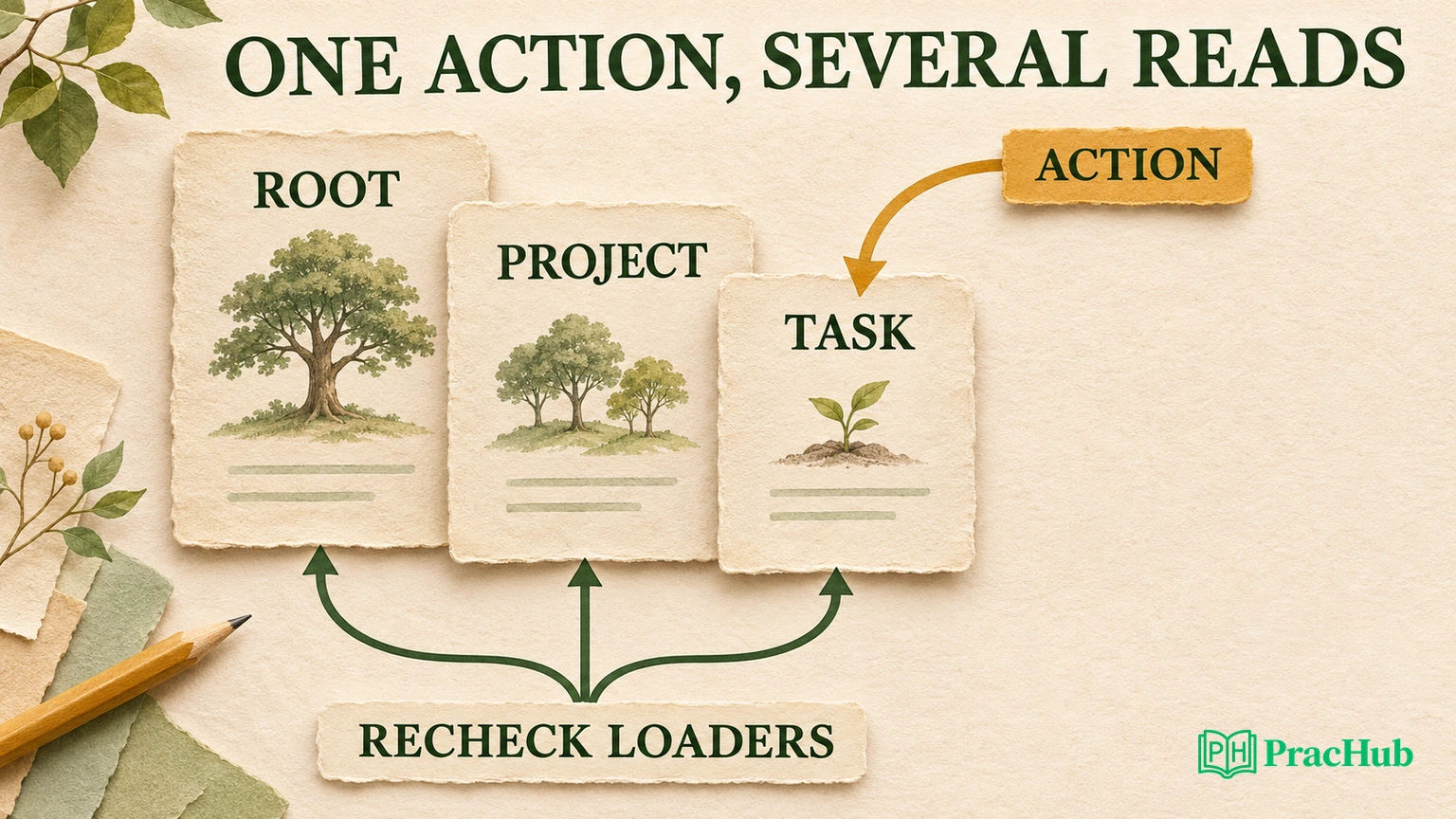
Suppose /projects/p1/tasks/t1 matches three routes: root, project, and task. The root loader reads the viewer, the project loader reads a task summary, and the task loader reads the editor’s title. Both project and task can therefore display the same changed title.
Official Remix v2 documentation says a non-GET mutation invokes one matching action, rather than every action in the nested hierarchy. For a non-index task route with an explicit action URL, that is the task action. Index routes introduce a separate ?index targeting distinction; this exercise deliberately avoids that ambiguity. Remix v2 action reference
Name the target before discussing invalidation. A task component’s position inside a project layout does not mean the project action handles its POST. Conversely, an explicit project action URL would change the write target even if the form visually appeared inside the task editor.
In the original fixture, initial rendering calls each loader once. Submitting Saved to the task URL calls the task action once and the other actions zero times. After successful revalidation, each loader has run twice and both title displays show Saved. The fetcher leaves the location at /projects/p1/tasks/t1.
| Observation | Initial render | After task mutation and revalidation |
|---|---|---|
| Root / project / task loader calls | 1 / 1 / 1 | 2 / 2 / 2 |
| Root / project / task action calls | 0 / 0 / 0 | 0 / 0 / 1 |
| Project summary / task editor | Draft / Draft | Saved / Saved |
| Current location | /projects/p1/tasks/t1 | unchanged |
These are observed callback counts for this configuration. They are not a promise about HTTP request counts, database queries, or every future-flag configuration. The root read happens to be eligible here even though the task mutation does not change the viewer.
Why can one write trigger several reads?
The official v2 data-flow model connects loaders, an action, and subsequent revalidation. An action may change data consumed by more than its own route, so the mutation’s target and the affected read set are different questions. Remix v2 full-stack data flow
In this editor, reloading only the task would leave the project’s title summary behind. That dependency explains why skipping the parent read would leave a visibly inconsistent editor. Ask what each loader consumes rather than assuming either “only the leaf reloads” or “everything always reloads.”
A concise answer is: “The task owns the write; the project and task both consume its result. I would inspect their returned revisions before removing either read.” That explains correctness before optimization. If the root loader is expensive, investigate its independent dependency instead of treating one successful edit as proof that every parent can be skipped.
When should you use a fetcher instead of navigation?
Officially, useFetcher supports server interaction without navigation. Its POST submission targets an action; fetcher.load reads a specific leaf loader. These are different operations. The hook exposes idle, submitting, and loading states, and its data persists across subsequent loads or submissions. Remix v2 useFetcher reference
For our inline title editor, keeping the current URL is appropriate. Opening the newly created task at its own URL calls for a navigation-oriented design instead. Choose from the intended interaction, then describe the API.
Fetcher identity also belongs in the trace. In one scenario below, editors A and B use different fetcher keys, allowing independent submissions. In another, two submissions reuse the same fetcher and the second interrupts the first. Calling both arrangements “two requests” conceals the important difference.
Do not treat idle as a success receipt for the current input. A previously stored fetcher.data value can still be present. Tie displayed validation or success information to the relevant operation, and distinguish a returned conflict from an accepted change. Otherwise an old confirmation can make an unsaved title look complete.
Which revalidation result wins in a read race?
The official v2 concurrency discussion describes overlapping fetcher mutations and revalidations. When a later-started revalidation finishes first, Remix can commit its fresh result and discard older revalidation results that subsequently arrive. That coordinates client data; it does not serialize the writes. Remix v2 network concurrency management
Here is the first independently executed schedule. There is no delayed server write in this run: both writes finish before their associated reads. A loader snapshots a value when it starts, and a test gate delays returning that snapshot.
| Step | Scheduled event | Store model | Project and task displays |
|---|---|---|---|
| 1 | Fetcher A commits Alpha; its reads pause with Alpha snapshots | Alpha, revision 1 | previous committed view |
| 2 | Different fetcher B commits Beta; newer reads finish | Beta, revision 2 | Beta / Beta |
| 3 | Release the older Alpha reads | Beta, revision 2 | Beta / Beta |
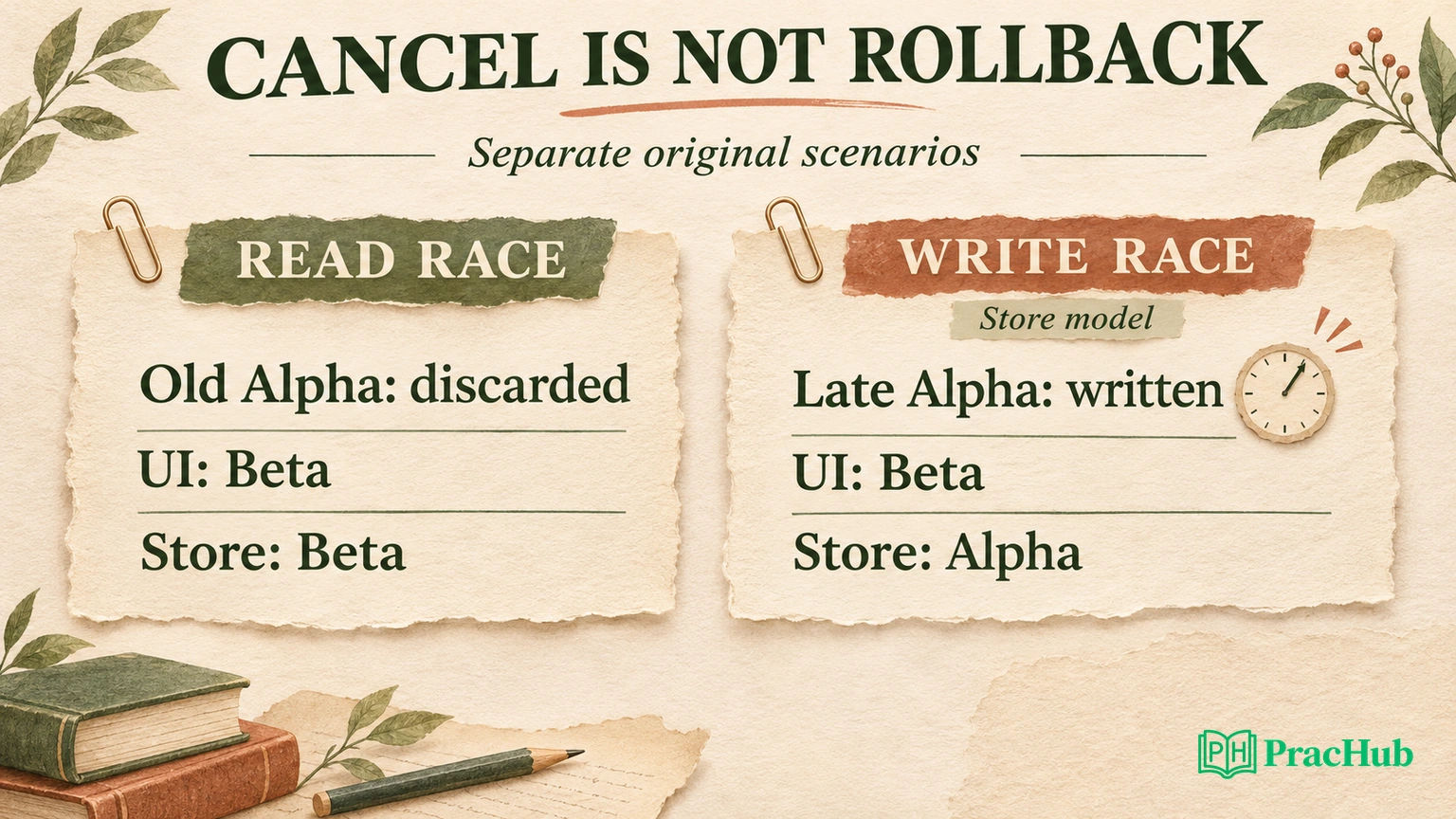
In this pinned Remix test router run, Beta stayed on screen after the held callbacks returned Alpha. Their request signals were aborted. That result demonstrates the stale-result boundary under this schedule, not universal transaction isolation.
An interview follow-up might ask whether debouncing solves the problem. It reduces how often you submit, but cannot prove ordering for requests already running. Similarly, disabling one button does not coordinate another tab or another person. Start with the smallest failed invariant and choose protection at that boundary.
Why does cancellation fail to roll back a mutation?
Official documentation explicitly warns that canceling a request in the client does not undo work already received by the server. A canceled mutation can finish after a later mutation’s revalidation. The browser may then display data that no longer matches storage. Remix v2 cancellation caveat
The second original schedule isolates that possibility. Alpha’s action callback pauses before writing. A second submission through the same fetcher aborts Alpha’s signal, writes Beta, and revalidates both displays to Beta. We then release Alpha’s callback, which deliberately ignores cancellation and writes Alpha.
The observed state is now precise: UI Beta, store model Alpha, aborted signal true. An explicit subsequent revalidation makes both displays show Alpha. This is a different execution from the previous read-race example; do not join their steps into one timeline.
Our callback models noncooperative server work inside the test process. It does not demonstrate a database commit over an interrupted socket. Its value is narrower: the actual client hooks stop tracking the older operation while its mocked action can still run. Your production investigation must establish whether the real server operation continued and when its write committed.
Record an operation ID, entity ID, submitted revision, server commit revision, and loader read revision. Correlate them with the client submission and cancellation. A canceled network row alone cannot tell you whether the write failed, succeeded, or remains in progress.
How would you stop the late write?
For this exercise, the proposed application rule is an expected-revision check. Both submissions began from revision zero. Beta writes first and changes the revision to one. Alpha later asks to update revision zero, so it receives a conflict instead of overwriting Beta.
-- Illustrative storage contract, not an executed database test
UPDATE tasks
SET title = :title, version = version + 1
WHERE id = :id AND version = :expected_version;
The comparison and write must be atomic in the storage system. A separate read-check-write sequence can race again. Scope the update to an authorized resource, validate input, and interpret zero updated rows carefully: your API must distinguish a conflict from an inaccessible or missing record according to its disclosure policy.
In the guarded fixture, Beta commits revision one and the released Alpha callback returns status 409. The model and both displays remain Beta. Because the guard executes synchronously against one in-process object, this only tests the example policy and client outcome. It is not evidence that a production transaction or distributed store supplies the same guarantee.
A conflict response also needs a usable next step. Preserve the person’s proposed title, retrieve the current revision, and let them compare or deliberately retry. Silently changing the expected revision and replaying the write would defeat the protection. Idempotency addresses repeated execution of the same operation; it does not automatically resolve two different titles competing for the same revision.
An expected revision also does not define which human intention should win. In this schedule, Beta wins because its conditional write reaches the store first. In a collaborative editor, you might instead need a merge rule or an explicit conflict screen. State the product policy before claiming that a version column solves collaboration.
Avoid treating a browser timestamp as an authoritative sequence across clients. Different clocks, retries, and delayed delivery complicate that assumption. A server-issued entity revision gives this exercise a shared comparison point. Even then, the update must include the version predicate; returning a revision in the response without enforcing it during the write changes nothing about the race.
Can shouldRevalidate or optimistic UI hide the bug?
The official shouldRevalidate reference allows a route to decline a reload and warns that incorrect decisions can desynchronize its UI. After a narrowly justified optimization, retain defaultShouldRevalidate for other cases. Remix v2 shouldRevalidate reference
Returning false merely because the project ID is unchanged is unsafe for this example: the project summary reads a title that the task action changes. Stable route parameters do not imply stable underlying data. Show the dependency that permits skipping a read, including mutation cases, before adding an optimization.
Optimistic rendering adds another value to inspect. A locally proposed title can differ from both the most recently committed loader result and stored data. Label it as pending and define what happens on validation failure or conflict. Clearing the pending display and retaining the proposed input are separate decisions.
If the task editor shows Beta but the project summary shows Alpha, inspect their loader revisions and revalidation decisions first. If both show Beta while storage contains Alpha, investigate the late-write boundary. When both screens look stale under interview pressure, identify which revision each one shows before adding a forced reload.
What should a useful Remix test prove?
The official createRemixStub utility provides mocked routes for testing components that depend on Remix hooks. Our four bounded scenarios ran with @remix-run/testing and @remix-run/react 2.17.5, React 18.3.1, and JSDOM 26.1.0. No Remix future flags were supplied. Remix v2 createRemixStub reference
The assertions cover one nested action target, matched-loader callback counts, unchanged fetcher location, discarded old reads, a continuing canceled callback, and the guarded conflict outcome. Gates control ordering directly rather than relying on a lucky delay. A timeout turns an unfinished scenario into a failure.
The fixture does not verify HTTP abort propagation, database isolation, SSR, production builds, browser rendering, Single Fetch transport, or client-loader overrides. Add integration coverage for the boundary your application actually uses. In an interview, state both the asserted invariant and the layer the test cannot reach.
Useful negative controls separate causes. Remove the revision condition and the guarded case should permit the late overwrite. Change the POST target to the project URL and the task-action assertion should fail. If your test still passes those changes, it may be asserting a final label without exercising the intended route or concurrency rule. These are proposed extensions, not additional executions included in our four recorded runs.
For a live debugging answer, ask for the request method and explicit action URL before investigating cache settings. Then compare the action’s accepted revision with the loader’s returned revision. If those match but the screen disagrees, inspect component state or optimistic rendering. If the accepted write itself is wrong, changing a loader cannot repair that decision. This sequence narrows the investigation without assuming every stale-looking screen has the same cause.
Practice explaining the boundary before proposing a fix
These verified PracHub records exercise adjacent frontend and concurrency reasoning. They are not a Remix-specific employer question bank, and the practice variations below are our suggestions rather than claims about the original prompts.
| PracHub question | Suggested practice focus |
|---|---|
| Implement Resilient Autocomplete Data Fetching | Explain a newer result arriving before an older one. |
| Design a Real-Time Comment System Front End With Optimistic Updates | Separate a pending proposal, acknowledgment, and canonical result. |
| Build an Arrow-Controlled Kanban Board in React | Add an original persisted-edit variation and identify competing updates. |
| Identify and handle race conditions | Write the interleaving that violates your intended invariant. |
| Handle cache-update conflicts in distributed services | Distinguish a current display from an authoritative write order. |
For your next Remix interview preparation rep, use the optimistic comment-system question. First predict the displayed and stored values for one canceled submission that still writes. Then explain the conflict response while preserving the user’s draft. Finish with the read revision, stored revision, and visible pending state; those observations make your proposed fix reviewable.
Sources and Further Reading
- React Router: versioned migration guide from Remix v2 to v7
- Remix v2: action targeting
- Remix v2: full-stack data flow
- Remix v2: useFetcher
- Remix v2: network concurrency management and stale-data caveat
- Remix v2: shouldRevalidate
- Remix v2: createRemixStub
Documentation and local fixture checked November 3, 2026. Numerical traces are original test observations under the stated configuration, not production benchmarks or hiring predictions.
Comments (0)