Rivian Software Engineering Intern Interview 2027: Coding, Embedded Systems, and Automotive Software
Quick Overview
Rivian and RV Tech internship preparation with verified 2027 role distinctions, historical candidate reports, coding practice, remote-command reliability and automotive test design.
A Rivian software engineering intern interview can involve conventional coding, embedded debugging, or a discussion about software that connects a phone to a vehicle. Your first preparation decision is identifying the employer and team. A mobile-app internship and a vehicle-access internship may share a product boundary while requiring different coding strengths.
2027 evidence check, September 7, 2026: Two verified software internship applications belong to Rivian and Volkswagen Group Technologies, or RV Tech, and specify a January–August 2027 commitment. They should not be confused with Rivian’s general summer-program description. Current postings support the role guidance below; older candidate accounts do not establish a universal 2027 interview loop.
Use Rivian Software Engineer questions on PracHub as a starting point for automotive reasoning. The company collection includes a senior-tagged design exercise, so treat it as a discussion prompt to scale down, not an intern-level requirement.
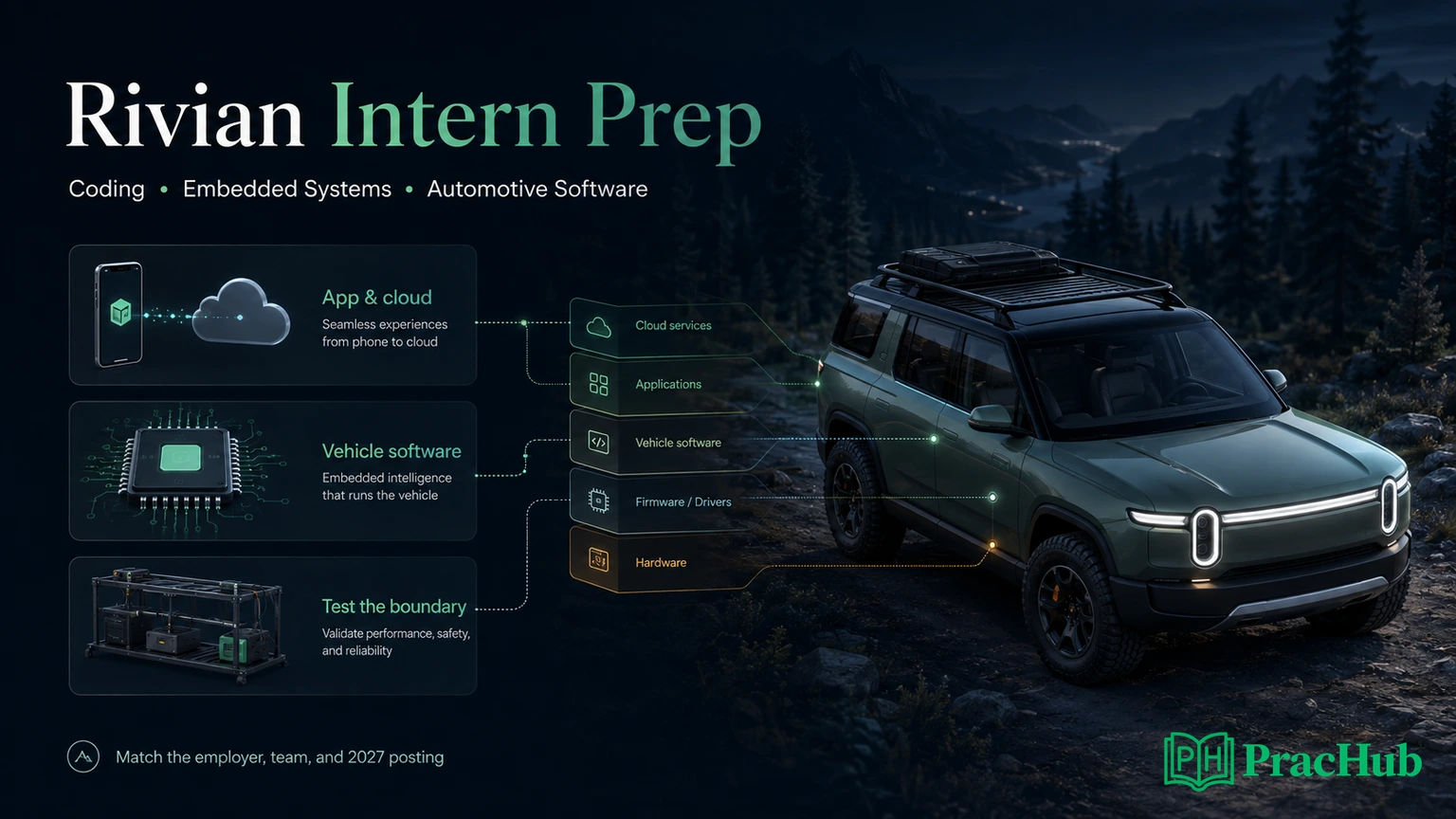
Which 2027 internship are you applying for?
Official facts: The US RV Tech Connected Systems application lists Irvine and Palo Alto, a hybrid arrangement, and full-time availability from January 11 through August 13, 2027. It covers multiple teams, including connectivity, vehicle access, embedded systems, cloud platform, and integration. The posting says team matching occurs during interviews based on background and interests.
Its minimum qualifications are enrollment in a bachelor’s or master’s program at an accredited US university and proficiency in at least one of Python, Go, C++, or Java. Related degree subjects, intent to return to school, and exposure to distributed systems, cloud platforms, CAN, MQTT, or IoT appear under preferred qualifications. Do not silently promote every preferred item into a minimum requirement.
The separate Applications, Infotainment & Mobile application gives the same dates and locations. Its language options are Kotlin, Java, C++, or Python. It covers areas such as Android Automotive, mobile applications, wireless integration, graphics, and test automation. US bachelor’s or master’s enrollment is a minimum; specific platform experience appears among preferences.
Preparation inference: A C++ candidate should describe their strongest relevant work honestly. An Android candidate should explain application lifecycle, state handling, and tests instead of pretending every automotive role is firmware development. Match your evidence to the actual application and clarify which team is interviewing you.
What candidate reports say—and what they cannot confirm
A Rivian internship account describing an April 2026 interview in Irvine mentions a project-focused screen, C questions tied to the candidate’s project, and high-voltage experience. That last topic reflects one candidate’s role context; it is not evidence that every software intern needs electrical-power expertise.
Another account posted in March 2026 describes an interview that actually occurred in March 2025. It reports manager, engineer, and HR discussions centered on previous work and academic projects. The posting date must not be mistaken for the recruiting cycle.
At RV Tech, a July 2026 Palo Alto intern report describes a recruiter screen and behavioral resume walkthrough, with a technical interview still pending. It is a partial account, not a completed three-round outcome. A different report of a February 2025 interview describes an HR screen and two technical conversations.
These accounts support preparing projects, coding, and team-specific explanations. They do not establish a universal OA, vendor, cutoff, round count, or response time. No two independent reports from the 2027 cycle were verified for this article. Confirm the format in your own invitation, especially whether the session is live coding, project review, or subsystem design.
Choose coding practice that matches the software boundary
Role-based preparation guidance: For Connected Systems, be ready to implement a small data-processing component and explain how it behaves when inputs repeat, arrive late, or exceed capacity. For apps and infotainment, add state transitions, asynchronous responses, and how a user sees errors. For embedded work, emphasize bounded memory, byte-level input, ownership, and concurrency.
Start with an explicit contract. A fixed-capacity queue needs a defined full-buffer behavior: reject the incoming item, overwrite an old item, or block a producer. Each choice changes the implementation and its callers. Do not call a single-threaded circular buffer thread-safe merely because its operations are constant time.
In a coding round, demonstrate a small complete solution before adding machinery. State the invariant, select a container, implement the main path, then test empty input, capacity one, repeated values, and wraparound. Explain both time complexity and the amount of retained memory.
For a C or C++ project discussion, prepare to trace a buffer from producer to consumer. Who allocates it? Can the producer reuse it before processing finishes? What happens on cancellation? These questions connect language knowledge to debugging without assuming the interviewer wants a textbook recital.
If the role mentions vehicle networking, learn the distinction between a message identifier, a payload, and the application’s interpretation of that payload. The Linux SocketCAN documentation is a primary reference for CAN interfaces and frame handling on Linux. It is study material, not evidence that your team uses a particular Linux interface or that every role requires CAN expertise.
Automotive design exercise: accepted does not mean applied
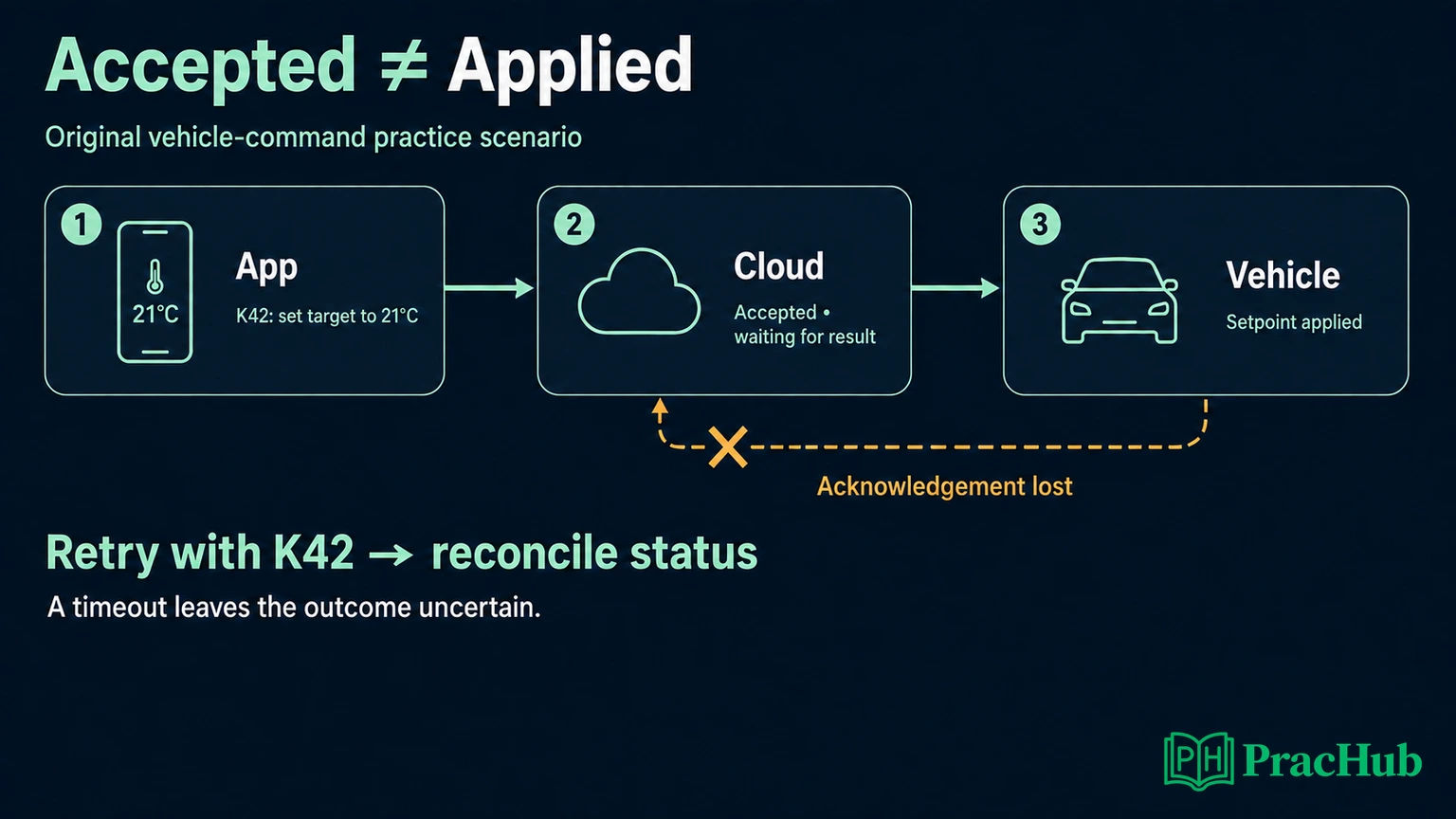
Original practice exercise, not a reported Rivian question: A mobile app asks a vehicle to set its cabin target temperature to 21°C. The cloud accepts the request, the vehicle applies it, and the acknowledgement is lost. The app times out and retries. What should happen?
Give the logical command an identity, such as K42, and keep that identity across retries of the same intent. Store its vehicle, requested value, and status. If the same identity arrives with a different requested value, reject the conflict rather than reinterpreting an old request. Authentication and authorization remain necessary on every relevant request; an idempotency key is not permission to control a vehicle.
Separate cloud acceptance from vehicle execution. An accepted command may still be waiting for connectivity. A delivered command may still be rejected by the vehicle. A vehicle acknowledgement that it applied a setpoint does not mean the cabin has physically reached the requested temperature.
In this exercise, repeating “set target to 21°C” expresses the same desired state. Repeating “increase target by 1°C” can produce a different result. However, even a set operation needs ordering rules: an old retry for 21°C must not overwrite a newer user request for 19°C. Define how the receiver recognizes superseded commands.
The AWS Builders’ Library discussion of idempotent APIs explains why retries need explicit caller intent and duplicate handling. Apply that principle at the vehicle boundary too. A cloud deduplication record alone cannot prove that a physical side effect happened exactly once.
Define expiry before execution, durable status where required, and reconciliation after an ambiguous timeout. If a command may already have executed, do not convert “no acknowledgement” into “definitely not applied.” Show the user an unresolved status until the system obtains evidence. An execution deadline prevents future stale execution only if the receiving component enforces it.
A useful interview follow-up is a controller restart between applying the setpoint and recording completion. Explain what persisted, what can be queried, and how you recover without guessing. The strongest answer identifies the gap between a transport guarantee and the outcome the product actually promises.
Embedded debugging: isolate the failing layer
Original fault-isolation exercise: An integration test says the app accepted a command, but the reported vehicle state did not change. Resist changing the mobile client immediately. Trace the command identity through acceptance, delivery, validation, execution, and acknowledgement.
Begin with observability that can distinguish those stages. Record bounded diagnostic events with command identity, software version, and meaningful status transitions. Avoid relying solely on unsynchronized wall-clock timestamps to establish causality across machines. A correlation identifier can connect evidence even when clocks disagree.
Then choose the smallest test environment that reproduces the failure. The following matrix is a preparation tool, not a description of Rivian’s internal test infrastructure.
| Injected fault | Smallest useful starting test | Evidence to inspect |
|---|---|---|
| Truncated or invalid payload | Decoder unit test | Rejection without buffer overrun or state mutation |
| Duplicate command delivery | Software integration test | Same logical result; no unintended repeat action |
| Acknowledgement lost after execution | Simulated vehicle integration | Status remains unresolved until reconciliation |
| Controller resets during a command | Hardware-in-the-loop test when device behavior matters | Persisted state, restart path, and reported outcome |
| Hardware response differs from the simulator | Instrumented controller bench | Actual I/O timing and mismatch with the model |
A hardware-in-the-loop setup connects a real controller to a test environment that simulates relevant inputs or connected systems. Its value is exposing behavior that a software-only substitute may miss. It does not automatically validate every vehicle condition, and a passing bench test is not a complete safety argument.
For an embedded interview, practice narrowing a failure with one hypothesis at a time. If the decoder rejects a valid message, inspect the documented representation and test vector. If the command reaches the controller but never completes, inspect state transitions and dependencies. If it succeeds only after a restart, investigate initialization and retained state before blaming the network.
Explain how the fix becomes a regression test. “Added a delay and it worked” is a symptom report. “The consumer read state before initialization completed; the fix established a readiness condition and the test forces the earlier interleaving” is a causal explanation.
Use projects to demonstrate engineering judgment
Prepare one project deeply enough to survive follow-up questions. Describe the user need, your contribution, the interface you owned, and a failure you investigated. Separate your implementation from team work, libraries, and hardware provided by others.
For a connected-device project, explain what happened during disconnection and reconnection. For an embedded project, discuss resource limits and how you inspected device behavior. For a mobile project, describe how you prevented a delayed response from replacing newer UI state. These are suggested story angles, not verified company behavioral prompts.
Use measurements you actually collected. If you did not measure latency or memory, say what evidence you did have and how you would instrument the next version. An honest limitation followed by a concrete measurement plan is more useful than invented performance numbers.
Finish with a trade-off you would revisit. Perhaps a simple queue was sufficient for the prototype, but production would need persistence and reconciliation. Explain the trigger for that change instead of presenting maximum complexity as proof of quality.
Five practice questions for this preparation track
Only the first entry below is Rivian-tagged, and it is labeled Senior+ on PracHub. Use a narrow sensor-diagnosis slice as a stretch exercise. The other four are cross-company practice selected for buffers, concurrency, retries, and technical communication—not predictions of your 2027 interview.
| Practice question | Focus for this article |
|---|---|
| Design and Debug an Automotive Sensor and Camera-Blockage System | Define the operating assumptions, separate obstruction from other faults, and explain validation. |
| Implement a ring buffer | Specify full/empty semantics and verify wraparound with bounded storage. |
| Discuss mutexes, memory alignment, polymorphism, idempotency | Explain language and concurrency decisions with concrete failure examples. |
| Design load balancing, caching, and idempotent APIs | Distinguish request acceptance, retry handling, and authoritative state. |
| Present a Project With Correctness Guarantees | Defend your actual ownership, failure handling, and validation evidence. |
Choose the two questions closest to your team first. Rehearse one complete implementation and one design explanation, then use the remaining questions to expose gaps. A clear answer to a smaller problem is a better diagnostic than browsing many solutions without testing your reasoning.
Keep the recruiting timeline attached to the right program
Official general guidance: Rivian’s student page describes a 12-week internship, a September–October application window, October–March interviews, and a May–September summer-program period. The page does not attach those windows to a specific 2027 requisition. It also says recruiter contact times vary with application volume.
The verified RV Tech applications instead specify January 11–August 13, 2027. Those are participation dates, not application deadlines. Confirm whether your academic schedule supports that full-time commitment before treating these openings as conventional summer internships. Do not infer sponsorship or work-authorization eligibility from university enrollment alone; follow the exact posting and recruiter guidance.
Once invited, confirm the team, language, format, and any assessment deadline. Keep a copy of the requisition and record the next step the recruiter provides. For your next preparation session, use the Rivian Software Engineer collection to practice explaining one automotive failure from observed symptom to testable cause.
Sources and Further Reading
- Rivian student programs — general program and recruiting windows
- RV Tech Connected Systems — official January–August 2027 US application
- RV Tech Applications, Infotainment & Mobile — official 2027 US application
- Rivian internship reports — distinguish interview and posting dates
- RV Tech internship reports — historical and partial candidate accounts
- AWS Builders’ Library — making retries safe with idempotent APIs
- Linux kernel documentation — SocketCAN
Comments (0)