Roblox Outpost Mars Assessment: Practice Block Coding with Coding Cookies
Quick Overview
An evidence-labeled Outpost Mars preparation guide explaining official Coding Cookies practice and using an original grid exercise to teach helper contracts, state tracing, and boundary tests.
Coding Cookies is Roblox’s official practice route for the block-coding interface used in Outpost: Mars. Start there to become comfortable assembling and running instructions. Then practice a harder skill: making a small program work when its starting position, input, or surrounding conditions change. Roblox Early Career
A block program can look tidy and still contain a fragile assumption. Perhaps a helper always turns right, even when the next task needs it facing forward. Perhaps a loop moves after its final action and leaves the robot one square beyond the intended endpoint. These are the kinds of mistakes that a deliberate practice session can expose.
This guide distinguishes official guidance, candidate reports, and original exercises. For complementary algorithm practice, the Roblox Software Engineer questions on PracHub cover state, traversal, and boundary reasoning. They are separate from the official game and are not predictions of your assessment.
Conceptual illustration; the pictured block labels are not a verified assessment command list.
What Coding Cookies prepares you for
Official fact: Roblox’s careers page assigns Coding Cookies to Outpost: Mars interface preparation. It assigns Kaiju Cats to the basic gameplay interface and strategic tactics of Robots and Factories. The names belong to different preparation paths; choosing the right one prevents spending all your practice time on the wrong interaction style. Official practice guidance
The officially linked Coding Cookies experience, published by Assessment Tools, describes a kitchen where you create coded recipes for robot chef E.R.N.I.E. It is untimed, unscored, and open-ended. Its description explicitly says activity there does not affect assessment results.
That makes it a place to experiment without optimizing an application score. It does not establish that every kitchen command, puzzle, or solution will appear in Mars. The public guidance confirms a connection between interfaces, not an identical set of tasks.
The official links were checked for this article; the assigned assessment was not playtested. Follow the current experience instructions for access and controls. A third-party page with a similar name or a different game ID is a weaker starting point than the link on Roblox’s own careers page.
What candidate reports add to the picture
Candidate report: In an August 2026 discussion, one applicant described creating several functions during a simulation portion, then discovering that a helper failed in particular scenarios during the assessed task. They reported falling back to manually stepping a drone in places. This is one person’s account, not a specification of every assessment version. Candidate’s function-debugging account
Separate candidate reports: An August discussion includes different reported map totals and an applicant who reported completing several Mars maps but still receiving a rejection. These uncontrolled, self-reported outcomes do not reveal a passing threshold or how individual sections are weighted. Roblox OA discussion
The useful preparation inference is limited: a helper that succeeds once may still depend on an unnoticed starting condition. It is worth practicing reuse and testing. The available evidence is too thin to promise a fixed map count, timer, block inventory, or optimal function library.
Use your invitation and assigned instructions for those operational details. Avoid converting another person’s route through their task into a universal walkthrough.
First learn what the blocks actually do
The following is original practice advice, rather than a claimed Coding Cookies tutorial sequence. Use the actions available in the official practice experience and check their behavior directly.
Start with a tiny sequence whose outcome you can predict. Run one action, observe the result, then combine two actions. Before making a longer recipe, identify what executes first and whether the interface shows where blocks attach or nest. A visually adjacent block may not belong to the sequence you intended.
Separate three questions: what the command means, when it runs, and what it changes. If a block changes a position or resource, include that change in your mental model. If a command repeats, work out whether it repeats one action or an entire nested group. Do not assume that a familiar-looking block behaves exactly like syntax from another programming tool.
Once a short sequence works, change one input or starting condition where the experience permits it. Predict the new outcome before running. This tests understanding rather than your ability to repeat a remembered arrangement.
If you already know Python or JavaScript, resist treating interface familiarity as beneath you. The goal is to reduce mistakes caused by selection, nesting, and execution order so that your programming knowledge remains useful in a different editor. Learning Roblox Studio or Luau is not established by these sources as a prerequisite for this practice route.
Give each reusable helper a starting and ending contract
A helper’s name is not enough. “Build a row” leaves unanswered where construction begins, which direction it proceeds, and where the agent finishes. Those details determine whether another helper can safely run afterward.
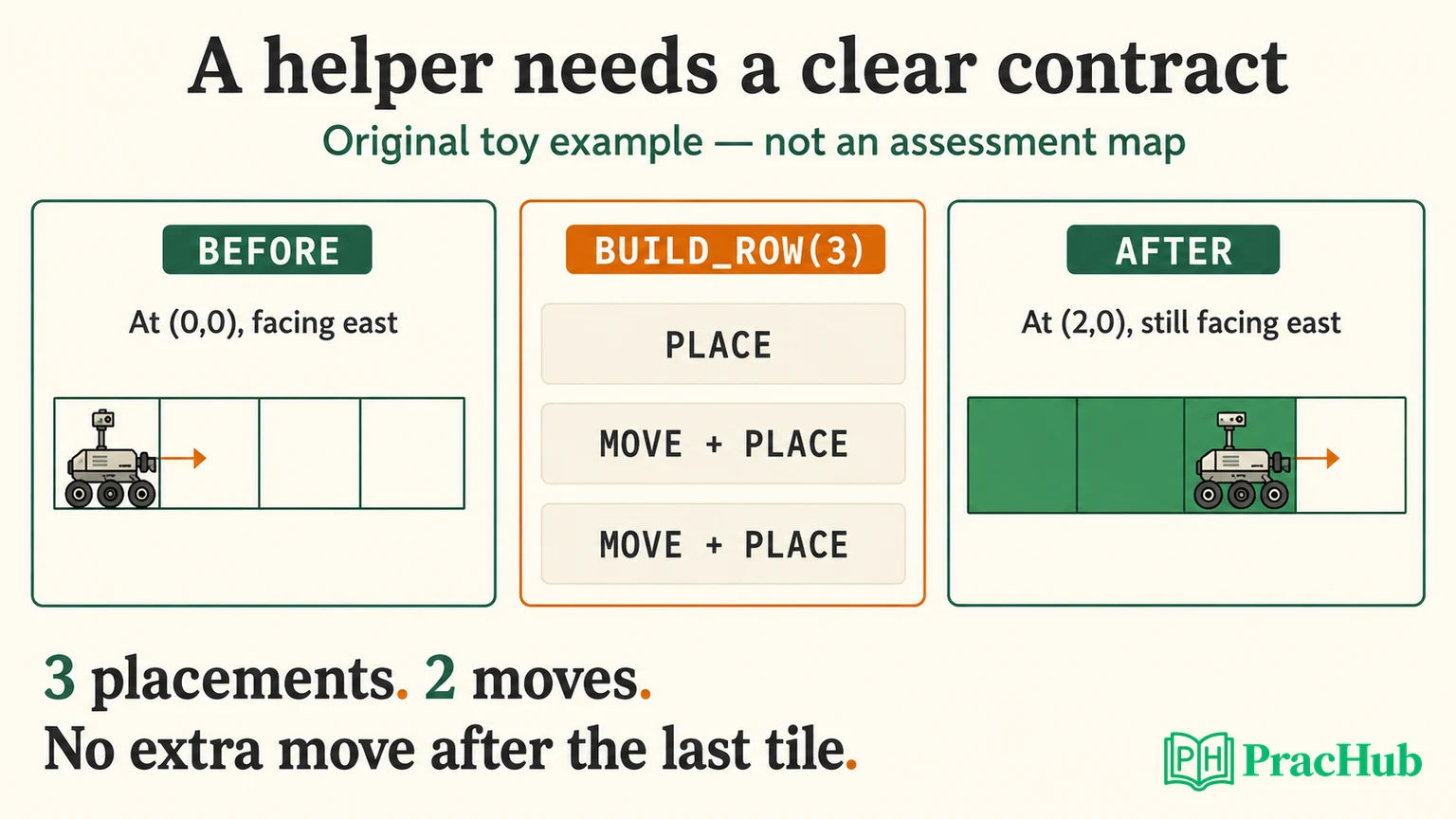
Original exercise: Imagine a paper grid with a rover that can place a tile on its current cell and move one cell forward. A placement does not move the rover. We define east as increasing x and north as increasing y. This is an invented teaching model, not a claim about Roblox’s command names or coordinate system.
Define BUILD_ROW(n) for a positive whole number n. It should place exactly n tiles, including the starting cell, and finish on the final tile without changing direction. Assume the required cells are clear and the exercise supplies enough tiles. State these assumptions instead of silently hoping they hold.
A correct conceptual sequence is:
BUILD_ROW(n), for n >= 1:
    PLACE
    REPEAT n - 1 TIMES:
        MOVE_FORWARD
        PLACE
These are pseudoblocks you can trace on paper; they are not instructions to type into Coding Cookies. If you adapt the idea to a permitted editor, use the actual available operations and their documented behavior.
The common alternative, repeating PLACE; MOVE_FORWARD exactly n times, places the same number of tiles but finishes one cell too far forward. The visible construction can look correct while the ending state breaks the next operation.
Trace the smallest example before building a larger solution
Start at (0,0) facing east and call BUILD_ROW(3) under the toy rules. Do not jump straight to the final picture. Record what changes after each action.
| Step | Action | Rover position | Tiles placed so far |
|---|---|---|---|
| Start | None | (0,0) | None |
| 1 | Place | (0,0) | (0,0) |
| 2 | Move forward | (1,0) | (0,0) |
| 3 | Place | (1,0) | (0,0), (1,0) |
| 4 | Move forward | (2,0) | (0,0), (1,0) |
| 5 | Place | (2,0) | (0,0), (1,0), (2,0) |
The result is three placements and two moves. Direction remains east. Those facts are part of the answer, not incidental animation details.
Now imagine calling the helper again immediately. It starts on the tile where the previous call ended, so the calls overlap at that cell. If you wanted a continuous extension with no repeated placement, the caller must first advance to the next cell, assuming that move is legal. This illustrates why combining individually correct helpers can still produce an incorrect program.
Test the assumption that one successful run can hide
For this exercise, n = 1 is especially revealing. The rover should place once and never move. An unnecessary final move becomes obvious without a large map obscuring it.
Try n = 2 next, then change the starting position and orientation. Starting at (4,2) facing north with n = 3 should end at (4,4) facing north in our coordinate convention. If your implementation instead heads east, it has confused “forward” with a fixed world direction.
Also test the contract’s limits. Our helper deliberately accepts only positive integers. A zero-length request requires a separate decision: reject it, or define a new no-op case. Do not let an accidental negative repeat count decide the behavior. Likewise, a blocked required cell violates the clear-path assumption; it is not a case this simple helper secretly solves.
When a larger sequence fails, find the first state that differs from your prediction. If the rover is already facing the wrong way before a helper starts, inspect the caller. If the starting state is correct but the first movement is wrong, inspect that helper’s command semantics. Debugging at that boundary is more informative than replacing the whole sequence.
A short test set should therefore vary length, start, direction, and whether the stated preconditions hold. It need not imitate a private assessment map to expose a fragile abstraction.
Make the solution correct before making it compact
Original preparation advice: Treat correctness and efficiency as separate questions. First establish that the program does what the task requires. Then ask which repeated work can be reduced without changing the result or the state expected by later steps.
In the toy row exercise, a repeat block makes the program shorter to express, but it does not reduce the necessary placements. A helper can improve readability and reuse while leaving the number of executed actions unchanged. “Fewer visible blocks” and “less work performed” are different measurements.
If your actual task displays an efficiency measure, read what it counts. Do not assume it rewards the shortest-looking program, the largest function library, or the most completed practice recipes. Publicly reviewed sources do not establish a universal Mars scoring formula.
Keep a working version before a substantial refactor when the tool permits it. Rerun the smallest case and a changed-start case after editing. A clever general helper is not an improvement if you can no longer predict its behavior when another operation calls it.
A useful endpoint for your practice session
You do not need to keep practicing until every experiment succeeds. A more useful stopping point is being able to explain a short sequence, identify its assumptions, and predict the result of one controlled variation before running it.
Try explaining your last correction in four sentences: what you intended, what happened, which assumption was wrong, and what you changed. For the toy example, that might be an extra move after the last placement. Use your own observed mistake when reflecting on an actual practice session.
Before starting an assigned section, read its instructions and timing information. Roblox’s careers page says assessments can be completed together or across a week; that is not permission to pause a section once its timer starts. For access problems or extension requests, use the support route on the official assessment page.
Five complementary exercises for block-program reasoning
These PracHub questions train transferable coding concepts. They do not reproduce Coding Cookies, reveal Mars layouts, or predict your interview. The set includes Software Engineer and adjacent Machine Learning Engineer records, selected for state and boundary reasoning rather than as evidence of a Mars question bank.
| PracHub question | A focused way to practice |
|---|---|
| Simulate robot path and detect boundedness | Track both position and orientation; explain why a complete state matters when commands repeat. |
| Can the character reach the destination? | Distinguish a legal transition from a desired destination, including obstacles and grid edges. |
| Level-Ordered Dependency Build Order | State which prerequisites must hold before an operation can run. |
| Find Windows Containing a Target | Test inclusive interval endpoints and overlapping ranges rather than relying on a middle-of-range example. |
| Implement a Rolling-Window Rate Limiter | Make boundary conditions explicit and test the moment state enters or leaves a valid range. |
Choose one question and write its smallest useful test before implementing it. Carry that habit back to official block-coding practice: a small, predictable example is often the fastest way to discover what a longer program is assuming.
Sources and Further Reading
- Roblox Early Career — official mapping between practice experiences and assessment interfaces, plus support guidance.
- Coding Cookies by Assessment Tools — the experience linked by Roblox; its description establishes untimed, unscored practice.
- Candidate report about a Mars helper failing in new scenarios — August 2026 self-report, not an official task specification.
- Roblox SWE OA discussion — August 2026 individual experiences; reported map totals are not a passing standard.
Comments (0)