SAP SD Interview Questions: Explain Pricing, Delivery Blocks, and Order-to-Cash Failures
Quick Overview
Diagnose a missing price condition separately from a delivery block, then trace order items, schedule lines, goods issue, billing, accounting and clearing.
A sales order has a missing price condition and a delivery block. Correcting the price does not authorize shipment. Releasing the delivery block does not supply the missing price. Answer SAP SD interview questions by naming the document and control that establishes each fact.
Follow one order from pricing through delivery, posted goods issue, billing, accounting and clearing. At each boundary, identify the existing document, the failed step and the evidence that would confirm the correction.
For adjacent practice, try PracHub’s Design cart and pricing engine classes. Explain the price calculation separately from permission to fulfill an order, then apply that distinction to the SAP case below.
Evidence boundary: official SAP documentation supplies the process concepts. Our order, condition dates, quantities, blocks and amounts are original exercises, not an employer’s questions or a customer incident. No SAP tenant was executed. The scope is a configured stock-material, delivery-related billing process; services, order-related billing, down payments and other variants require a different trace. App functions and control behavior depend on edition, release and configuration.
Start SAP SD interview questions with the item and schedule line
Official SAP Learning distinguishes a sales document’s header, items and schedule lines. Items describe what the customer orders; schedule lines hold shipping-related dates and quantities. A document’s overall status reflects several processing statuses rather than replacing them. SAP: sales process and document structure
Our fictional order CASE42 contains item 10 for twelve EA. Its pricing date is November 3, 2026. The intended base price is USD 25 per EA, followed by a ten-percent discount on that base. Taxes, freight, currency conversion, returns and other charges are excluded.
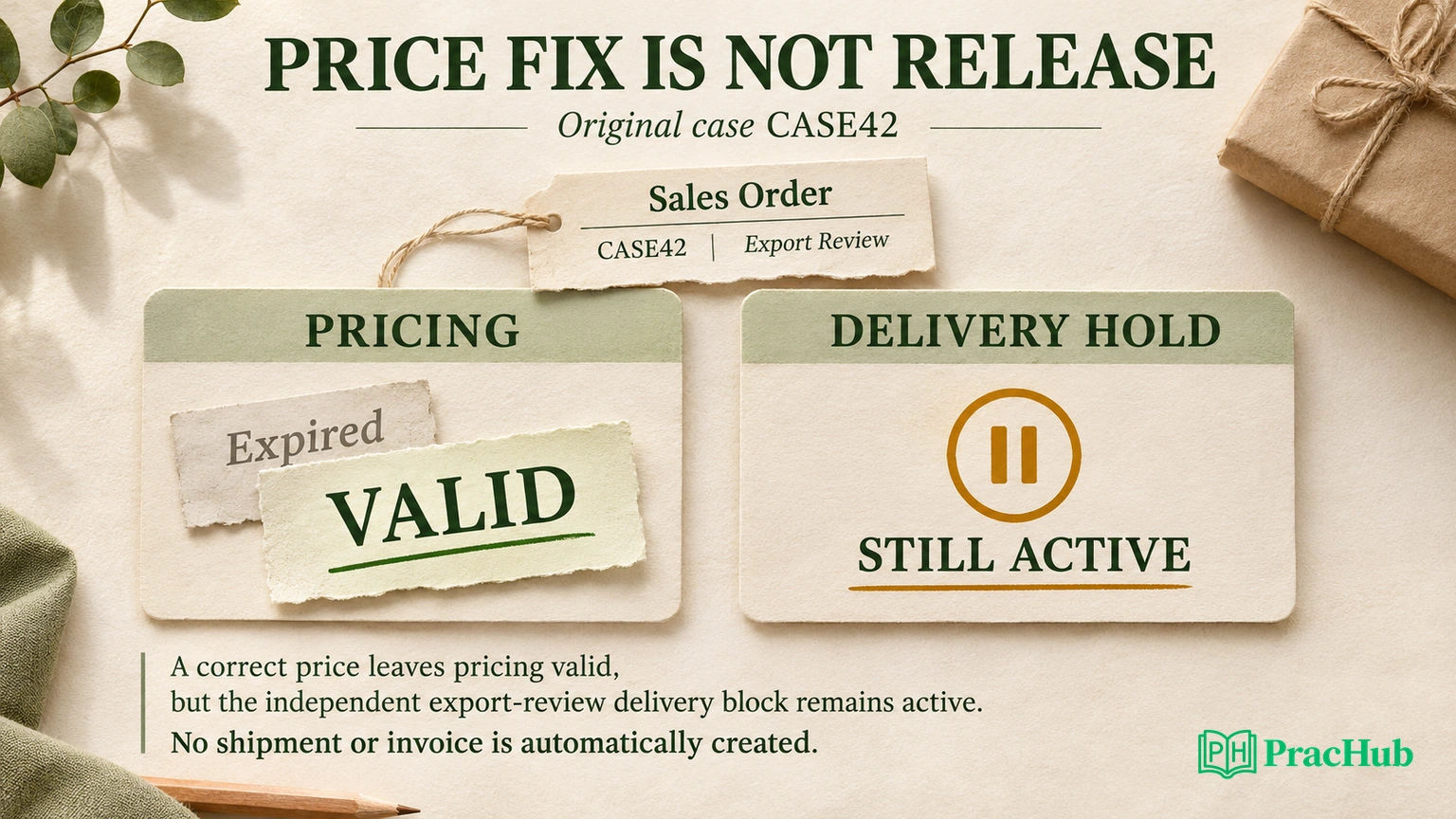
Two supplied problems are independent. The expected base-price condition record expired on October 31. Schedule line 1 also has an export-document-review delivery hold. For this exercise, the reason blocks delivery creation while leaving the supplied twelve-unit confirmation intact. That is a declared configuration assumption, not a universal consequence of setting a delivery block.
There is initially no outbound delivery, goods issue, billing document or posted customer receivable in the case. Do not turn an incomplete price into a legitimate zero-value sale. The intended net can be calculated for comparison, but the order does not yet establish a valid net amount.
How do you diagnose the missing price condition?
Officially, SAP’s condition technique separates the pricing procedure, condition type, access sequence and condition records. Procedure determination considers the sales area and document/customer pricing procedures. A condition type can be marked mandatory, manual-only or statistical. SAP: introducing the condition technique
The access sequence is the search strategy; it is not the price itself. SAP’s pricing-control lesson distinguishes the condition table’s key fields from the access hierarchy, condition properties and procedure selection. Those distinctions help you avoid changing a condition record when the order selected the wrong pricing procedure. SAP: pricing-control components
First establish which procedure was determined for this order. Then inspect whether the expected base condition belongs to it and is applicable. Next compare the access keys and the relevant record’s validity against the document’s pricing date. Check currency, unit and price basis as well: USD 25 per EA and USD 25 per hundred EA are different offers.
In CASE42, the supplied evidence narrows the failure to an expired record for the intended key. It does not establish that the procedure or access sequence is wrong. Ask the responsible pricing owner to confirm the approved terms and effective period before maintaining or correcting data.
Compare a nearby successful order only after matching the relevant organization, customer, material, date and process. A working order for another sales area or a different pricing date is a useful lead, not proof that configuration is identical. Preserve the messages and failed lookup evidence so another consultant can reproduce the diagnosis.
What should change after the authorized price correction?
Assume the pricing owner authorizes the intended USD 25 record from November 1 onward. After the appropriate price update, inspect the item’s resulting conditions and completeness rather than relying on the fact that someone saved a record.
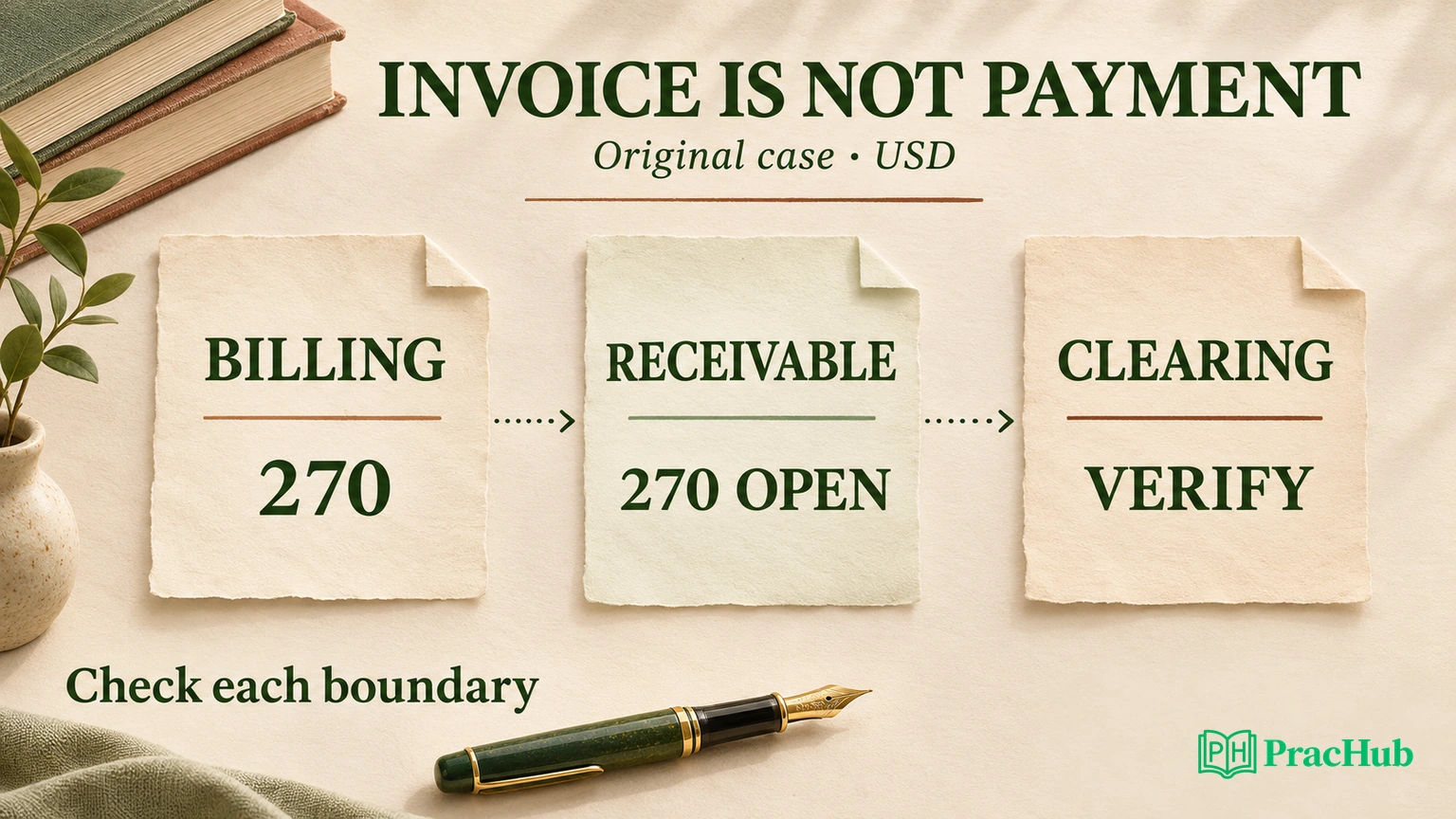
The original arithmetic is twelve times USD 25, or USD 300 gross base; the ten-percent base discount is USD 30; the expected net is USD 270. This is a simplified commercial calculation, not a complete SAP pricing simulation or accounting journal.
Confirm that the discount uses the intended base and remains active. A value visible in the condition list need not be the value contributing to the final net. Avoid a manual override merely to reproduce USD 270 unless the business process explicitly authorizes that method and preserves its audit trail.
SAP documents different pricing-update types, and billing repricing can depend on item-level copying control. Therefore, selecting “new pricing” is not a harmless universal refresh: establish which elements should be redetermined and which should remain. SAP: pricing updates and billing copying control
Our expected after-state is valid item pricing at USD 270 with the schedule-line hold still present. The price owner has resolved a commercial-data problem. They have not approved the export documentation or performed a logistics release.
Why is the delivery still blocked?
Official S/4HANA 2025 FPS02 (October 2026) delivery documentation distinguishes header and schedule-line blocks. A header delivery block’s effect depends on assignment to the relevant delivery type; a schedule-line block remains effective independently of that assignment. Delivery also has other prerequisites, including due schedule lines and document completeness. This is the cited on-premise scope, not a universal Cloud app click path. SAP: prerequisites for processing deliveries
Record the block’s level, reason, affected quantity and responsible owner. In this case the evidence is schedule line 1, twelve EA, awaiting export-document approval. A clear header does not disprove that supplied schedule-line hold.
SAP’s current Manage Sales Orders – Version 2 documentation describes schedule-line delivery blocks, status information and incompleteness information. It also directs users to related apps when required fields are unavailable. Identify the actual edition, release and app before giving instructions. SAP: Manage Sales Orders – Version 2 functional details
Only the authorized approval should trigger removal of this hold. Afterward, inspect the saved schedule line and remaining delivery checks. A block can be one reason an order is not deliverable without being its only reason. Do not remove unrelated controls to get a delivery number.
| Original case combination | What the evidence establishes | What remains unresolved |
|---|---|---|
| Price missing; hold active | Two separate problems | Pricing diagnosis and export approval |
| Price valid; hold active | USD 270 price restored | Delivery permission |
| Price missing; hold removed | This hold is no longer active | Valid price and applicable incompletion controls |
| Price valid; hold removed | Both supplied problems addressed | Other delivery prerequisites and actual execution |
This matrix is a reasoning aid, not an SAP status code table. In particular, missing pricing does not have one universal delivery consequence: the actual incompletion and processing configuration determine which steps are prevented.
If the hold reappears after saving, record when and where it was set again. A defaulting rule, approval dependency or another configured process may be relevant, but none is established by that symptom alone. Compare the change history and current reason with the authorized release. Repeatedly clearing the field would lose the distinction between a failed save and a control deliberately being reapplied.
What separates confirmation, delivery and goods issue?
A confirmed schedule quantity is a planning commitment in this exercise. It is not evidence that twelve units were picked, that an outbound delivery exists or that goods issue was posted. Conversely, a delivery number does not prove that its goods movement succeeded.
Once both supplied issues are resolved and other prerequisites are met, suppose an authorized delivery for twelve EA is created. Continue checking the delivery’s processing evidence rather than promoting the entire order directly to “shipped and billed.” The physical quantity and document references must agree.
SAP’s receivables-integration lesson identifies goods issue, billing and their related financial documents as distinct parts of document flow. A goods-issue accounting effect is not the customer invoice’s receivable posting. SAP: sales-order and receivables integration
Our process assumption requires posted goods issue before delivery-related billing. Do not apply that prerequisite to every SAP sales variant. If the interviewer changes the case to services or order-related billing, revisit the document relationship before reusing this sequence.
| Evidence checkpoint | Supplied successful continuation | It does not prove |
|---|---|---|
| Order item | Valid USD 270 net | Export hold released |
| Schedule line | Hold released; twelve EA confirmed | Delivery created |
| Outbound delivery | Twelve EA in referenced delivery | Goods issue posted |
| Posted goods issue | Twelve EA movement with posting evidence | Billing document created |
| Billing document | USD 270 invoice with correct reference | FI posting successful |
| FI customer item | USD 270 receivable posted | Payment allocated or cleared |
| Clearing | Invoice and payment matched, clearing evidence present | Every unrelated order issue resolved |
For a partial-delivery variation, suppose only four of the twelve EA proceed. Keep the same unit price and ten-percent discount, with no scale changes. The original calculation for those four units is USD 100 base, USD 10 discount and USD 90 net. The other eight units remain a separate quantity balance; a USD 90 invoice should not be compared directly with the entire USD 270 order as if both covered twelve units.
This variation changes the reference quantity, not the original price diagnosis. Before calling a difference an error, identify which delivery items the invoice covers and whether pricing was copied or redetermined. Our simplified USD 90 is an expected comparison under declared assumptions, not a prediction of every partial-billing configuration.
An invoice exists. Why might accounting still be open?
Official Manage Billing Documents documentation distinguishes incomplete, to-be-posted and completed billing states. Posting can fail because of a posting block, accounting-interface or account-determination error, pricing error or missing authorization. Even “completed” is not universal proof of an ordinary FI receivable: documents not relevant for accounting, such as pro forma invoices, are an exception. SAP: Manage Billing Documents
For a follow-up, suppose CASE42’s ordinary invoice exists for USD 270 but its transfer to accounting reports an account-determination error. The first failed boundary is now billing-to-FI posting. Releasing the old delivery hold again or recreating the sales order would not address that message.
Capture the billing document and item, reference delivery, posting status, exact message and relevant accounting data. Route the configuration or master-data question to its responsible owner, then verify the supported posting retry against the existing document. Do not create a second invoice simply because the first lacks a posted journal entry.
After successful posting, identify the actual customer item and its amount. That is stronger evidence than an invoice PDF or an email output status. If the billing amount differs from USD 270, compare the effective conditions and copying/repricing behavior before assuming an arithmetic error.
Does receiving USD 270 mean the invoice is cleared?
Official SAP clearing guidance says an invoice posted to receivables becomes an open item. Incoming payment may clear it automatically, but separate clearing can be necessary. Successful clearing supplies item status, a clearing journal-entry reference and date. SAP: clearing customer open items
In our continuation, the customer pays USD 270, but the payment initially remains on account rather than allocated to this invoice. Equal amounts alone do not establish the intended match. Inspect customer, currency, invoice reference and open-item assignment, then follow the approved clearing process.
After the correct invoice and payment are matched, the simplified selected-item balance is zero. To verify the real process, inspect cleared status and its reference; our spreadsheet-style subtraction cannot establish SAP clearing. We exclude discounts at payment, deductions, foreign exchange and residual-item treatment; any of them would require a revised reconciliation.
How do you present the diagnosis in an interview?
When asked why the order still cannot proceed, try this original spoken answer: “Item 10 has an expired base-price record and an independent schedule-line export hold. I would verify the pricing key and date before an authorized correction, then confirm the intended USD 270 net. That correction should leave the hold intact. After export approval, I would verify its release and trace delivery, goods issue, billing, FI posting and clearing separately.”
Then explain which observation would change your answer. If a delivery already exists, ask which step is actually failing. If the price condition is present but inactive, investigate applicability rather than inventing another record. If FI posting failed, preserve the existing invoice and use its posting error.
The local arithmetic companion calculates the declared base, discount and net and records the two independent case controls. It does not validate SAP condition determination, availability, block configuration or financial posting. That boundary lets you discuss the example confidently without claiming platform execution you did not perform.
Practice pricing and document-state reasoning
These verified PracHub records offer adjacent commercial-calculation and order-system practice. They are not a SAP SD question bank, hiring predictions or evidence that an SAP consultant interview requires a coding round. The SAP follow-ups are our original practice suggestions.
| PracHub question | Follow-up to rehearse |
|---|---|
| Design cart and pricing engine classes | Separate condition selection, calculation and fulfillment permission. |
| Design receipt system with combo discounts | State the discount base and order before calculating a net. |
| Compute shipping cost with tiered pricing | Keep quantity units, price basis and calculation rules explicit. |
| Design an E-Commerce Checkout Flow That Prevents Concurrency Bugs | Define which event establishes each committed business state. |
| Architect Shopify's checkout from cart to paid order for many merchants | Explain why an order, payment and downstream documents are distinct. |
For your next SAP SD scenario-based interview rehearsal, begin with the cart and pricing exercise. Write the two remaining-problem lists: price corrected with the hold retained, then hold removed with pricing still incomplete. Finish by naming the next document and evidence you would inspect, rather than declaring the entire order complete.
Sources and Further Reading
- SAP Learning: sales process and document structure
- SAP Learning: condition technique and pricing updates
- SAP Learning: pricing-control components
- SAP S/4HANA 2025 FPS02 (October 2026): prerequisites for processing deliveries
- SAP S/4HANA Cloud: Manage Sales Orders – Version 2 functional details
- SAP Learning: sales-order and receivables integration
- SAP S/4HANA Cloud: Manage Billing Documents and posting status
- SAP Learning: clearing customer open items
Documentation checked November 3, 2026. The arithmetic and document ledger are original desk exercises; no SAP system or employer interview process was tested.
Comments (0)