Scenar.io Review: Linux Debugging Interviews, Simulated Output, and Debriefs
Quick Overview
Review Scenar.io’s conversational troubleshooting format, loaded scenario catalog, AI-paused access state and displayed allowances. An original loopback experiment separates port conflicts, TCP connectivity and application responses.
Scenar.io is designed for practicing Linux debugging explanations through a conversation with a simulated server. For interview rehearsal, distinguish generated output from executed commands. In our current check, the scenario catalog loaded, but the site displayed an AI-paused notice and we did not establish an interactive round or inspect a completed debrief. This review therefore evaluates the visible format and its evidence boundaries.
PracHub publishes this review and owns the complementary practice links. Our single-server crash diagnosis question offers another evidence-first exercise. The loopback listener experiment below is original work executed locally, separate from Scenar.io’s simulated environment or feedback.
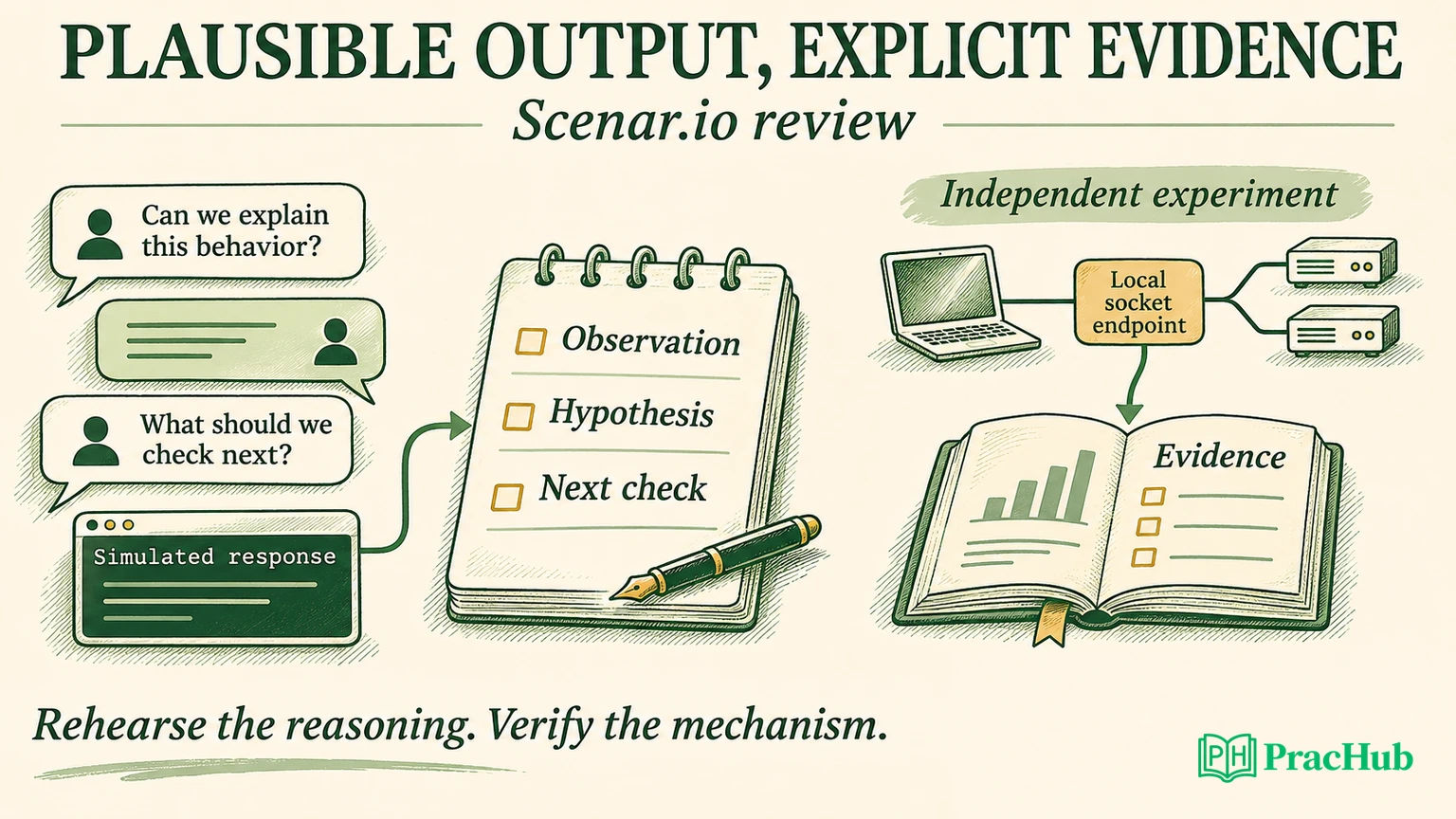
What the product proposes to simulate
Provider description, checked November 3, 2026: Scenar.io presents debugging interviews in natural language, with simulated command output and progress toward a cause, immediate recovery and prevention. Its visible home demonstration illustrates a failed web-server start followed by a listener-conflict investigation.
The FAQ explicitly says this is not a real terminal: the AI produces plausible output from scenario state. It also acknowledges that output and feedback can be wrong. Use that description to set the practice boundary: rehearse what you would inspect and why, then verify operational claims independently.
No independent candidate reports or employer-specific process evidence support this review. We did not provide voice, a resume, private logs or account data, and we did not test the model’s accuracy or feedback calibration.
A realistic-looking response is not an operating-system receipt. It may be useful material for reasoning, but it does not establish that a command exists on your target distribution, that its flags are correct or that an actual service changed state.
What loaded, and where our session stopped
Direct observation: the initial catalog briefly showed 0/0. After loading, it displayed 21/21 and populated scenario cards. The early empty state was transient; it would be inaccurate to describe the product as permanently lacking scenarios.
The page also displayed an AI-paused status. Opening the introductory Nginx scenario showed an interviewer-style choice. We kept the default Helpful option and selected Start Interview. The page returned to the catalog with the same pause notice; we did not reach an interactive exchange.
This is a dated access result, not a diagnosis of the service’s backend or a claim about every visitor. We cannot tell from that observation whether a later attempt, another account or a different day would behave identically. We did not repeatedly consume attempts or infer a particular quota cause.
The Verbal tab exposed role-topic choices and advertised follow-ups and scoring. We inspected those choices without starting a voice session. A visible mode description does not demonstrate a successful follow-up, a complete interview or a useful score.
Without a completed round, debrief quality remains unverified. We can discuss what a debrief should preserve, but we cannot claim to have reviewed one generated for our own attempt.
Simulation and execution answer different questions
A conversational simulator can test whether you request a useful observation before changing the system. A local or remote execution environment can test whether a specific operation actually produces a result. Preserve the different evidence each method produces.
| Practice surface | Evidence you can reasonably preserve | What it does not establish alone |
|---|---|---|
| Provider’s animated home example | The intended question-and-output interaction | A round you personally completed |
| Generated command response in a future round | The scenario’s presented observation | Actual host state or exact command behavior |
| Your written explanation | Which hypothesis and next check you proposed | Whether a real service recovered |
| Independently executed fixture | Behavior under its recorded inputs and environment | Fidelity of the product’s simulation |
Keep this distinction in your practice notes. If you say you checked the listener, retain the presented output and explain what it implies within the exercise. If you say you verified a command, record the actual environment and result. Avoid switching between those meanings mid-answer.
A simulation also gives you a chance to challenge inconsistency. If two outputs appear incompatible, ask about time, host, namespace and the exact endpoint before inventing an explanation. A good reasoning process can preserve uncertainty even when the supplied evidence is imperfect.
Original listener experiment: occupied is not the same as healthy
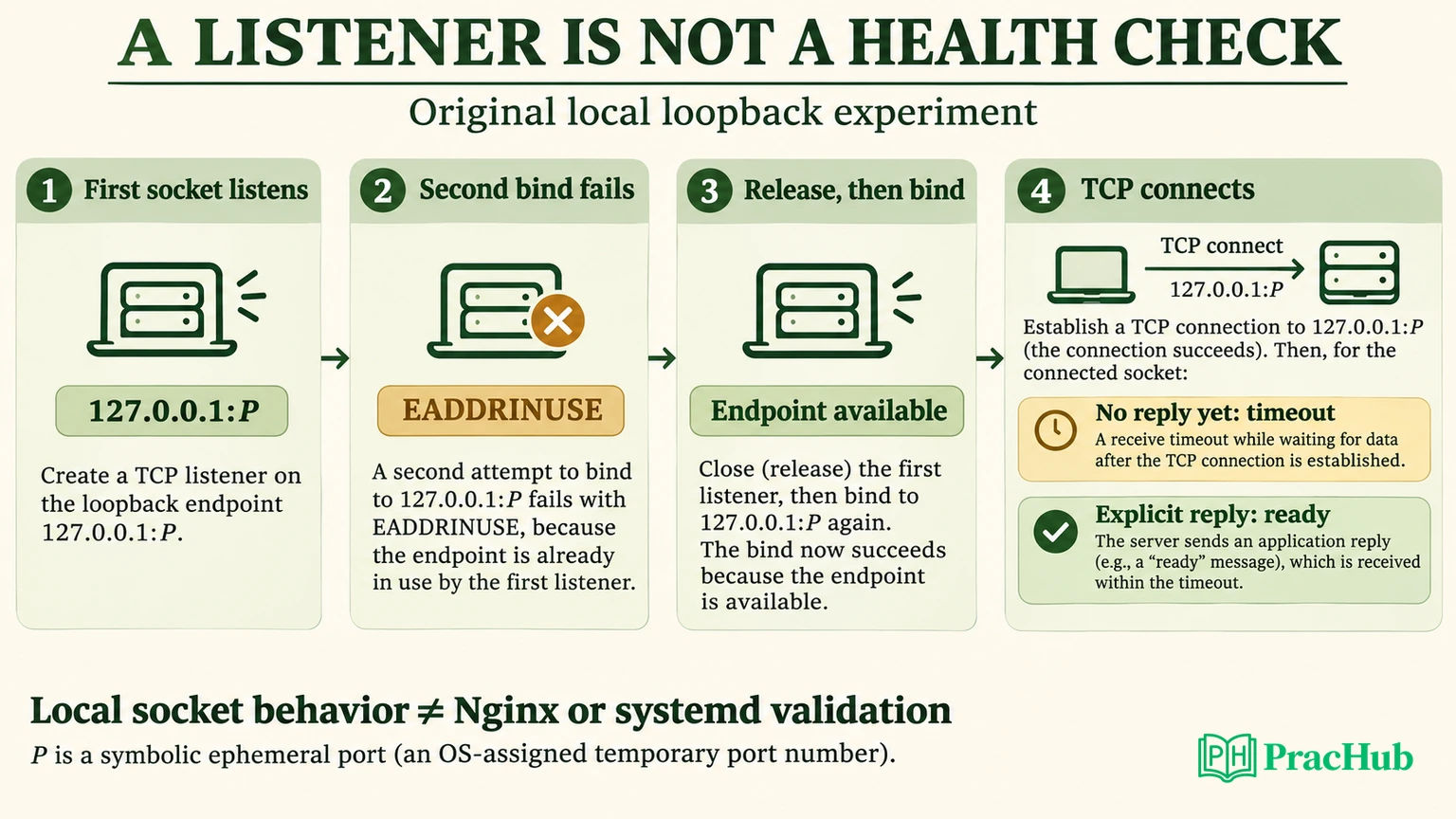
Our original exercise isolates the listener idea shown in the product’s public demonstration. It uses Python sockets on local loopback, an automatically assigned unprivileged port and a short-lived process. It does not launch Nginx, systemd or a Linux virtual machine.
The Python socket reference documents bind, listen, connect, accept and receive as distinct operations. We used those boundaries to separate three claims: an endpoint is occupied, a TCP connection can be established and application data is actually returned.
First, one socket bound and listened on 127.0.0.1 at the assigned port. A second socket, without port-sharing options, attempted to bind the same endpoint. It failed with EADDRINUSE in our local environment. That observation identifies a conflict under these conditions; it does not identify a real service owner.
Next, the first listener closed before any connection was accepted. A replacement socket successfully bound the same endpoint. This controlled release tests the relevant resource dependency without killing an unrelated process or modifying a system service.
Finally, a client connected to the replacement listener. Before the fixture sent application data, the client’s receive timed out. After the fixture accepted the connection and sent the explicit bytes ready, the client received them.
| Original local observation | Defensible conclusion | Conclusion to avoid |
|---|---|---|
| Second bind returned EADDRINUSE | The first listener prevented this bind under these settings | A particular production process must be stopped |
| Bind succeeded after controlled release | The fixture could claim the endpoint after release | A web application has started correctly |
| TCP connect succeeded; receive timed out | Connection establishment did not supply our expected data | The application is healthy |
| Explicit fixture reply arrived | Those bytes crossed this local connection | A full user transaction works |
The script’s expected observations all passed on Darwin. Socket behavior and reuse details can vary by platform and configuration, so this is a recorded local experiment rather than a universal claim about every bind. It used no external host, firewall change, privileged port or process termination.
The receive timeout was deliberately produced by withholding an application reply. It is not a measured production latency result. Likewise, the word ready is the fixture’s chosen response, not a real health-check standard.
An evidence-ordering probe for the next available round
Our recommendation is to practice the order of questions, not to memorize the home demonstration’s answer. For a service that will not start, first establish the reported failure, its time and the specific service context. Then request the observation that distinguishes a configuration failure from a resource conflict or another cause.
If a presented error indicates an address conflict, ask which exact address and port are involved and what owns the relevant listener. Keep host and network-namespace context explicit. A listener observed elsewhere does not automatically explain this process’s bind failure.
Before suggesting a stop or restart, identify the owner and the intended service relationship. Another process might be legitimate. The exercise should explain which change is authorized, what dependency it affects and how you would verify recovery afterward.
Now change the case: there is no bind error, but the service accepts connections and returns no useful response. The next check should move toward application handling and dependencies. Repeating a listener-conflict fix would no longer follow from the evidence.
The local fixture gives this variation a concrete reference. It demonstrates a connection that succeeds before application bytes arrive, so you have a concrete reason to reject the shortcut from open port to healthy service. The fixture does not supply a root cause for every timeout.
What a useful debrief should preserve
Scenar.io advertises a debrief covering discovered clues and improvement areas. Since we did not complete a round, the following is an evaluation method for a future attempt, not a description of feedback we received.
Preserve the first observation that changed your hypothesis. A debrief should let you see whether you requested that evidence directly or arrived at it after unrelated actions. A list of commands without their purpose makes the reasoning difficult to repeat.
Separate recovery from prevention. In the original listener case, releasing a controlled fixture resource allows another bind. Preventing recurrence would require explaining why competing ownership existed and how configuration or lifecycle controls should change. Those are different claims with different validation needs.
Also separate a missed clue from an incorrect model. If you know that connect differs from an application reply but forgot to request the latter, practice sequencing. If you believe connection establishment proves application health, repair the underlying concept before optimizing speed.
When generated feedback asserts a mistake, compare it with the actual transcript and a primary reference. Keep a correction only when you can explain why it is supported. Check an evaluator’s claim against the transcript before changing a supported conclusion.
Free limits and future access need a current check
The pricing page displayed monthly free allowances of five debugging, three verbal and two sandbox rounds. It also showed $15 thirty-day and $29 ninety-day passes with disabled Coming soon controls and no-renewal language. We did not buy, activate or verify any entitlement.
The FAQ describes additional turn, hint and daily-use limits. Those can matter independently of a monthly allowance. The AI-paused banner in our visit does not identify which particular condition caused it, and a visible free allowance does not guarantee immediate session availability.
Before planning a timed practice session, check that a round actually starts and that the current terms match the feature you need. Save your reasoning independently if continuity matters. We did not verify account synchronization, resumed sessions or retention.
The FAQ also says typed material is sent to a model provider and stored with an attempt. Use invented practice inputs when testing the format; real incident logs and credentials are unnecessary for the listener exercise described here.
Practice the gaps the product leaves open
These complementary PracHub prompts ask for concrete evidence and operating-system reasoning. They are independent exercises, separate from Scenar.io’s scenarios, clue tracking and AI feedback.
| PracHub question | What to examine |
|---|---|
| Diagnose a Single-Server Crash with Concrete Linux Evidence | Choose concrete host evidence before assigning a crash cause. |
| On-Call Case Study: Debugging a Misbehaving Production Server | Explain the next check when a production server’s symptoms are ambiguous. |
| Troubleshoot Processes That Randomly Crash While Being Created on Linux Cluster Hosts | Distinguish process-creation failures from the disappearance of an already running process. |
| Diagnose CPU Performance Problems on a Linux Server | Use CPU evidence to discriminate hypotheses rather than repeating a generic command list. |
| Explain What Happens When a Linux Shell Runs ls | Trace what an actual shell and process do, separate from a conversational simulation. |
Who should consider Scenar.io next
Scenar.io’s stated format fits a learner who wants to verbalize Linux troubleshooting and defend the next observation. Our current access check leaves interactive output and debrief quality unverified. Recheck availability before depending on it for a scheduled mock.
Meanwhile, answer the single-server diagnosis prompt and write the evidence you need before changing anything. Distinguish an occupied endpoint, a successful connection and a valid application response. Use one unsupported jump between those claims as the next concept to practice.
Comments (0)