Sec Guy Interview Simulator Review: Julie, SOC Practice, and Session Credits
Quick Overview
Review Sec Guy’s public beta, free SOC demo device gate and paid-session claims. Original phishing evidence and transcript-negation examples show what to check before relying on coaching, code reviews or session-credit promises.
Sec Guy Interview Simulator presents cybersecurity rehearsal with Julie, a virtual interviewer, and a transcript-confirmation step before coaching. Its free SOC demo is worth inspecting if you want spoken practice, but our attempt stopped at a required camera, microphone and transcription check. We did not grant those permissions or receive a score. Evaluate the confirmed answer and its evidence before relying on the promised report.
PracHub publishes this review and owns the complementary practice links. Our phishing explanation question provides an independent prompt. The synthetic evidence ledger and transcript-correction exercise below are original educational examples, not a Sec Guy report, real security incident or scored answer.
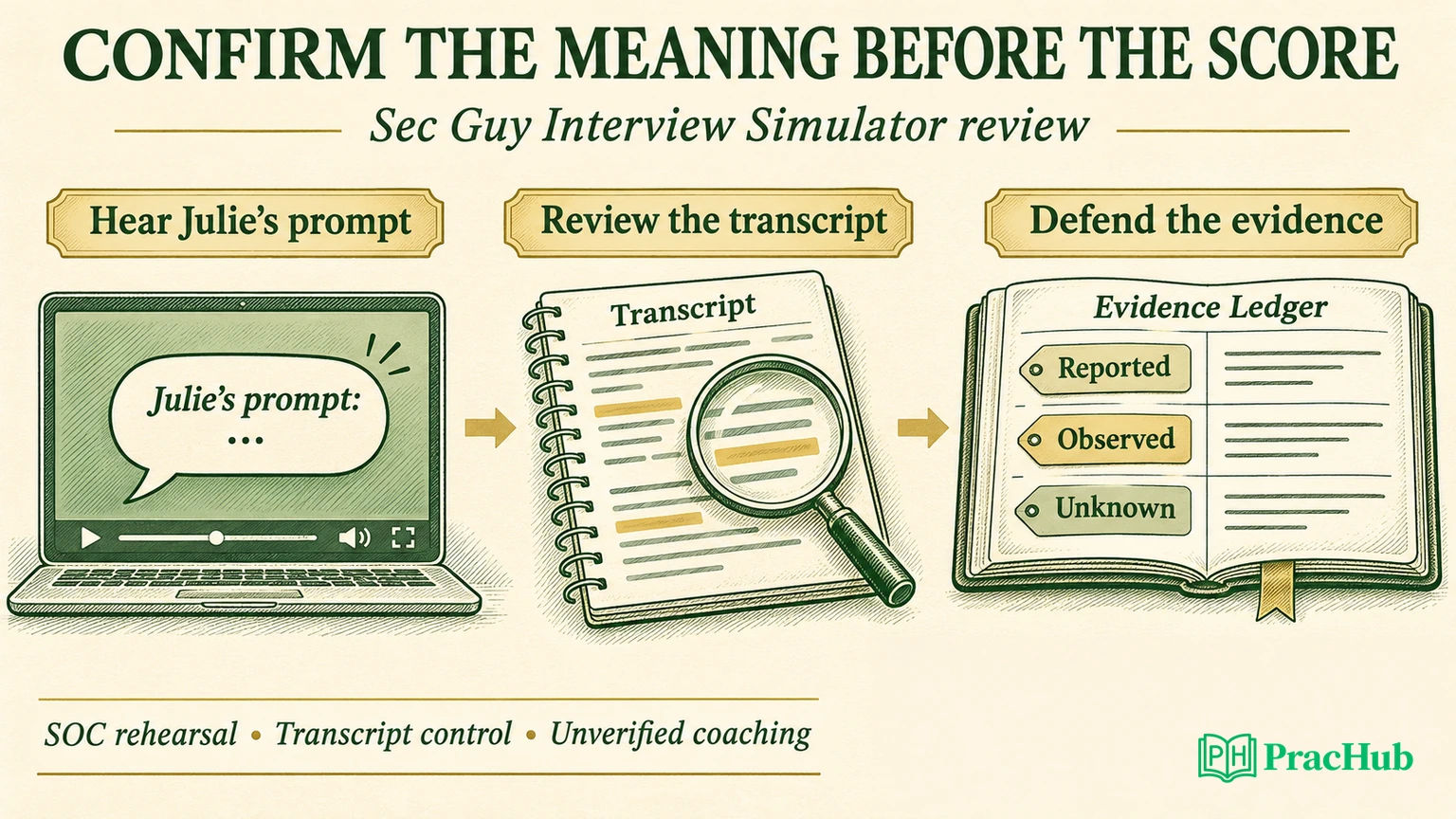
The public beta’s distinct practice format
Provider claims, checked November 3, 2026: the simulator landing page describes six scored answers per paid session, optional coding challenges and a coaching report. It presents role and sector targeting, with optional pasted opportunity context. Company-specific packs are marked for a later release.
Those are preparation features, not evidence of a particular employer’s hiring process. No independent candidate reports or measured hiring outcomes support this review. The provider itself labels the beta as coaching rather than hiring prediction.
The parent product page links back to the simulator and describes the credit purchase and sign-in flow. That connection helped establish product identity. We did not purchase credits, sign in, provide a job description or paste a resume summary.
The learner can review the transcript before it reaches evaluation. A speech system can change the meaning of a technically sound answer. Confirmation creates an opportunity to detect that change before discussing the quality of the evaluator’s response.
What the free demo actually showed
Direct observation: the demo advertised three questions without an account or card. Starting it opened a technical-check page requiring camera, microphone and transcription. Its completion control remained disabled until the device check; we stopped before granting access.
The setup displayed Julie’s virtual-interviewer area, but that is not evidence of a completed conversation or adaptive follow-up. We supplied no audio, confirmed no transcript and tested no answer evaluation. The example coaching card on the landing screen was promotional illustration, not feedback on our attempt.
We also observed a private-build notice saying checkout was locked, while the parent site displayed paid offers. We did not resolve that access difference through a purchase. Do not infer from the public price that checkout and credit activation have been independently verified.
For someone who needs text-only rehearsal, the device gate is a practical consideration. This review did not establish an alternative route that bypasses it. You can still evaluate the product descriptions and prepare an answer independently without claiming to have used the full demo.
Original SOC evidence ledger: separate the events
Our invented interview prompt is simple: a user reports clicking a suspicious email link. The task is to explain what you would establish next. All evidence labels below are synthetic; no mailbox, account or endpoint was investigated.
The official Microsoft phishing-investigation guide distinguishes questions about delivery, links, attachments, execution and sign-ins. That supports a useful interview habit: do not compress different events into a single statement that the account or device is compromised.
| Original evidence item | What it supports | What it does not establish |
|---|---|---|
| E1: Message delivered to a mailbox | The user had a possible exposure | The link was opened |
| E2: User reports clicking the link | A reported interaction to investigate | Credentials were submitted |
| E3: A browser event records the destination | A recorded navigation in that context | Successful authentication at the destination |
| E4: No attachment execution evidence supplied | Execution remains unestablished | No execution occurred anywhere |
| E5: A sign-in event appears later | An identity event requiring correlation | The email caused that sign-in |
The ledger keeps unestablished events visible. A user report, a browser event and an identity log have different origins and limitations. In an interview, name the source and what you would correlate rather than narrating an unsupported chain of compromise.
A weak answer might jump from the click to wiping the device. Another might dismiss the case because the message was deleted. Both conclusions outrun these inputs. The next action depends on the observed scope, available telemetry and organizational authority.
Our recommendation is to explain a proportional investigation: preserve relevant evidence through the approved process, establish what interaction occurred and involve the appropriate response owner. For a real organization, the incident plan and authorized responders determine containment actions; this paper case grants no operational authority.
NIST SP 800-61r3 places incident response within cybersecurity risk management. Use that framing to explain responsibilities and decisions, rather than treating an interview checklist as permission to disconnect assets or change access.
Why transcript confirmation can change the technical answer
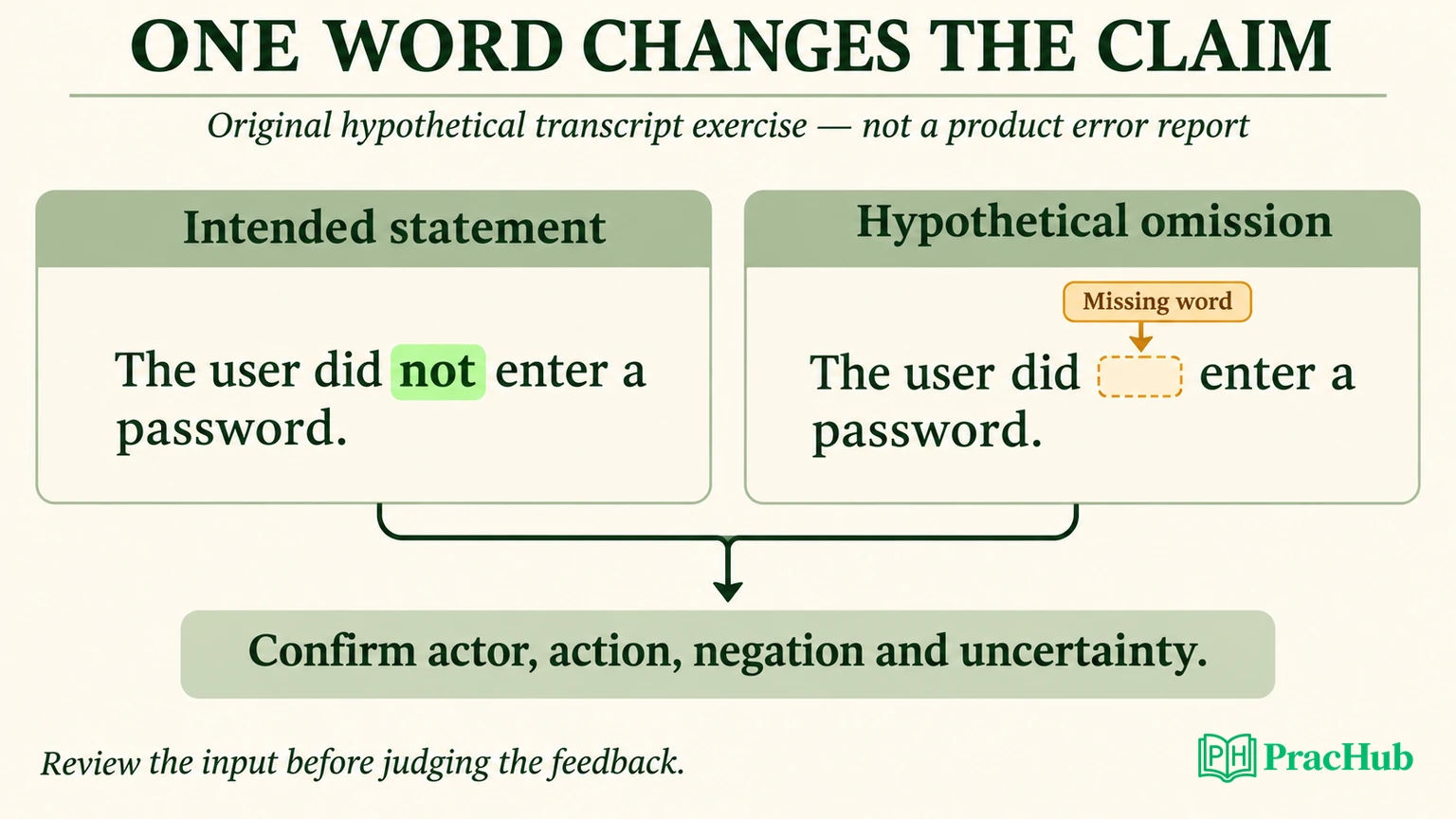
Consider this original spoken statement: “The user did not enter a password. I would verify that report against the available evidence.” Now imagine a transcript that omits not. The confirmed text would assert the opposite event before the evaluator ever considers the reasoning.
This is a hypothetical transcription error, not one we observed in Sec Guy. We did not record speech or submit either version. Its purpose is to show what a transcript review should protect: event meaning, uncertainty and the distinction between a report and verified evidence.
Check negation first. Then check actor, action and timing. “The email was blocked” is different from “the sign-in was blocked.” “A user reported a click” is different from “the log proves credential submission.” A changed verb or negation can change which response the evidence supports.
Preserve the uncertainty as well. If the spoken answer says a sign-in may be related, do not confirm text that says it was caused by the email. Correcting that sentence is part of evaluating the input, not an attempt to manipulate a score.
Finally, check technical names that carry meaning. A transcript can look grammatically clean while confusing an account identifier, a system or a security control. The review should preserve what you actually intended before you judge whether the coaching recognized it.
Compare two answers without inventing a score
Original answer A says the click proves compromise and immediately proposes a broad disruptive action. It gives no evidence boundary, does not establish the affected identity and does not name who can authorize the change.
Original answer B identifies the click as a report, asks whether credentials or files were involved, checks relevant identity and endpoint evidence and explains how escalation follows the organization’s response process. It also states what remains unknown.
Each next step in answer B addresses an identified uncertainty. That is our editorial judgment about these invented answers. It is not a score from Julie, an independent benchmark or a claim that Sec Guy would grade them differently.
If you later use the demo, keep a correctness reference before looking at the feedback. Ask whether the report catches the unsupported jump in answer A, recognizes the evidence distinctions in answer B and identifies a concrete improvement. A higher number alone does not answer those questions.
Change the prompt after reviewing it. Suppose there is now confirmed credential submission, or confirmed file execution, rather than only a click. Your explanation should change with the evidence. Repeating an unchanged answer would show that the original reasoning was not doing enough work.
Coding challenges need their own execution boundary
The demo’s public description says its optional security coding exercises are reviewed as text and are not executed. That distinguishes this interview feature from a separate live coding workspace linked elsewhere in the product family. We did not open a coding session or submit code.
A text review may discuss correctness or edge cases, but it cannot supply an execution receipt by itself. If your answer contains a parser or detection rule, run a separate controlled test before claiming it works. Keep that local result distinct from any model comments about the code.
For interview preparation, explain expected inputs, failure behavior and limitations before showing the implementation. If feedback recommends a change, inspect its effect on those requirements. Do not accept an untested edit solely because it accompanies a confident explanation or a complexity label.
The same standard applies to our ledger. It is a reasoning exercise, not executable detection logic. We performed no malware analysis, indicator lookup, telemetry query or incident response action to validate it.
Session credits and privacy claims require careful reading
The current public offers were $7 for one session credit and $25 for five, with no-subscription language. The home page describes one credit per completed session. We did not verify activation, interrupted-session handling, retry behavior or a ledger deduction.
Before buying, confirm what completion means and what happens if transcription or evaluation fails. The parent site describes limited refund exceptions. Read those current terms in context; this review neither interprets them as a legal guarantee nor establishes a successful refund or purchase.
The privacy summary says camera frames stay local and only the reviewed transcript reaches evaluation. It describes browser-dependent speech processing, temporary audio in the server transcription route and optional saved reports designed to expire after thirty days. These are provider statements, not a network or retention audit.
Read the processing steps separately. Local camera preview does not imply every input stays on the device, because transcript evaluation is a separate step. Use invented opportunity context for a trial and understand the processing route before providing real material. Our review transmitted no personal interview answers or background documents.
What a focused trial should establish
Choose one answer whose mechanism you can check, such as the difference between a reported click and confirmed credential submission. Prepare the answer first, confirm that its transcript preserves the distinction, then inspect whether the coaching responds to the actual reasoning.
Keep the confirmed text beside the feedback. If the input is wrong, fix the input before treating the score as evidence about your knowledge. If the input is correct but the feedback makes an unsupported claim, compare that claim with the relevant reference and record the disagreement.
Use that known omission to evaluate a future session. It does not require assuming that a six-question report measures readiness for every security role, sector or seniority level. Save a correction you can explain and apply when the scenario changes.
Practice the gaps the product leaves open
These complementary PracHub questions cover phishing, monitoring and access reasoning. They are independent prompts, separate from Julie’s interview questions, rubrics and coaching reports.
| PracHub question | What to examine |
|---|---|
| Explain Phishing Attacks, Then Design Anti-Phishing Education for Crypto Exchange Users | Explain the attack mechanism and choose prevention that follows from it. |
| Design a Security Monitoring Framework | Define which signals support an investigation and which remain ambiguous. |
| Helping SOC Analysts Handle Fewer, Higher-Value Security Alerts at Microsoft | Prioritize alert evidence without treating volume or a score as incident severity. |
| Explain auth, key rotation, secrets, and incident response | Connect credential and session decisions to a confirmed incident scope. |
| Design an RBAC Relational Schema | Explain an access decision at the resource boundary rather than relying on a role label. |
Who should consider Sec Guy next
Sec Guy’s format is relevant if you want Julie-led cybersecurity rehearsal and are willing to complete the stated device checks. Transcript confirmation is a useful feature to examine, while its evaluation quality and paid-credit behavior remain unverified in this review.
Start by answering the phishing prompt with an evidence ledger. Mark each statement as observed, reported or unknown, and preserve one negated sentence exactly. That gives you a concrete reference for judging both transcription and coaching when you choose to try a session.
Comments (0)