Shield AI Software Engineering Intern Interview 2027: C++, Robotics, and Mission Systems
Quick Overview
Prepare for Shield AI SWE intern interviews in 2027 with C++ practice, robotics timing exercises, testing examples, and clearly labeled recruiting evidence.
For a Shield AI software engineering intern interview in 2027, prepare to connect correct C++ code with predictable execution and convincing test evidence. That combination fits the company’s public software work. It does not mean every intern faces the same robotics interview or a confirmed HackerRank assessment.
What is verified: As of September 7, 2026, Shield AI’s official internship list includes Summer 2027 electrical and advanced manufacturing roles. A corresponding 2027 SWE internship and its interview sequence were not found in the sources checked. This guide separates official engineering context, an adjacent candidate report, and original preparation exercises. Shield AI internship openings
Start with Shield AI Software Engineer questions, then use the exercises below to practice explaining decisions. The company-tagged records currently shown there are Senior+ material; adapt their scope to student experience instead of treating them as an intern question forecast.
What the official roles tell you—and what they do not
Official role context: Shield AI’s full-time Computer Vision Engineer (C++) opening describes real-time perception pipelines and integration with robotics, optical, and AI engineers. Its Hivemind page describes tools for developing, testing, and deploying AI pilots. These sources make C++ implementation and cross-discipline integration relevant preparation areas; neither publishes an intern assessment syllabus. Computer Vision Engineer, Hivemind
Official senior-role context: The Mission Systems Software Engineer – BlueSky posting discusses component interfaces, latency, jitter, scheduling, resource budgets, and verification through simulation and hardware/software integration. It requires substantial experience, including eight or more years overall. Use it to understand engineering concerns, not to decide that an intern must already be a mission-system architect. Mission Systems Software Engineer
Preparation inference: A student can demonstrate the same reasoning at a smaller scale: define an interface, measure a lab program’s execution, reproduce a bug, and explain which tests support a claim. A modest project with traceable evidence gives you more to discuss than an ambitious diagram you cannot defend.
Do not borrow eligibility requirements from the electrical internship. Once a SWE requisition appears, check its location, enrollment requirements, start dates, work arrangement, and any role-specific access conditions directly. Save the requisition ID so that later conversations refer to the same opening.
Is a C++ HackerRank round confirmed for interns?
Candidate report, different seniority: In an April 2026 Reddit post, a candidate for Senior Applications Engineer, Autonomy described passing recruiter and hiring-manager conversations before an upcoming C++ pairing session on HackerRank. They mentioned earlier vector-iteration and array-removal questions. In a later reply, the original author said the pairing problem involved a hash map and that they did not receive an offer. Original candidate account and follow-up
That is one person’s senior-role experience, not a verified 2027 internship loop. Cross-posts of the same account do not create independent corroboration. Advice from other commenters also does not establish the company’s current question difficulty or evaluation rules.
The practical lesson is narrower: rehearse ordinary data structures in C++ while explaining your choices aloud. Do not replace fundamentals with robotics vocabulary. No fixed intern round count, assessment duration, cutoff score, or decision turnaround is established by this evidence.
If you receive an invitation, confirm the language options, coding environment, interview length, and whether the conversation includes a project discussion. Those details should determine your final practice sessions.
C++ preparation: make mutation and complexity explicit
Start with vectors, strings, hash maps, sorting, and basic graph traversal. For each exercise, state what the input means, which mutations are allowed, what the output guarantees, and how you will test the implementation. This is preparation advice, not a list of confirmed Shield AI questions.
A useful vector exercise is removing rejected records while preserving the order of retained records. Clarify whether modifying the original vector is allowed and whether the predicate depends only on the current record. Explain why advancing an iterator after invalidating it is unsafe.
Language rule: The C++ working draft specifies that vector erasure invalidates iterators and references at or after the erased position. Insertion that reallocates invalidates all references, pointers, and iterators to the elements. These are concrete rules to apply when reviewing a loop. C++ vector modifiers
Try empty input, no rejected records, every record rejected, and consecutive rejected records at both ends. Repeated single-element erasure can also shift elements repeatedly; describe the cost before offering a compaction approach. A linear scan with a write position provides a useful alternative when the element type and mutation contract permit it.
For hash maps, distinguish “key absent” from “key present with a zero value.” Explain collision handling conceptually and avoid calling every operation unconditionally constant-time. The C++ specification distinguishes average behavior from potentially linear worst-case operations and says rehashing invalidates iterators. Unordered-container requirements
In a pairing exercise, narrate your invariant before typing. Then run a small example, inspect a boundary case, and explain one change you would make if the input grew. Recovering from a mistaken assumption calmly is part of a useful practice session.
Robotics timing: account for the whole task
Original preparation exercise, not a reported interview question: A laboratory diagnostic application must finish processing a sample within 20 milliseconds of its arrival. It reads a sample, computes a diagnostic result, and publishes that result to a test dashboard. The example is deliberately small enough to reason through without specialized robotics hardware.
You measure one run as follows:
| Stage or allowance | Time in this example | What to explain |
|---|---|---|
| Read and validate | 4 ms | Include the work needed before computation can start. |
| Compute diagnostic | 9 ms | Identify the input size and test configuration. |
| Publish result | 3 ms | Include the actual completion boundary, not just enqueueing. |
| Residual budget | 4 ms | 20 minus 16; this is arithmetic headroom for this run. |
The observed stages total 16 milliseconds. Now suppose the job waits six milliseconds in a queue before reading begins. End-to-end latency becomes 22 milliseconds, so the example misses its deadline even though none of the three stage measurements changed.
This is the first discussion point: define the clock boundary. “The function takes 16 milliseconds” and “the result arrives within 20 milliseconds of input arrival” are different claims. Use a suitable monotonic elapsed-time measurement and record the relevant start and completion events.
The second point is evidence quality. One successful run does not establish a worst-case execution bound. Neither does adding three independently measured percentile values establish the same percentile for the complete pipeline. Measure the complete path under stated conditions and keep observations separate from guarantees.
Then investigate variation. Does a first-run allocation behave differently from a warmed-up run? Does background logging contend for a lock? Does a larger input change processing time? Choose one hypothesis, change one condition, and retain enough detail to reproduce the result.
For an interview, finish with a bounded claim: “Under this workload and configuration, these measurements show where time went; I would need additional analysis before claiming a hard deadline guarantee.” That answer demonstrates useful engineering judgment without pretending a classroom benchmark certifies a production system.
Mission-system preparation: explain why a test result is trustworthy
The senior Mission Systems posting makes verification relevant engineering context. The following CI exercise is original preparation, informed by that context and the company-tagged dependency-aware pipeline question. It describes an ordinary software test workflow, not Shield AI’s internal deployment architecture.
Suppose build B produces an artifact. Unit tests U and static checks S both depend on B. Integration tests I may start only after U and S succeed. Packaging P requires I to succeed. U and S can run concurrently; I cannot start simply because either one finishes.
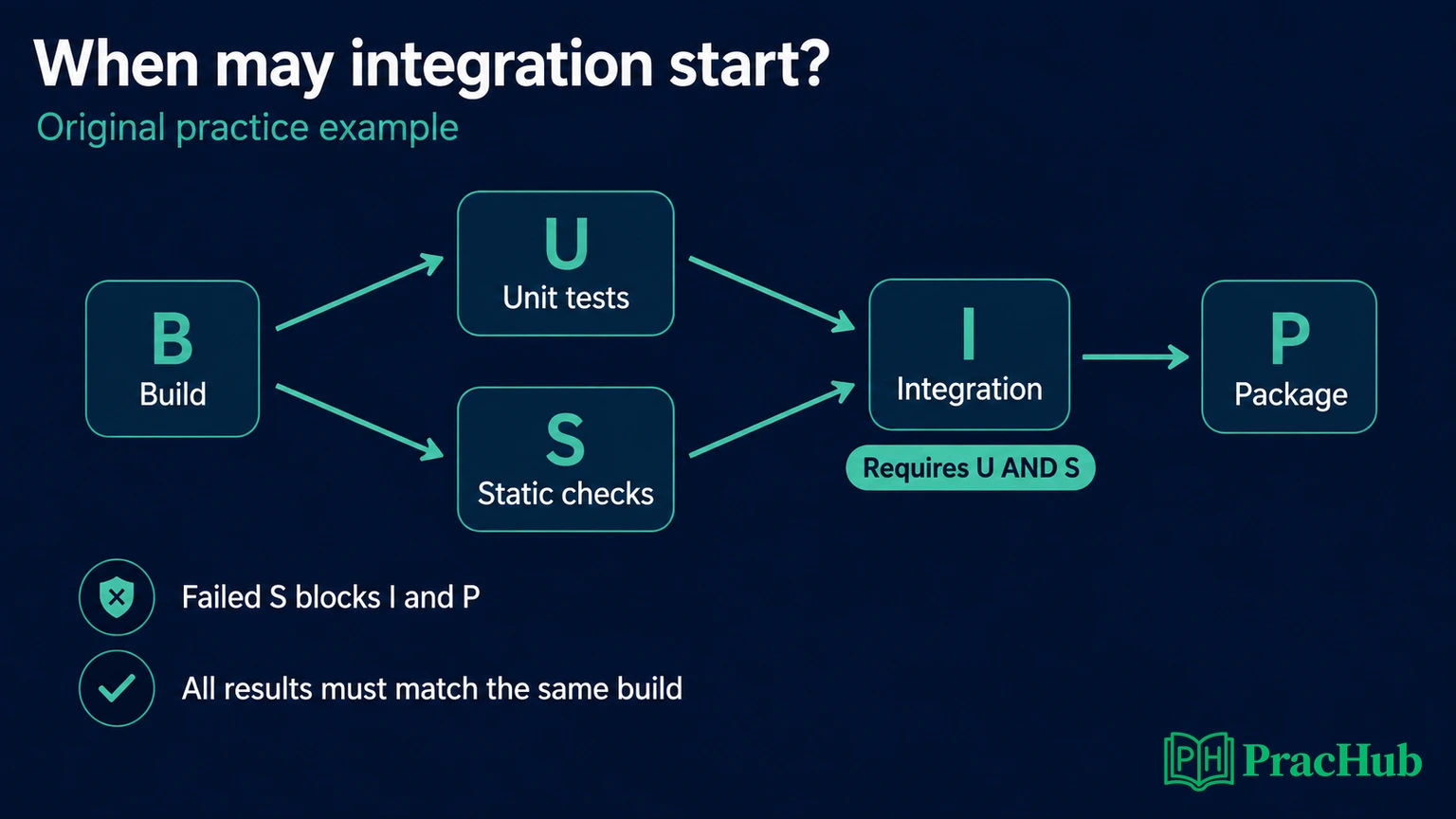
A clear explanation begins with state. Give each job a pending, running, passed, failed, or blocked status. Here, blocked means it cannot run because a required parent failed; pending means it is still waiting for eligible work. A failed static check blocks downstream integration and packaging in this exercise; it does not turn an unexecuted integration test into a failed test. That distinction matters when someone investigates the result.
Next, tie evidence to the artifact. If build B2 replaces B1, a passing U result from B1 cannot automatically satisfy B2’s dependency. Record the build identity and relevant test configuration with each result. Otherwise, a green dashboard can combine evidence about different programs.
Now consider duplicate completion notifications. If the scheduler decrements a remaining-dependency count twice for the same parent, it could start a child early. Explain how tracking each parent’s accepted completion prevents that mistake. For this exercise, discuss the invariant before reaching for distributed infrastructure.
Finally, reject a cycle or a reference to a missing job before scheduling. A topological traversal helps identify valid dependency ordering, but an interview answer should also explain what error the user receives and why no package is produced from an invalid graph.
Good tests include one failed parent, duplicate completion, a missing dependency, a cycle, and results from the wrong build. This produces a concrete answer to “How would you test a system?”: name the invariant, create a counterexample, and state the expected observable outcome.
Five questions to practice with that scope
The first three questions below are currently listed on PracHub’s Shield AI Software Engineer page with Senior+ tags. The final two are cross-company supplements chosen for hash-map implementation and dependency ordering. None is presented as a verified 2027 intern question.
| Practice question | What to demonstrate |
|---|---|
| Count Pairs with the Minimum Absolute Difference | Clarify pair semantics, duplicates, sorting, and the count being returned. |
| Explain How You Would Test a System | Connect requirements to test cases, observability, and the limits of passing results. |
| Design a Dependency-Aware CI/CD Pipeline | Explain dependency completion, failure propagation, and artifact identity. |
| Implement an Integer Hash Map | Handle collisions, absent keys, updates, and deletion while defending complexity. |
| Implement topological sort and tree boundary traversal | Use the graph portion to practice dependency ordering and cycle detection. |
For each, attempt an answer before reading a solution. Record where you needed clarification and repeat the exercise with one changed constraint. For senior design material, aim for a coherent small design and explicit limitations rather than imitating a large architecture.
Project discussion and the 2027 application timeline
Prepare one project story in enough detail to withstand follow-ups. State the requirement, your contribution, a failure you reproduced, the change you made, and the evidence that supported it. Separate what you personally implemented from a library, teammate, or tutorial.
A lab program is sufficient if you can show a meaningful engineering decision. For example, explain that processing looked fast in isolation but queue waiting caused missed targets. Describe the measurement boundary you corrected and which workload you reran. Do not invent performance numbers or remove unsuccessful results from the story.
For motivation, connect your interests to a specific aspect of Shield AI’s public work—C++ integration, robotics software, or test tooling—and acknowledge what you still need to learn. Prepare questions about the team’s software boundary, how interns validate changes, and what a successful project handoff looks like.
Timeline boundary: No official 2027 SWE application deadline or interview calendar was verified. The presence of other Summer 2027 internships is a reason to monitor the official board, not proof that software applications share their dates. Keep an application record with the exact requisition, submission date, contact, and next action.
Once contacted, ask the recruiter for the expected stages and next update point. Prepare around the actual team and invitation: coding fundamentals first, then a concise project explanation and the relevant systems discussion. Use Shield AI Software Engineer questions to rehearse those answers while keeping senior practice material separate from confirmed intern requirements.
Sources and Further Reading
- Shield AI official internship openings
- Shield AI Computer Vision Engineer (C++) — full-time role context
- Shield AI Mission Systems Software Engineer – BlueSky — senior role context
- Shield AI Hivemind
- Senior Applications Engineer candidate’s C++ pairing account and follow-up
- C++ working draft: vector modifiers
- C++ working draft: unordered associative containers
Comments (0)