SHL Coding Assessment Guide for Software Engineers
Quick Overview
SHL Coding Assessment Guide for Software Engineers now pairs its existing format and process guidance with a clearly sourced PracHub practice set. The added section shows each question's actual company, stored round, difficulty, prompt shape, and a timed workflow without claiming guaranteed assessment reuse.
An SHL invitation can look deceptively simple: open the link, choose a language, and solve a few coding problems. The real challenge is that "SHL assessment" does not describe one universal test. Employers can configure different coding simulations, technical knowledge modules, time limits, languages, and proctoring controls.
This guide explains what software engineers should expect, how SHL evaluates code, why hidden test cases matter, and how to build a practical preparation plan. Before drilling random algorithms, start with real interview questions with written solutions and company-specific interview prep so your practice reflects the employer and role behind the assessment.
Quick Verdict
Prepare for SHL as both a coding test and an employer-configured screening step. Expect a browser IDE, code stubs, visible tests, hidden edge cases, and a timer. Your score may reflect functional correctness, programming ability, and programming practices rather than only whether one sample output matches.
The best strategy is to practice clean solutions under time pressure, test boundaries before submitting, and read the invitation carefully. Use SHL's official practice simulation for platform familiarity, then use PracHub to rehearse realistic company questions and the interview rounds that may follow.
What Is the SHL Coding Assessment?
SHL offers coding simulations for software development and related technical roles. Its core Automata simulation places candidates in an online IDE where they complete real-world coding problems, run code, and receive feedback from test cases.
An SHL assessment can also contain separate modules. A software engineering invitation might combine coding with programming concepts, debugging, front-end work, SQL, data science, cognitive tests, or behavioral assessments. Your invitation and on-screen instructions are the source of truth.
Is every SHL coding test the same?
No. SHL's Automata fact sheet describes one common configuration with up to two questions and a 45-minute allowance, but employers can select different products and settings. Do not assume that a friend's question count, language list, or cutoff will match yours.
SHL Coding Assessment Question Types
Algorithm and implementation problems
These tasks ask you to complete a function using the provided signature and code stub. Common skills include arrays, strings, hash maps, sorting, parsing, loops, conditionals, and basic data structures. Harder tasks may require graphs, dynamic programming, or careful complexity analysis.
Practice translating a written requirement into a correct function without rewriting the surrounding scaffold. Many avoidable failures come from changing the expected signature, return type, or output format.
Debugging and code-fix tasks
SHL also offers simulations that measure the ability to repair logical or syntactical errors and reuse existing code. For these questions, the goal is not to replace everything with your preferred design. Read the existing control flow, isolate the defect, and make the smallest reliable correction.
Programming concepts and technical knowledge
A separate knowledge module may cover algorithms, data types, program flow, program structure, paradigms, quality, and productivity. That is different from the hands-on coding simulation, so check whether your invitation lists multiple assessments.
Role-specific simulations
SHL's catalog includes front-end, SQL, Selenium, data science, and other technical simulations. A data-oriented invitation may require query logic or data manipulation, so add focused SQL interview practice when the job description calls for it.
How the Coding Environment Works
The platform typically provides a problem statement, starter code, an editor, language selection, and compile or run controls. SHL's candidate guidance says the data is passed to the required function, so candidates should not add their own input-reading flow unless the instructions explicitly request it.
Standard-library functions may be available, but restricted libraries can produce compiler errors. SHL also warns that candidates may be unable to create custom test cases in some Automata experiences. Choose from the languages enabled by the employer, avoid switching late, and reason manually about edge cases.
How SHL Coding Scoring Works
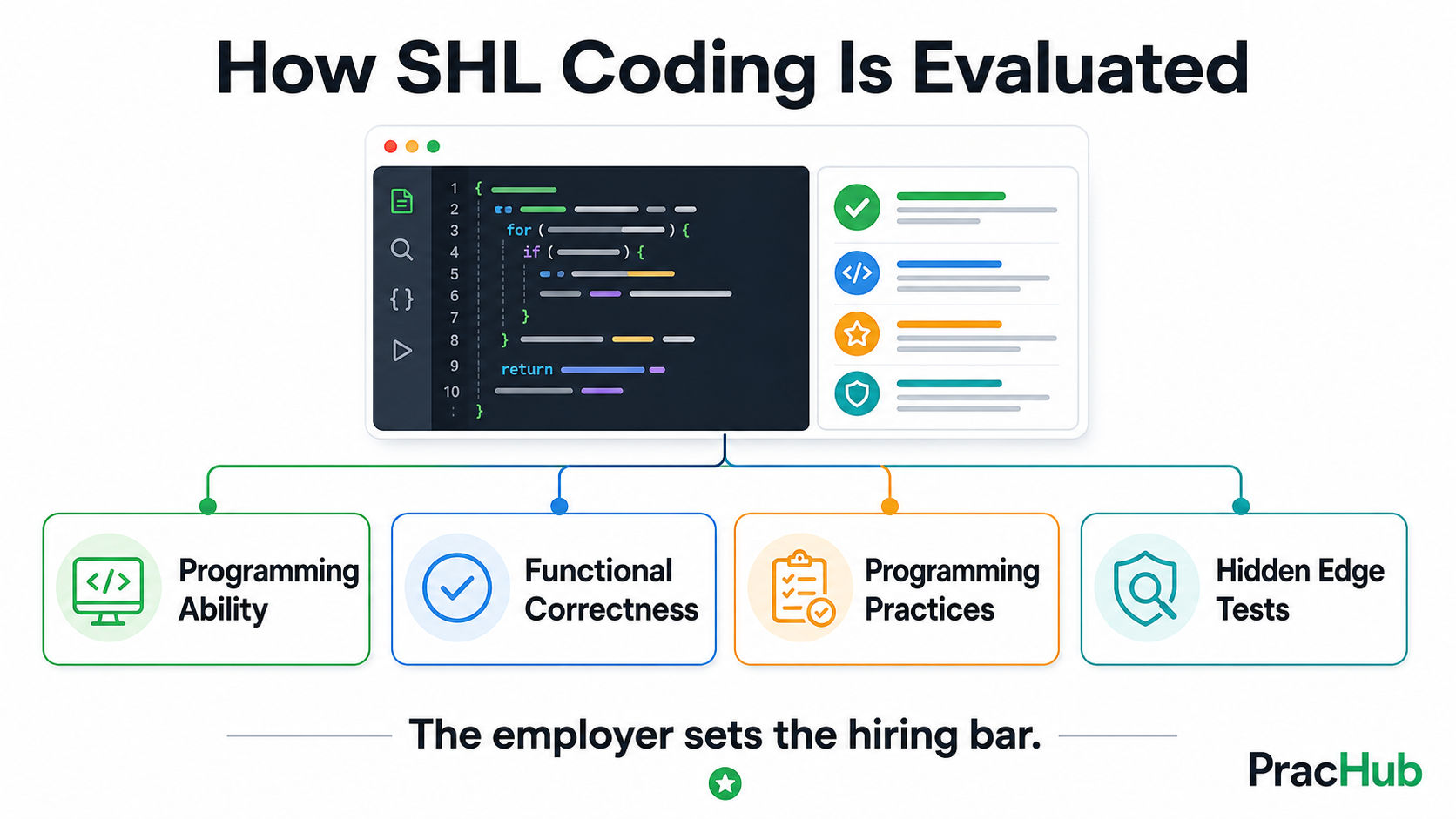
SHL's Automata materials report multiple signals, including overall score, programming ability, functional correctness, and programming practices. SHL also describes evaluating solution logic against benchmark data, which means a nearly correct approach may provide more information than a simple pass-or-fail label.
| Scoring signal | What it can reflect | How to prepare |
|---|---|---|
| Functional correctness | Whether outputs satisfy visible and hidden tests | Check empty, minimal, duplicate, negative, and large inputs |
| Programming ability | Whether the solution logic addresses the problem | Choose a clear algorithm before coding |
| Programming practices | Readable and maintainable implementation choices | Use meaningful names and avoid unnecessary complexity |
| Performance | Whether the approach handles larger constraints efficiently | Estimate time and space complexity before submitting |
What is a good SHL coding score?
There is no universal public passing score for every SHL coding assessment. The employer chooses the assessment configuration and hiring bar, and may compare your coding result with other modules or application evidence. Aim for the strongest complete solution you can produce instead of guessing a cutoff.
Why Hidden Test Cases Matter
SHL candidate support explicitly confirms that Automata questions can include visible tests and hidden edge test cases. Passing the examples therefore proves only that your solution works on a small sample. Hidden tests may expose incorrect assumptions, runtime failures, or an approach that does not scale.
Before submitting, mentally test an empty input, a one-element input, repeated values, already sorted data, maximum constraints, and values at every stated boundary. Then check integer overflow, mutation, indexing, null handling, and whether your return type exactly matches the stub.
When local code works but SHL fails
First compare compiler versions, permitted libraries, function signatures, and input handling. Remove debug output and confirm there is no infinite loop. If the platform still appears incorrect, record the error and contact SHL support with the assessment details rather than repeatedly changing a sound solution at random.
SHL Proctoring and Technical Setup
Proctoring is configurable, so not every SHL coding assessment uses the same controls. Depending on the employer and platform, the session may monitor camera access, window switching, screenshots, or other events. SHL's 2025 release notes explain that enabled events can contribute to a recruiter-facing proctoring index for manual review.
Use a laptop or desktop, complete SHL's browser check, close unnecessary applications, and stabilize your internet connection. If camera access is requested, grant it before the timer starts. Treat the instructions shown on your specific test as authoritative.
A Practical SHL Preparation Strategy
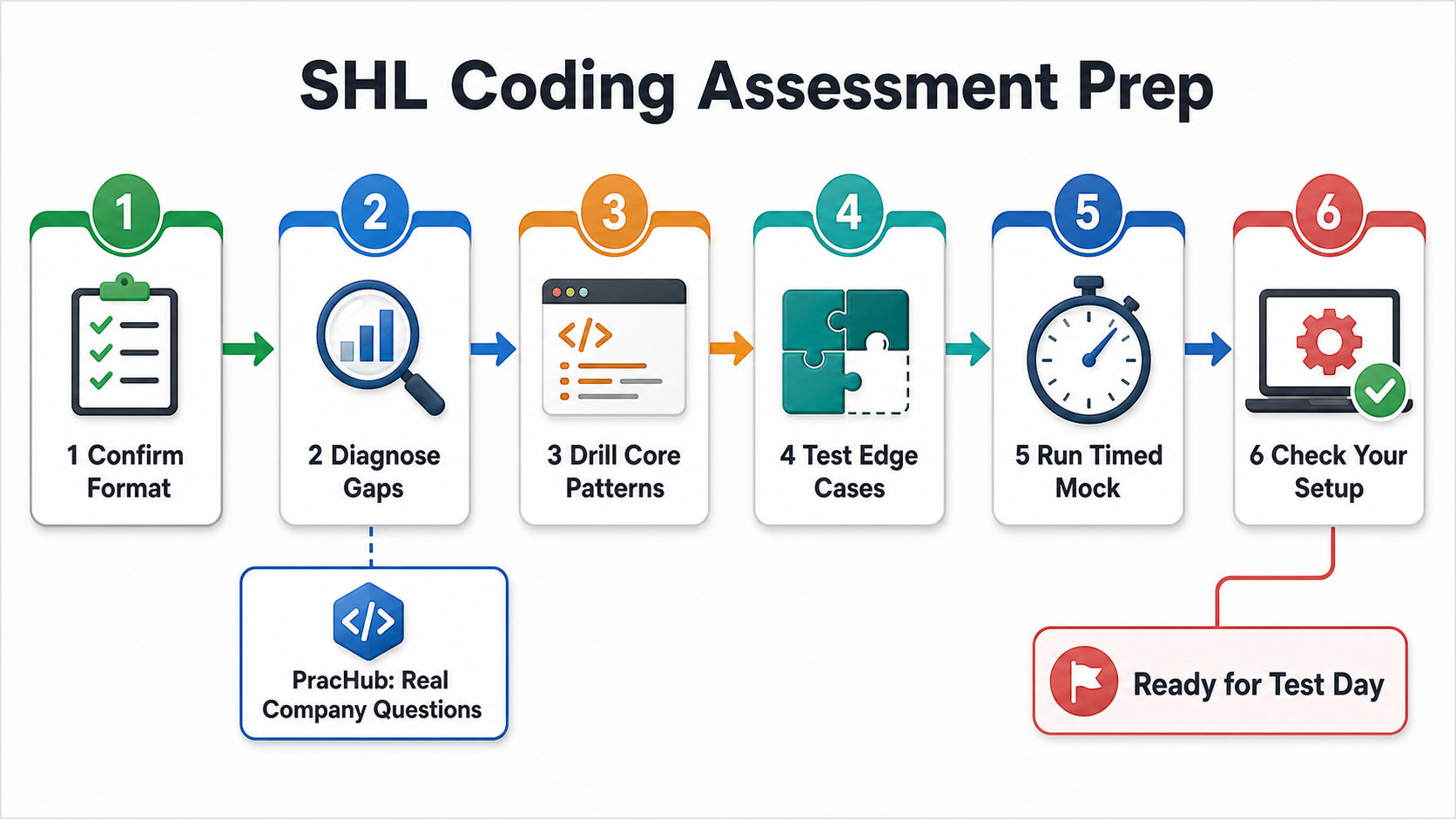
Step 1: Decode the invitation
Write down the assessment names, deadline, duration, allowed languages, and any device or proctoring requirements. If the invitation is vague, ask the recruiter whether it includes coding, cognitive, or role-specific modules.
Step 2: Diagnose with realistic questions
Complete two or three timed problems from PracHub without reading the solutions first. Tag every miss as problem interpretation, algorithm choice, implementation, edge cases, or time management. This diagnosis prevents a week of unfocused grinding.
Step 3: Drill the highest-value gaps
Focus on arrays, strings, maps, sorting, parsing, and complexity unless the role clearly requires more advanced topics. For each problem, explain the brute-force approach, improve it, code it, and test boundaries. Review the written solution only after a real attempt.
Step 4: Rehearse the SHL environment
Use SHL's official Coding Simulation practice test to learn the editor and submission flow. The practice difficulty may not exactly match the employer's assessment, but platform familiarity reduces avoidable mistakes.
Step 5: Run one full timed mock
Match the invitation's time limit, avoid external help, and reserve the final minutes for hidden-test reasoning. Practice deciding when to ship a correct baseline solution and when an optimization is worth the remaining time.
Common Mistakes to Avoid
The most common mistake is optimizing too early. A clear correct solution usually beats an unfinished clever one. Candidates also lose points by changing the function signature, reading input when data is already passed to the function, leaving debug output, or trusting visible examples too much.
Another mistake is preparing only for the OA. A strong score may lead quickly to live coding, system design, or behavioral interviews. Continue with system design questions and behavioral and leadership practice while the assessment is still fresh.
SHL Practice vs. PracHub Practice
SHL's official simulation is best for learning platform mechanics. PracHub is more useful for building an employer-specific question set, attempting realistic prompts, and reviewing written solutions across the wider interview loop.
Use them together: diagnose your gaps with PracHub, rehearse the interface with SHL, return to PracHub for timed company questions, and finish with the non-coding rounds attached to your target role.
Practice with real questions from PracHub
A platform or process article cannot honestly attribute one company's question to every employer that uses the format. This set therefore uses real cross-company PracHub questions to rehearse common OA patterns. Each row shows its actual company and stored round; none is claimed to be supplied by this platform.
| Question | Evidence | Difficulty | Main pattern |
|---|---|---|---|
| Q1: Thread-Safe Stock Inventory: Buy and Sell Without Overselling | Optiver · Technical Screen | Medium | Arrays and hashing |
| Q2: Linear Interpolator with Extrapolation | Two Sigma · Technical Screen | Medium | Intervals |
| Q3: In-Memory URL Shortener: Encode and Decode | Microsoft · Technical Screen | Medium | Graphs |
| Q4: Highest Average-Salary Team in an Org Chart | Amazon · Technical Screen | Medium | Sliding window |
What the prompts actually ask
Q1. Thread-Safe Stock Inventory: Buy and Sell Without Overselling
Bank evidence: Optiver, Technical Screen, Medium. Thread-Safe Stock Inventory: Buy and Sell Without Overselling You are implementing the inventory-management core of a small brokerage service.
Q2. Linear Interpolator with Extrapolation
Bank evidence: Two Sigma, Technical Screen, Medium. Linear Interpolator with Extrapolation You are given n knot points in a 2D coordinate system, where knots[i] = [xi, yi]. All x-coordinates are distinct, but the points are given in no particular order.
Q3. In-Memory URL Shortener: Encode and Decode
Bank evidence: Microsoft, Technical Screen, Medium. Implement an in-memory URL shortener that can encode a long URL into a short URL and decode that short URL back to the original long URL. Design a class Codec (or the equivalent in your language) that supports two operations: - encode(longurl) — take a long URL string and return a short URL string.
Q4. Highest Average-Salary Team in an Org Chart
Bank evidence: Amazon, Technical Screen, Medium. Highest Average-Salary Team in an Org Chart A company's reporting structure is a single hierarchy. Every employee has a unique integer id, a name, an integer salary, and a managerid — the id of the person they report to. Exactly one employee (the CEO) has managerid = null, meaning they have no manager.
Run the set like an assessment
- Read all four prompts first. Give each a difficulty estimate and choose an order before coding.
- Hide the solution. Write the invariant, complexity target, and three edge cases before opening the editor.
- Use one timer. Preserve five minutes at the end for boundary, tie, scale, and output-format tests.
- Log the failure mode. Record the broken invariant or missed edge case, not merely the question title.
FAQ
Does SHL show all test cases?
No. SHL candidate support states that Automata questions can contain visible tests and hidden edge test cases. Treat visible examples as a starting point and manually test boundaries, duplicates, empty values, large constraints, and complexity before submitting.
Can I use my preferred programming language?
SHL supports many languages across its coding products, but the employer can limit the options for a particular assessment. Choose from the languages shown in your test and avoid switching late unless necessary.
Can I use standard libraries?
SHL says predefined standard-library functions may be used, but libraries not permitted by the instructions can be blocked. Read the assessment rules carefully and prefer common built-ins over unusual dependencies.
Will I receive my SHL score?
Not necessarily. SHL says the hiring organization controls candidate results and feedback. Contact the recruiter for your outcome or next steps rather than assuming SHL support can release the report.
Final Takeaway
An SHL coding assessment rewards more than making one sample pass. Read the configuration, respect the code stub, write a clear correct solution, and reason explicitly about hidden edge cases and performance.
Start withPracHub's real interview questions and written solutions, use SHL's official practice environment to learn the platform, and continue preparing for the interviews that follow. That workflow turns an unfamiliar assessment link into a manageable engineering task.
Official references: SHL Coding Simulations, Automata assessment fact sheet, SHL Automata candidate support, and SHL practice tests. Product settings vary by employer; official details were checked on August 2, 2026.
Comments (0)