SHL Inductive Reasoning Test Guide 2026: Pattern Questions, Timing, and Practice Strategy
Quick Overview
Understand the current SHL inductive reasoning test format, pattern question types, adaptive timing, scoring, and a practical seven-day preparation strategy.
An SHL inductive reasoning invitation often creates two immediate questions: what kind of patterns will appear, and how fast do you have to solve them? The confusing part is that many preparation pages still describe an older SHL test with 18 questions in 24 minutes.
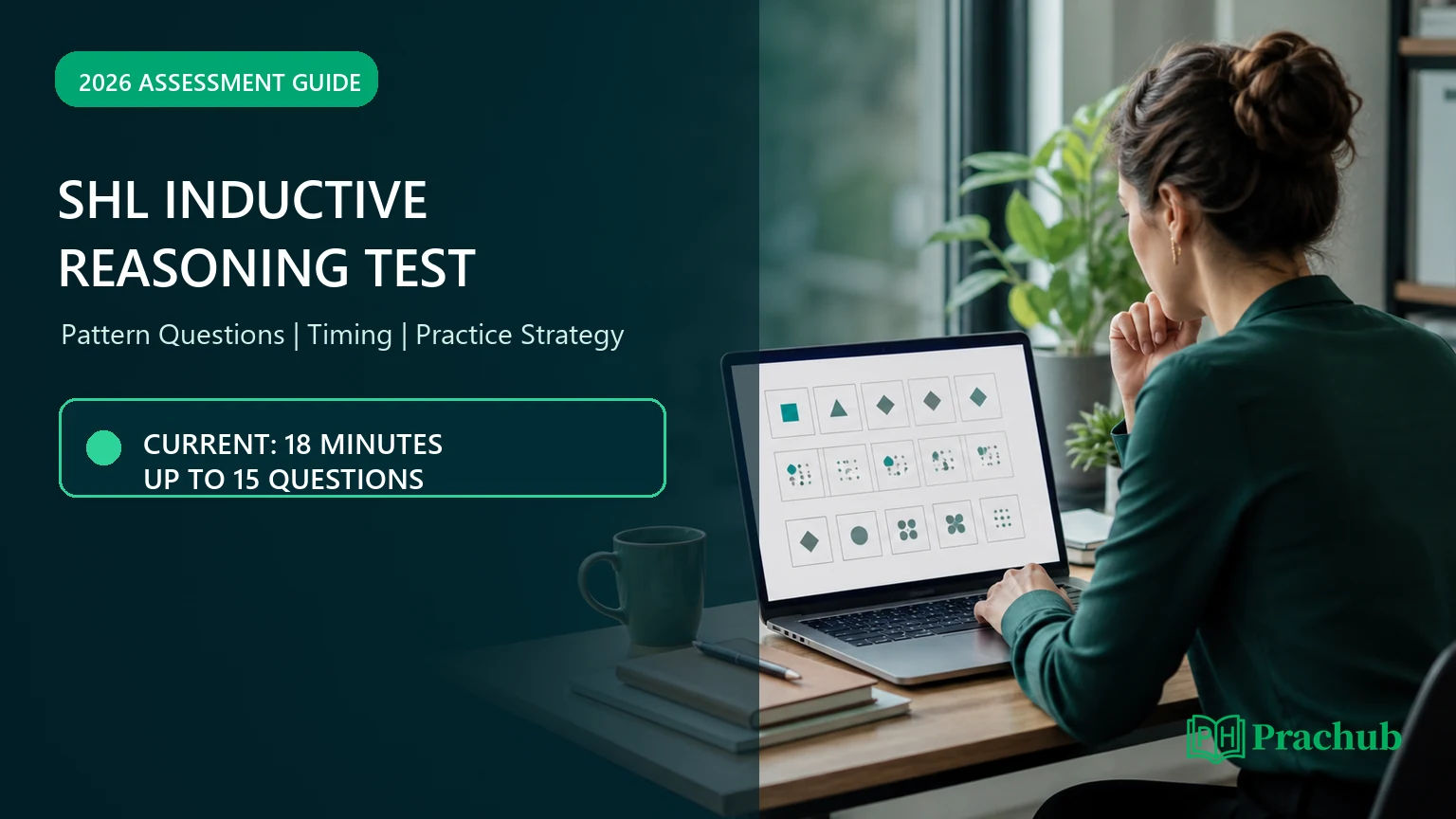
For the current standalone SHL Verify Interactive - Inductive Reasoning assessment, SHL lists 18 minutes, up to 15 questions, one sitting, and an adaptive, activity-based format. The older Verify Inductive Reasoning versions were retired during 2024. Your own invitation still wins because employers can select a different SHL product or assessment bundle.
This guide explains the current format, the pattern families worth practicing, a repeatable solving method, scoring, and a seven-day plan. To build the underlying reasoning skills between practice tests, use PracHub interview questions with written solutions and review your reasoning only after making a complete attempt.
SHL inductive reasoning test: quick answers
| Candidate question | Evidence-based answer |
|---|---|
| What is the current standalone format? | SHL lists 18 minutes and a maximum of 15 interactive, adaptive questions. |
| Is the test 24 minutes with 18 questions? | That describes a retired legacy version, not the current Verify Interactive product. |
| What does it measure? | Your ability to infer rules and patterns from incomplete information, then use them to predict an outcome. |
| Are the questions only shape sequences? | SHL says tasks can use shapes and alphanumeric sequences; the interactive presentation can vary. |
| Is there a universal pass score? | No. SHL does not set one pass mark; the employer decides how results affect progression. |
| Can I see my result? | The employer controls whether candidate results or feedback are shared. |
What does SHL inductive reasoning measure?
Inductive reasoning is the ability to infer a general rule from specific examples and apply that rule to a new case. In an assessment, you see a small amount of visual or symbolic information, identify what changes and what stays constant, and predict the missing or next state.
SHL positions the assessment for work involving troubleshooting, creative problem solving, and generating new solutions. The official fact sheet says information may appear as shapes or alphanumeric sequences. That makes the test less about memorized formulas and more about controlling a search through possible rules.
Inductive reasoning is different from deductive reasoning. Deduction starts with stated rules and asks what conclusion must follow. Induction gives you examples but hides the rule. Your task is to discover the simplest rule that explains all the evidence.
Current SHL format vs the retired version
The format distinction matters because it changes pacing. SHL retired Verify Inductive Reasoning v1 and v2 during 2024 and named Verify Interactive - Inductive Reasoning as the replacement.
| Detail | Current Verify Interactive | Retired Verify v2 reference |
|---|---|---|
| Time | 18 minutes | 24 minutes |
| Maximum questions | 15 | 18 |
| Presentation | Interactive and activity-based | Multiple choice |
| Scoring design | Adaptive | Adaptive |
| Intended setting | Unsupervised, one sitting | Legacy product, no longer the default |
If a guide tells you to plan for exactly 80 seconds across 18 questions, it is probably using the legacy specification. For the current standalone assessment, 18 minutes divided by 15 gives a rough ceiling of 72 seconds per maximum question. Do not turn that average into a rigid rule: an adaptive test can vary what you see, and your employer may configure a different product.
Pattern questions you should expect
SHL does not publish a reusable bank of live questions, and memorizing screenshots would be a poor strategy anyway. The useful unit of preparation is the relationship being tested. Most abstract pattern tasks can be decomposed into a few attribute families.
Shape and orientation changes
A triangle may rotate 90 degrees, a line may reflect across an axis, or an element may alternate between two orientations. Track direction separately from shape. A distractor often applies the correct rotation to the wrong object.
Position and movement
An object may move clockwise around corners, shift one cell per frame, or alternate between rows and columns. Mark the position sequence before considering color or count. Many hard-looking puzzles become simple once location is isolated.
Count, addition, and removal
The number of shapes, dots, sides, or filled regions may increase, decrease, or combine. Check whether one panel is the sum, difference, or overlap of two earlier panels. Count carefully before inventing a more complicated spatial rule.
Alternating and interleaved rules
Odd and even positions can follow separate sequences. For example, panels 1, 3, and 5 may rotate while panels 2, 4, and 6 change color. If one rule works only every other frame, test an interleaving before discarding it.
Matrix and row-column relationships
In a grid, each row or column may apply the same transformation: union, subtraction, rotation, or a change in quantity. Test the relationship in a complete row first, then apply it to the incomplete row. A valid rule should explain every finished example, not only one pair.
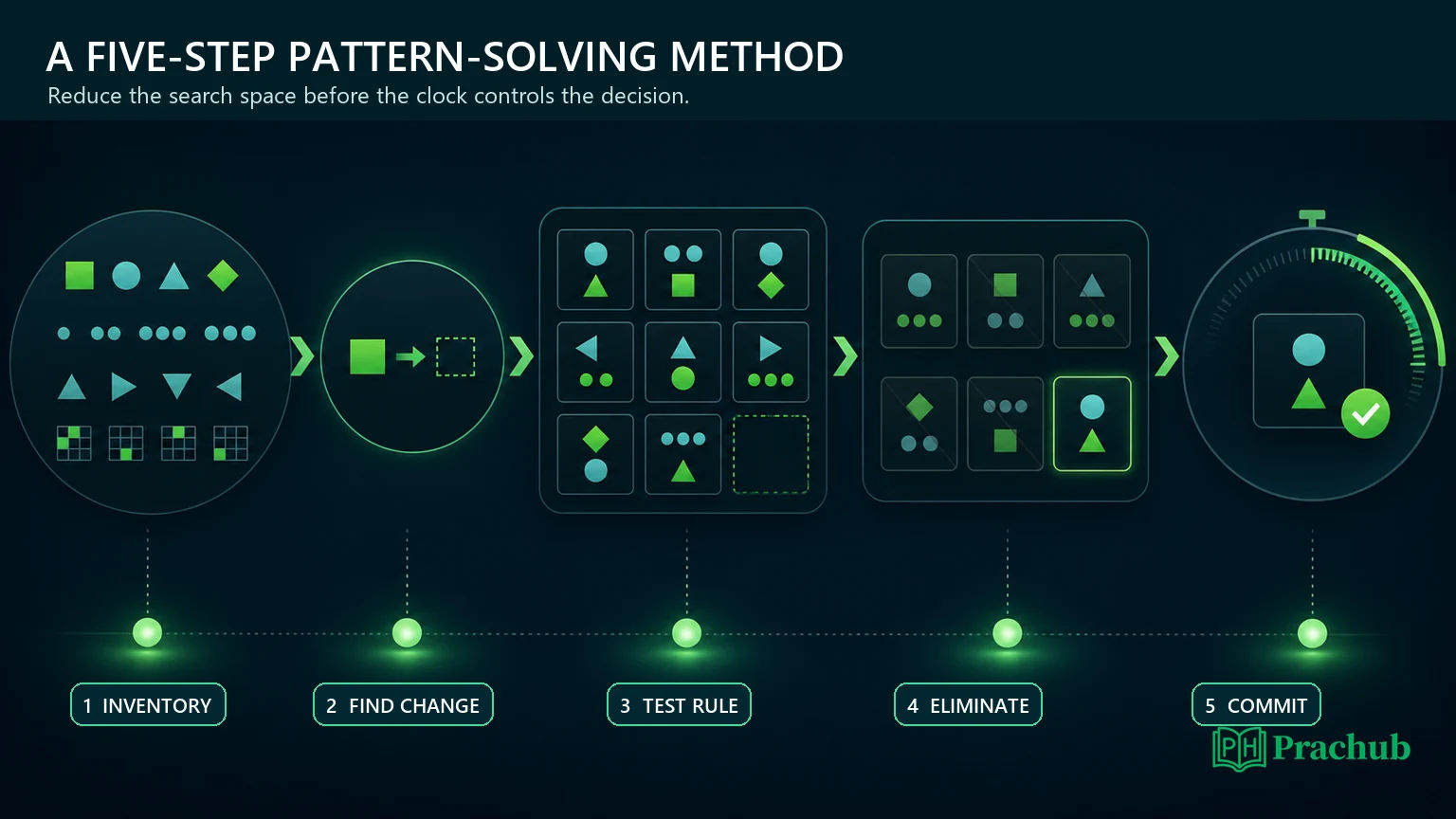
A five-step method for solving pattern questions
Speed comes from reducing the number of hypotheses you test. Use the same sequence on every unfamiliar item so that pressure does not push you into random guessing.
1. Inventory the attributes
List what is visible: shape, count, fill, size, orientation, position, and order. Notice which attributes remain constant. A fixed feature is useful because it removes an entire category of possible rules.
2. Identify one change at a time
Describe the transition in plain language: “the filled square moves clockwise” or “the count increases by one.” Avoid combining three changes before each has evidence. Simple rules are faster to verify and easier to reject.
3. Test the rule against every example
A hypothesis that fits two panels but fails the third is not almost correct. Reject it. In a matrix, verify the same row or column operation more than once before applying it to the missing cell.
4. Predict before reading the options
Form a mental answer first. Then use the choices to eliminate mismatches in count, position, or orientation. This reduces the chance that a visually attractive distractor shapes your theory.
5. Commit or move on
If your rule explains all examples and one choice matches, answer. If you are still generating unrelated theories after a reasonable checkpoint, make the best evidence-based selection permitted by the instructions and preserve time for later items.
Timing strategy for an adaptive test
An adaptive assessment chooses later item difficulty using earlier responses. It is therefore more useful to protect accuracy and steady pace than to chase a rumored raw score. SHL says adaptive delivery supports shorter administration and more precise scoring.
Use three practical checkpoints. In the first few items, read the interaction instructions and establish a controlled rhythm. In the middle, watch for a single question consuming several normal-question intervals. Near the end, follow the on-screen timer and avoid leaving an answer unfinished because you were trying to prove an elegant rule.
Do not assume that every question deserves exactly 72 seconds, that everyone receives all 15 questions, or that an unanswered item has a specific penalty. Those details are not universal in SHL's public candidate guidance. Follow the behavior shown in your actual assessment.
How SHL scores the test
Ability reports commonly compare performance with a norm group, such as people in a relevant role or level. A percentile is not the percentage of questions you answered correctly. A 60th percentile result means performance was higher than 60 percent of the selected comparison group.
There is also no universal “good SHL score.” SHL explicitly says it does not set passing scores. The hiring organization chooses the comparison group, combines the assessment with other application evidence, and decides any progression threshold.
You may not receive a report. SHL's candidate support says the employer controls candidate data and whether feedback is released. A practice-site percentage, when available, is useful for tracking your own improvement but is not the same as an employer's norm-referenced hiring decision.
How to practice without overfitting
Begin with SHL's official example and full-length practice environment. The goal is to learn the interaction and timing, not to collect leaked questions. SHL says its free practice material is primarily designed to make candidates comfortable with how assessments work, and practice-site results are not shared with an employer.
After each timed set, classify mistakes instead of merely counting them. Useful labels are missed attribute, unnecessarily complex rule, failed to verify, distractor bias, and time panic. Your next session should target the most common failure label.
Mix visual patterns with numerical and verbal rule inference. The surface changes, but the core habit stays the same: inventory evidence, propose the smallest rule, test it, and explain why alternatives fail. This produces transferable reasoning rather than recognition of one puzzle style.
Practice with relevant questions from PracHub
These PracHub question-bank records train pattern detection, constraint reasoning, and timed decision-making. They are practice material, not predictions of your exact SHL assessment.
| PracHub question | Practice focus | Why it helps |
|---|---|---|
| Solve Aptitude Test: Logical, Numerical, Verbal Reasoning | Mixed timed reasoning | Builds fast rule recognition and disciplined skipping under a short clock. |
| Find Patterns in Numeric Sequences Quickly | Sequence inference | Trains simple-rule testing before escalating to a complex explanation. |
| Find Next Terms in Sequences | Irregular sequences | Develops evidence checking across arithmetic, fractional, and recurrence patterns. |
| Solve a Logical Reasoning Puzzle | Constraint deduction | Practices eliminating impossible states and justifying the remaining answer. |
| Deduce Position from Logic Clues | Grid and spatial constraints | Strengthens position tracking, adjacency reasoning, and uniqueness checks. |
A seven-day SHL practice plan
| Day | Focus | What to do |
|---|---|---|
| Day 1 | Baseline | Complete an official example set and record accuracy, pace, and error types. |
| Day 2 | Attributes | Drill rotation, reflection, position, count, fill, and alternating sequences. |
| Day 3 | Matrices | Practice row-column transformations and explain each rule in one sentence. |
| Day 4 | Timed reasoning | Run two short timed sets and enforce a move-on checkpoint. |
| Day 5 | Weak-area repair | Rework misses by error label, then solve fresh items from the same family. |
| Day 6 | Full simulation | Use the official practice environment in a quiet, uninterrupted setup. |
| Day 7 | Light review | Review your checklist, verify the invitation and device, and avoid cramming. |
Test-day setup and rules
Use a quiet location, stable connection, and a supported device. Reboot if needed, close unrelated programs and tabs, and start before the deadline rather than at it. Read the instructions and practice interaction because the control itself can change how you answer.
SHL's candidate guidance warns that the timer continues during a timed test and advises candidates not to switch windows, copy content, or share assessment material. Do not use unauthorized resources. If you need an accommodation or encounter a technical problem, document it and contact the organization or SHL support through the route in your invitation.
Frequently asked questions
How many questions are on the SHL inductive reasoning test?
SHL lists a maximum of 15 questions for the current standalone Verify Interactive - Inductive Reasoning assessment. Because it is adaptive and employers may choose other SHL products, use the product name and instructions in your invitation as the final authority.
Is SHL inductive reasoning 18 minutes or 24 minutes?
The current standalone Verify Interactive assessment is 18 minutes. The 24-minute, 18-question specification belongs to an older Verify Inductive Reasoning version that SHL retired during 2024. Older preparation pages may still repeat the legacy format.
Is the SHL inductive reasoning test adaptive?
Yes, the current Verify Interactive product uses computer-adaptive delivery. That means the sequence can respond to performance and may not feel identical for every candidate. Focus on accurate rule inference and controlled pacing instead of comparing individual questions with someone else's test.
What is a passing SHL inductive reasoning score?
SHL does not set a universal pass mark. Employers decide how to use the result, which norm group applies, and whether the assessment is a screen or one input among several. Treat any public cutoff claim as employer-specific unless the employer confirms it.
Can I see my SHL test score?
Possibly, but not automatically. SHL says the hiring organization controls candidate results and whether feedback may be released. Practice-site reports can sometimes show a percentage correct, but that practice result is separate from the employer's assessment.
Final takeaway
Prepare for the current interactive test, not a retired format: up to 15 questions in 18 minutes, with adaptive activities built around hidden rules and patterns. The strongest strategy is consistent and explainable: inventory attributes, isolate the smallest rule, verify it across all evidence, eliminate contradictions, and move on deliberately.
Use SHL's official practice to learn the interface, then deepen the underlying skills with PracHub interview questions and written solutions. Review why your rule worked or failed; that learning is more valuable than memorizing any one pattern.
Sources and Further Reading
- SHL Verify Interactive - Inductive Reasoning Assessment Fact Sheet
- SHL notice retiring legacy Verify Inductive Reasoning tests
- SHL Direct inductive reasoning example questions
- SHL practice tests and assessment advice
- SHL candidate support: pass marks
- SHL candidate support: access to assessment results
Research note: This guide was checked on August 26, 2026. SHL can offer different products and employers can configure assessment packages, so the exact product name and instructions in your invitation remain the source of truth.
Comments (0)