SIG Quant Trading OA 2027: Probability, Brain Teasers, Round 2, and Timeline
Quick Overview
A candidate-focused SIG Quant Trading OA guide covering reported probability questions, brain teasers, round-two variations, and interview timing.
Updated August 17, 2026.
A SIG Quant Trading invitation lands in your inbox with a 60-minute timer. One candidate says the assessment has 17 probability and brain-teaser questions. Another says “Round 2” is CodeSignal. A third is preparing for a 30–45 minute video call. Are these people describing the same process?
Not necessarily. Current Summer 2027 reports show meaningful differences by role, office, and where candidates start counting rounds. The most useful preparation starts by matching your exact Quantitative Trading role and invitation—not by combining every SIG post into one imaginary funnel.
Use SIG (Susquehanna) interview questions on PracHub to practice the probability, expected-value, and logic skills behind the assessment. This guide explains what current reports agree on, what remains uncertain, and how to prepare for the possible second steps without confusing Quant Trading with Quant Developer.
Quick verdict
For the first SIG Quant Trading OA, prepare for probability, expected value, brain teasers, and some algebra under a one-hour time limit. A current Dublin candidate described 17 questions in 60 minutes, while another current applicant reported that the invitation allowed pen, paper, and a calculator. These are candidate reports, not a universal SIG specification.
The reported first assessment is not the four-question CodeSignal used for SIG Quant Developer. However, some U.S. Quant Trading applicants say a CodeSignal assessment appeared later, after a recruiter or phone conversation. Others call a live video interview “Round 2.” Treat the wording, platform, duration, and office in your invitation as stronger evidence than the round number.
| Question | Best current answer |
|---|---|
| What is in the first OA? | Current reports emphasize probability, expected value, brain teasers, and basic algebra. |
| How many questions? | One detailed Summer 2027 report says 17 questions; SIG has not published a universal count. |
| How much time? | Several current candidates report 60 minutes. Use the timer in your invitation. |
| What is Round 2? | It may be a second OA, a CodeSignal after a call, or a live video round depending on the process. |
| What score passes? | No official cutoff was found. Candidate score estimates are too small and inconsistent to define one. |
First confirm which SIG role you applied for
SIG recruits Quantitative Traders, Quantitative Systematic Traders, Quantitative Researchers, Quantitative Strategy Developers, and engineers. All work near quantitative markets, but their early assessments can be very different.
The official Philadelphia Summer 2027 Quantitative Trader posting emphasizes quantitative and logical reasoning, analytical skill, strategic games, competitive activities, and decision science. Programming is a plus, not the center of the role. The official Dublin posting similarly highlights puzzles, game theory, clear communication, and decision-making; it says applicants do not need a finance background because the internship teaches the domain.
By contrast, Quant Developer and Trading System Engineering roles ask for deeper coding evidence. If your invitation says CodeSignal and gives four programming tasks, read the requirements in front of you rather than forcing this probability guide onto the wrong track.
What candidates report about the first OA
The clearest current-cycle description is a 60-minute assessment with 17 questions. A candidate who advanced believed they answered at least 16 correctly and heard back just over a week later. Another candidate estimated 14 correct but did not yet know the outcome. That is not enough data to infer a cutoff.
Multiple reports describe the content as probability and brain teasers, with a small amount of direct algebra. One candidate explicitly contrasted it with Zetamac-style mental arithmetic. Another said the problem types felt familiar across cycles even when numbers changed. Do not turn that observation into a memorization strategy; SIG can change questions, and later rounds reward reasoning you can explain.
Probability and counting
Expect small sample spaces that punish careless counting: cards, dice, repeated trials, random selections, or events with overlapping cases. The main decision is often whether to count the event directly, count its complement, or condition on an earlier outcome.
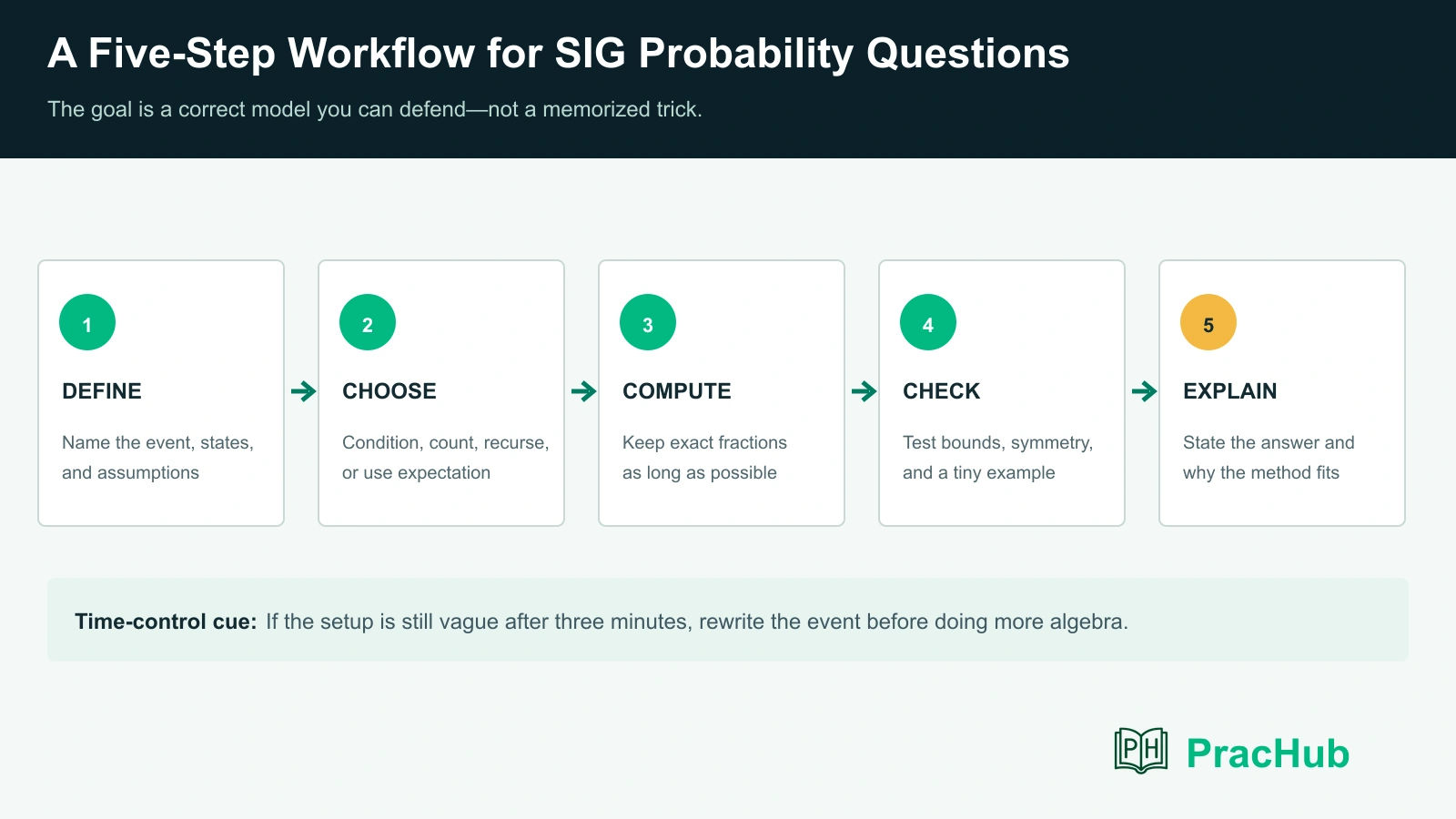
Write the event before calculating. “At most two failures” and “not more than two failures” are identical mathematically, but candidates lose points when they silently solve “exactly two.” A one-line definition protects the rest of the work.
Conditional probability and Bayes
These questions test whether new information changes the sample space. Ask what was observed, whether the observation mechanism is biased, and which prior probabilities still apply. A tree diagram or a small table is often faster and safer than reaching immediately for Bayes' formula.
Expected value and sequential decisions
SIG's official trading materials emphasize probability, odds, expectancy, and decisions under uncertainty. In an OA, that can appear as a game, a stopping decision, a repeated bet, or a comparison between strategies.
Separate the value of one round from the value of a policy. If the game repeats, define the state and what changes after each outcome. A short recurrence can be clearer than enumerating every future path.
Brain teasers and algebra
A brain teaser is not an invitation to be clever at random. Translate the story into constraints, eliminate impossible cases, and verify the remaining assignment. Current candidates mention a few questions that are essentially pure algebra, so keep ratio, average, rate, and system-of-equations skills warm.
A practical 60-minute strategy
If your assessment has 17 questions in 60 minutes, the average budget is a little over three and a half minutes. That average is a planning tool, not a requirement that every question receive equal time.
| Time | Goal | Decision rule |
|---|---|---|
| 0–5 min | Scan the assessment | Identify direct counting, familiar probability, and longer multi-step problems. |
| 5–25 min | Secure fast points | Complete questions with a clear model; flag any that need a second pass. |
| 25–48 min | Solve medium problems | Use conditioning, complement, expectation, or algebra deliberately. |
| 48–56 min | Return to the best remaining opportunity | Choose by expected points, not by which puzzle offended your pride. |
| 56–60 min | Audit | Check event wording, denominators, units, and accidentally omitted cases. |
Keep exact fractions until the final step unless the platform requires decimals. If a calculator is allowed, use it to verify arithmetic after the model is correct—not to search blindly for a pattern. When revisiting questions is disabled, adjust the plan to finish and check each item before moving forward.
Why “Round 2” is confusing in 2027
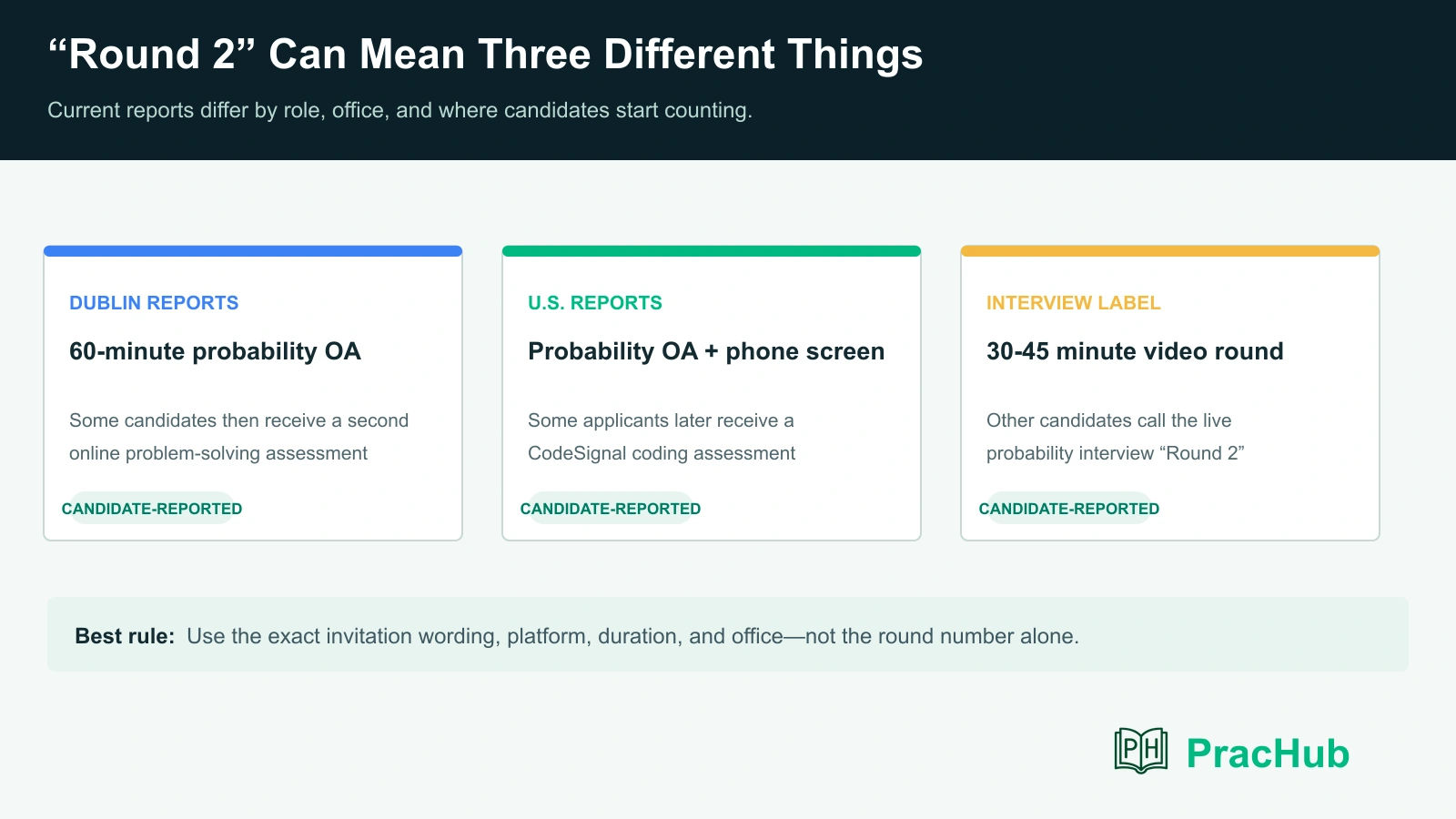
Candidate posts currently use “Round 2” for at least three different events. This is the most important ambiguity to resolve before you prepare.
Path 1: a second online problem-solving assessment
A Dublin Summer 2027 candidate reported receiving a second OA after the 60-minute probability round. The invitation described another evaluation of problem-solving and technical ability, but the candidate had not yet received enough detail to confirm the exact format. Later comments did not establish a reliable universal question set.
If this matches your email, wait for the actual platform and instructions before choosing a study plan. “Technical ability” can mean more quantitative reasoning, programming, or a mixed assessment.
Path 2: recruiter or phone screen, then CodeSignal
Some U.S. Quant Trading candidates report an initial probability OA, a recruiter or phone conversation, and then a CodeSignal assessment. One applicant with 520/600 advanced; another with the same reported score did not. That small sample strongly argues against treating 520 as a universal cutoff.
If CodeSignal appears, switch preparation modes. Review arrays, strings, maps, sorting, implementation, and time management. Do not assume the probability OA has disappeared; it may simply have been the earlier filter.
Path 3: a 30–45 minute video interview
Other candidates call a live video round the second interview. Current discussions expect motivation, resume questions, and probability or brain teasers, but the exact balance is desk- and interviewer-dependent. In a live setting, communication matters as much as speed: state the model, ask one clarifying question when needed, and update your answer openly after a hint.
What SIG is evaluating beyond the answer
SIG's official career materials repeatedly connect trading with decision science, game theory, probability, odds, and expectancy. That suggests a broader target than raw calculation: can you simplify uncertainty, make a defensible choice, and explain why?
For a live round, narrate the useful steps without producing a stream of consciousness. Define assumptions, name the method, compute, and sanity-check. If you make an error, correct it directly. A candidate who updates cleanly can show more trading judgment than someone who protects a wrong answer with increasingly complicated algebra.
Your motivation story should also fit the role. “I like math” is incomplete. Connect your interest to repeated decisions with incomplete information, fast feedback, strategic competition, or collaborative problem solving. Use one concrete project, game, competition, or research example rather than a list of adjectives.
How long does SIG take to respond?
SIG does not publish a fixed OA response deadline. Current reports show different clocks: some applicants waited weeks for the first OA, one Dublin candidate heard about the second assessment just over a week after Round 1, and some U.S. candidates moved from a phone conversation to CodeSignal within days. Others reported longer silence.
The Dublin posting says recruiting is rolling and encourages early applications. Rolling review creates uneven timelines because applicant volume, office capacity, and interview scheduling change throughout the season. A slow response is not a reliable score report.
If a recruiter has contacted you, a concise follow-up after roughly ten business days is reasonable unless they gave a different timeline. Otherwise, keep preparing and applying. Do not let one portal become your entire recruiting plan.
Practice with SIG questions from PracHub
These SIG question-bank records are not predictions of your exact Summer 2027 OA. They cover the same reasoning families: discrete probability, continuous probability, sequential games, and logical constraint solving.
| PracHub question | Practice focus | Why it helps |
|---|---|---|
| Compute Stockout Sufficiency Probability | Binomial probability and complements | Trains precise interpretation of “at most” and efficient event counting. |
| Find Probability of Overlapping Blooms | Continuous and geometric probability | Builds a visual sample-space model instead of formula memorization. |
| Compute Ruin Probability With Bold Betting | Sequential states and recursion | Connects a betting policy to reach-or-ruin probabilities. |
| Solve Relative-Truth Cat Puzzle | Logic, constraints, and algebra | Practices eliminating inconsistent cases without random guessing. |
Attempt each problem under a short timer, then explain your setup aloud before opening the written solution. Use PracHub's broader interview questions with written solutions to add Bayes, expected value, combinatorics, and behavioral practice once the four-question set reveals your weak areas.
A seven-day SIG Quant Trading plan
| Day | Focus | What to do |
|---|---|---|
| Day 1 | Format and diagnostic | Read the invitation, then solve a 60-minute mixed probability set without pausing. |
| Day 2 | Counting and conditional probability | Practice complements, combinations, independence, conditioning, and Bayes. |
| Day 3 | Expected value | Solve games, repeated bets, stopping decisions, and simple recurrences. |
| Day 4 | Brain teasers and algebra | Translate stories into constraints, ratios, rates, and small systems of equations. |
| Day 5 | Full simulation | Use the exact time limit and permitted tools shown in your invitation. |
| Day 6 | Round 2 branch | Prepare either live probability communication or CodeSignal coding based on your email. |
| Day 7 | Review and recovery | Rework misses, rehearse “why trading/why SIG,” and stop adding new topics. |
Frequently asked questions
Is the SIG Quant Trading OA automatic?
SIG has not said that every applicant receives it. Candidates report receiving invitations anywhere from quickly to several weeks after applying. Invitation speed alone does not reveal whether resume screening is complete.
Is the 2027 OA really 17 questions in 60 minutes?
That is the clearest current candidate report, especially for Dublin, but it is not an official global specification. Confirm the count and timer in your own invitation.
How many questions do I need correct?
No official cutoff was found. One candidate who believed they had at least 16 correct advanced, while another estimated 14 and was still waiting. Those anecdotes cannot establish a threshold.
Does the SIG Quant Trading OA include coding?
The reported first OA emphasizes probability and brain teasers. Some U.S. Quant Trading candidates report a later CodeSignal step, so coding may appear deeper in certain processes.
Can I use a calculator?
At least one Summer 2027 invitation reportedly allowed pen, paper, and a calculator. Rules can vary, so use only the resources explicitly permitted in your assessment instructions.
Is Round 2 another probability test?
It can be, but “Round 2” is ambiguous. Current reports include a second online assessment, a CodeSignal after a phone call, and a live video interview. Match the platform and wording rather than the label.
Do I need finance knowledge?
SIG's Dublin posting says no finance background is required and the internship teaches the domain. Probability, logic, strategic thinking, and communication are more useful starting points for the assessment.
Final takeaway
The SIG Quant Trading OA 2027 is best approached as a timed test of probability models, expected value, logic, and disciplined decision-making. The strongest current report describes 17 questions in 60 minutes, but SIG has not published a universal format or cutoff.
Prepare the first assessment in front of you, then branch based on the exact next invitation. Start with SIG (Susquehanna) interview questions, complete the four linked problems, and use the written solutions to diagnose your reasoning—not to memorize an answer bank.
Sources and Further Reading
- SIG Quantitative Trader Internship: Summer 2027 - Philadelphia Area
- SIG Quantitative Trading Internship: Summer 2027 - Dublin
- SIG Trading Careers and Decision Science
- Current Candidate Discussion: SIG Quant Trading OA Format
- Current Candidate Discussion: SIG 2027 QT Second OA
- Current Candidate Discussion: Later CodeSignal Assessment
- Current Candidate Discussion: 30–45 Minute Video Round
- Current Candidate Discussion: U.S. Quant Trading Invitations and Timing
Research note: This guide was checked on August 17, 2026. Official SIG sources establish role expectations and recruiting context; candidate discussions are used only for current-cycle format, sequence, and timing signals. Individual offices, roles, and invitations can differ.
Comments (0)