Software Engineer to Machine Learning Engineer: Interview Gaps to Close
Quick Overview
A practical guide for software engineers moving into ML engineering: identify interview gaps in data, evaluation, modeling, MLOps, and project evidence.
A backend engineer can design a reliable API and still fail a machine learning engineering interview by optimizing the wrong metric, splitting data incorrectly, or treating a notebook score as production evidence. The transition is not a reset. It is a change in what “correct” means.
The strongest preparation keeps your software engineering advantages and closes the gaps that make model behavior uncertain: data provenance, evaluation design, statistical reasoning, training pipelines, deployment, monitoring, and product trade-offs. Start with Machine Learning Fundamentals: Tree Models, Training, Evaluation, and Embeddings to see how implementation and model reasoning meet in one discussion.
Evidence boundary: Google Cloud's official role guide describes a machine learning engineer as someone who builds, evaluates, productionizes, monitors, and improves ML systems. The preparation framework and interview exercises below are editorial guidance derived from those responsibilities. PracHub records are practice material, not proof that a particular employer will ask the same questions.
What already transfers from software engineering?
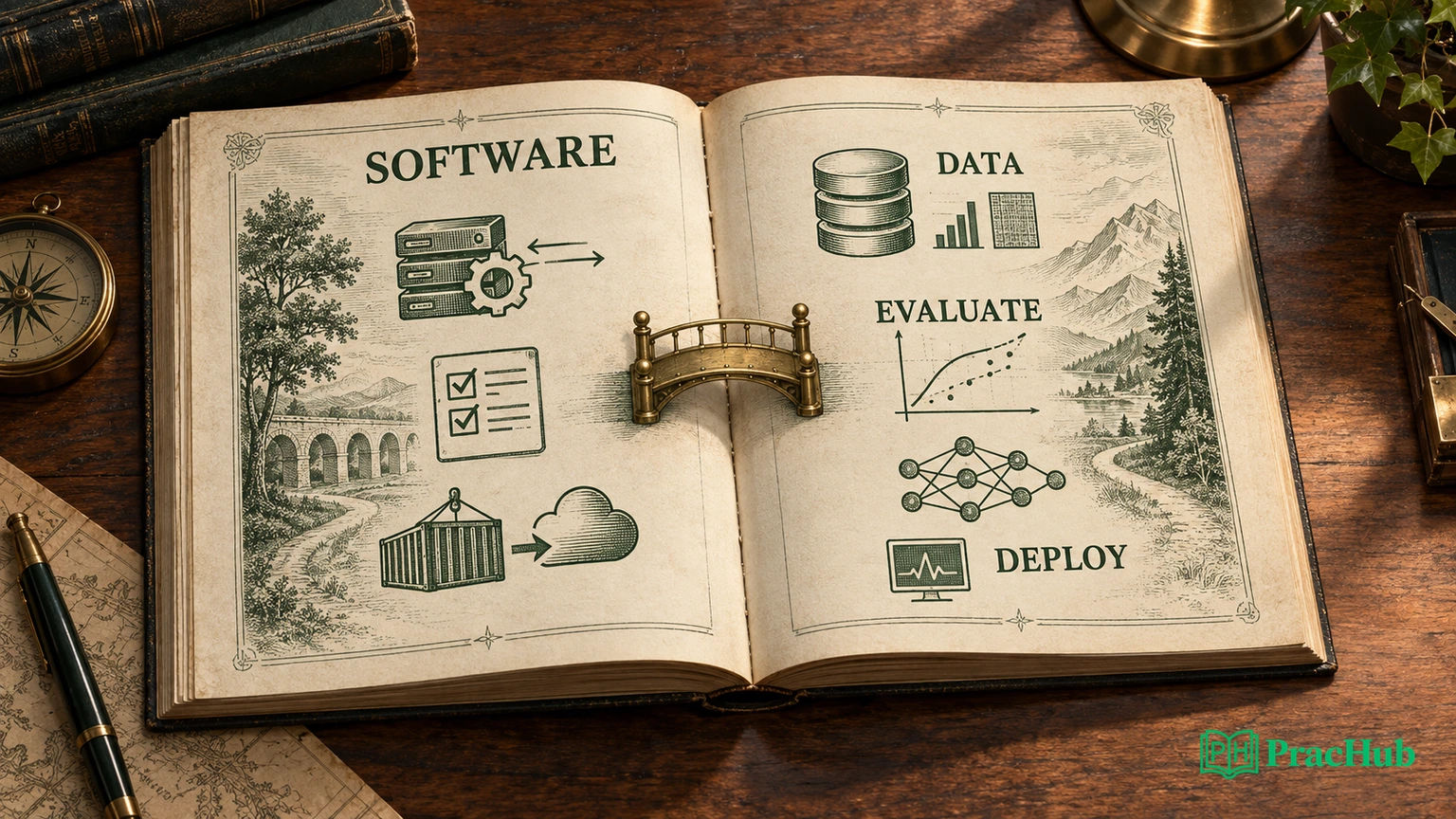
Your ability to define interfaces, isolate failures, review code, test edge cases, operate services, and explain trade-offs is valuable in ML engineering. A model-serving endpoint still needs bounded latency, authentication, graceful degradation, observability, and a rollback path. A feature pipeline still needs idempotency, schema contracts, ownership, and replay behavior. A training job still needs reproducible dependencies and a clear failure state.
The transfer is strongest when you connect each engineering habit to an ML failure. For example, an API contract becomes a feature schema plus freshness contract. Unit tests become transformation tests, invariance checks, and small deterministic fixtures. Deployment safety expands from binary health to both system health and model quality. Monitoring must cover request errors and latency, but also input drift, prediction distributions, delayed labels, and business outcomes.
Do not pitch the transition as “I can code, so I can learn the ML later.” That makes the largest gap sound incidental. Say instead that production engineering is your foundation and show how you have added the data and evaluation controls required for probabilistic behavior.
Where does “correctness” change?
Traditional application code often has a specified output for a specified input. An ML system usually estimates a relationship from finite, biased, and changing data. A test suite can prove that the pipeline runs and that an invariant holds; it cannot prove that the model will generalize to tomorrow's population.
A good interview answer separates four questions. Is the implementation correct? Is the offline estimate valid? Does the deployed system meet operational constraints? Does the outcome help the product without unacceptable harm? A model can pass the first three and still optimize a proxy that hurts users. It can also have a strong average metric while failing a small, important segment.
Use a concrete example. For fraud detection, accuracy can be high because fraud is rare. Precision affects investigator workload, recall affects missed fraud, latency affects checkout, and threshold choice affects both costs. The label may arrive weeks later, so an online dashboard cannot instantly confirm model quality. This is the kind of reasoning that distinguishes an ML engineer from an engineer who merely wraps a model in an API.
Which data questions should you answer before choosing a model?
Define the prediction unit, prediction time, label, and availability time for every feature. If one row represents a user-day, explain which events are visible at the decision timestamp and how multiple events are aggregated. Ask how labels are produced, how often they are missing, and whether missingness is related to the outcome.
Then inspect sampling. Training data may reflect only users who were previously approved, items that were shown, or cases reviewed by humans. That selection changes what the model can learn. Random row splitting can leak the same user, device, patient, or seller into both train and validation sets. Time-dependent systems often need an out-of-time test rather than a random split.
Finally, trace transformations. Imputation, scaling, vocabulary building, feature selection, and target encoding must be fit on training data within each validation fold. Scikit-learn's official common-pitfalls guide warns that learning preprocessing information from test data creates leakage. In an interview, name the offending operation and move it inside a pipeline or fold rather than saying only “avoid leakage.”
How much statistics and modeling depth is enough?
You do not need to derive every algorithm from first principles for every MLE role. You do need a working model of bias and variance, regularization, calibration, thresholding, class imbalance, cross-validation, confidence in comparisons, and error analysis. You should be able to choose a baseline, explain what a metric rewards, and diagnose a gap between train and validation behavior.
For common model families, know the assumptions and failure modes. Explain why a linear model is useful as an interpretable baseline, how tree ensembles handle nonlinear interactions, why feature scale matters for distance-based or gradient-based methods, and when an embedding represents similarity rather than causation. Be ready to discuss missing values and categorical variables as data-contract decisions, not library trivia.
The interview signal is not vocabulary volume. It is whether you can make a defensible choice under constraints. “Use XGBoost” is weak. “Start with regularized logistic regression because labels are limited and explanations matter; compare a boosted-tree model with grouped, time-aware validation; then inspect calibration and segment errors” is testable.
What project evidence closes the gap fastest?
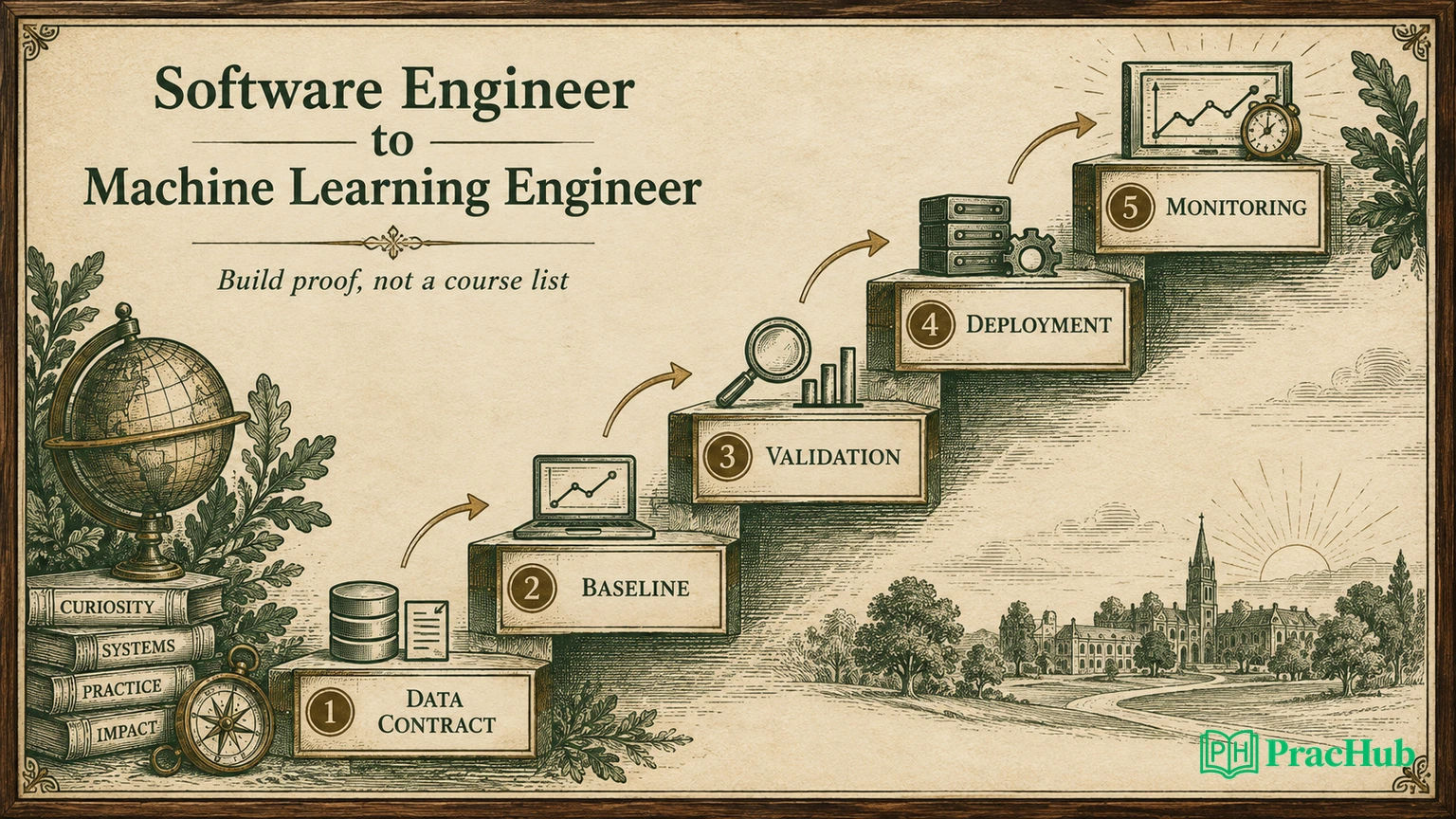
Build one project that includes the full decision path instead of five notebooks. Begin with a baseline and a written data contract. Version the split logic and training configuration. Add a reproducible pipeline, validation report, model artifact, small inference service or batch scorer, and monitoring plan. Record one failed experiment and why you rejected it.
For example, turn an existing ranking or recommendation service into an ML case study. Define the candidate set and objective, construct point-in-time features, compare a heuristic with a learned ranker, evaluate by time and user segment, and specify the online experiment. Add a fallback when features are stale. This uses your system-design experience while demonstrating that you understand exposure bias and delayed feedback.
In the interview, tell the story as a sequence of decisions: problem, constraints, data, baseline, split, metric, error analysis, deployment, monitoring, and next experiment. State what you personally implemented. A polished demo without this evidence can look like framework assembly rather than engineering judgment.
How should you answer an ML system design prompt?
Start from the product action, not the model. Identify who receives a prediction, when it is needed, and what happens if the system is wrong or unavailable. Define training examples and labels, then describe feature generation with event time and processing time. Choose offline and online metrics that connect to the action.
Next draw the serving path and training path separately. The serving path needs a latency budget, online features or retrieval, model version, fallback, and logging. The training path needs validated data, reproducible features, evaluation gates, an artifact registry, and a promotion decision. Explain how you prevent training-serving skew.
Close the loop with monitoring and retraining triggers. Operational alarms cover errors, latency, throughput, and resource saturation. Model monitoring covers input quality, drift indicators, prediction distribution, calibration where labels arrive, and segment outcomes. Retraining on a schedule is not automatically safe; a new dataset or model still needs gates and rollback.
What coding rounds change for an MLE candidate?
Core data structures and algorithms remain relevant, especially for general MLE roles. Add fluent Python data handling, vectorized reasoning, numerical edge cases, and the ability to test a transformation. Expect questions that mix code with ambiguity: deduplicate events, compute features without future data, implement a metric, or debug a training pipeline.
Narrate invariants. If you aggregate events, state the key and time window. If you shuffle, state the seed and whether order matters. If you parallelize, distinguish CPU work, I/O, memory, and determinism. Validate shapes and types before training, and use tiny examples whose expected result you can calculate manually.
Avoid turning a coding answer into a library recital. Interviewers can change the input representation or prohibit a helper. Show the underlying logic first, then mention the production implementation you would use.
How can you diagnose your own gap in one weekend?
Run three short mocks. First, take a familiar service and answer an ML design prompt end to end. Second, audit a small dataset for leakage, split errors, class imbalance, and label timing. Third, present one project in ten minutes while a partner asks “how do you know?” after every result.
Score evidence, not confidence. Can you write the prediction timestamp? Can you calculate the baseline? Can you justify the split? Can you explain a metric failure with a numeric example? Can you describe rollback and delayed-label monitoring? Every “no” becomes a preparation task.
Then choose the narrowest artifact that proves improvement: a leakage test, grouped split, calibration plot, model card, feature freshness alarm, or load test. This produces a portfolio that answers interview follow-ups rather than merely listing courses.
Practice the transition with connected questions
These PracHub records train related reasoning. They are not a forecast of a company's exact interview loop.
| PracHub question | Practice focus | Why it helps |
|---|---|---|
| Machine Learning Fundamentals: Optimizers, Scaling Laws, and Clustering | Core modeling concepts | Reveals gaps hidden by framework familiarity |
| Machine Learning Fundamentals: Tree Models, Training, Evaluation, and Embeddings | Evaluation and model families | Connects algorithms to trade-offs |
| Describe Your Machine Learning Project Experience | Project narrative | Tests ownership and evidence |
| Design Work Orchestration for Machine-Learning Data Pipelines | MLOps and pipelines | Transfers distributed-systems strengths |
| Design Machine Learning Model for Facebook Groups Post Ranking | ML system design | Forces objective, features, evaluation, and serving together |
The transition is credible when you can show both halves: disciplined software delivery and disciplined empirical evaluation. Keep the engineering habits that already work, then make data timing, split design, metrics, and model feedback as explicit as an API contract.
Use a gap matrix instead of a course list
Map each interview signal to evidence you can show. For data, produce a point-in-time dataset contract and a leakage test. For modeling, compare a simple baseline with one stronger model and explain the error slices. For evaluation, justify the split, metric, threshold, and uncertainty. For systems, show a versioned training job, serving path, fallback, and monitoring plan. For communication, present one failed choice and the evidence that changed your mind.
Rate each row as “can explain,” “can implement,” or “can defend with an artifact.” The third standard is the useful one. A certificate can organize study, but it does not demonstrate that you diagnosed a bad split or shipped a monitored model. Spend preparation time where evidence is missing.
Tailor the matrix to the job description. An infrastructure-heavy MLE role may emphasize distributed training, feature platforms, or serving. An applied role may emphasize experimentation, error analysis, and stakeholder decisions. Official role descriptions help identify responsibilities, but a posted requirement still does not reveal the exact interview. Use it to prioritize, then prepare transferable reasoning.
Comments (0)