Sprinklr Product Engineering Intern OA 2027: Technical Assessment, Coding, and Interview Process
Quick Overview
An evidence-aware guide to Sprinklr's Product Engineering Intern process, separating the official Technical Assessment from reported coding, project, and interview patterns.
Sprinklr officially tells university candidates that engineering and technical roles can include a Technical Assessment after resume review. What it does not publish is one universal 2027 timer, platform, question count, cutoff, or interview sequence. Those details can change by campus, location, role, and recruiting wave.
The safest preparation strategy is therefore two-layered: trust the official stage names, then use recent and historical candidate reports to identify recurring skills without treating any one report as a guarantee. This guide separates those layers and turns them into a practical plan. For broader timed practice, use PracHub's Software Engineer questions to test coding, explanation, and edge-case habits before your invitation arrives.
Quick answer: what is confirmed for 2027?
Sprinklr's official early-career page describes four steps: resume review, a Technical Assessment for engineering and technical roles, evaluation through interviews with hiring-team members, and an offer stage for selected candidates. That is the strongest public description of the process.
Candidate accounts add useful detail but not a fixed contract. A recent 2026 intern OA report described three algorithmic tasks, while 2024 Product Engineering Internship accounts commonly described three coding questions followed by two technical interviews and HR. These reports support preparing for DSA, implementation, project depth, and spoken problem solving. They do not establish that every 2027 candidate receives the same three-question test or the same number of interviews.
| Process element | Evidence level | What to prepare | What remains variable |
|---|---|---|---|
| Resume review | Official | Relevant projects, fundamentals, and clear ownership | Campus and role-specific shortlisting rules |
| Technical Assessment | Official stage; format candidate-reported | Timed coding, DSA, complexity, and testing | Platform, timer, question count, cutoff, and proctoring |
| Hiring-team interviews | Official stage; content candidate-reported | Live coding, projects, CS fundamentals, and communication | Number, order, and exact specialization |
| Offer | Official | Availability and logistics | Decision timing and team details |
The official Sprinklr early-career process
The Sprinklr Internships and Early Careers page is unusually helpful because it names a Technical Assessment directly. It also puts that stage after university recruiting reviews the resume or CV and before a series of hiring-team interviews. That sequence answers two common questions: the assessment is part of a screened hiring process, and passing it is not the final decision.
The page does not say that every applicant automatically receives an assessment. It also does not name HackerEarth, HackerRank, CodeSignal, or another provider. Unless the invitation specifies a platform, do not build your preparation around browser behavior or a provider-specific score scale.
Your invitation is the source of truth for logistics. Check the exact deadline, time zone, supported languages, permitted resources, identity checks, and whether the assessment must be completed in one sitting. If any rule is unclear, ask the recruiter before opening the test rather than relying on a forum post from another campus.
What candidates report about the technical assessment
The most current role-specific evidence is a 2026 LeetCode post titled Sprinklr Online Assessment intern (2026). It describes three problems involving one-to-one character mapping, constructing minimum and maximum arithmetic expressions from digits and operators, and counting attendance strings under absence and consecutive-late constraints.
That mix is more informative than memorizing the exact prompts. It suggests that a candidate may need to move between hash-map invariants, combinatorial search or greedy reasoning, and dynamic programming. The tasks also reward careful interpretation: injective mappings, operator placement, and sequence restrictions all fail when a solution quietly changes the contract.
Historical internship reports point in the same general direction. An IIT Kanpur Product Engineering Intern account describes three coding questions in 90 minutes, then two technical interviews and HR. A 2024 GeeksforGeeks report also describes three OA coding problems before live coding, a technical interview, and HR. Treat the three-question pattern as a useful simulation target, not a promised 2027 format.
What the OA may test
Data structures and algorithms
Prepare arrays, strings, hash maps, sorting, binary search, trees, graphs, greedy methods, and one- or two-dimensional dynamic programming. Sprinklr reports often use implementation-heavy prompts rather than one obvious named pattern. Start by defining the state and invariant instead of hunting for a memorized title.
For a mapping problem, ask whether two source characters may map to one target character and whether unused alphabet symbols matter. For a counting problem, define exactly what each DP state represents before writing transitions. For a tree or graph, decide when a node becomes visited and what disconnected or cyclic input means.
Complexity and hidden tests
Recent 2026 tasks include an attendance-counting constraint of up to 100,000 days. That scale is a reminder to read constraints before choosing brute force. A recurrence that is correct for small examples may still fail the assessment if it performs exponential enumeration or uses an oversized state.
Before submitting, test the smallest input, duplicate-heavy input, a boundary value, and one case that distinguishes your algorithm from the tempting wrong approach. Recheck integer overflow, recursion depth, output ordering, and whether the problem asks for a count, one valid construction, or an optimum.
How to handle the coding questions
Use a four-pass workflow. First, scan every prompt and rank them by confidence, implementation cost, and scoring opportunity. Second, secure one complete solution, including your own tests. Third, return to the harder task with the remaining time visible. Fourth, reserve a final review block for hidden-test failures.
Do not spend the entire session polishing the first answer while another task remains blank. Conversely, do not abandon a nearly complete solution for a speculative optimization unless the constraints prove it is necessary. The practical goal is maximum correct evidence, not equal time per question.
Write code that is easy to inspect under pressure. Keep parsing separate from core logic when the platform allows it, use names that preserve the invariant, and remove debug output. If partial test credit is available, a clean baseline can be worth more than an unfinished optimal idea, but only the test report and invitation can tell you how that assessment is scored.
What comes after the assessment?
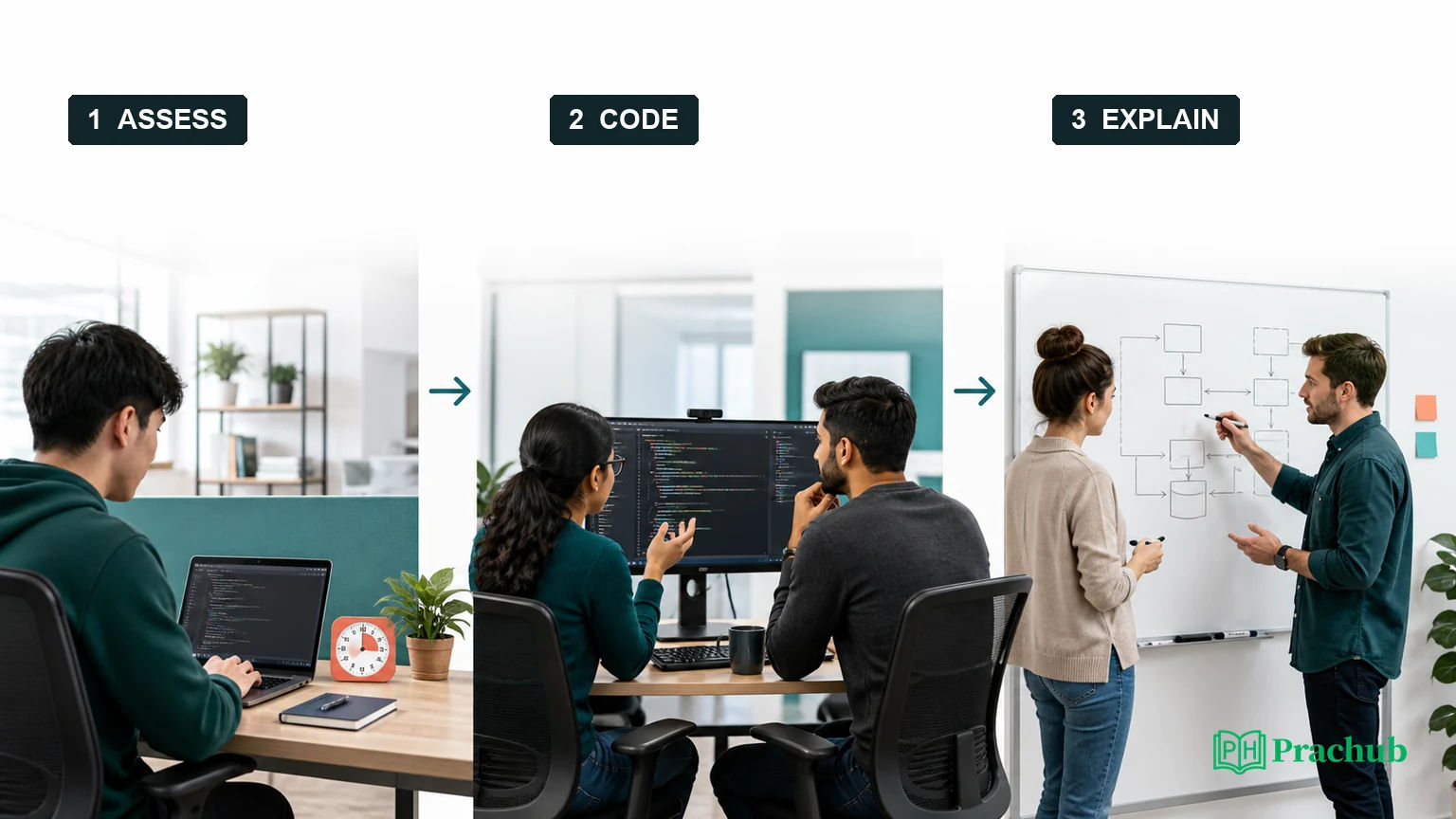
Sprinklr's official wording is a “series of interviews with the hiring team members.” Candidate reports make that less abstract. A Product Engineer Internship report on LeetCode describes two similar technical rounds: a short introduction and CV discussion followed by two programming problems in a shared document. The final conversation was HR.
Another 2024 report describes a live coding round with tree problems, then a technical round that explored prior internships, an in-memory file-system implementation in C++, and a math puzzle. A July 2026 campus discussion also mentions DSA and puzzles, with system design appearing for some candidates. The shared signal is not one exact question family; it is the ability to explain a solution while an interviewer changes constraints or probes fundamentals.
Live coding
Practice talking through clarification, approach, complexity, implementation, and testing. Avoid narrating every keystroke. Explain decisions that help the interviewer evaluate correctness: why the data structure fits, what invariant the loop maintains, and which edge case could break it.
When you get a hint, incorporate it visibly. Restate what changed in your understanding, adjust the plan, and continue. Recovering well can produce stronger evidence than silently forcing a flawed approach.
Resume and project depth
Know every technical noun on your resume. For each major project, prepare the problem, architecture, your exact contribution, the hardest failure, one trade-off, and a measurable result. If you claim performance or scale, know how it was measured. If you did not measure it, say what you would instrument next.
Object-oriented design and CS fundamentals
The file-system report is a useful model for a practical design prompt. Clarify required operations, error behavior, path semantics, data structures, and complexity before coding. Older candidate reports also mention OOP, databases, operating systems, and language fundamentals. Review the fundamentals connected to your chosen language and projects rather than cramming unrelated trivia.
Behavioral fit and The Sprinklr Way
Sprinklr's culture page names four values: customer obsession, accountability, teamwork, and trust. Prepare one concise story for each signal. A good answer explains the situation, your decision, the concrete action you owned, and what changed as a result.
For “Why Sprinklr?”, connect your interests to the company's AI-native customer-experience platform, large enterprise users, or the engineering problems created by unified data and real-time customer interactions. Then make the answer personal: name the kind of product or technical responsibility you want to learn during the internship.
Avoid reciting values without evidence. “I value teamwork” is weak; a specific disagreement you resolved, including what you changed after listening, is useful. Sprinklr says it values collaboration, accountability, and straight communication, so your stories should show those behaviors under a real constraint.
Practice with Sprinklr-relevant questions from PracHub
These PracHub question-bank records train skills that appear across timed assessments and Product Engineering interviews. They are practice material, not predictions of your exact Sprinklr assessment or interview. Each complete title in the first column opens the question and written solution.
| PracHub question | Practice focus | Why it helps |
|---|---|---|
| Solve Two OA Coding Problems | Multi-part implementation and boundaries | Trains switching between independently graded tasks without losing test discipline |
| Group Strings By Anagram Signature | Hash maps, canonical keys, and complexity | Builds the mapping invariant needed for many string-transformation prompts |
| Implement Topological Sort and Tree Boundary Traversal | Graph ordering and tree traversal | Matches the reported need to explain correctness across distinct DSA families |
| Design an in-memory filesystem and circular queue | APIs, object design, and state invariants | Mirrors the practical file-system and data-structure depth seen in technical reports |
| Design comprehensive OA test cases | Hidden tests, boundaries, and oracles | Turns the last minutes of an assessment into a repeatable review process |
Attempt each question without opening the solution. Afterward, classify the gap as pattern recognition, wrong complexity, implementation error, missed edge case, or unclear explanation. The category, not the question title, should determine the next drill.
A seven-day preparation plan
| Day | Focus | What to do |
|---|---|---|
| Day 1 | Format and baseline | Read the invitation, verify logistics, and complete one timed three-problem diagnostic |
| Day 2 | Strings and hashing | Practice mappings, frequency signatures, parsing, and duplicate-heavy cases |
| Day 3 | Graphs and trees | Complete one traversal and one dependency-order problem; explain correctness aloud |
| Day 4 | Dynamic programming | Define states and transitions for sequence-counting and optimization problems |
| Day 5 | Practical design | Implement a small stateful API and defend data structures, errors, and complexity |
| Day 6 | Interview simulation | Run a live coding mock followed by a 25-minute project deep dive |
| Day 7 | Repair and reset | Fix recurring mistakes, review values and logistics, then stop cramming |
Frequently asked questions
Is the Sprinklr Product Engineering Intern OA automatic?
Sprinklr does not publicly say that every applicant receives it automatically. Its official early-career process places resume review before the Technical Assessment, so candidates should not interpret an invitation as proof that no screening occurred. The exact trigger can vary by campus, role, and recruiting wave.
How many coding questions are on the Sprinklr OA?
Several Product Engineering Internship reports, including one from 2026, describe three coding questions. Sprinklr's official page does not confirm that count for every 2027 assessment. Use a three-problem simulation for preparation, but follow the timer and instructions in your own invitation.
What difficulty should I expect?
Candidate reports range from approachable interview problems to medium or competitive-programming-style tasks. Prepare to complete standard DSA accurately and to make progress on one harder implementation or DP problem. Difficulty labels are subjective, so constraints and test coverage are more useful than forum ratings.
Does Sprinklr ask system design or puzzles for interns?
Some reports mention object-oriented design, a file-system implementation, math puzzles, or system-design discussion, but these are not universal official requirements. Intern candidates should prioritize coding and project depth, then add practical design and core fundamentals rather than preparing a senior-scale architecture curriculum.
How long after the OA does Sprinklr respond?
Sprinklr publishes no guaranteed response window. Timing can depend on campus schedules, interviewer availability, headcount, and batch review. Follow the recruiter-provided window; if none is given, send one concise follow-up after roughly a week and continue other applications while you wait.
Final takeaway
The Sprinklr Product Engineering Intern process has one firm public anchor: engineering candidates may move from resume review to a Technical Assessment and then hiring-team interviews. The useful candidate pattern is coding-heavy, but the platform, timer, cutoff, and exact loop remain variable.
Prepare for the evidence that repeats: DSA across several families, careful implementation, hidden-test defense, project ownership, and clear spoken reasoning. Start with the linked Software Engineer questions, use the five-question table as a diagnostic, and let your invitation override every unofficial format claim.
Sources and Further Reading
- Sprinklr Internships and Early Careers
- Sprinklr Careers: Our Culture and The Sprinklr Way
- Sprinklr Candidate Preparation Page
- Sprinklr Online Assessment Intern 2026 Candidate Report
- Sprinklr Product Engineer Internship Interview Experience
- IIT Kanpur Product Engineering Intern Selection Process
- Sprinklr Product Engineering Internship 2024 Candidate Report
- Recent Sprinklr Intern Interview Discussion, July 2026
Research note: This guide was checked on August 30, 2026. Sprinklr can change assessment tools, question counts, interview order, and campus-specific processes. Follow the instructions in your own invitation.
Related Articles
How to Ask Clarifying Questions in a Coding Interview: Requirements, Edge Cases, and Examples
Learn which clarifying questions to ask before coding, how to confirm requirements and edge cases, and turn interviewer answers into assumptions and tests.
State Farm Technology Internship 2027: HireVue, Coding Assessment, and Final Interview
State Farm Technology Internship 2027 guide: HireVue, coding assessment, final interview, reported questions, timeline, and preparation.
CodinGame Assessment Guide 2026: Coding Games, Scores, Code Playback, and Candidate Reports
Learn how CodinGame assessments work in 2026, including coding games, partial and comparative scores, code playback, reports, and preparation.
What to Do When You Get Stuck in a Coding Interview: Hints, Recovery, and Communication
Learn what to say when you get stuck in a coding interview, how to request useful hints, recover momentum, and communicate your reasoning clearly.
Comments (0)