State Farm Technology Internship 2027: HireVue, Coding Assessment, and Final Interview
Quick Overview
An evidence-aware State Farm Technology Internship 2027 guide covering the official hiring process, reported HireVue coding tasks, final interviews, timelines, and preparation.
State Farm's public hiring process confirms that some roles use a pre-employment assessment and that interviews may include video and a hiring manager. It does not publish one universal 2027 Technology Internship sequence, coding platform, question count, cutoff, or response time.
The practical answer is that technology candidates should prepare for a digital HireVue-style screen, a short coding task, and a later live interview, while treating every detail in the invitation as controlling. Use PracHub Software Engineer questions to rehearse the coding and communication skills before the timer starts. The question-bank records are practice material, not a prediction of your exact State Farm assessment.
Quick answer: what should candidates expect?
State Farm's official careers site describes five broad steps: create a profile and apply, complete a pre-employment assessment if the role requires one, interview by video and/or with a hiring manager, receive an offer if selected, and finalize it after required checks. Its digital-interview guide also confirms that State Farm uses HireVue for at least some interview experiences.
Candidate reports add more detail for technology and software internships. They commonly describe a recorded behavioral section, one coding problem or compact implementation task, an explanation of the solution, and a later live interview mixing behavioral and technical questions. Those reports are useful patterns, but they are not a guaranteed 2027 template.
| Stage | What is supported | What remains variable |
|---|---|---|
| Application review | State Farm reviews the submitted profile for the specific opening | Whether every qualified applicant receives the next step |
| Digital assessment | Some roles use an assessment; State Farm publishes HireVue preparation guidance | Question count, coding language, timer, attempts, and cutoff |
| Coding task | Multiple technology candidates report a coding component | Exact difficulty, prompt, scoring, and whether it is inside HireVue |
| Final interview | State Farm says interviews may involve a hiring manager | Number of interviewers, live coding, OOP depth, and behavioral mix |
| Decision | Offers appear in the candidate profile and remain contingent on required checks | Response time and whether the portal updates before email |
The official State Farm hiring process
1. Profile and application
Candidates apply to a specific requisition through State Farm Careers and create or update a profile. Read the actual Technology Internship posting rather than relying on a generic internship summary. Location, work authorization, graduation window, hybrid expectations, and required attachments can differ across programs.
An application is not evidence that the assessment is automatic. State Farm says candidates are considered for the opening they select, while recent internship reports include both screened and unscreened outcomes. The invitation only proves that you reached that employer-configured step.
2. Possible pre-employment assessment
State Farm says some positions use pre-employment and/or language assessments. It does not say every technology candidate receives an identical test. For a coding assessment, confirm the deadline, expected duration, allowed languages, permitted resources, and whether camera or microphone access is required before beginning.
3. Video or hiring-manager interview
State Farm says interviewing may be completed by video and/or with a hiring manager. Its official digital-interview guide covers both recorded and live sessions and recommends Google Chrome, a system test, a quiet workspace, stable camera placement, and professional lighting.
4. Offer and finalization
Selected candidates view offer details in their State Farm profile. The company then finalizes the offer after required checks. Until that happens, a completed assessment, recruiter call, or portal status is progress rather than an offer.
What candidates report about the HireVue
Recent and historical software-intern reports often combine behavioral prompts with a coding task inside one digital experience. Examples include several recorded behavioral questions followed by one easy-to-medium coding problem, then a request to explain the approach. A 2025 report described a technical item placed between behavioral responses and a separate explanation page.
The consistent signal is broader than any leaked prompt: State Farm can evaluate communication and implementation together. Prepare to move from a STAR answer to code without losing structure. After coding, be ready to summarize the algorithm, complexity, tests, and one improvement in plain language.
Do not assume that every HireVue records the same data or gives the same number of attempts. State Farm's invitation and HireVue setup screen should tell you what equipment and permissions are needed. Follow the current rules rather than copying another candidate's setup.
What the coding assessment may test
Candidate reports span simple string or array processing, game-like state updates, and a later technical question about object-oriented programming. One accepted-offer report described recreating part of the game 2048; another described array parsing. These are examples of practical implementation, not predictions of a repeated question.
Strings, arrays, and hash maps
A compact internship task may require parsing text, counting values, grouping records, validating input, or transforming an array. Clarify the expected output, then test empty input, one item, duplicates, unusual characters, and the largest plausible case.
Stateful implementation
A small game or service task tests whether you can maintain invariants across operations. Define the state, isolate each transition, and keep movement or merge rules deterministic. Avoid placing every rule in one long function, because hidden cases become difficult to reason about.
OOP and software fundamentals
Final-round reports mention object-oriented principles and project questions. Be ready to explain encapsulation, abstraction, inheritance, and composition with an example from code you have written. The interviewer may care more about judgment and maintainability than textbook definitions.
Testing and explanation
A solution that passes visible examples can still fail hidden tests. Before submitting, cover boundary values, repeated values, invalid states, output formatting, and one performance case. If the assessment asks for an explanation, connect each test to a risk in the implementation.
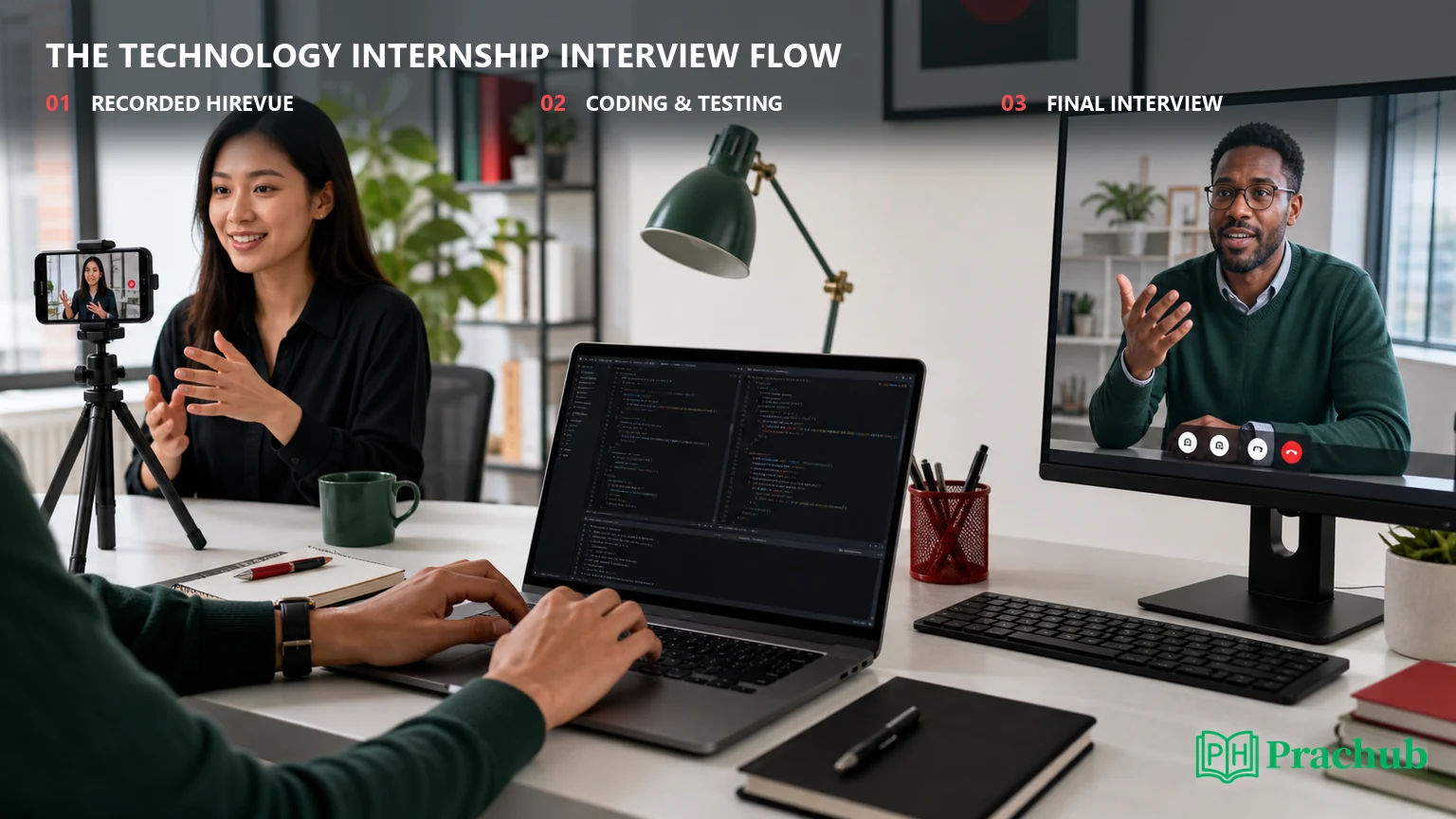
What happens after the digital assessment?
Candidate reports describe several paths. Some people received a scheduling or recruiter call roughly a week or two after HireVue, followed by a final virtual interview. Others waited several weeks or were rejected after completing all visible test cases. A delay does not reveal a reliable cutoff because resume review, headcount, interviewer capacity, location, and application volume can all affect timing.
The later interview is often described as a mix of behavioral questions, resume or project discussion, OOP fundamentals, and one live coding problem. Some reports describe a mostly behavioral round, while others include explicit coding. That disagreement is a reason to prepare both rather than choosing one rumor.
If the recruiter schedules a call, confirm the agenda politely. A logistics call may cover availability and interview timing; it should not be treated as a guaranteed offer. Keep applying elsewhere until a written offer is available in the candidate profile.
How to prepare for the final interview
Rehearse one project at three depths
Prepare a 30-second overview, a two-minute architecture explanation, and a deeper technical discussion. Cover the user problem, your ownership, constraints, design decisions, testing, results, and what you would change. This prevents a project answer from collapsing into a list of technologies.
Practice live coding aloud
State the input, output, constraints, and examples before choosing a data structure. Code a correct baseline, test it, then improve it if time remains. Narrate decisions without describing every keystroke. If you get stuck, identify the smallest uncertain step and ask a focused clarification.
Build four behavioral stories
Use STAR stories for teamwork, conflict, learning from a mistake, and delivering under ambiguity. State Farm's technology careers page emphasizes collaboration and customer needs, so connect engineering decisions to reliability, usability, or business outcomes rather than discussing code in isolation.
Follow candidate-integrity rules
State Farm publishes AI standards for candidate integrity and expects honest, individual work. Do not assume an AI assistant, external notes, documentation, or a second device is allowed. Use only what the invitation explicitly permits, and ask the recruiter before starting if a rule is unclear.
Practice with State Farm-relevant questions from PracHub
PracHub does not currently expose a State Farm-specific Software Engineer collection. The five verified records below train the closest reported skills: compact OA implementation, string grouping, hidden-test design, project explanation, and hiring-manager behavioral judgment. They come from other stored company records and are not predictions of your exact State Farm interview.
| PracHub question | Practice focus | Why it helps |
|---|---|---|
| Solve Two OA Coding Problems | Arrays, strings, and careful implementation | Rehearses switching between compact tasks while preserving correctness. |
| Group Strings By Anagram Signature | Hash maps, canonical keys, and duplicates | Builds the grouping and parsing discipline common in short coding screens. |
| Design comprehensive OA test cases | Boundaries, hidden tests, and failure analysis | Forces you to test the implementation instead of trusting visible examples. |
| Explain a challenging project end-to-end | Ownership, architecture, and results | Prepares the project depth expected in a live final interview. |
| Answer common HM behavioral prompts | Conflict, prioritization, failure, and motivation | Creates concise evidence-based answers for a hiring-manager conversation. |
A seven-day preparation plan
| Day | Focus | Deliverable |
|---|---|---|
| Day 1 | Read the requisition and invitation | Write down deadline, format, languages, permissions, location, and eligibility rules. |
| Day 2 | HireVue stories | Record four STAR answers and reduce each to a short outline. |
| Day 3 | Strings and arrays | Complete two timed problems and log every implementation mistake. |
| Day 4 | Stateful coding | Implement a small game or service with explicit state-transition tests. |
| Day 5 | OOP and project depth | Explain OOP trade-offs and rehearse one project at three levels of detail. |
| Day 6 | Full simulation | Combine recorded behavioral answers, one timed coding task, and a verbal explanation. |
| Day 7 | Final review | Test the device, confirm the rules, review the mistake log, and avoid new topics. |
Frequently asked questions
Is the State Farm Technology Internship OA automatic?
State Farm does not publicly say that every applicant receives an assessment automatically. Treat the invite as evidence that you reached a configured screening step, not proof that your resume has already cleared every later review.
Is the coding assessment inside HireVue?
Some software-intern reports describe behavioral video questions, a coding task, and an explanation within the same digital flow. Other roles may separate the components. Follow the links and instructions in your own invitation.
How difficult is the State Farm intern coding question?
Candidate descriptions range from very easy implementation to LeetCode easy or medium. Difficulty labels are subjective, and the prompt can change. Prepare for clean strings, arrays, hash maps, state transitions, and hidden tests.
What is the final State Farm technology interview like?
Reports commonly mention behavioral questions, resume or project discussion, OOP fundamentals, and sometimes one live coding task. The exact mix depends on the team and recruiting cycle.
How long does State Farm take to respond after HireVue?
Historical reports range from roughly a week to several weeks, with some candidates receiving no next-round invitation. There is no published service-level agreement. A concise recruiter follow-up is reasonable after the stated timeline passes.
Final takeaway
The strongest preparation does not depend on guessing one 2027 question. State Farm officially confirms that some roles use assessments and that interviews can be digital or hiring-manager led. Candidate reports make the likely technology pattern clearer: behavioral responses, a coding or implementation task, explanation, and a later mixed final interview.
Read the invitation as the source of truth, practice code you can test and defend, and prepare stories that connect technical choices to people and outcomes. That combination remains useful even when the platform, timer, or exact sequence changes.
Sources and Further Reading
- State Farm Careers: The Employment Process
- State Farm Careers: Technology and User Experience
- State Farm Digital Interviewing Tips
- State Farm Careers: Internship Categories
- State Farm Software Engineer Internship Interview Reports
- State Farm SWE Intern Process Candidate Discussion
- State Farm SWE Intern Final Round Candidate Discussion
- State Farm Enterprise Technology Internship Candidate Discussion
Research note: This guide was reviewed on August 30, 2026. State Farm can change requisitions, assessment settings, timelines, and interview stages. Official pages and the candidate's invitation take priority over historical reports.
Related Articles
How to Ask Clarifying Questions in a Coding Interview: Requirements, Edge Cases, and Examples
Learn which clarifying questions to ask before coding, how to confirm requirements and edge cases, and turn interviewer answers into assumptions and tests.
Sprinklr Product Engineering Intern OA 2027: Technical Assessment, Coding, and Interview Process
Sprinklr Product Engineering Intern OA 2027 guide: official assessment steps, reported coding topics, interviews, timeline, and preparation.
CodinGame Assessment Guide 2026: Coding Games, Scores, Code Playback, and Candidate Reports
Learn how CodinGame assessments work in 2026, including coding games, partial and comparative scores, code playback, reports, and preparation.
What to Do When You Get Stuck in a Coding Interview: Hints, Recovery, and Communication
Learn what to say when you get stuck in a coding interview, how to request useful hints, recover momentum, and communicate your reasoning clearly.
Comments (0)