What to Do When You Get Stuck in a Coding Interview: Hints, Recovery, and Communication
Quick Overview
A practical coding interview recovery guide with diagnostic steps, hint-request scripts, a worked example, communication tactics, and linked PracHub practice.
Getting stuck in a coding interview is not automatically a failure. The important signal is what you do next. Pause, name the exact blocker, restate the facts you know, test a tiny example, and choose the simplest correct baseline you can explain. If you still need help, ask for a directional hint instead of asking for the solution. Then incorporate the hint aloud and keep moving.
That recovery lets the interviewer see your reasoning and judgment. Rehearse it with Software Engineer interview questions and written solutions, not to memorize answers but to practice recovering when your first idea fails.
The short answer: name, shrink, and ask
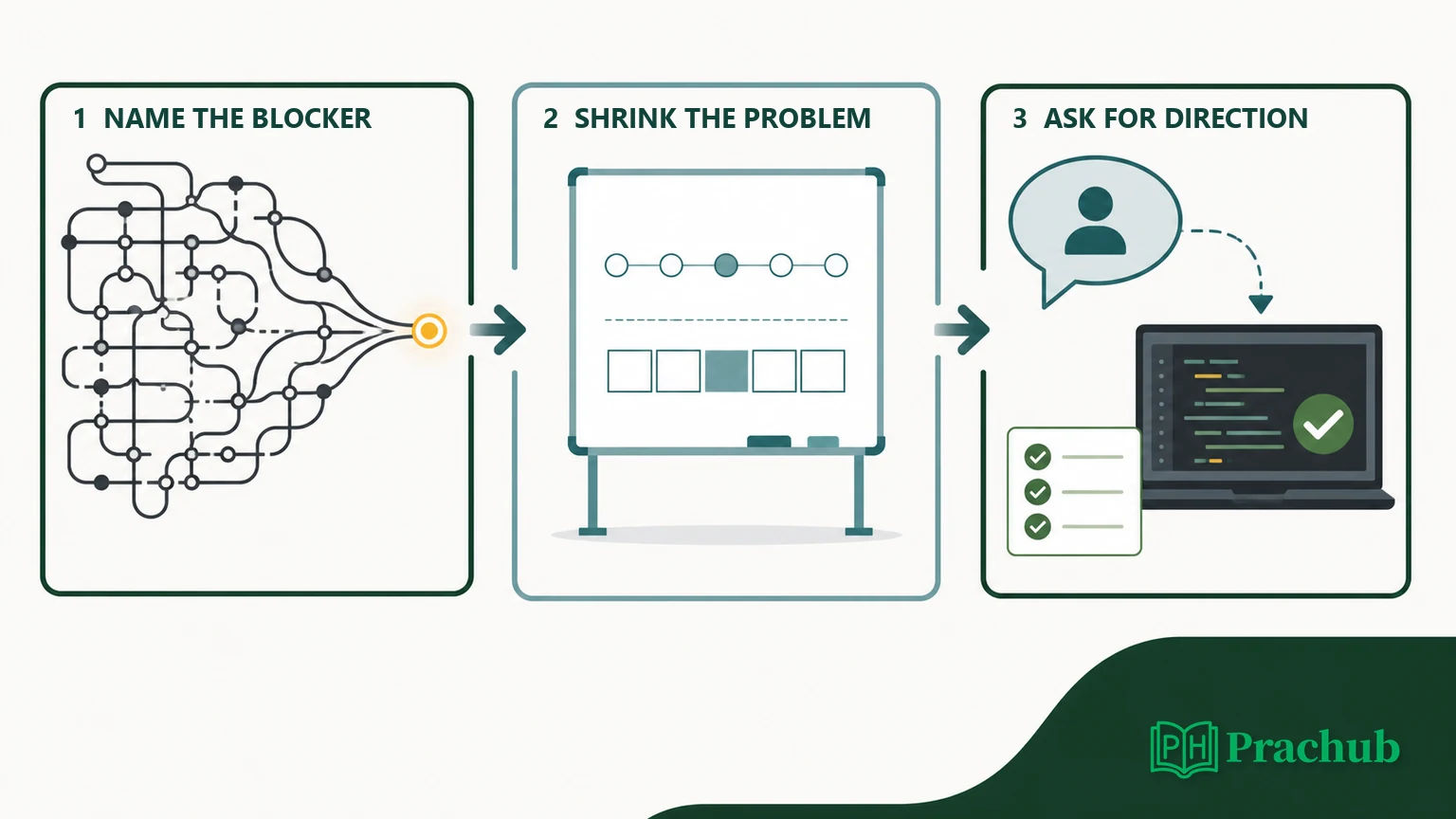
When your mind goes blank, use three moves:
- Name the blocker. Say what is unclear: the requirement, the algorithm, the data structure, the proof, or a bug in your code.
- Shrink the problem. Build a tiny example, remove one constraint, or describe a brute-force solution. A smaller version gives you something concrete to reason about.
- Ask for direction. Explain what you tried and request the smallest useful hint: confirmation of an assumption, a nudge toward a pattern, or feedback on two approaches.
Microsoft advises candidates to share their thought process, state assumptions, and ask clarifying questions when stuck. CodeSignal likewise describes technical interviews as an evaluation of problem solving and communication, not just whether the final code passes.
First diagnose why you are stuck
"I am stuck" is too broad to solve. Identify the failure mode before changing direction.
| Type of blocker | What it feels like | Best first move |
|---|---|---|
| Unclear prompt | You do not know what counts as valid input or output | Restate the requirement and ask one precise clarifying question |
| Algorithmic blocker | You understand the task but cannot find an efficient approach | State a brute-force baseline and test a small example |
| Implementation blocker | Your approach seems right but the code is failing | Trace one input, inspect invariants, and isolate the first wrong state |
| Complexity concern | You have a working idea but suspect it is too slow or memory-heavy | Calculate complexity, identify the bottleneck, and propose one optimization |
| Interviewer silence | You cannot tell whether your direction is acceptable | Summarize your decision and ask for confirmation before committing |
| Technical issue | The editor, audio, screen share, or connection is failing | Say so immediately and follow the interviewer's troubleshooting process |
Each blocker needs a different question. Asking "Can I get a hint?" when the real problem is an ambiguous edge case reveals little about your thinking.
A reliable coding interview recovery sequence
1. Pause without apologizing repeatedly
A short pause is normal. Say, "I want to check this against a small example," and use the time productively. One calm sentence is better than a stream of apologies. You are signaling that you noticed uncertainty and are managing it.
2. Restate the contract
Repeat the input, expected output, and important constraints in your own words. Then surface assumptions:
"I am assuming duplicates are allowed, the input can be empty, and the output order does not matter. Is that correct?"
This can reveal that your difficulty came from solving the wrong version of the problem. It also follows the clarification-first guidance in Microsoft's technical interview preparation material and CoderPad's candidate checklist.
3. Put a correct baseline on the table
If the optimal approach is not visible, describe the simplest correct solution. Give its time and space complexity and explain why it is not yet satisfactory.
"A nested-loop solution would be correct in O(n squared) time. The repeated work is comparing the same values, so I am looking for a way to store or order that information."
A baseline creates forward progress. It gives you a correctness anchor, helps the interviewer see what you understand, and exposes the exact optimization gap.
4. Use a tiny example to recover the invariant
Choose the smallest input that still contains the difficult behavior: a duplicate, a cycle, an overlap, an empty branch, or an off-by-one boundary. Write down the state after each step. Ask what must remain true.
For a sliding-window problem, the invariant might be "the window always satisfies the constraint." For a graph traversal, it might be "each node enters the queue at most once." Naming the invariant often reconnects an implementation detail to the overall approach.
5. Compare two plausible directions
If you have alternatives, make the trade-off visible:
"I see two directions: sort first for O(n log n) time and constant extra lookup space, or use a hash map for expected O(n) time with O(n) space. Unless stable ordering matters, I would choose the hash map."
This shows that you can generate options and make a reasoned decision.
6. Ask for the smallest useful hint
Explain the blocker before requesting help. A good request sounds like this:
"I have a correct O(n squared) baseline and ruled out sorting because we must preserve order. I am missing the data structure that removes the repeated lookup. Could you give me a directional hint?"
If you receive a hint, paraphrase it, connect it to your current model, and continue. Do not pretend you independently discovered it.
How to ask for hints without surrendering the problem
Hints have levels. Start with the least revealing request that can unblock you.
| Hint level | What to ask | Use it when |
|---|---|---|
| Clarification | "Should I optimize for time, memory, or both?" | The target or constraint is unclear |
| Confirmation | "Does this invariant match the requirement?" | You have a model but want to verify it |
| Direction | "Am I missing a useful preprocessing step?" | You need a category of approach |
| Structure | "Would it help to track information as I scan?" | You need a data-structure nudge |
| Implementation | "Can you point me to the state transition I should recheck?" | The algorithm is sound but the code is stuck |
Avoid "What is the answer?" or a sequence of guesses designed to make the interviewer solve the problem. A useful hint request contains evidence: what you understand, what you tried, why it failed, and what kind of guidance would help.
Hints do not have one universal meaning. Companies use different rubrics, and some interviewers deliberately collaborate. CodeSignal's structured-interview guidance treats communication and collaboration as observable competencies. What matters is whether you understand the hint, update your approach, and continue coherently.
Useful scripts for common stuck moments
When the prompt is ambiguous:
"Before I choose a data structure, may I confirm whether input order must be preserved and whether duplicates are meaningful?"
When you have no optimal solution yet:
"I can start with a correct brute-force solution, then use its bottleneck to derive an optimization. I will state both complexities as I go."
When two approaches seem possible:
"The trade-off is time versus memory. I would choose the hash-based approach under these constraints. Does that interpretation match what you want me to optimize?"
When your code fails an example:
"The high-level invariant still looks right, so I am going to trace the first state change and find where the implementation diverges."
When you need a hint:
"I have ruled out X because of the ordering requirement. Is the intended direction closer to preprocessing, or should I revisit the way I modeled the state?"
When the interview tool fails:
"The editor stopped accepting input on my side. I want to make the issue visible now; should I refresh, switch to the backup link, or continue verbally?"
Google's candidate guidance recommends telling the interviewer or recruiter when a technical issue occurs rather than silently losing interview time.
A worked recovery example
Suppose you must return whether a directed set of tasks can be completed given dependency pairs. You recognize that cycles matter, but you cannot remember the full topological-sort implementation.
Name the blocker: "I know the decision depends on whether the directed graph contains a cycle; I am reconstructing the cleanest way to detect it."
Shrink the problem. Draw A -> B -> C, then add C -> A. In the acyclic example, one task has no unmet prerequisites. In the cycle, none can be removed first.
State a baseline. You could run depth-first search and track the current path. From the tiny example, recover Kahn's invariant: remove a node with indegree zero and decrement its neighbors. If the processed count is smaller than the node count, a cycle remains.
If the queue update is still unclear, request a structural hint: "I have the indegree invariant and cycle condition. Could you confirm whether a queue of zero-indegree nodes is the intended implementation?" That request exposes substantial progress and asks only for confirmation.
What interviewers can still evaluate during recovery
Amazon says its software-development interviews assess how candidates apply knowledge and solve problems, not merely what they have memorized. Its preparation guidance also emphasizes syntactically correct, robust, tested code and attention to edge cases. That means recovery is not empty time. An interviewer can still observe whether you:
- clarify requirements before committing;
- preserve correctness while optimizing;
- generate and compare alternatives;
- test boundaries and invalid inputs;
- explain complexity honestly;
- accept feedback without becoming defensive; and
- translate a hint into a working change.
Communication should make decisions inspectable. Say what changed and why, then code or test the next step.
Mistakes that make being stuck worse
Going silent for a long stretch. The interviewer cannot distinguish careful thought from total confusion. Give a brief status update and make your next action observable.
Bluffing familiarity. CodeSignal advises candidates not to bluff. Say what you know and reason from first principles; an unsupported claim is harder to recover from than an honest gap.
Optimizing before proving correctness. A slower correct baseline is more useful than a clever but undefined idea.
Coding through a broken model. More syntax will not repair a misunderstood requirement. Return to the contract and a tiny example.
Ignoring the hint. Paraphrase it and identify which assumption, invariant, or data structure changes.
Treating one bug as failure. Debug methodically. Trace the first incorrect state rather than rewriting everything.
Practice recovery with PracHub questions
These PracHub question-bank records are practice material, not predictions of your exact assessment or interview. Each complete title in the first column links directly to the question and written solution.
| PracHub question | Recovery skill to rehearse | Why it helps |
|---|---|---|
| Solve Two OA Coding Problems | Move from a baseline to a better implementation | Practice explaining bottlenecks and testing boundaries under time pressure |
| Group strings that are anagrams | Compare sorting and frequency-key approaches | Make the time-versus-space trade-off explicit |
| Merge Overlapping Intervals | Recover the invariant after sorting | Use a small overlap example to explain the merge condition |
| Find a Valid Task Execution Order with Dependencies | Reconstruct graph state and cycle handling | Practice requesting confirmation without asking for the solution |
| Design comprehensive OA test cases | Diagnose implementation failures | Build a disciplined edge-case and retesting process |
For each question, stop after the baseline. Name the optimization blocker, draw a tiny example, and formulate one directional hint request. Then finish and record whether the hint changed your model or only the implementation.
Frequently asked questions
Is getting stuck in a coding interview an automatic rejection?
No universal rule makes one stuck moment an automatic rejection. Rubrics differ. Your recovery, communication, correctness, and use of feedback can still provide evidence.
How long should I think before asking for a hint?
There is no employer-wide limit. After clarifying the prompt, trying a small example, and stating a baseline or failed direction, ask for the smallest hint that moves you forward.
Does asking for a hint hurt my score?
It may affect evaluation differently across interview loops, but a focused hint request is usually more useful than prolonged silence or random coding. Explain what you tried and integrate the response. Do not assume that a hint is either harmless or fatal; the rubric is company-specific.
What if I forget the name of an algorithm?
Describe the behavior and reconstruct it from invariants. You can say, "I do not remember the name, but I want to repeatedly process nodes with no remaining prerequisites." Correct reasoning matters more than recalling a label.
What if I cannot finish the code?
Prioritize a coherent partial result. State the remaining steps, complexity, edge cases, and tests. If possible, complete a correct baseline before leaving an optimized version half-defined. Be honest about what is implemented and what is still conceptual.
Sources and Further Reading
- Microsoft technical interviewing guidance
- Microsoft interview tips
- Amazon software development interview topics
- Amazon SDE II interview preparation
- CodeSignal technical interview guide for interviewers and candidates
- CodeSignal guide to structured interviews
- CoderPad technical interview cheat sheet
- Google virtual interview candidate resource
Research note: This guide was checked on August 30, 2026. Interview formats, rubrics, and policies vary by employer and can change; follow the instructions in your own invitation.
Related Articles
How to Ask Clarifying Questions in a Coding Interview: Requirements, Edge Cases, and Examples
Learn which clarifying questions to ask before coding, how to confirm requirements and edge cases, and turn interviewer answers into assumptions and tests.
State Farm Technology Internship 2027: HireVue, Coding Assessment, and Final Interview
State Farm Technology Internship 2027 guide: HireVue, coding assessment, final interview, reported questions, timeline, and preparation.
Sprinklr Product Engineering Intern OA 2027: Technical Assessment, Coding, and Interview Process
Sprinklr Product Engineering Intern OA 2027 guide: official assessment steps, reported coding topics, interviews, timeline, and preparation.
CodinGame Assessment Guide 2026: Coding Games, Scores, Code Playback, and Candidate Reports
Learn how CodinGame assessments work in 2026, including coding games, partial and comparative scores, code playback, reports, and preparation.
Comments (0)