StackSage Review: DevOps Interview Courses, Browser Labs, and Practice Depth
Quick Overview
Review StackSage’s public DevOps syllabus and sampled first lesson. An original course-to-evidence map and local working-directory experiment distinguish guided recognition from unprompted troubleshooting and actual execution.
StackSage’s DevOps and SRE Interview Prep course provides guided explanations and recognition exercises in a browser. Our guest check reached the first lesson’s interview-stage sorter, while later lessons displayed sign-in requirements. Inspect its exercises before relying on lab descriptions or completion indicators as evidence of unprompted troubleshooting. Pair the guidance with a small diagnostic task whose result you can explain independently.
PracHub publishes this review and owns the complementary practice links. Our service-stability and incident question asks you to defend that reasoning in another setting. The course-to-evidence map and local working-directory experiment below are original examples, separate from StackSage’s lessons and feedback.
What the public course describes
Provider positioning, checked November 3, 2026: the course page describes six lessons and an approximate ninety-minute course. Its syllabus covers preparation, concepts, troubleshooting, design, behavioral examples and offers. It promotes browser-based interactive learning without local setup or cloud accounts.
We did not measure the completion time or audit every lesson. The estimated duration does not establish the time needed to become competent in the underlying topics. Reading a curriculum and demonstrating a skill remain separate activities.
The syllabus’s hiring-loop descriptions are general teaching material. We did not verify them against a particular employer, role or recruitment cycle. Course anecdotes also do not become independent candidate reports merely because they describe an interview outcome.
Use the syllabus to identify the kind of practice offered. Confirm the actual assessment format with your recruiter or invitation before turning a general course outline into a company-specific plan. This review makes no hiring-outcome or employer-process prediction.
What happened in the guest lesson
Direct observation: the interactive course opened with a guest profile. Lesson 1 was accessible; lessons 2–6 displayed Free with Login controls. The page also used broad unlocked-access language. We did not sign in or verify account entitlements.
Inside Lesson 1, we read through the first seven of eleven steps. Two concept checkpoints required selecting an answer before continuing. One asked what a troubleshooting prompt was testing; another addressed claiming unfamiliar tools. The expected choices received positive feedback.
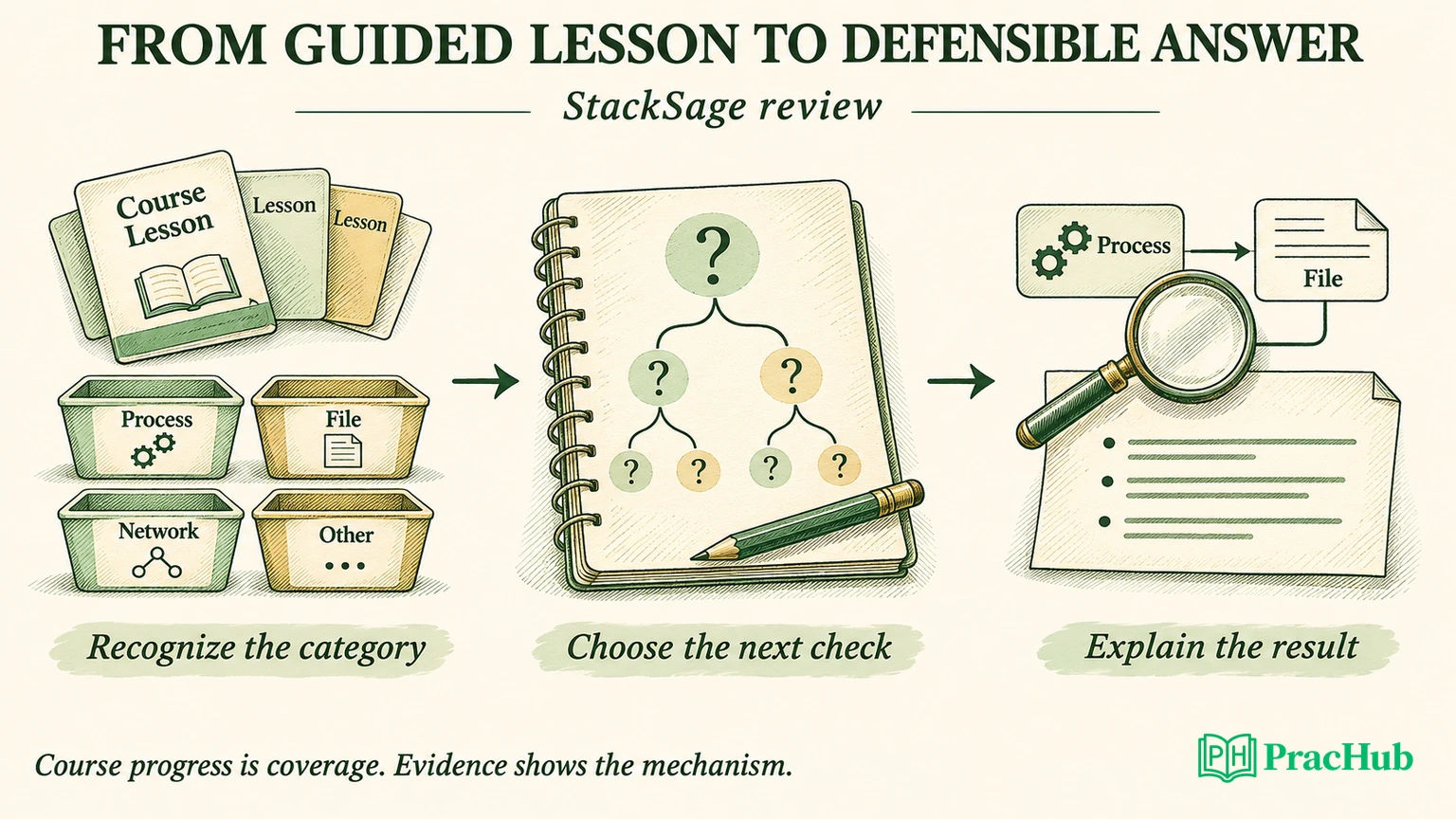
The practice step was an interview-stage sorting exercise. We placed one logistics item into the recruiter-screen bucket, received confirmation and saw the next card. We did not complete the sorter, lesson or course. After exiting, the course still displayed zero completed lessons and zero total XP.
Those observations establish that the sampled interaction worked. They do not establish that the learner can diagnose a system, write an automation script or explain a design without prompts. A correct multiple-choice response is a narrower result than a working operational demonstration.
Browser-lab language needs an exercise-level check
The public pages mention CLI simulators, architecture sandboxes and incident practice. The first interview-course exercise we inspected was sorting, not a terminal. We did not run a cloud lab or validate a shell implementation elsewhere on the platform.
Check what the selected exercise actually accepts and evaluates. A sorting card tests category recognition. A guided command task may test following an instruction. An open diagnostic task asks you to choose the observation yourself. Each can be useful, but the evidence they produce differs.
This course teaches interview preparation alongside technical topics, so identify which kind of skill each activity tests. Recognizing a hiring stage may help organize study. It does not prove the technical performance expected within that stage.
If you need hands-on practice, inspect a relevant lesson’s input and result before relying on the platform-wide lab description. Establish whether commands execute, produce fixed responses or represent a visual model. Our sampled lesson does not settle those questions for other courses.
Original map: turn the syllabus into evidence
Attach an observable task to each preparation goal. The map below is an original learning aid based on the course’s topic groups. It does not claim that we completed the later lessons or that StackSage uses this rubric.
| Preparation goal | Independent evidence to produce | Result that would be too weak |
|---|---|---|
| Explain a concept | Predict behavior when one condition changes | Repeat a definition with no consequence |
| Troubleshoot a failure | Choose a check that separates competing causes | Name a familiar command without its purpose |
| Defend a design | State a constraint, trade-off and failure test | Reproduce a diagram without assumptions |
| Explain experience | Identify your action and a verifiable result | Present the team’s work as entirely yours |
| Plan preparation | Match a demonstrated gap to a relevant task | Treat a completion badge as the gap analysis |
For the sampled stage sorter, the next independent task is not another category click. Explain what evidence a troubleshooting interviewer would expect from you, then attempt a failure case without seeing the candidate causes. That directly tests the gap between recognizing a stage and performing within it.
For a design topic, remove the finished diagram and change a requirement. For a project story, ask what failed and which observation made you revise the implementation. Check whether your explanation changes with the evidence when a requirement changes.
Original no-hint case: a process fails after a launch change
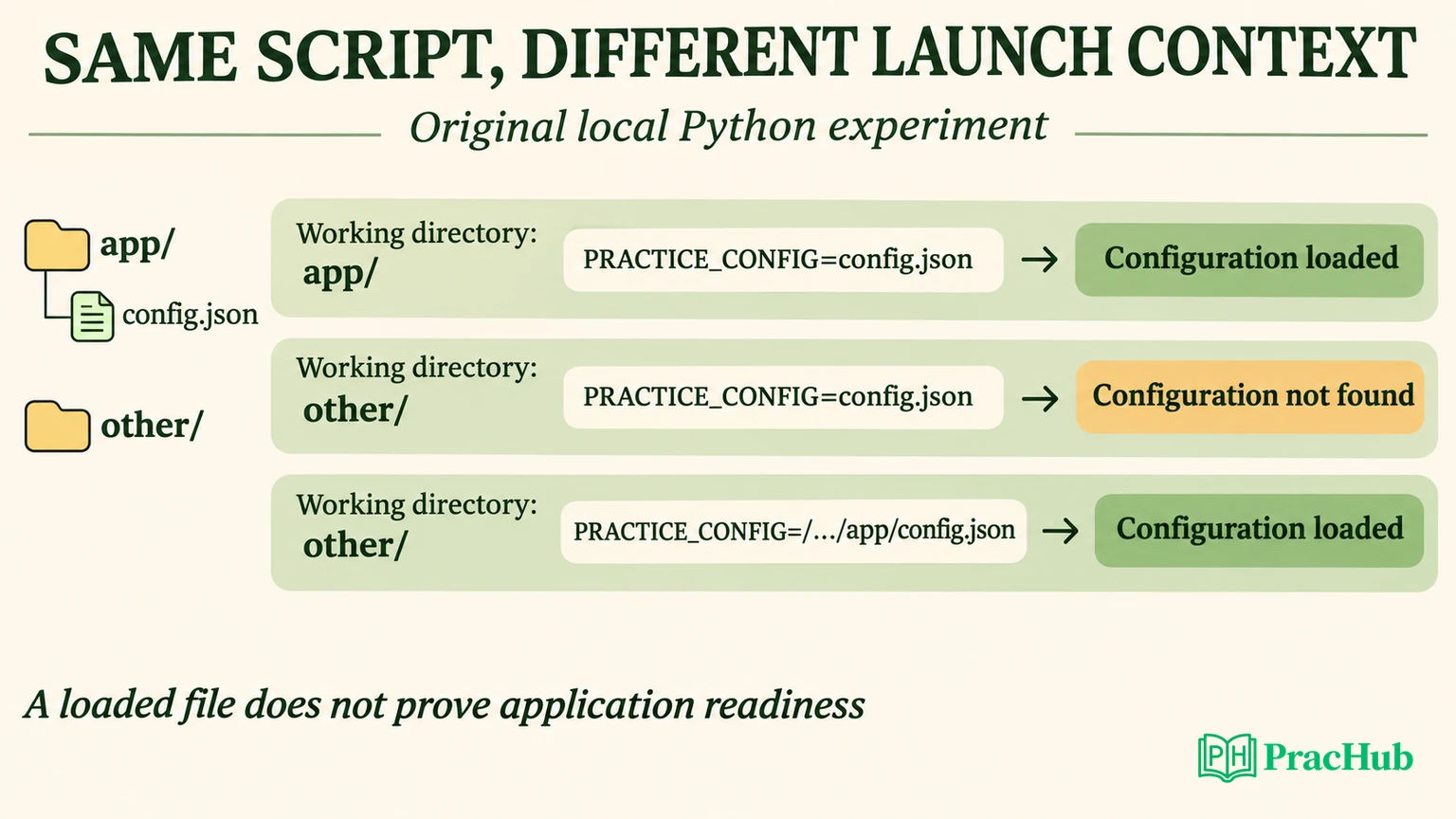
Consider an invented Python worker that reads a JSON file named by PRACTICE_CONFIG. In one launch context, the value is config.json and the working directory contains that file. Another launcher starts the same script from a different directory, retaining the same relative value.
Before revealing the fixture’s result, ask what you would inspect. The script did not necessarily change. A launch context can change the meaning of a relative path. You need evidence about the selected configuration value and working directory before blaming dependencies or rewriting the file parser.
The official Python subprocess documentation explains that cwd selects the child’s working directory and an explicit env mapping supplies its environment. We used those controls to create a small reproducible contrast rather than relying on a hypothetical terminal transcript.
The original fixture ran three local child processes with the same script. It created temporary directories and a synthetic configuration. The environment contained only the fixture’s named setting; it did not print or copy the user’s environment.
| Original launch case | Observed result | Narrow conclusion |
|---|---|---|
| Relative path, directory containing config.json | Exit 0; configuration loaded | The selected relative lookup found this file |
| Same relative path, different working directory | Exit 2; configuration not found | That lookup failed in this launch context |
| Absolute path, same different directory | Exit 0; configuration loaded | The explicit path located the fixture file |
All expected results passed on Darwin with Python 3.12.14. No cloud account, system service, container, network listener or StackSage terminal was used. The worker only loads configuration and prints a marker; it is not a running application with a readiness guarantee.
We created this practice case independently of StackSage’s lessons. It supplies a concrete answer to a diagnostic question you can ask after a guided course: which observation would distinguish a missing file from a changed interpretation of its path?
Explain the result without overstating the fix
A defensible answer says that the controlled working-directory change altered the relative lookup. It cites the configuration setting, launch directory and process result. It does not say that all process-start failures are working-directory errors.
The absolute path succeeds in this fixture, but it is not automatically the best deployment design. A real application might use a documented base directory, an explicit configuration argument or a launcher contract. Choose the approach according to the actual requirements and explain how it behaves across environments.
Likewise, exit zero means this worker loaded the chosen file and reached its marker. It does not prove a downstream connection, a valid deployment or a successful user request. If a real service needs further initialization, its readiness check must cover that requirement separately.
Now change the case again. Suppose the file exists at the selected path but cannot be read, or contains invalid JSON. The original missing-file branch no longer explains everything. State the new evidence you need instead of treating the previous successful remedy as a universal fix.
That is the kind of follow-up an independent drill can add to guided lessons. It asks you to carry a mechanism into a changed condition. A recognition quiz can introduce the concept, while this explanation exposes whether the model behind your answer is usable.
Distinguish hints, feedback and independent performance
The two checkpoints we sampled supplied answer choices, and the sorter supplied named buckets. Those cues constrain the problem. Positive feedback confirms the expected choice within that activity; it does not measure every skill associated with the topic.
For your next independent attempt, remove the choices and describe your own first check. Afterward, compare the explanation with the course. Record whether you needed a hint, missed a condition or chose an action before gathering enough evidence.
Keep those observations separate from progress indicators. Finishing a lesson can be a useful record of coverage. It cannot tell you whether you can repeat the reasoning later without the surrounding hints. We did not test delayed recall, scoring calibration or a readiness threshold.
The course’s general preparation advice can still organize a learner’s work. Its value for you depends on the specific omission it helps repair. Choose a task from the original map, produce the evidence and use the result to decide what to revisit.
Access and depth limits from this review
The static page advertised free interactive learning, while the app marked later lessons as requiring login and described early-access terms. We verified the unsigned first-lesson path, not an unrestricted anonymous route through the entire syllabus.
We did not create an account, test synchronization, measure retention or complete a proficiency checklist. No paid or cloud action was performed. If a later lesson or lab is essential to your preparation, confirm its current access requirements before depending on it for a scheduled session.
The current sample supports a verdict about guided structure and recognition practice. It leaves the depth of later troubleshooting content, independent terminal behavior and full-course outcomes open. Check those remaining capabilities directly before relying on the shared lab description.
Practice the gaps the product leaves open
These independent PracHub prompts turn course topics into explanations you must defend. They are separate from StackSage lessons, quizzes, experience points and proficiency checklists.
| PracHub question | What to examine |
|---|---|
| How You Build Service Stability and Troubleshoot Production Incidents | Explain the evidence connecting a stability symptom with the next diagnostic action. |
| Explain owning and debugging infra modules | Defend the implementation and failure behavior of infrastructure you claim to own. |
| Discuss complex project decisions and observability | Connect a project decision with the observation that would show it was wrong. |
| Own Production Incidents and Validate Large Pipeline Migrations | Describe validation and operational continuity during a risky change. |
| Handle On-Call Incidents | Show how you communicate uncertainty and act within an incident process. |
Who should try StackSage next
StackSage is relevant if you want a guided starting structure for DevOps or SRE preparation. Inspect the first lesson, distinguish its recognition exercises from the technical work you need to demonstrate and verify access to any later lesson you plan to use.
Then answer the stability and incident prompt without a course page open. Name the observation that would change your hypothesis, explain what the result establishes and state what remains untested. Use that gap to select the next lesson or independent experiment.
Comments (0)