Staff Software Engineer Interview Guide 2026: Coding, System Design, Technical Retrospective, and Leadership
Quick Overview
A practical Staff Software Engineer Interview Guide 2026 covering coding, system design, technical retrospectives, leadership, and scope calibration.
A Staff interview gets harder when the interviewer asks why another capable engineer disagreed with you. A clean architecture drawing is only the starting point. You need to explain the constraint, the competing option, the evidence available at the time and how the decision remained safe after your involvement ended.
This Staff Software Engineer guide connects coding, system design, technical retrospectives and leadership through one worked migration. It preserves a practical preparation plan while making the difficult decisions visible. The case is fictional; its teams, dates and measurements are supplied teaching data, not an interview report or a story you should claim as your own.
Try Explain a Difficult Technical Decision before reading the case. That Oracle Backend Engineer practice record asks for competing options, constraints, evidence and a condition that would change your choice. It is useful adjacent practice, not a promised Staff interview question.

What does a Staff Software Engineer interview assess?
Prepare evidence of correct implementation, technical judgment and the ability to make other engineers effective. A useful answer explains what you owned, how dependencies changed the decision and which parts others could operate independently. A title or a large project budget cannot supply those details.
There is no single Staff interview sequence. Ask recruiting about coding format, design or project presentations, level calibration, interviewers and permitted tools. Will Larson's candidate guidance recommends clarifying formats and required preparation. Treat that as practitioner advice, not an employer's published interview policy.
Public leveling frameworks also differ. Dropbox's IC5 framework emphasizes multi-year, multi-team strategy and choices that benefit the wider organization. GitLab describes technical leadership within team domains, communication with other teams and decomposing complex requirements; its page directs readers to current job-level competencies. Neither is a universal mapping of Staff titles.
| Interview area | Evidence to prepare | Common gap |
|---|---|---|
| Coding | Contract, invariant, runnable slice and boundary tests | Correct-looking code with an unexplained failure path |
| System design | Requirements, data ownership, failure behavior and migration | Components with no accountable operator |
| Retrospective | Contemporaneous evidence, alternatives and changed assumptions | A success story reconstructed entirely in hindsight |
| Leadership | A legitimate disagreement and a mechanism for deciding | Claiming that everyone agreed after one persuasive meeting |
| Scope | Personal contribution and what partners could own | Borrowing credit for the whole program |
Worked retrospective: an event contract breaks a consumer
The fictional company has three teams: Fulfilment produces shipment events, Notifications consumes them for customer messages, and Analytics consumes them for reporting. A new rush priority value reaches Notifications, which only accepts standard and express. Its parser rejects those records. Retrying unchanged events increases backlog without making the payload compatible.
The customer goal is delivery of valid notification work without silently changing shipment meaning. The next launch is eight weeks away. Product teams cannot all pause feature work for a shared rewrite, and the platform has one engineer available for migration support. These are case assumptions, not typical industry deadlines.
The exercise asks you to own the event-contract decision and migration coordination. You do not manage either product team. Fulfilment still owns shipment meaning, Notifications owns delivery behavior and Analytics owns its reporting model. Naming that boundary prevents a central platform proposal from quietly absorbing every team's domain decisions.
Timeline: observations before explanations
| Point | Supplied evidence or action | What it establishes |
|---|---|---|
| Day 1, 10:00 | New priority enabled for a limited producer cohort | A specific change to investigate |
| 10:08 | Parser failures show the previously unseen value | Compatibility failure, not proof of insufficient capacity |
| 10:12 | Expansion paused; incompatible records retained in quarantine | New exposure stops while records remain inspectable |
| 10:25 | Producer disables the new value for that cohort | Reversible mitigation; backlog still needs reconciliation |
| Day 2 | Three owners compare contracts and rejected payloads | Shared understanding of who defines the field |
| Week 1 | Decision record and replay procedure reviewed | Agreement on a testable migration boundary |
Do not say that disabling the producer repaired already rejected records. The retained records need an approved transformation or a compatible reader, then controlled replay. Record identities and disposition counts must reconcile. Customer messages need their own duplicate protection; a transport retry alone does not provide exactly-once effects.
The contributing conditions are an undocumented consumer restriction, a producer rollout without compatibility evidence and an alert that measured aggregate pipeline health. This is a systems explanation, not a story about a careless team. Google's SRE postmortem guidance emphasizes contributing conditions, impact and useful follow-up actions rather than individual blame.
Decision record: choose the smallest safe shared contract
Write a short record before debating implementation. In this case it states the problem, decision owner, consulted teams, constraints, feasible alternatives, chosen option, verification and the trigger for reopening the choice. The owner is responsible for making a timely decision; consultation does not require every person to prefer it.
| Option | Why a capable engineer might prefer it | Why this case does not select it now |
|---|---|---|
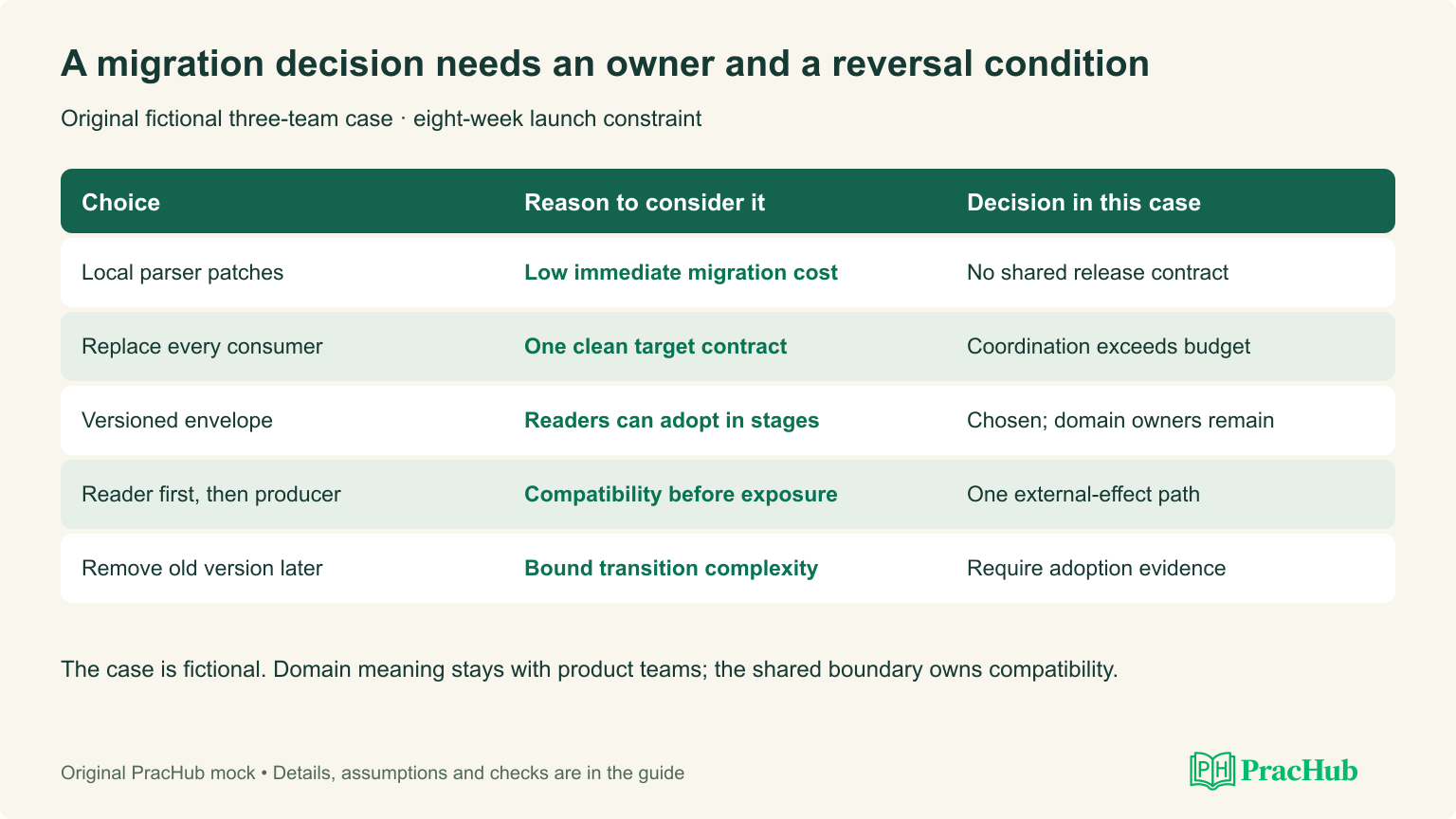
| Keep each team-specific parser | Local autonomy and little immediate platform work | No shared compatibility boundary before the next producer change |
| Replace all consumers in one release | One consistent contract and fewer transition states | Coordinated release and staffing exceed the eight-week constraint |
| Versioned envelope with reader compatibility checks | Incremental adoption and explicit ownership | Chosen, with a temporary migration cost and a removal plan |
The chosen envelope carries an event identity, producer identity, schema version and payload. Version 1 remains supported while readers adopt version 2. A compatibility fixture exercises both known values and an unknown value. Unsupported values are retained and alerted for a domain decision; the system does not map rush to standard merely to reduce error counts.
The invariant is that a retained event has one traceable disposition: processed, quarantined pending a decision, or explicitly rejected under the contract. A delivery receipt prevents a replay from sending a second message for the same logical operation. This is an architectural requirement, not an implemented broker or database guarantee in this article.
Reader support ships before producer expansion. Shadow processing can compare interpretations, but cannot trigger customer messages. Only one path performs the external effect. Keep the old compatible path until replay and rollback have been tested; deleting it early makes a feature toggle an inadequate rollback plan.
Cross-team disagreement: change the proposal using the concern
Notifications prefers a narrow parser patch. Its engineers worry that a platform migration will delay customer-facing work and create a new on-call dependency. Fulfilment prefers a clean replacement because supporting two versions makes future producers harder to reason about. Both concerns are legitimate.
The exercise's decision owner first asks each team to state the failure it fears. Notifications identifies an unbounded support commitment; Fulfilment identifies indefinite version-1 support. That leads to a revised agreement: publish the envelope contract centrally, keep interpretation in each domain, provide an opt-in adapter and set a review date for version removal after adoption evidence exists.
The migration register names a reader owner, a deadline and the evidence required for each consumer. The platform engineer owns the compatibility test harness and replay tooling, not every customer's semantic rule. Notifications owns delivery deduplication and its runbook. Fulfilment owns producer rollout. Analytics owns validation against reporting expectations.
This is more credible than “I convinced everyone.” Explain what changed in your original design, what remained unresolved and who accepted the temporary cost. A partner's objection is useful when it changes a contract, schedule or verification step. Repeating it as an obstacle you overcame loses that evidence.
Canary gate: inspect the cohort before the aggregate
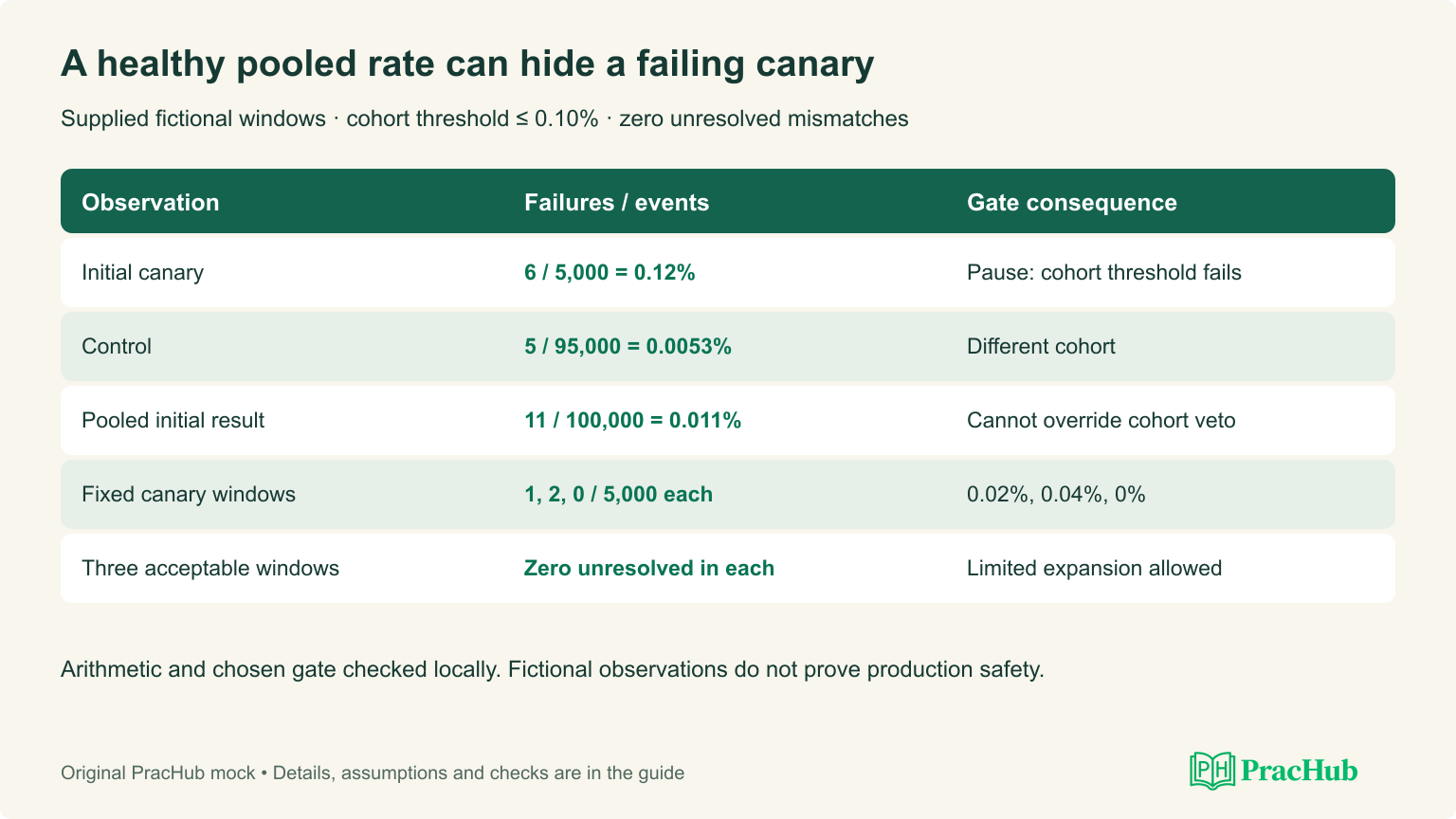
Here are synthetic, equal-duration observation windows. The guardrail is at most 0.10% parser failures within the canary cohort, zero unresolved disposition mismatches and three consecutive acceptable windows before expansion. The threshold and minimum are chosen for this exercise; a real team must set them from user risk, volume and monitoring behavior.
The first canary has 6 failures among 5,000 events: 0.12%, so it fails the cohort guardrail. Its control has 5 failures among 95,000 events. Pooling them gives 11/100,000 = 0.011%, which looks acceptable while hiding the canary regression. A low aggregate is not permission to expand.
After correcting reader compatibility and reconciling retained records, the next three canary windows have 1, 2 and 0 failures, each among 5,000 events. Their rates are 0.02%, 0.04% and 0%. With zero unresolved mismatches in each, the supplied gate allows the next limited expansion. It does not prove universal safety or eliminate the need for a rollback owner.
from fractions import Fraction

def can_expand(windows):
    if len(windows) < 3:
        return False
    for events, failures, unresolved in windows[-3:]:
        if (type(events) is not int or events <= 0 or
            type(failures) is not int or not 0 <= failures <= events or
            type(unresolved) is not int or unresolved < 0):
            raise ValueError("invalid observation")
        if Fraction(failures, events) > Fraction(1, 1000) or unresolved:
            return False
    return True

assert not can_expand([(5000, 6, 0)] * 3)
assert can_expand([(5000, 1, 0), (5000, 2, 0), (5000, 0, 0)])
assert not can_expand([(5000, 1, 0), (5000, 2, 0), (5000, 0, 1)])
The small checker inspects only the last three windows once enough exist; it is not a production monitoring validator. Exact fractions avoid rounding a threshold-crossing rate down. Local checks verify the published rates, equality at the gate, inadequate windows, reconciliation veto and rejected malformed observations. No production rollout was run.
Outcome: show the result and the limit of the evidence
In the supplied case, a baseline week has 120 parser failures among 100,000 events. A later week has 15 among the same count: 0.12% becomes 0.015%, an 87.5% relative reduction. That calculation describes fictional before/after data; it is not evidence that the migration alone caused the improvement. Traffic mix and concurrent changes would need investigation in a real project.
The adoption record shows all three readers supporting the versioned envelope, with domain behavior still owned locally. The durable artifacts are compatibility fixtures in release checks, a disposition reconciliation report, named replay ownership and a reviewed version-removal trigger. “We wrote documentation” is weaker than explaining which subsequent change that documentation and test prevented.
For your own story, distinguish your role from team outcomes: the decision record you wrote, the experiment you proposed, the disagreement that changed your plan and the migration boundary you negotiated. Only use measurements you actually collected. Redact private customer information and describe unavailable evidence honestly.
Follow-up: one team loses its migration capacity
Now the interviewer removes Notifications' migration engineer and moves the launch to four weeks away. The original six-week estimate for full adoption is no longer feasible. More urgency does not create staffing capacity.
Reopen the decision. Defer the new priority for notification traffic, preserve the current contract and use the smaller parser/compatibility patch where it can be tested safely. Continue shadow validation for the future version, but stop claiming three-team adoption by launch. Agree with Product on the reduced feature scope and its customer consequence.
If the launch requires the new meaning for every shipment, the fallback is insufficient. Escalate the explicit trade-off between delivery scope, date and resourcing to the decision owner for that business commitment. Do not bury an impossible requirement inside “we will work harder.” A Staff answer can include an uncomfortable limit while still offering a feasible technical path.
Connect the retrospective to coding, design and level
For coding practice, implement a small disposition registry before adding distributed components. Define stable event identity, duplicate behavior and allowed transitions. Test that a rejected transition changes nothing and that replay does not invent a second identity. A concurrency follow-up requires atomic validation and mutation; a plain dictionary is not a multi-worker transaction.
For design practice, draw one event from producer to reader and then one recovery path. Name the source of truth, authorization boundary, retained data, replay limit and external effect. Explain the point where a version can be retired. A diagram becomes useful when another engineer can use it to make a local decision safely.
Use Senior, Staff and Principal as questions about scope, not guaranteed title translations. Which service did you personally own? Which cross-team boundary did you change? Which portfolio priority was beyond your authority? A Staff-domain story can be strong without an organization-wide rewrite; overstating reach makes ownership harder to evaluate.
Five sessions that produce reviewable preparation
| Session | Work | Artifact to review |
|---|---|---|
| 1 | Implement a stateful coding slice and a changed requirement | Invariant, runnable example and a rejected operation |
| 2 | Design the current-to-target migration | Owners, one failure path and removal criteria |
| 3 | Reconstruct a real project from contemporaneous evidence | Timeline, alternatives and one mistaken assumption |
| 4 | Rehearse disagreement and a staffing change | Revised proposal and the scope you would defer |
| 5 | Run a mixed mock matched to the invitation | Weakest answer, missing evidence and a concrete next repetition |
Give a short project opening, then allow questions to choose the depth. Practice answering what you got wrong, who disagreed and what would reverse your choice. Your preparation should make the evidence easier to inspect, rather than making the story sound flawless.
Frequently asked questions
Is Staff interviewing just harder coding?
Coding still provides evidence of correctness and maintainability. Staff preparation also needs technical judgment, ownership boundaries, migration and influence. The employer determines the actual mix.
How many interview rounds should I expect?
There is no universal Staff schedule. Ask recruiting about formats, presentation requirements, interviewers, level calibration and tool permissions before planning your preparation.
Can I use the example as my own project story?
No. The migration, timeline, teams and measurements are fictional teaching material. Use the structure with your own work, personal contribution and evidence you are permitted to share.
Does Staff always mean responsibility for several teams?
No. Public company frameworks describe different scopes. Dropbox emphasizes multi-team strategy, while GitLab describes team-domain technical leadership and points to its current job-level competencies. Use the target role rubric.
What should I do when an interviewer changes the constraints?
Identify the assumption that no longer holds, reconsider the feasible options and update ownership, rollout and verification. Explain what you would stop or defer rather than defending the original plan unchanged.
Sources and scope
Reviewed October 8, 2026. Career frameworks are company-specific context; practitioner guidance is not an employer interview schedule. The migration, teams, timeline, guardrails and measurements above are original fictional teaching material. The code checks arithmetic and a chosen gate, not operational safety or hiring outcomes.
- Dropbox IC5 Staff Software Engineer framework — multi-team strategy and broader organizational judgment.
- GitLab Staff career framework — domain leadership and links to current level competencies.
- Google SRE postmortem culture — evidence, contributing conditions and useful follow-up.
- Interviewing for Staff-plus roles — Will Larson's practitioner guidance on clarifying the process.
Comments (0)