Staff System Design Interview Guide: Scope, Ambiguity, Platforms, and Technical Strategy
Quick Overview
A practical Staff-level system design framework for scoping ambiguous prompts, defining platform boundaries, sequencing migrations, and explaining technical strategy.
A Staff system design prompt can sound deceptively familiar: design a deployment platform, redesign a payments stack, or build a service used by every product team. The trap is treating it like a Senior interview with more traffic, more regions, and a larger diagram.
At Staff level, the hardest question is often not how the service works. It is what the organization should standardize, what teams should continue to own, and how the company can move from today's system to the proposed one without stopping delivery.
This guide shows how to scope ambiguity, define platform boundaries, sequence a migration, and explain technical strategy. Before your interview, use PracHub's senior+ system design questions to practice driving discussions instead of waiting for the interviewer to lead you.
Quick answer: Staff design is strategy under technical constraints
A strong Staff answer still needs sound APIs, data models, reliability, capacity, and failure handling. The difference is that those choices sit inside a larger argument: why this problem matters, where the ownership boundary belongs, how multiple teams adopt the design, and which sequence reduces risk fastest.
Titles vary across companies, so there is no universal Staff rubric. Public Staff frameworks still emphasize judgment, ambiguity, collaboration, architecture, and turning complex requirements into executable work.
| Dimension | Typical Senior emphasis | Staff-level emphasis |
|---|---|---|
| Scope | A service or product area | A domain, platform, or multi-team constraint |
| Architecture | A correct scalable design | Durable boundaries, ownership, and evolution |
| Trade-offs | Latency, consistency, cost | Those trade-offs plus adoption and coordination cost |
| Delivery | Implementation plan | Migration, sequencing, rollback, and organizational capacity |
| Success | System SLOs and feature outcomes | Outcomes, platform adoption, team velocity, and reduced risk |
Start by defining the decision, not drawing the diagram
When the prompt is broad, do not respond with twenty disconnected clarifying questions. Use the first few minutes to turn the prompt into a decision the room can evaluate.
State the outcome first: "I will design an internal deployment platform that lets product teams ship safely without becoming experts in every infrastructure detail." Then identify the primary users, current pain, business or engineering consequence, time horizon, and non-goals.
Next, define the decision boundary. Are you choosing a control plane, redesigning the execution layer, or replacing every runtime? Are you solving for one region this year or a global company over three years? Which constraints are fixed, and which assumptions can change?
A good opening sounds decisive without pretending certainty: "I will optimize first for safe self-service across fifty teams. I will keep application code and service-specific SLOs with product teams, centralize deployment policy and auditability, and treat a runtime rewrite as out of scope unless the current system makes the control plane infeasible."
Scope the system at three levels
Staff candidates often either stay too local or zoom out until the design becomes an organization chart. A useful middle ground is to describe the system at three connected levels.
Product or workflow level: Who uses the system, and what must become faster, safer, or cheaper? Define the critical journey and measurable outcome.
Platform level: Which reusable capabilities should become shared infrastructure? Define contracts, tenancy, policy, observability, and extension points. A platform should remove repeated complexity, not absorb every team-specific decision.
Organization level: Who owns the control plane, data plane, integration, and on-call burden? Which teams must migrate, and what makes adoption rational? Ownership is architectural when it determines interface quality, incident response, or operability.
Close the scoping phase with explicit in-scope and out-of-scope statements. This gives the interviewer a chance to redirect you before you invest in the wrong system.
Handle ambiguity by ranking unknowns
Ambiguity is not a request to guess. It is a request to identify which unknowns can change the design. Rank them by architectural impact.
First clarify outcome and users. Next clarify scale and risk: traffic shape, critical data, availability, compliance, cost ceiling, and acceptable migration downtime. Then clarify existing constraints: legacy systems, team skills, contracts that cannot break, and deadlines.
For lower-impact details, state a reversible assumption and continue. "I will assume deployment history can be eventually consistent; if audit records require immediate global consistency, I would move that path to a strongly consistent store." This keeps momentum while exposing the consequence.
Return to assumptions when the design reaches a point that would invalidate them. Staff-level navigation is not asking more questions; it is asking the few questions that prevent an expensive wrong turn.
Think in platform boundaries, not a central platform that owns everything
A platform design must explain what becomes a paved road and what remains an extension point. Centralizing authentication, policy enforcement, audit logs, deployment state, and default observability may reduce repeated risk. Centralizing every application configuration or availability decision can create a bottleneck.
Cover the control plane and data plane separately. The control plane stores desired state, policy, permissions, and workflow history. The data plane performs the work and should degrade in a defined way if the control plane is unavailable. That separation creates useful follow-ups around blast radius, regional isolation, and recovery.
Make multi-tenancy concrete: identity, quotas, noisy-neighbor protection, secret isolation, auditability, cost attribution, and escape hatches. Define the contract that lets product teams integrate without learning platform internals.
Finally, explain adoption. A technically elegant platform fails if migration is expensive and the old path remains easier. Offer compatibility adapters, automated migration checks, strong defaults, documentation, and measurable improvements such as lower lead time or fewer deployment incidents.
Turn architecture into an executable technical strategy
Architecture describes a target system. Technical strategy explains how a constrained organization moves toward it. StaffEng describes useful engineering strategy as guidance grounded in repeated, specific design decisions rather than abstract declarations.
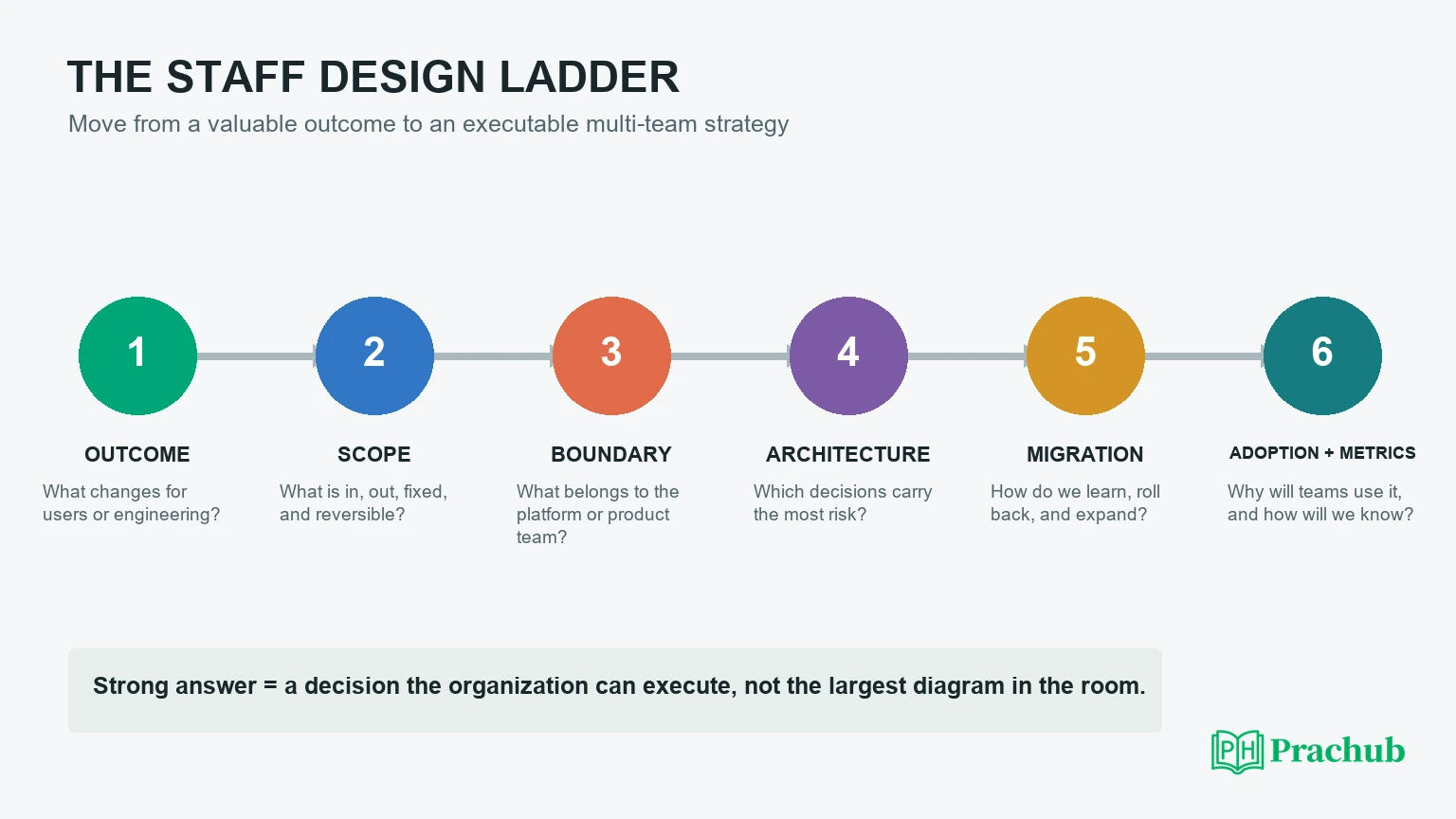
Build your strategy from six parts: current state, diagnosis, guiding principles, target capabilities, transition stages, and success measures. Your diagnosis should explain why local fixes are insufficient. Your principles should narrow future decisions, such as "policy is centralized, execution remains regional" or "all migration steps are reversible until traffic is proven."
Sequence work by risk, not diagram order. Validate the hardest unknown, ship a thin path to one representative team, and define rollback criteria before expanding. State when dual writes, backfills, compatibility layers, or temporary duplication are worth their cost.
Worked example: design an internal deployment platform
Suppose the interviewer says, "Our company has fifty product teams and unreliable deployments. Design a deployment platform." A Senior answer might begin with webhooks, a queue, workers, artifact storage, and rollout strategies. Those components matter, but a Staff answer first diagnoses the constraint.
You might learn that teams use four CI systems, production permissions are inconsistent, and incidents often come from manual promotion steps. The first objective is therefore not "replace all CI." It is "create one auditable release contract and a safe promotion path while allowing existing build systems to produce artifacts."
Your control plane accepts an immutable artifact reference, deployment manifest, environment, owner, and policy context. It validates permissions and policy, records desired state, and creates a rollout plan. Regional controllers execute that plan, report health, and pause or roll back when SLO-based checks fail.
The first phase supports one runtime and two volunteer teams. The second adds adapters for the dominant legacy workflow and measures setup time, deployment frequency, rollback success, and incident rate. Only after evidence shows value do you deprecate manual promotion and require the shared release contract.
This answer is Staff-level because the architecture, ownership, and migration reinforce one another. It does not require a grand rewrite, and it creates checkpoints where evidence can change the plan.
Make Staff-level trade-offs explicit
Centralization versus autonomy: centralize capabilities that benefit from consistent policy or economies of scale; leave product-specific behavior with teams closest to the customer.
Global standard versus regional independence: a global control plane simplifies governance, while regional execution limits blast radius and supports data residency. State the behavior during partitions.
Ideal target versus migration reality: a cleaner end state may not justify a risky rewrite. Compatibility debt can be a deliberate temporary investment when it creates learning and reversible adoption.
Platform power versus usability: every configuration option increases cognitive load and support cost. Prefer safe defaults, observable contracts, and a small number of intentional extension points.
Short-term delivery versus long-term leverage: name what you will not build yet, the signal that would justify it later, and the cost of waiting. This turns "future-proofing" into a testable decision.
Communicate like a Staff engineer under time pressure
Use a visible sequence: outcome, scope, architecture, critical deep dive, failure behavior, migration, and measures. Tell the interviewer when you are switching levels: "The system is now viable; I want to spend the next ten minutes on tenant isolation because it determines both the data model and team ownership."
Go deep selectively. A Staff answer is not shallow breadth. Choose one or two load-bearing decisions and defend them with failure modes, alternatives, and operational consequences. Summarize after each deep dive so the overall strategy remains legible.
Common failures include drawing before defining the problem, inventing scale, proposing a platform with no customers, ignoring the current system, assuming mandated adoption, and presenting a multi-quarter rewrite with no early value.
Also avoid using organizational language as a substitute for technical reasoning. "Align with stakeholders" is not a plan. Name the stakeholders, the conflicting incentives, the evidence you would collect, the decision owner, and the interface or milestone that resolves the conflict.
Practice with Staff-level PracHub questions
These prompts are not predictions of your exact interview. They are useful because each one can be extended beyond component design into platform boundaries, migration, governance, and long-horizon trade-offs.
| PracHub question | Staff-level practice focus | Push the answer further |
|---|---|---|
| Design multi-tenant CI/CD platform | Shared platform boundaries and tenant isolation | Define ownership, adoption incentives, migration stages, and cost attribution. |
| Design a distributed system end-to-end | Ambiguous scope and multi-tenant analytics | Choose the decision boundary, target SLOs, and phased operating model. |
| Design production-ready dedup service | Backfills, schema evolution, and safe change | Plan regional rollout, compatibility, rollback, and ownership of maintenance work. |
| Design a Scalable and Safe Agentic System | Trust boundaries, policy, and platform governance | Separate model autonomy from deterministic controls and define adoption guardrails. |
A seven-day Staff system design preparation plan
| Day | Focus | What to do |
|---|---|---|
| Day 1 | Level calibration | Compare one Senior answer with a Staff version; add ownership, migration, and success measures. |
| Day 2 | Ambiguity | Take three vague prompts and write only the outcome, scope, assumptions, and non-goals. |
| Day 3 | Platform boundaries | Design one control plane and data plane; define tenancy, contracts, and escape hatches. |
| Day 4 | Migration | Turn a greenfield design into stages with compatibility, rollback, and adoption metrics. |
| Day 5 | Selective depth | Practice two ten-minute deep dives on failure isolation and data consistency. |
| Day 6 | Full mock | Run a 50-minute interview and record where the conversation loses its decision thread. |
| Day 7 | Review | Rewrite the opening, final recommendation, and two weakest trade-off explanations. |
Frequently asked questions
How is a Staff system design interview different from a Senior interview?
Staff interviews generally expect a broader decision boundary, more ambiguity, and stronger reasoning about ownership, migration, and cross-team impact. The exact bar varies by company, so ask the recruiter what the round evaluates and whether leveling happens before or after the loop.
Should a Staff answer include organization design?
Include ownership and coordination when they change the architecture or its operability. Do not redesign the org chart. Explain who owns contracts, on-call, policy, migrations, and exceptions.
How much time should I spend clarifying requirements?
Spend enough time to define the outcome, users, critical constraints, and scope. For lesser unknowns, make an explicit assumption and continue. Revisit it only when a design choice depends on it.
How technical should a Staff system design answer be?
Technically deep, but selective. Show that you can reason through APIs, storage, consistency, reliability, and capacity, then choose the areas that carry the most strategic risk for a detailed discussion.
Do I need a multi-year vision in a 45-minute interview?
You need a credible direction and a near-term sequence, not a fictional five-year roadmap. Describe the target capabilities, the first evidence-producing milestone, and the signals that would change later investments.
What if the company uses the same system design prompt for Senior and Staff?
The prompt can remain the same while the expected conversation changes. Use the ordinary design as a base, then demonstrate Staff scope through problem selection, platform boundaries, migration, operational ownership, and long-term trade-offs.
Final takeaway
A Staff system design answer is not the biggest architecture you can draw. It is a coherent decision: a valuable problem, a deliberate scope, durable boundaries, justified technical choices, a safe path from the current state, and evidence that multiple teams can execute the strategy.
Practice until you can move smoothly between system mechanics and organizational consequences. Start with PracHub's system design question bank, then force every answer to include an explicit migration, ownership model, and success measure.
Sources and Further Reading
- StaffEng: Staff-plus Interview Processes
- StaffEng: Interviewing for Staff-plus Roles
- StaffEng: Writing Engineering Strategy
- GitLab Engineering Career Framework: Staff
- GitLab Architecture Design Workflow
- AWS Well-Architected Framework Definitions
- Experienced Developers Discussion: Staff-plus Interview Scope and Ambiguity
Research note: This guide was checked on August 24, 2026. Staff titles, interview formats, and leveling standards vary by company, team, and hiring loop.
Comments (0)