System Design Interview Rubric by Level: Mid-Level vs Senior vs Staff
Quick Overview
A practical system design interview rubric showing how the expected scope, technical depth, reliability thinking, trade-offs, communication, and leadership signals change from Mid-Level to Senior to Staff.
Two candidates can draw nearly the same architecture and receive different interview feedback. One may have produced a strong Mid-Level answer; the other may have missed the Staff bar. The difference is rarely the number of boxes on the whiteboard.
System design interviews are calibrated to expected scope, independence, judgment, and influence. A Mid-Level engineer is usually proving that they can design a bounded system coherently. A Senior engineer must drive a production service through scale and failure. A Staff engineer must also choose the right boundary, account for organizational constraints, and show how the design can be adopted and evolved.
This guide turns those differences into a practical rubric. Use it with PracHub's Senior+ system design questions: answer one prompt at your target level, then replay it at the level above. That exercise exposes missing depth faster than memorizing another reference architecture.
The same architecture prompt can test a bounded component, a complete service, or a broader platform strategy.
Quick answer: the dimensions stay similar, but the bar moves
Most interviewers still care about requirements, architecture, data, reliability, trade-offs, and communication. What changes is how much of the problem you are expected to discover and own without being led.
| Dimension | Mid-Level | Senior | Staff |
|---|---|---|---|
| Default scope | Bounded component or product flow | Complete production service | Platform, domain, or multi-team capability |
| Ambiguity | Clarifies missing functional details | Converts vague requirements into workloads and SLOs | Challenges the boundary and identifies the highest-leverage problem |
| Technical depth | Coherent APIs, data, and core flow | Bottlenecks, consistency, capacity, and failure containment | Selective deep dives plus interfaces across systems and teams |
| Reliability | Handles obvious failures and retries | Defines degradation, recovery, observability, and operational ownership | Creates reusable reliability mechanisms and risk-reduction strategy |
| Trade-offs | Explains local choices | Defends choices against workload and business constraints | Balances technical, product, organizational, and multi-year costs |
| Delivery | Describes implementation steps | Proposes a safe phased rollout | Plans migration, adoption, ownership, and evolution |
| Communication | Keeps the design understandable | Drives the interview and prioritizes depth | Creates alignment, names unresolved decisions, and enables others |
This is a practice rubric, not a universal company scorecard. A company may call the same scope L4, L5, Senior, or Staff, and some organizations finalize level only after the interview loop. Ask the recruiter what level is being evaluated and what the design round is meant to test.
Five signals interviewers can evaluate at every level
A useful rubric begins with stable dimensions. First is problem framing: did you clarify users, use cases, constraints, and non-goals? Second is architecture coherence: do the APIs, data model, components, and request paths fit together?
Third is depth and trade-offs. You should know where the design becomes difficult and explain why one option fits better than another. Fourth is production readiness: capacity, security, reliability, observability, and cost should appear in proportion to the target level.
Fifth is ownership through communication. Strong candidates do not narrate every possible technology. They establish a decision sequence, invite correction at useful checkpoints, and spend time on the risks that matter most.
The Mid-Level system design bar
A strong Mid-Level answer proves that you can turn a bounded requirement into a design another engineer could implement. You should clarify the primary user flow, define a small API surface, choose a sensible data model, and trace one request from client to storage and back.
You are also expected to notice obvious edge cases. If a worker crashes, does the job disappear? If a request is retried, can it create a duplicate? If two users update the same object, which result wins? You do not need a perfect multi-region strategy, but you should not design as if failure never happens.
The common mistake is premature scale theater. Adding Kafka, Kubernetes, three databases, and global replication before establishing the core contract makes the answer less convincing. At this level, a simple architecture with explicit assumptions usually scores better than an elaborate diagram you cannot defend.
The Senior system design bar
A Senior candidate is usually expected to own a full production service. That means converting a broad prompt into traffic estimates, data volume, latency targets, availability expectations, and consistency requirements. The architecture must continue to make sense when demand rises or a dependency fails.
Depth should be selective but concrete. For a notification system, you might examine partitioning, retry state, idempotency, slow-consumer isolation, and ordering. For a logging platform, you might go deeper on write amplification, indexing, retention, hot tenants, and degraded query behavior.
Senior judgment also appears in operations. Name the metrics that detect customer harm, the failure that triggers an alert, the recovery path, and the rollout guardrail. A good Senior answer connects technology to a service objective instead of saying only that a component is "scalable" or "highly available."
The Staff system design bar
Staff is not simply Senior with more components. Public engineering ladders commonly describe a move toward domain leadership, longer-term impact, and technical leverage. In an interview, that often means deciding whether the prompt should be solved as one service, a shared platform, or a set of team-owned capabilities.
A Staff candidate should expose organizational interfaces alongside technical ones. Who owns the event schema? How do product teams migrate without a synchronized rewrite? Which decisions must be standardized, and where should teams retain autonomy? How will the platform earn adoption rather than merely exist?
The answer still needs technical depth. The difference is that depth serves a strategy. You might compare a centralized control plane with federated execution, explain the blast radius of each option, then propose a staged path that reduces risk while preserving future choices. For a full answering framework, use the Staff system design interview guide.
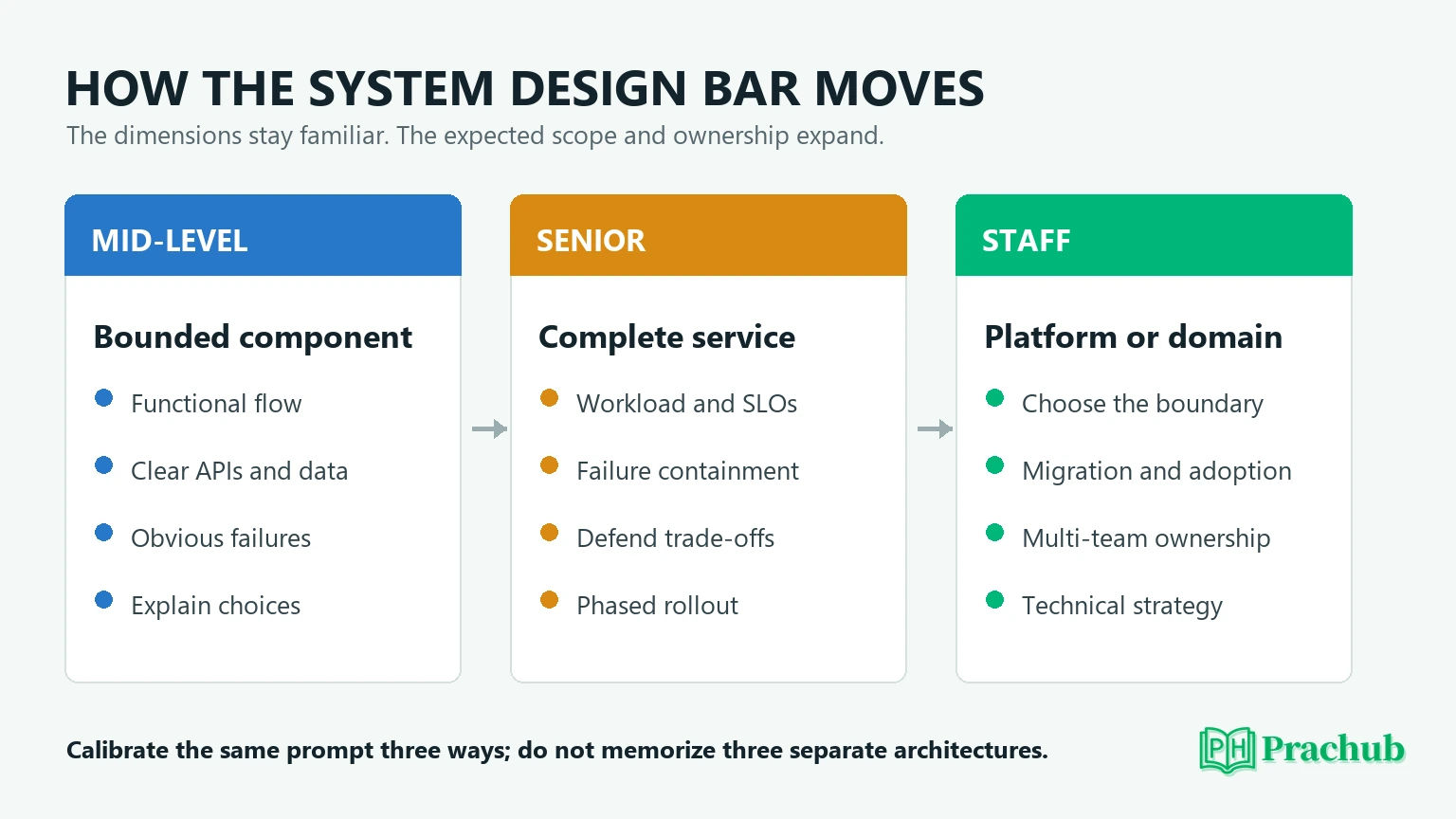
Leveling changes the expected problem boundary, operational ownership, and leadership signal - not just architectural complexity.
Worked example: design a notification platform at three levels
Mid-Level: make delivery correct
Start with producers, subscriptions, a durable queue, workers, and delivery status. Define the publish and subscribe contracts, then explain retry limits and idempotency. A strong answer keeps one slow destination from blocking unrelated deliveries and gives operators enough state to replay a failed item.
Senior: make the service dependable at scale
Now quantify events per second, burst size, destination count, and delivery-latency SLOs. Partition work according to the actual ordering requirement, protect the system with backpressure and quotas, and define dashboards for queue lag, delivery success, retry rate, and terminal failures.
The Senior answer also addresses data retention, tenant isolation, schema evolution, and regional failure. It proposes a rollout that starts with one delivery channel or traffic cohort, verifies behavior, and expands without making every producer migrate at once.
Staff: decide whether this should become a platform
The Staff version asks why several teams need notification delivery and which shared guarantees are worth centralizing. It separates policy, routing, and audit in the control plane from scalable delivery in the data plane. It defines ownership boundaries with producer and consumer teams.
Then it addresses adoption: compatibility adapters, migration sequencing, service-level tiers, cost attribution, and a path for legacy systems. The strongest answer names where standardization would become harmful and leaves an escape hatch for unusual workloads.
How interviewer follow-ups change by level
At Mid-Level, follow-ups often test whether your design is internally correct: "What happens when the worker crashes?" or "How do you prevent duplicates?" At Senior, the interviewer is more likely to inject load, dependency failure, a strict SLO, or a consistency conflict and expect you to adapt the architecture.
Staff follow-ups test the decision boundary: "Should every team use this platform?" "How do you migrate three legacy systems?" "What if security and product disagree on the contract?" The technical question remains, but the evaluation also observes how you make a durable decision under competing constraints.
Use a target-level self-review after every mock
Review the recording or notes with three labels: missing, present, or strong for the target level. Score problem framing, architecture coherence, deep-dive quality, production readiness, and ownership. Do not turn the labels into a universal passing number; use them to choose the next practice task.
If your Senior design is coherent but has no measurable workload, your next drill is capacity and SLO framing. If your Staff answer has broad strategy but no credible failure deep dive, repeat the prompt and spend ten minutes proving one mechanism. The diagnosis should produce a specific next rep.
Common mistakes that make an answer look misleveled
Mid-Level candidates often overbuild. They skip the user contract and reach for distributed components before proving the basic flow. Senior candidates often under-operate. They draw a plausible architecture but do not explain bottlenecks, degraded behavior, or how anyone will run it.
Staff candidates often stay too abstract. Strategy without a technically credible deep dive sounds like commentary rather than leadership. The opposite mistake is treating Staff as a speed contest: more boxes, more terminology, and more requirements do not demonstrate broader leverage.
At every level, avoid exhaustive breadth. A design round rewards prioritization. State what you are not covering, explain why, and go deep where the highest-risk decision lives.
Practice these PracHub questions at more than one level
Attempt each prompt cold for 35 to 45 minutes. Keep the core product constant, then change only the target level and observe what new decisions become necessary.
| PracHub question | First calibration | Level-up follow-up |
|---|---|---|
| Design an Alert Notification Service for Downstream Consumers | Delivery state, retries, and isolation | Turn repeated team needs into a governed platform |
| Design a high-level logging system | Ingestion, storage, and queries | Define SLOs, multi-tenancy, cost, and adoption |
| Design a distributed job scheduler | Scheduling, leases, and retries | Separate control and data planes across teams |
| Design multi-tenant CI/CD platform | Jobs, runners, artifacts, and isolation | Plan migration, ownership, and platform evolution |
A seven-day level-calibration plan
| Day | Focus | What to do |
|---|---|---|
| Day 1 | Baseline | Record one cold answer at your target level. |
| Day 2 | Problem framing | Rewrite requirements, workload, SLOs, and non-goals in five minutes. |
| Day 3 | Technical depth | Trace one write, one read, and one failure end to end. |
| Day 4 | Operations | Add capacity, observability, degraded behavior, and recovery. |
| Day 5 | Level up | Replay the same prompt one level higher without changing the core product. |
| Day 6 | Challenge | Ask a partner to inject ambiguity, migration, and ownership conflicts. |
| Day 7 | Final mock | Run a timed interview and grade only the five stable dimensions. |
Frequently asked questions
Is system design required for Mid-Level software engineers?
It depends on the company and role. When it appears, the expected scope is often narrower than a Senior round, but candidates still need coherent APIs, data flow, failure awareness, and clear communication.
What separates a Senior system design answer from a Mid-Level answer?
The Senior answer usually owns a complete production service. It quantifies workload and SLOs, identifies bottlenecks, handles failure and operations, and defends trade-offs without waiting for the interviewer to provide every constraint.
What separates Staff from Senior in system design?
Staff answers add boundary selection, multi-team interfaces, migration, adoption, and longer-term technical strategy. They still need depth, but the depth supports broader leverage rather than merely making one service more sophisticated.
Can companies use the same prompt for all three levels?
Yes. The interviewer can add follow-ups that expand scale, ambiguity, organizational scope, and evolution. That is why practicing the same prompt at multiple levels is so effective.
What if I do not know the target level?
Ask the recruiter how leveling works, what the round evaluates, and whether level is fixed before the loop. In the interview, establish a practical service boundary first, then show that you can expand it if the interviewer wants broader scope.
Should I discuss teams and ownership in a system design interview?
At Senior, mention operational ownership when it affects reliability or rollout. At Staff, team boundaries, governance, migration, and adoption are often central to whether the proposed platform can succeed.
Final takeaway
The system design bar does not rise by adding more technology. It rises as you take responsibility for a larger decision: first a correct component, then a dependable service, then a platform or strategy that other teams can safely adopt.
Choose one PracHub prompt, answer it at your target level, and repeat it one level higher. Compare your decisions with the written solution, identify the first missing signal, and make that signal the focus of your next mock.
Sources and Further Reading
- GitLab Engineering Career Framework: Intermediate
- GitLab Engineering Career Framework: Senior
- GitLab Engineering Career Framework: Staff
- GitLab Engineering IC Leadership
- StaffEng: Staff-plus interview processes
- StaffEng: Interviewing for Staff-plus roles
- AWS Well-Architected Framework pillars
Research note: This guide was checked on August 24, 2026. Titles, leveling, interview formats, and internal rubrics vary by company and team.
Comments (0)