SystemDesignHQ Review: Company Tracks, Peer Designs, and Premium Access
Quick Overview
Review SystemDesignHQ’s public Meta curriculum, practice and peer-design access boundaries, and dated plan claims. An original short-link revocation timeline and constraint matrix turn a familiar diagram into correctness questions.
SystemDesignHQ offers a connected route from company-themed reading to design practice and mocks. The public Meta track gave us a concrete curriculum to inspect. However, our unsigned session reached login before executing a practice canvas, and the Peer Designs route led to pricing. Use the catalog to organize practice, then verify interactive access and feedback quality before paying.
PracHub publishes this review and owns the complementary practice links. Our production-ready URL shortener question gives you a separate design to defend. The cache-revocation model below is original educational work, independent of SystemDesignHQ’s implementation or grading.
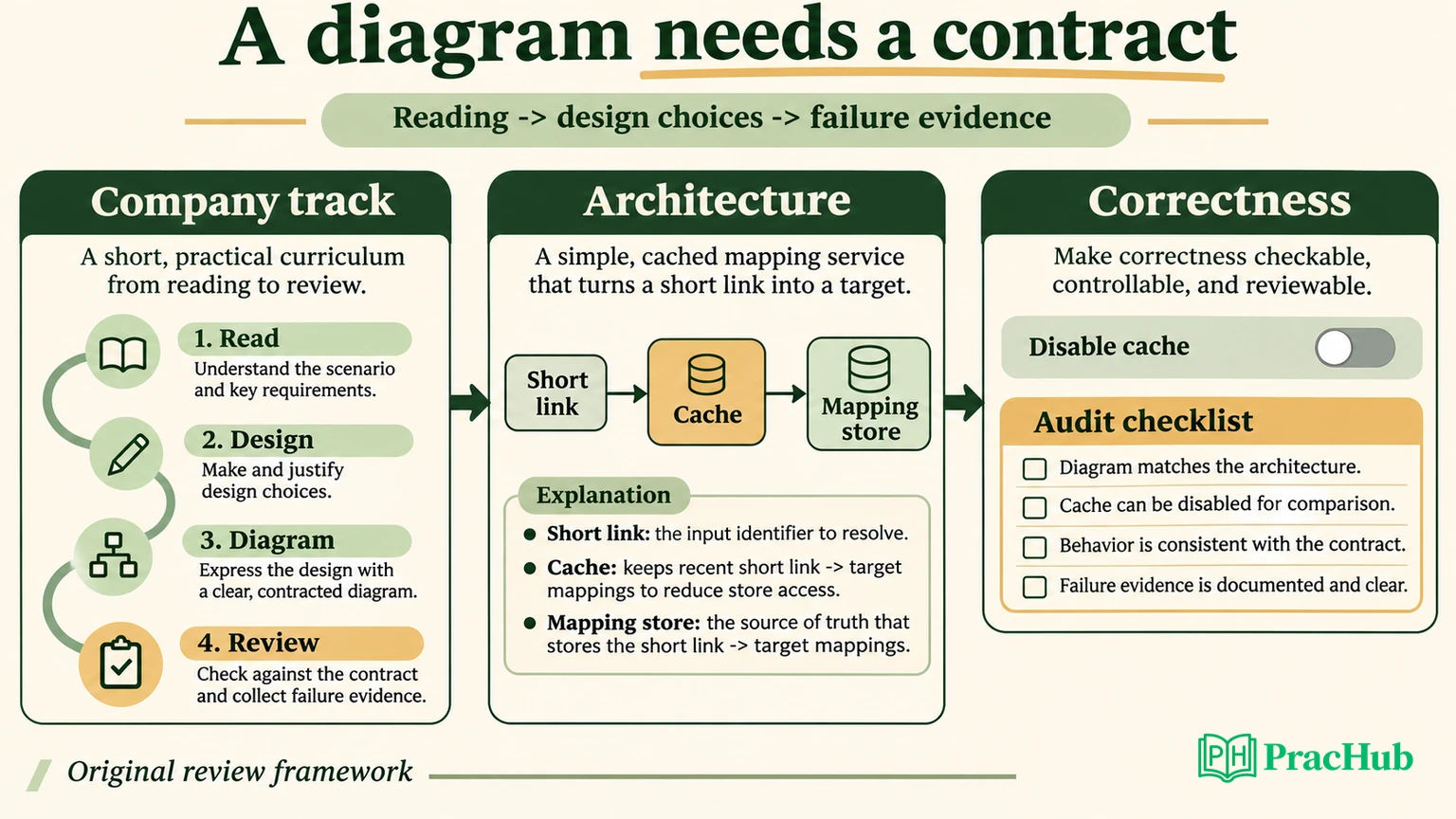
Confirm the product and the accessible surface
Provider description, checked November 3, 2026: the SystemDesignHQ homepage promotes architecture articles, interactive whiteboarding, company preparation and mocks. The observed domain spells “desing” in its address while the page brands itself SystemDesignHQ. We verified that exact destination rather than substituting a similarly named service.
The homepage also presents peer-feedback and hiring-success claims. We did not verify reviewer identities, employment affiliations, customer outcomes or the advertised success measures. Testimonials are promotional material, not independent candidate reports supporting this review.
We inspected public navigation, a company curriculum, a reading preview and the rendered pricing cards. We did not register, purchase, submit a design or receive feedback. A button or feature description does not establish that its underlying workflow was executed.
Company tracks organize topics, not verified employer rounds
Direct observation: the company directory displayed Meta, Google, Stripe and Dropbox tracks. Their descriptions emphasized different system-design themes. Meta was open to inspect; other visible cards used PRO labels and pricing links.
The Meta track showed eight problems and a three-week curriculum. Its topics included a rate limiter, notification system, marketplace, timeline and chat designs. These are provider-curated preparation choices. We found no independent evidence that the arrangement reproduces a current Meta interview loop.
The page’s zero-percent progress described the unsigned view we saw. It was not an assessment of our ability. Likewise, a suggested duration is a study structure, not evidence that a learner will master the material within that period.
Our interpretation: a company label is useful when it changes which trade-offs you rehearse. It becomes less useful if you memorize a preferred architecture and assume that the employer expects it. Ask what workload, failure condition or product requirement makes a selected problem relevant to your target role.
For example, practicing a timeline and a rate limiter should produce different artifacts. The timeline needs an explicit read/write distribution and freshness policy. The limiter needs a counting unit, time boundary and behavior during coordination failure. The company label alone supplies none of those contracts.
The public routes expose distinct access boundaries
The practice library displayed problem cards, difficulty labels and time suggestions. Starting the URL-shortener item opened a choice between reading and practice. Choosing practice led to a login page with that problem in the callback path. We did not reach an executable whiteboard.
The URL-shortener article exposed an introduction and requirements preview before a login-to-continue notice. We limited the review to that accessible preview. Its employer tags are the provider’s attribution; we did not establish question-level provenance.
Selecting Peer Designs in our session ultimately opened pricing. This is an observed route result, not proof that every signed-in user lacks peer access. We did not inspect a submitted design, comment thread, reviewer profile or completed critique.
Choose a trial around the action you need. Reading, drawing, storing, sharing and receiving feedback are different actions. Verify the one you need in the actual account and plan. A public card describing a canvas cannot substitute for testing how that canvas preserves and evaluates your work.
Read the Free card’s icons as well as its text
The pricing page rendered both included and excluded items in the Free card. Its check icons marked three practice problems, five articles, a basic whiteboard, peer-design viewing and one monthly mock as included. Cross icons marked cloud saving, the complete libraries, company tracks and AI feedback as excluded.
We inspected the rendered icon states because a plain text extraction listed both groups together. That distinction prevents a misleading claim that every listed feature belongs to the free tier. It remains a provider offer, not a balance or entitlement we activated.
Paid cards displayed a three-month option at $100 and a one-year option at $250, alongside promotional comparisons. We report the displayed dollar symbol without independently confirming a currency or checkout total. Mock allowances differed by card. We did not purchase, test redemption or verify a refund.
There is also a boundary worth checking: the public Meta curriculum opened although the Free pricing card excluded company tracks. Viewing a roadmap and receiving all of its associated practice or feedback rights may be different. Our unsigned observations cannot resolve signed-in enforcement.
| Desired action | Evidence available in this review | What remains untested |
|---|---|---|
| Inspect a company roadmap | Meta curriculum opened publicly | Full track entitlements |
| Read a sample explanation | URL-shortener preview opened | Complete signed-in article |
| Solve on the whiteboard | Practice choice reached login | Canvas behavior and grading |
| Compare peer designs | Peer navigation reached pricing | Designs, comments and reviewer quality |
| Use paid mocks | Allowances advertised on cards | Booking, execution and feedback |
Original design test: what does disabling a link mean?
A diagram containing a cache and database can look complete while leaving the most important behavior undefined. Our original exercise changes a shortener’s requirement: after an administrator disables a link and receives acknowledgment, should the next redirect still work?
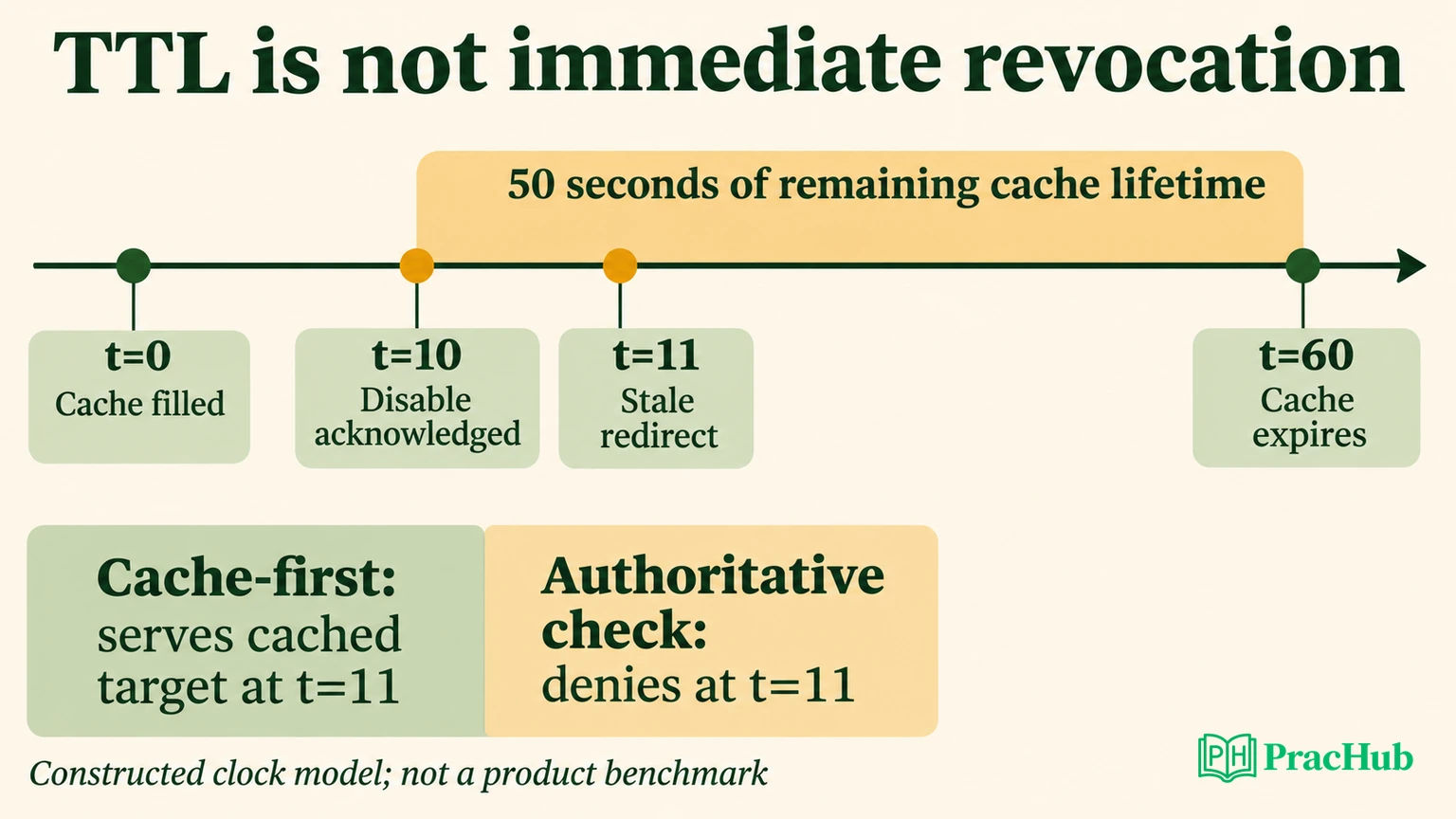
Assume a single cache entry was filled at time zero with target A and a sixty-second lifetime. At time ten, the authoritative record becomes inactive and the disabling operation acknowledges success. At time eleven, another redirect request arrives. These are constructed inputs, not observations of SystemDesignHQ or a deployed shortener.
In the first policy, the redirect path returns a fresh cached target without checking the record. The request at eleven returns A. The entry expires at sixty, after which the database check denies access. Fifty seconds of cache lifetime remained at acknowledgment.
In the second policy, the redirect path checks authoritative active status before using the cached target. It denies the request at eleven. This removes the stale-authorization behavior in our small model, while adding a dependency the cache-first path avoided.
We executed a local clock-controlled Python model of these two policies. Checks confirmed the result before disabling, the stale cache-first result afterward and denial after expiry. It models neither a real HTTP cache nor Redis, network failures, browser behavior or concurrent invalidation.
A sixty-second mapping lifetime alone does not satisfy an immediate-disable contract. It can support a different contract that explicitly tolerates stale redirects. Choosing between those contracts is a requirements decision, not a matter of drawing an additional cache box.
Turn the example into a constraint-to-evidence matrix
Use this matrix when reading an example or comparing a peer’s design. It is our independent review tool, not SystemDesignHQ’s rubric. Each row asks for something that a component label alone cannot establish.
| Requirement to defend | Design detail to specify | Evidence to produce |
|---|---|---|
| Codes identify the intended link | Uniqueness scope and collision handling | Two colliding creation attempts |
| Disabled links stop redirecting | Status authority and acknowledgment boundary | Request immediately after disable |
| Cache updates preserve current state | Version rule and invalidation failure policy | Delayed old update after a new disable |
| Redirects remain available during faults | Allowed stale behavior or explicit denial | State-store timeout trace |
| Expired mappings stay expired | Time source and exact expiry comparison | Requests just before and at expiry |
Choose mechanisms against the stated contract. If the interviewer allows up to a minute of stale redirects, a bounded cache policy may be acceptable. State that assumption, then explain why the particular lifetime and refill behavior support it.
If disabling must take effect before acknowledgment, consider an authoritative check or a carefully defined invalidation protocol. Explain what happens when one cache node is unreachable. Acknowledging first and hoping the invalidation arrives later supplies a different guarantee.
Versioning adds another question. Suppose an old active-state message arrives after a newer disable message. The receiver needs a rule that rejects the obsolete update. A diagram arrow labeled “invalidate” does not define ordering, retry behavior or which state survives a delayed delivery.
These cases are useful for assessing peer feedback. A comment identifying an unhandled acknowledgment boundary gives you a concrete revision. A comment that only recommends a fashionable database provides much less evidence about correctness. We did not test which kind of critique SystemDesignHQ produces.
Keep origin caching separate from cached redirects
Our model concerns the application’s mapping cache. A browser or intermediary holding a redirect response introduces another location where a request might be answered without reaching that application. We did not simulate those clients or make a claim about their exact HTTP behavior.
For an interview, draw each place that can answer the user. Then state which layer your disabling guarantee controls. If an already-delivered redirect lets a client navigate directly to the destination, changing the mapping store cannot retroactively remove that knowledge.
Define which requests the guarantee covers. You can promise a result for new requests that reach an authoritative service, or define a broader system with additional controls. You should not imply that invalidating one server-side entry erases every copy of a previously shared destination.
Decide what a paid trial must demonstrate
Before buying for peer review, request or inspect a real example of the feedback format. Check whether it names a missing requirement, explains the consequence and offers a revision you can test. A reviewer affiliation claim alone does not establish that quality.
Before buying for mocks, confirm what the allowance counts: bookings, completed sessions or another unit. We did not activate a paid plan, so the public card cannot answer cancellation, rescheduling or actual session-quality questions.
For whiteboarding, use a single changed requirement rather than recreating a memorized diagram. Save the original assumption, the altered contract and the resulting design change. This makes the trial about a capability you can inspect, even if the platform supplies no numerical grade.
Practice the gaps the product leaves open
These independent PracHub prompts extend the sample-design critique. They are not exports of SystemDesignHQ tracks, peer evaluations or company-question provenance.
| PracHub question | What to examine |
|---|---|
| Design a Production-Ready URL Shortener | Define disabling, expiry and the redirect contract before choosing a cache. |
| Design a scalable URL shortener with expiration and security | Separate ownership, abuse controls and expiration from code generation. |
| Find the Bugs in an AI-Generated URL Shortener | Find correctness gaps behind plausible generated architecture or code. |
| Handle cache-update conflicts in distributed services | Explain which version wins when the cache and authoritative state disagree. |
| Design a Rate Limiter: Algorithm Trade-offs, Scalability and Availability | Connect tenant limits and failure behavior to explicit API requirements. |
Who should consider SystemDesignHQ
SystemDesignHQ is worth inspecting if you want a company-themed roadmap connected to system-design reading and advertised practice tools. The public Meta curriculum provides a concrete starting point; interactive execution and peer-feedback quality remain separate evaluation tasks.
Start with the production-ready shortener prompt. Define the disable acknowledgment contract and trace a request immediately afterward. Use that trace to judge whether an example or a future peer critique actually improves your design. Base a purchase on access and feedback behavior verified for your intended plan.
Comments (0)