SystemsExpert Review 2026: Is AlgoExpert's System Design Course Worth It?
Quick Overview
An evidence-based SystemsExpert review for 2026 covering AlgoExpert's 25-module system design curriculum, 13 practice questions, videos, current bundle pricing, strengths, limitations, and who should buy it. The guide compares course-first learning with PracHub practice and includes four linked system design questions plus a seven-day decision test.
A system design course can make architecture diagrams feel familiar. The harder test arrives when an interviewer gives you an ambiguous prompt, changes a requirement halfway through, and asks you to defend every trade-off.
That distinction matters when deciding whether SystemsExpert is worth paying for. Before buying another course, try several system design questions on PracHub without notes. If you cannot explain caching, replication, sharding, and queues, you may need structured teaching. If you know those concepts but struggle to scope, estimate, or respond to follow-ups, you need more interview practice.

SystemsExpert organizes system design knowledge; interview readiness depends on using that knowledge under open-ended pressure.
Quick Verdict: Is SystemsExpert Worth It in 2026?
SystemsExpert is a polished, coherent introduction to system design interviews. AlgoExpert's official pages currently list 25 fundamentals modules, 13 design questions, 38 videos across those two sections, a 50-question quiz, written walkthroughs, diagrams, a glossary, and a workspace built around interview-style solutions.
That package can be worth it for a candidate who is new to distributed systems, dislikes assembling a curriculum from scattered resources, and learns well from video. The lesson sequence is clear, the interface is focused, and the sample designs cover recognizable products such as a news feed, file storage, streaming, chat, lodging, and ride-sharing APIs.
It is not a complete substitute for interview practice. Thirteen labeled design problems can teach a reusable structure, but a real interview still requires independent scoping, quantitative reasoning, failure analysis, and fast responses to unfamiliar follow-ups. Senior and staff candidates may also need deeper production judgment than a broad interview course can provide.
Our recommendation is to use SystemsExpert as a teaching layer if a free diagnostic reveals concept gaps. Use PracHub for unfamiliar prompts, company context, and written solutions that test whether the material transfers. The two resources solve different problems.
What Is SystemsExpert?
SystemsExpert is AlgoExpert's system design interview product. It is separate from the original AlgoExpert coding curriculum, although the current purchase page may bundle SystemsExpert with AlgoExpert and the company's other products.
The course has two main learning layers. The first is a fundamentals path that moves from client-server architecture and network protocols through storage, caching, load balancing, databases, replication, sharding, leader election, streaming, rate limiting, publish-subscribe systems, monitoring, security, and API design. The second is a set of 13 open-ended system design questions with mock-interview videos and written walkthroughs.
The fundamentals path is broad and deliberately sequential
The official curriculum begins with basic vocabulary, then adds the components needed to reason about distributed systems. This progression helps candidates who have seen terms such as consistent hashing or leader election but cannot yet connect them to a complete design.
The advantage is coherence. Instead of opening twenty browser tabs and wondering what to study next, you get a defined path. The limitation is that broad coverage does not guarantee production depth. A module can teach what replication is without giving you years of intuition about recovery, operational ownership, or the consequences of a bad consistency choice.
The 13 questions model a recognizable interview structure
The public question list includes designs for products and APIs resembling AlgoExpert, Amazon, Reddit, Facebook News Feed, Google Drive, Netflix, Uber, Tinder, Slack, Airbnb, and Twitch, plus a stockbroker and deployment system. That variety exposes candidates to feeds, storage, messaging, streaming, marketplaces, and transactional workflows.
Each question is presented with video and written material. The official workspace also includes a scratchpad and a mock-interview walkthrough, which makes the product more useful than a collection of passive lectures.
What SystemsExpert Does Well
It reduces curriculum uncertainty
System design has an intimidating surface area. A beginner can spend more time choosing resources than learning. SystemsExpert's ordered modules remove that decision cost and make progress visible.
This is especially useful if your interview is four to eight weeks away and you need a first complete pass. You can learn the vocabulary, see how components interact, and build a repeatable answer structure before attempting harder prompts.
It combines several learning formats
Video, diagrams, written walkthroughs, a glossary, code examples, and a quiz reinforce the same material in different ways. Candidates who do not retain much from text-only books may find this presentation easier to follow.
The written walkthroughs also matter. Video is good for seeing the flow of a discussion, while text is easier to scan when reviewing why a design used a queue, how it partitioned data, or where it accepted eventual consistency.
It teaches communication, not only component names
The interview-style videos show how a solution can be narrated. That is valuable because interviewers score the reasoning they can observe, not the architecture you silently imagined.
A strong candidate clarifies requirements, states assumptions, estimates scale, proposes interfaces, identifies bottlenecks, and changes direction when new constraints appear. Watching that structure demonstrated can help a first-time candidate avoid jumping directly into a diagram.
Where SystemsExpert Can Fall Short
Thirteen guided questions are not broad transfer evidence
Thirteen designs are enough to demonstrate common patterns, but not enough to prove that you can handle any unfamiliar system. Rewatching a polished solution can create recognition without independent recall.
After each lesson, attempt a prompt whose title does not reveal the architecture. Do not open the solution until you have produced requirements, estimates, APIs, a data model, a high-level design, and a failure analysis. That gap between the course example and a cold attempt is where interview readiness becomes visible.
Senior and staff interviews require deeper judgment
A senior candidate may be asked to compare migration strategies, define ownership boundaries, discuss incidents, quantify cost, or explain how an architecture evolves over several years. These questions are not answered by naming a load balancer and database.
SystemsExpert can provide a map, but experienced candidates should add production case studies, design documents, architecture reviews, and repeated prompts with adversarial follow-ups. The course should be a starting point, not a claim that every system design gap is closed.
A general curriculum cannot map your exact interview loop
Companies vary. One interviewer may emphasize APIs and data modeling; another may focus on reliability, operational debugging, mobile constraints, security, or product trade-offs. Role and seniority change the expected depth.
Use PracHub company pages to identify likely round types, then choose practice questions that resemble the decisions your target role will make. A strong general course is still general.
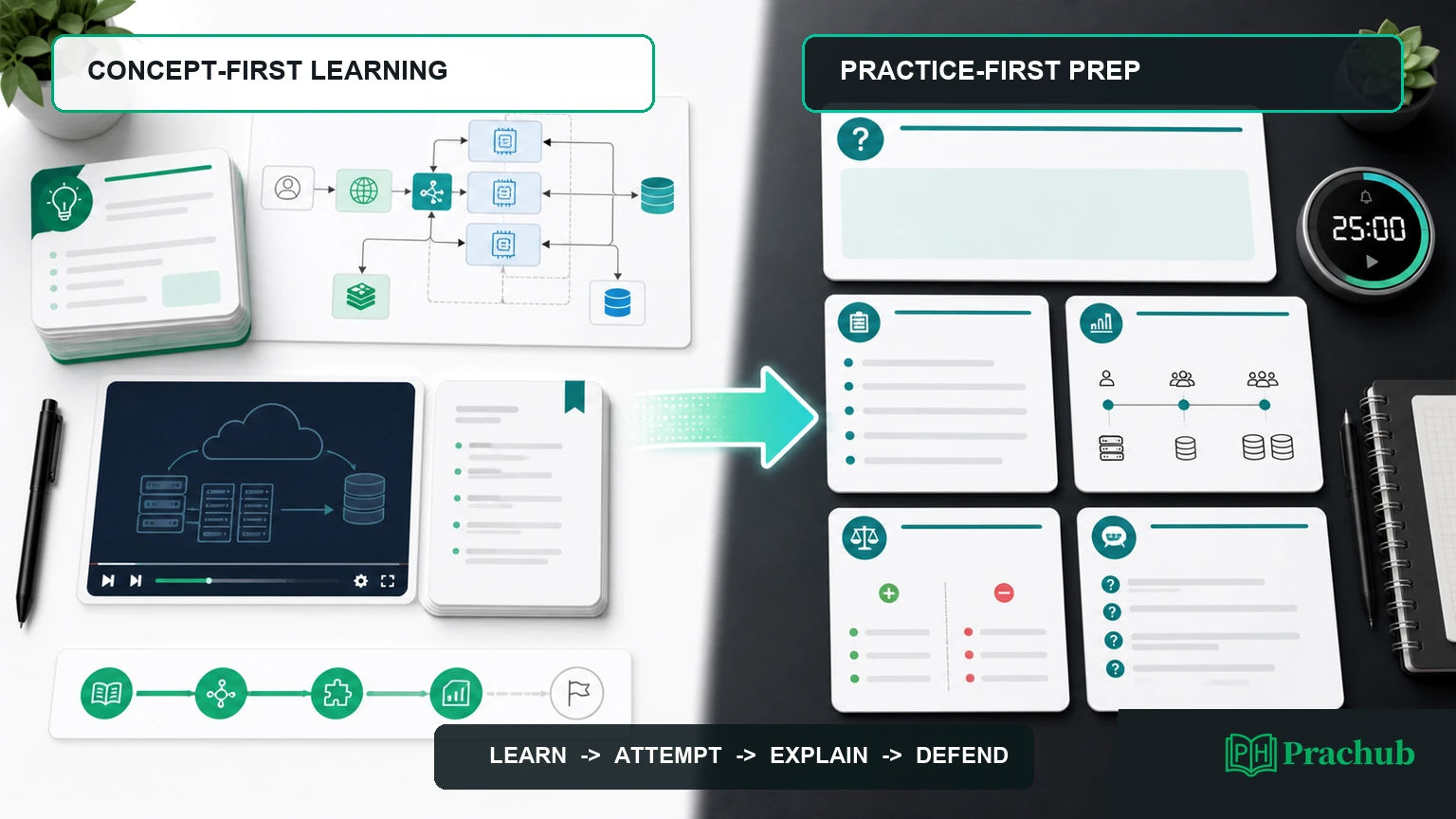
Concept-first learning becomes valuable when it is followed by cold prompts, explicit trade-offs, and interview-style follow-ups.
SystemsExpert vs PracHub
This is not a simple winner-takes-all comparison. SystemsExpert is primarily a structured course. PracHub is primarily a question and preparation platform. Choose based on the bottleneck you can actually observe.
| Decision factor | SystemsExpert | PracHub | Best use |
|---|---|---|---|
| Primary job | Teach a sequenced system design curriculum | Practice company, role, and category-specific questions | Course for learning; PracHub for transfer |
| Concept coverage | 25 organized fundamentals modules | Questions and learning tracks across system design topics | SystemsExpert when foundations are fragmented |
| Prompt variety | 13 curated design questions | A broader and continuously updated question bank | PracHub for unfamiliar repetitions |
| Explanations | Video mock interviews and written walkthroughs | Written solutions, follow-ups, and category context | Use the format that exposes your weakest reasoning |
| Company targeting | General interview preparation | Company and position pages | PracHub near a booked interview |
| Cost decision | Paid access; current offer is time-sensitive | Free starting path with optional premium access | Run a diagnostic before paying |
SystemsExpert Pricing in 2026
Pricing needs a timestamp. On August 22, 2026, AlgoExpert's official purchase page displayed a limited-time $119 one-year All Access offer for seven products, including SystemsExpert, beside a crossed-out $693 figure. The page used a countdown, so that price should not be treated as a permanent SystemsExpert list price.
This also makes older reviews that quote a standalone SystemsExpert price unreliable for today's decision. Check the final checkout page for the current amount, access period, included products, renewal behavior, and applicable terms.
At $119 for the full bundle, the value can be reasonable if you will use both system design and other included products. If you only need one design refresher before an interview next week, the bundle may still be more content than you can realistically consume.
The right calculation is not price divided by video count. Ask whether the product will change your weekly behavior. If you will complete the sequence, take notes, attempt the questions cold, and revisit weak areas, structure has value. If you mainly collect courses, another purchase will not fix the habit.
Who Should Buy SystemsExpert?
Consider buying it if system design is new to you, you want one coherent curriculum, you prefer video explanations, or free resources have left important gaps. It can also help a coding-focused engineer develop the vocabulary needed to begin practicing architecture questions.
Use it selectively if you already understand distributed systems but want a concise refresher and interview framework. Start with the free modules and workspace demo, then decide whether the remaining material is likely to add depth.
Skip or delay the purchase if you can already design unfamiliar systems clearly, your failure mode is rambling or weak follow-up handling, or your interview is so close that completing a new curriculum would displace higher-value practice. Staff-level candidates should also avoid treating any general course as sufficient by itself.
Practice Systems Design on PracHub
Use the following prompts as an unlabeled diagnostic. Each complete title in the first column opens the question and written solution directly. Attempt the prompt before reading the solution, then score requirements, estimates, interfaces, data model, scaling, reliability, and communication separately.
| PracHub question | Practice focus | Why it helps |
|---|---|---|
| Design an Alert Notification Service for Downstream Consumers | Asynchronous delivery, retries, idempotency, subscriber isolation | Tests whether you can turn publish-subscribe vocabulary into explicit delivery state and failure handling. |
| Design a Distributed Token-Bucket Rate Limiter | Atomic updates, clock semantics, hot keys, failure policy | Forces quantitative trade-offs between latency, strictness, and acceptable oversubscription. |
| Design a Resilient Chat System | Ordering, durable handoff, offline replay, membership | Requires an end-to-end data flow and a critique of designs that acknowledge before durability. |
| Design a High-Demand Ticketing System | Inventory consistency, holds, payments, surge control | Tests correctness under contention and ambiguous payment outcomes, not only high-level boxes. |
A Seven-Day Test Before You Pay
| Day | Focus | What to produce |
|---|---|---|
| Day 1 | Cold diagnostic | One 45-minute design, recorded without notes. |
| Day 2 | Failure review | A list of missing concepts versus execution mistakes. |
| Day 3 | Free curriculum sample | Notes from SystemsExpert's free lessons and workspace demo. |
| Day 4 | Second cold prompt | A new design using the improved framework. |
| Day 5 | Follow-up pressure | Responses to scale, outage, consistency, and cost changes. |
| Day 6 | Company context | A map of the target role, round, and likely design depth. |
| Day 7 | Buying decision | Choose a course only if concept gaps remain the main blocker. |
If Day 2 shows that you cannot explain the building blocks, SystemsExpert may save time. If you know the concepts but your answer lacks structure, rehearse with more prompts. For a conversational drill, use PracHub's AI system design practice guide. For another concept-first comparison, read PracHub vs ByteByteGo.
Frequently Asked Questions
Is SystemsExpert good for beginners?
Yes. The ordered fundamentals path begins with client-server architecture, networking, storage, latency, and availability before moving into more advanced distributed systems topics. Beginners still need independent practice so the concepts do not remain passive knowledge.
Is SystemsExpert enough for a senior engineer interview?
Usually not by itself. It can refresh fundamentals and demonstrate a strong answer structure, but senior interviews often require deeper operational judgment, migration planning, incident reasoning, cost analysis, and company-specific depth.
How many system design questions does SystemsExpert include?
The official SystemsExpert product and question pages currently list 13 design questions. The product page also lists 25 fundamentals videos, for 38 videos across the fundamentals and question sections.
Is SystemsExpert the same as AlgoExpert?
No. AlgoExpert's original product focuses on coding interview preparation. SystemsExpert focuses on system design. They may be sold together through an All Access bundle, so verify what the current checkout includes.
What is the best alternative to SystemsExpert?
The best alternative depends on the gap. Books and visual courses can teach concepts; PracHub can provide company, role, and category-specific questions with written solutions; peer or AI mocks can expose communication problems. Most candidates benefit from combining one teaching resource with repeated cold practice.
Final Recommendation
SystemsExpert is worth considering when your main constraint is learning system design in a coherent order. The curriculum is organized, the presentation is polished, and the combination of videos, written walkthroughs, diagrams, glossary material, quiz questions, and an interview-style workspace gives beginners a clear path.
Do not confuse course completion with interview readiness. Run a cold diagnostic first, buy only if concept gaps are the dominant problem, and return to unfamiliar prompts after every lesson. Start with PracHub's system design question bank, measure what breaks, and let that evidence decide whether SystemsExpert is the right next step.
Sources and Further Reading
- Candidate discussion criticizing SystemsExpert depth
- Experienced developers discussing system design preparation resources
Research note: This review was checked on August 22, 2026 using public product, curriculum, purchase, and discussion pages. Pricing and included products can change. Public testimonials and forum comments describe individual experiences and do not establish typical hiring outcomes.
Comments (0)