TA Embedded Review: Firmware Q&A, Seniority Filters, and Practice Limits
Quick Overview
Use TA Embedded’s public firmware catalog to choose prompts, then deepen sampled ISR and runtime-statistics answers with explicit policies, traces and target evidence.
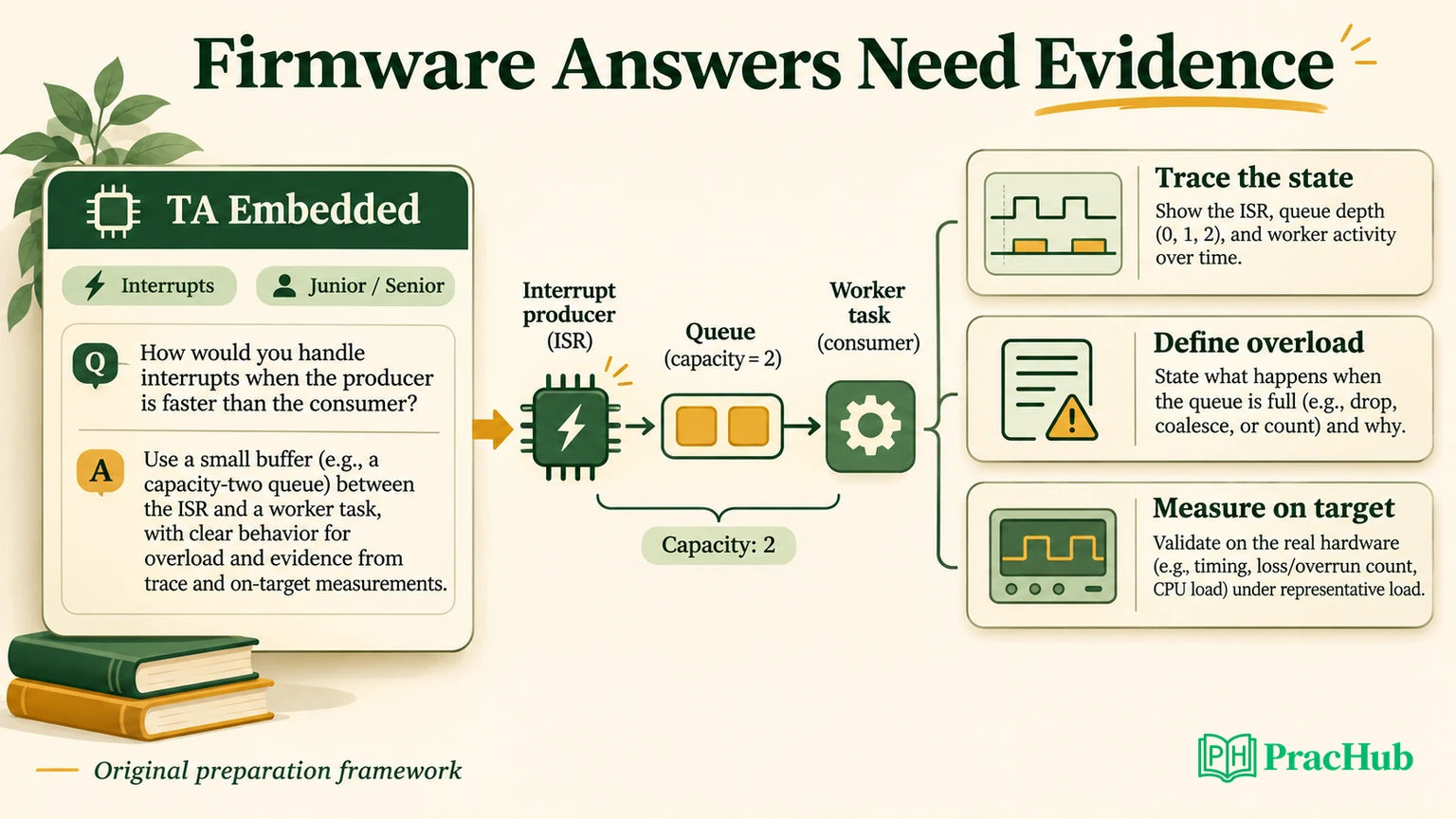
TA Embedded is useful for finding firmware interview questions by topic and seniority, then checking a short answer without signing in. The public samples we inspected covered interrupt restrictions and FreeRTOS runtime statistics. Use those answers to start a deeper explanation: a convincing interview explanation also needs a failure policy, a trace and evidence from the relevant target.
PracHub publishes this review and owns the complementary practice links. Our producer–consumer buffer exercise gives you another place to defend ownership and capacity decisions. The queue trace below is an original educational model, separate from TA Embedded’s questions and from an executing interrupt handler.
What the public firmware catalog actually exposed
Direct observation, November 3, 2026: the TA Embedded interview page displayed 55 questions, eight topic filters and All, Junior, Mid and Senior level controls. We used the public catalog and expanded selected answers. We did not audit all 55 entries or establish that the level labels match any employer’s hiring rubric.
The three inspected filter combinations narrowed the visible list. Interrupts with Junior selected showed two questions. Interrupts with Senior selected also showed two. Senior with RTOS selected showed two questions, including CPU profiling and hard versus soft real-time behavior. These are counts for the inspected combinations, not a claim about how frequently employers ask those questions.
English and French controls were visible. We did not switch languages or compare translation quality. The wider site also exposed courses, services and sign-in routes; public access to sampled Q&A does not establish access to every course or personalized service.
| Inspected surface | What we could establish | What remains open |
|---|---|---|
| Topic and seniority filters | The three combinations above narrowed the visible list | Whether the labels predict interview difficulty |
| Junior interrupt answer | The answer expanded without an account | Whether a learner can implement the advice correctly |
| Senior RTOS answer | Configuration and runtime-statistics APIs were discussed | Whether profiling works safely on a particular target |
| Public Q&A session | Questions and answers were readable | Account features, paid access, judging and feedback quality |
Our assessment: this format suits a quick check of what you can explain unaided. It is weaker evidence of implementation skill. We did not encounter an execution interface in the sampled answers, but that bounded observation does not establish that the entire product lacks coding practice.
The ISR answer provides a useful first layer
The expanded junior answer advised keeping interrupt work short, avoiding blocking and lengthy operations, using appropriate FromISR APIs, and protecting shared data. It also warned about operations such as formatted printing and dynamic allocation. Each point raises a mechanism to explain: what can block, what is shared and who owns the work.
Start with the consequence. An interrupt handler that waits for a consumer to free space can prevent the system from making the progress it needs. Moving work to a task changes where that work happens; it does not automatically solve overload or establish safe ownership of the transferred data.
The official FreeRTOS interrupt-management chapter describes interrupt-safe queue operations and the task-woken mechanism. Queue capacity still matters. A nonblocking send can fail when the queue is full, so an answer that stops at “use FromISR” leaves an important branch unexplained.
For a real implementation, identify the exact kernel version, port, interrupt priority rules and wake-up procedure. A similarly named API on another RTOS may have different requirements. Shared access and peripheral acknowledgement also need their own contracts; neither is established by choosing a queue API.
Original exercise: follow the full-queue branch
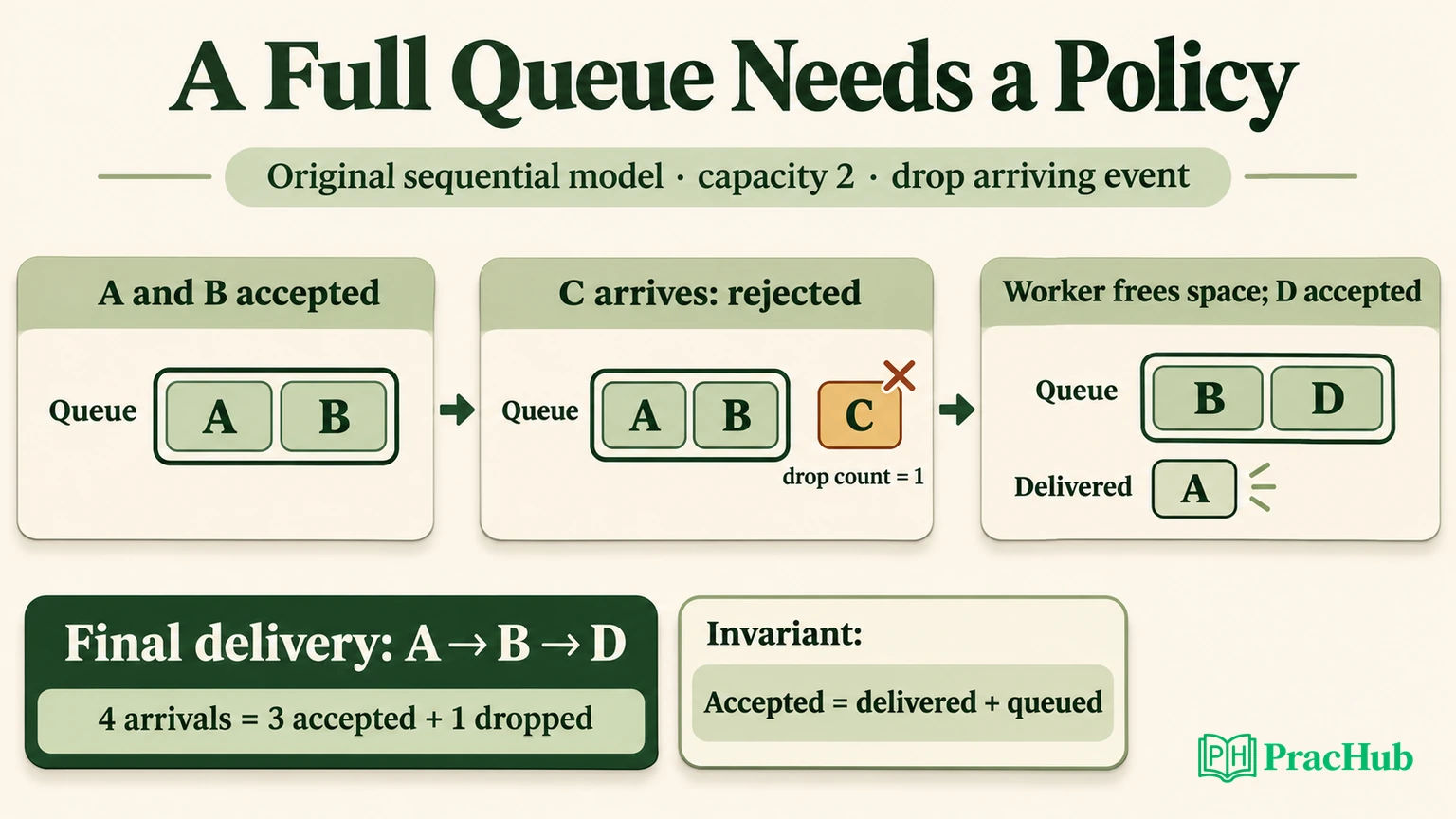
Consider an invented device whose interrupt produces small event records and whose worker consumes them in arrival order. The queue holds two records. Our chosen overload policy is drop the arriving record and increment a drop counter. That is an exercise requirement, not TA Embedded’s recommendation or a generally safe policy for every device.
The following sequence deliberately sends three events before the worker runs:
| Step | Event | Queue afterward | Result |
|---|---|---|---|
| 1 | Interrupt produces A | A | Accepted |
| 2 | Interrupt produces B | A, B | Accepted; queue full |
| 3 | Interrupt produces C | A, B | C dropped; drop count becomes one |
| 4 | Worker consumes | B | A delivered |
| 5 | Interrupt produces D | B, D | Accepted into released capacity |
| 6 | Worker consumes | D | B delivered |
| 7 | Worker consumes | Empty | D delivered |
The final delivered sequence is A, B, D. Four events arrived, three were accepted and one was dropped. Capacity never exceeded two. Under this policy, dropping C must preserve B and leave an observable drop count.
Our local Python model checked three invariants after every event: occupancy remains within capacity, accepted events equal delivered events followed by queued events, and accepted plus dropped events account for all arrivals. It also checked an empty drain, overflow at capacity one and reuse of released capacity. All checks passed.
After interrupt C:
  accepted = [A, B]
  delivered = []
  queued = [A, B]
  dropped = [C]

After the final worker step:
  accepted = delivered = [A, B, D]
  queued = []
  dropped = [C]
This is a sequential state model. It does not execute FreeRTOS, measure interrupt latency, validate memory ordering or prove a lock-free implementation. Its purpose is to make the policy observable before discussing a particular synchronization mechanism. A correct model can still be implemented incorrectly on hardware.
A useful interview follow-up changes the data contract. If every event represents a payment or safety action, dropping it may be unacceptable. If each event merely requests a refresh of the latest sensor value, coalescing may be reasonable. Explain which information the application needs to preserve before changing the storage policy.
Pointers create another branch. Copying a pointer into a queue does not necessarily extend the pointed-to object’s lifetime. State who owns the payload, when reuse becomes legal and what happens on a failed send. A successful queue operation alone cannot establish that the consumer will read valid data later.
Seniority filters should change your follow-up depth
A catalog label helps you choose a prompt. It does not establish that reciting the displayed answer is sufficient for that level. Our recommendation is to deepen one question along a chain you can defend: define the mechanism, trace a failure, choose a policy and describe a measurement.
Here is an original follow-up map for the inspected subjects. It is a preparation aid, not a reconstruction of a company interview or TA Embedded’s scoring rubric.
| Starting answer | Mechanism to explain | Failure to trace | Evidence to request |
|---|---|---|---|
| Keep the ISR short | Move bounded work to a consumer | Producer outruns the worker | Queue high-water mark and drop count |
| Use an interrupt-safe API | Check return value and wake behavior | Full queue or delayed worker execution | Accepted-send and scheduling trace |
| Protect shared state | Define ownership and critical sections | Reused payload or inconsistent snapshot | Interleaving and lifetime trace |
| Measure CPU usage | Define counter, interval and denominator | Wraparound or intrusive measurement | Target timer properties and collection method |
Mark the boundary of what you know while answering. If you cannot name the target’s interrupt priority restrictions, say which documentation you would check. If you have not measured a latency, describe a proposed measurement rather than turning a theoretical bound into a personal result.
A senior discussion may involve trade-offs that the short answer cannot resolve. Increasing capacity absorbs a larger burst but consumes memory and may hide a slow consumer. Raising worker priority changes scheduling effects elsewhere. The right explanation connects the choice to event rates, deadlines and the consequences of loss.
Read the runtime-statistics answer with measurement limits
The sampled senior RTOS answer described enabling runtime statistics, providing a sufficiently fine-grained counter and using formatted or raw task-statistics APIs. It also mentioned counter overflow. That is a useful checklist of configuration concepts, but the measurement procedure still needs examination.
The official FreeRTOS task-utilities documentation describes runtime counts and percentages, with resolution dependent on the configured counter. It also warns that the relevant statistics collection is intended as a debugging aid and can disrupt execution. Check the specific API and kernel version before collecting it in a timing-sensitive system.
An original arithmetic example makes the interpretation problem concrete. Suppose cumulative counters show a task at 40 units out of 100 total. Later they show 50 out of 200. Its cumulative share is now 25 percent, but its share during the intervening interval was 10 out of 100, or 10 percent. The cumulative and interval percentages describe different time spans.
This arithmetic assumes compatible counters and a clean interval without an unhandled wrap. On a device, establish counter width, frequency, collection consistency and overhead. A higher counter frequency improves resolution while potentially shortening the time before wraparound. Quoting a percentage without those conditions leaves the observation difficult to defend.
In an interview, connect profiling to the original symptom. A low average CPU share does not exclude a missed deadline during a burst. For the queue exercise, a maximum occupancy or drop trace may answer the overload question more directly than a lifetime utilization percentage.
Access and feedback boundaries to check before relying on it
The inspected Q&A could be read publicly. We did not create an account, purchase training, submit code, run target hardware or obtain a personalized assessment. We therefore cannot verify private access allowances, grading accuracy, coaching quality or hiring outcomes.
No independent candidate reports support the conclusions in this review. Product navigation and sampled answers are direct observations; FreeRTOS documentation supports the technical caveats; the handoff trace and follow-up map are our original exercises. Keep those evidence types separate when deciding what the product can do for your preparation.
Before committing more time, choose one topic you can test independently. Read the question, answer aloud with the solution closed, then compare your explanation. Record a missing mechanism or unsupported assumption. After recalling the definition, test whether your implementation survives the failure case.
Practice the gaps the product leaves open
Use these complementary prompts to turn short firmware answers into a state trace, an explicit failure policy and a testable claim. They are PracHub questions, separate from TA Embedded’s catalog.
| PracHub question | What to examine |
|---|---|
| Implement a thread-safe producer–consumer buffer | Explain producer and consumer ownership before choosing synchronization. |
| Design a Thread-Safe Bounded Blocking Queue | Contrast task-side waiting with an interrupt producer that cannot wait for capacity. |
| Compare Stack and Heap Memory and Probe Stack Direction | Follow object lifetimes and stack use through an interrupt-to-task handoff. |
| How to root-cause Wi‑Fi chip stops after 30 minutes | Connect a delayed failure to bounded evidence rather than naming an RTOS feature. |
| Reason About Endianness, Ring Buffers, and Stack Behavior in Firmware | Trace buffer contents and machine assumptions before claiming firmware correctness. |
Who should use TA Embedded next
Use the public catalog when you need a focused firmware prompt and a short answer to challenge your recall. The inspected filters make it easy to move between an interrupt definition and a deeper RTOS discussion. Pair that convenience with an execution environment appropriate to the claim you want to make.
For a concrete next step, take the producer–consumer buffer exercise, state a capacity and overload policy, and trace the first rejected arrival. Then explain which ownership, scheduling and target measurements the paper trace leaves unresolved. That produces an answer you can defend beyond the catalog’s level label.
Comments (0)