tech-interview.ai Review: Cloud Whiteboards, Voice Trade-offs, and Access Limits
Quick Overview
Review tech-interview.ai’s advertised cloud whiteboards and voice follow-ups, observed login and paid-pack waitlist, and practice-content disclosures. An original two-request inventory model and independent checklist test design explanations without claiming a live mock.
tech-interview.ai is aimed at candidates who want to explain cloud architectures aloud while drawing them. Its public pages connect voice follow-ups, a design canvas and feedback. Our unsigned free-session entry required sign-in, and the paid pack remained on a waitlist. Verify access before planning a trial; we did not execute the advertised mock workflow.
PracHub publishes this review and owns the complementary practice links. Our inventory-reservation question supplies an independent exercise. The concurrency trace and review checklist below are original educational work, separate from tech-interview.ai’s interviewer or scoring.
What the public product promises
Provider description, checked November 3, 2026: the homepage advertises cloud system-design practice for AWS, Azure, GCP and DevOps. It describes a voice interviewer that follows the learner’s diagram, asks follow-up questions and returns feedback about architecture trade-offs.
The page also shows illustrative scores and says previous sessions can be reviewed through transcripts, diagram snapshots and feedback. We did not produce those example scores or inspect an actual session history. The marketing illustration is not a recording of our test.
We found no independent candidate reports establishing interviewer realism, score calibration or improved hiring outcomes. This review examines the public product; it supplies no employer-process evidence. The original technical case tests an explanation method, not the platform’s effectiveness.
The free entry and paid offer have different boundaries
Direct observation: selecting Start free on the homepage led to a Clerk sign-in page for the dashboard. We stopped there. We did not register, accept account terms, grant microphone access or conduct a voice conversation.
The pricing page advertised one free interview of up to ten minutes and twenty AI credits. The displayed free-plan link used a signup destination. These are advertised account benefits; our unsigned navigation did not activate or consume them.
Its $29 one-time pack advertised three forty-five-minute interviews and one hundred AI credits, with no automatic renewal. However, the same page explicitly said that the paid pack was coming soon and checkout had not opened. The available action was sign-in to join a waitlist. We did not join it or make a purchase.
The waitlist message limits what the public price establishes about availability. Likewise, one interview slot and twenty assistance credits should not be combined into a claim of twenty interviews. Check the unit attached to each allowance.
The terms page says interview credits are consumed when a new mock starts. It also describes AI output as potentially incomplete or inaccurate. We read those statements; we did not verify credit deductions, cancellation behavior, billing or a refund.
| Question before a trial | What we observed | What remains untested |
|---|---|---|
| Can a guest start a mock? | Homepage entry reached sign-in | Authenticated entitlement and session start |
| Is the paid pack purchasable? | Pricing said checkout coming soon | Purchase and activation |
| Does the AI inspect drawings? | Provider describes diagram-aware follow-ups | Actual component interpretation |
| Are scores dependable? | Illustrative scores and feedback claims | Calibration and repeated-session consistency |
| Can work be reviewed later? | History and transcript features advertised | Saved content and retrieval |
A whiteboard should make assumptions visible
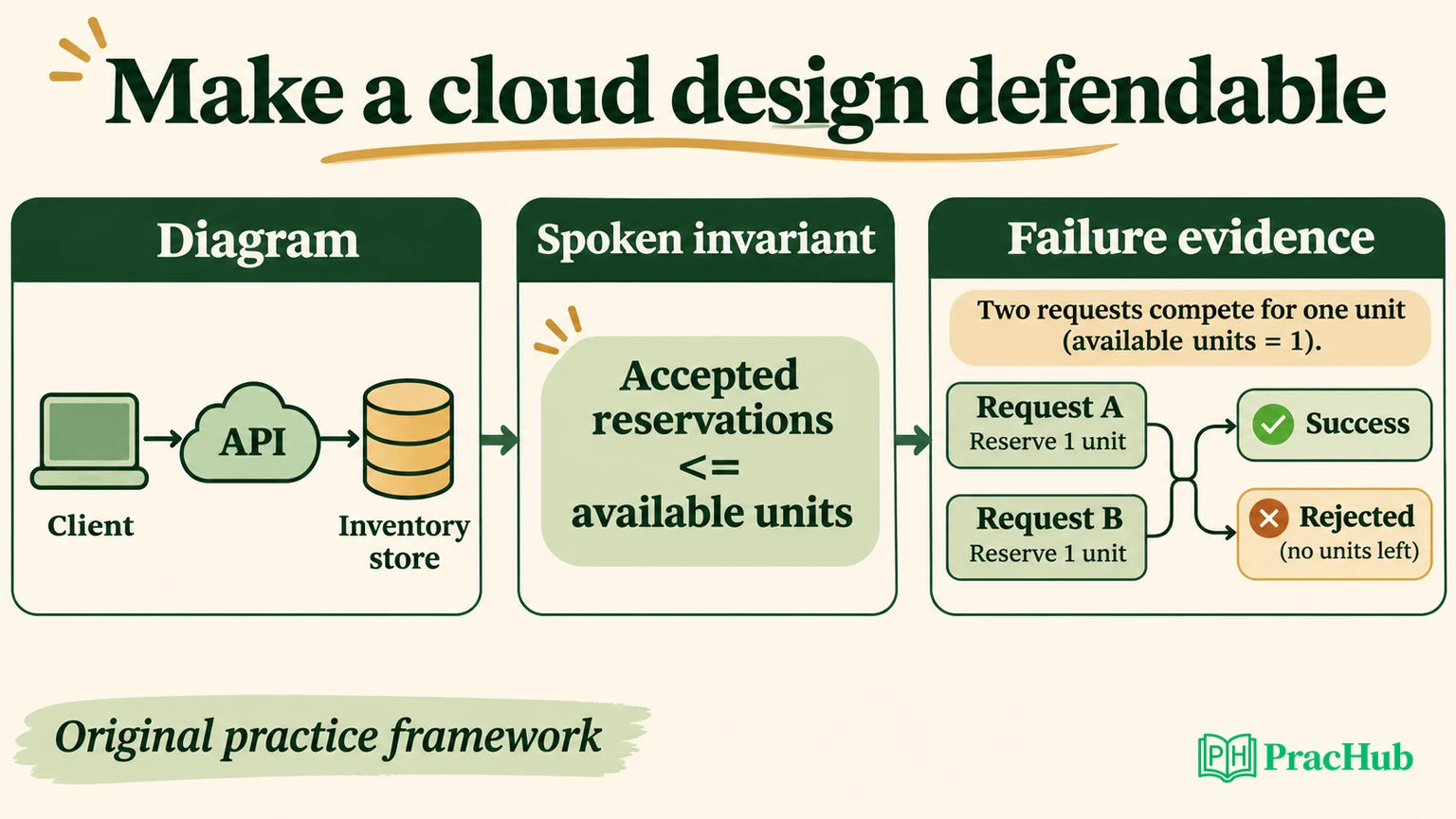
Our interpretation: diagram-aware questioning could be useful if it exposes what a component label leaves unsaid. Drawing an inventory database and several API servers does not establish how competing reservations are ordered. Naming a cloud service does not establish a business invariant.
Start with a sentence the interviewer could falsify: for one available unit, at most one distinct reservation may succeed before inventory is replenished or released. Then identify the operation that decides success. This is more concrete than saying the system is scalable and strongly consistent.
A useful follow-up asks where that decision occurs, what state it reads and when the caller can rely on the response. A second asks what happens after a timeout. Neither question requires an elaborate diagram; both require the candidate to connect arrows with state transitions.
Use the drawing to expose the reservation decision. A cache may accelerate availability displays while the authoritative reservation still needs another path. Explain which values are advisory, which operation commits stock and what a customer sees when those layers disagree.
We did not test whether tech-interview.ai asks these follow-ups. They form an independent standard for evaluating a future session. Record a specific question that changed your design, rather than treating a long conversation as proof of useful depth.
Original trace: one unit can produce two accepted reservations
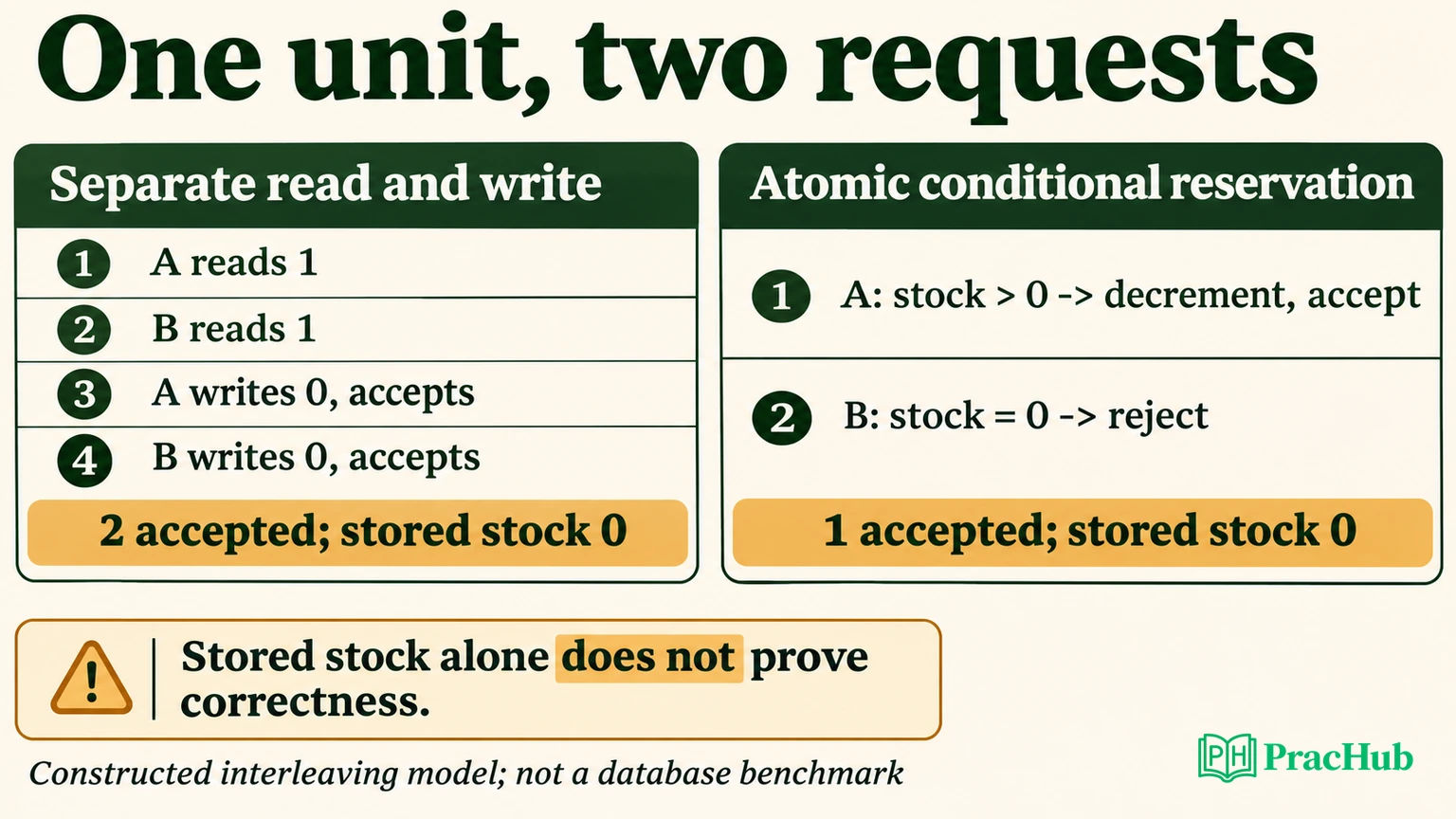
Consider our constructed single-item example. The initial stock is one. Request A reads the stock; request B also reads one before either writes. Each decides that a unit is available. A writes zero and accepts its reservation. B then writes zero and also accepts.
The final stock is not negative, yet two reservations succeeded against one unit. A check that only inspects the stored count misses the violation. Check accepted reservations alongside the stored counter.
This is a deliberately split read-and-write model. It does not claim that an atomic database statement behaves this way. Its purpose is to show why an application-side availability check followed by a stale assignment leaves an ordering problem.
We enumerated all six interleavings of two read/write pairs while preserving each request’s local order. Four allowed both reads to see one and produced two accepted reservations. The two sequential schedules accepted only the first request. These counts describe the model’s complete schedule set, not a probability of failure in a real system.
The alternative model treats the condition and decrement as one indivisible reservation action. In both possible request orders, the first succeeds and the second sees no stock and fails. We checked the stock and acceptance totals for each constructed order.
No database, cloud service, network, threads or platform interviewer ran in this experiment. We explicitly supplied interleavings to a small Python program. The result demonstrates a logical counterexample and an atomic specification, not measured throughput or a deployed correctness guarantee.
Connect an atomic claim to a real implementation
For a relational implementation, one possible starting point is a conditional update that decrements only when stock is positive and checks whether a row was affected. It must be connected to reservation creation and the surrounding transaction, rather than described as an isolated magic statement.
The official PostgreSQL transaction-isolation documentation explains that under Read Committed, a competing update can wait and re-evaluate its condition against an updated row. That is a specific database behavior to study. Our Python model did not execute or verify it.
A defensible answer names the database and isolation assumptions. It also explains rollback if recording the reservation fails, and prevents an accepted response before the intended commit. Do not generalize one engine’s concurrency behavior to every cloud datastore.
Changing to a distributed design introduces additional questions. Which shard owns the item? Can two regions independently allocate the same stock? What happens during a partition? The diagram needs a stated policy for rejecting, delaying or limiting operations when the authoritative decision cannot be reached.
A voice interviewer can ask these questions, but a feedback report is not a substitute for the answers. For a future trial, compare each suggestion with the actual invariant and the documented behavior of the proposed implementation.
A retry is a different problem from a second buyer
Now change the example. A reservation commits, but its response is lost. The same client retries. A unique request identifier and a durable result can let the service return the original outcome rather than allocate another unit.
The identifier distinguishes retries of one logical operation. It does not by itself prevent two different buyers, with different identifiers, from claiming the last item. You still need an authoritative stock decision. Combining both concerns under the word “idempotency” hides the missing guarantee.
The reverse error also matters. An atomic decrement can prevent overselling while still charging or decrementing twice for one retried request. State exactly which side effects belong to the logical reservation and how their results are recovered.
We did not add retries, payments or crashes to the executed interleaving model. These are separate follow-up design questions. A good answer should preserve that boundary rather than claim that the small successful model proves an entire checkout system safe.
An independent checklist for evaluating a session
Use the following checklist to inspect a transcript and drawing together. It is our original practice tool, not tech-interview.ai’s hidden grading rubric or an objective score of the product.
| Review dimension | Evidence worth saving |
|---|---|
| Invariant | At most one accepted reservation for one available unit |
| Decision point | Exact conditional mutation, transaction and owner |
| Counterexample | Two reads before either write, with acceptance totals |
| Retry contract | Stable logical identifier and recoverable result |
| Failure policy | Caller behavior during timeout, rollback or authority loss |
A follow-up has depth when it changes one of these artifacts. Perhaps you revise the acknowledgment point, add a durable operation result or narrow a regional availability promise. A suggestion to add more replicas without discussing allocation authority does not resolve the single-unit race.
Afterward, compare the spoken answer with the final diagram. If the answer says one writer owns an item but the drawing has two independent regional writers, record the inconsistency. A fluent explanation and a technically coherent design need to agree.
We did not test speech recognition, interruptions or diagram parsing. If you later try the service, inspect the transcript for lost qualifiers before treating feedback about your answer as accurate. An omitted “only after commit” changes the meaning of an acknowledgment guarantee.
What the privacy page says about practice content
The privacy policy, dated August 12, 2026, lists diagrams, prompts, transcripts, feedback, scores and session history among practice content. It says relevant architecture and interview content may be sent to AI and speech-service providers to operate the experience.
That is a provider disclosure, not a traffic audit we performed. We did not measure retention, test deletion or establish where a particular session would be processed. No voice, internal diagram, credentials or private project material was submitted during this review.
For a trial, the invented one-item inventory example is sufficient to examine reasoning. It does not require a production topology or customer details. Ask whether you can review and remove the saved artifacts you care about; the unsigned public page cannot establish those account-side controls.
Practice the gaps the product leaves open
These independent PracHub questions extend the inventory and retry reasoning. They are complementary prompts, not tech-interview.ai scenarios, scorecards or verified employer questions.
| PracHub question | What to examine |
|---|---|
| Reserve Cart Inventory Without Overselling | Define the single-unit reservation invariant and concurrent attempts. |
| Design a Shopping Cart Service That Keeps Inventory Consistent Under Concurrency | Separate cart state from the authoritative stock mutation. |
| Design a Flash Sale with a Virtual Queue and Exact Inventory | Explain whether a queue changes admission, correctness or both. |
| Thread-Safe Stock Inventory: Buy and Sell Without Overselling | Show the exact critical section and the assumptions of the local model. |
| Design an Idempotent Payment Processing Platform | Handle duplicate requests separately from competing requests. |
Who should try tech-interview.ai next
Consider a bounded trial if you want to rehearse spoken cloud trade-offs beside a diagram. The current public access path requires an account, and the paid offer remained waitlisted when checked. Actual follow-up quality, canvas behavior and feedback usefulness remain unverified here.
Prepare the inventory-reservation prompt first. Explain the two-read counterexample, identify the authoritative mutation and separate retries from distinct buyers. In any future mock, judge the feedback by whether it helps repair one of those concrete decisions. Save the reasoning and design decision that the feedback helped change.
Comments (0)