TrueInterview.io Review 2026: Are Real Company Questions and AI Coaching Worth It?
Quick Overview
An evidence-led review of TrueInterview.io's candidate-reported question bank, signed-out practice experience, AI coaching claims, pricing, limitations, and fit versus PracHub.
TrueInterview is worth trying for free when you have a specific technical interview coming up and its company, role, or round coverage matches your target. Paying is harder to recommend without first testing that relevance. The public practice workspace is useful, but the site's AI coaching and “real company questions” positioning are first-party claims—not independent guarantees of feedback quality or future interview content.
Disclosure and fact-check: PracHub is a competing interview-prep platform. We checked TrueInterview's public pages, signed-out practice experience, live pricing selectors, Terms, Guidelines, Privacy Policy, and every cited link on August 25, 2026. We did not create an account, submit code, upload a resume, buy a plan, or test hiring outcomes.
This review helps software engineers judge the public question experience, candidate-report evidence, AI claims, pricing, privacy, and the choice versus the PracHub interview question bank. It does not rate paid coaching as if we had used it.
Illustration: the four evidence areas assessed in this review—not a screenshot of TrueInterview's interface.
Quick Verdict: Is TrueInterview Worth It in 2026?
Start free. Pay only after the content proves relevant to your exact target. TrueInterview combines company-tagged questions, candidate reports, timed practice, AI review, and job-search tools.
The strongest paid reason is also the narrowest: complete company question banks require Insider, not Pro. Pro adds larger practice sets, more AI usage, unlimited interview reports, and career tools, but the public plan table marks full company banks as unavailable. If company coverage brought you, test free samples before committing.
| TrueInterview | PracHub |
|---|---|
| Best for: practice, AI reports, and career tools together | Best for: focused technical and behavioral question discovery |
| Questions: candidate-reported samples; complete banks require Insider | Questions: searchable practice records by question and category |
| AI: starter Free allowance; larger stated paid allowances | AI: written prompts and solutions for self-review |
| Caution: provenance and coaching quality are not independently established | Caution: users create their own mock routine |
Neither platform predicts the exact assessment or interview a reader will receive.
What We Verified—and What We Did Not
TrueInterview is an interview-preparation and job-search platform operated by TrueCode Technologies Inc. Its public catalog spans coding, object-oriented design, system design, machine-learning system design, SQL, and candidate reports. The Interviews board displayed 2,242 experiences during our August 25 check. That is a dated first-party counter, not an audited quality measure.
We used a three-layer evidence check throughout this review:
- Observed: visible in a signed-out browser session, such as the public question workspace and pricing selector.
- First-party claim: described by TrueInterview but not independently tested, such as paid AI allowances and Career Co-pilot output.
- Not verified: account, payment, submission, and outcome behavior that our signed-out review could not test.
Are the “Real Company Questions” Actually Useful?
A candidate-reported question bank collects prompts attributed to interview recollections. It can reveal patterns, but it is not an official company syllabus.
TrueInterview says its questions are reported by candidates, stamped with the interview month, and checked against other reports of the same round. Its Terms draw a tighter boundary: user content is not necessarily pre-screened, endorsed, or verified, and the company does not claim to possess confidential or proprietary interview questions. The Community Guidelines also tell contributors to share original recollections rather than copied wording, NDA-covered material, or claims of official and current company content.
Candidate reports can reveal skill families, round types, and useful explanations. Treat repeated patterns as a preparation signal, not a leak or prediction.
Before relying on a company collection, sample several entries and ask:
- Does each item match your role, level, location, and interview stage?
- Is there enough context to practice constraints, trade-offs, and follow-ups?
- Is the reported month recent enough for a hiring process that may have changed?
Practice the underlying skill and explain why an approach works; do not memorize answers.
What the Free Question Workspace Shows
We repeated the same signed-out check across three free pages: Merge Intervals, Durable Key-Value Store Serialization, and Infection Spread Simulation. On all three, the full prompt and Solution tab opened without sign-in. Each showed an editor with six languages, a local-draft notice, and Interview mode; AI Review required sign-in.
The interface kept the prompt, Solution, and AI Review in adjacent tabs, with Run and Submit beside the editor. Interview mode exposed a stopwatch plus 15-, 20-, 25-, 30-, 45-, and 60-minute choices. Think aloud said transcription occurs on-device, audio does not leave the browser, the transcript feeds the report, and it is discarded after leaving.
Paid gating was also visible: the In-Memory KV Cache with WAL Log system-design item was Insider-locked, and the OpenAI system-design listing marked all 18 displayed questions members-only. We did not run or submit code, start a timed session, or create an account, so we did not validate judging, hidden tests, transcript handling, or report quality. Think aloud is not a live voice or video interviewer.
AI Coaching: Useful Feedback or an Unverified Black Box?
AI coaching is automated feedback on a solution or practice session. TrueInterview says its AI evaluation reads a solution against a reference and asks interviewer-style follow-ups. Its pricing table lists TrueBot and rubric-scored evaluation across all plans, with a starter monthly allowance on Free and larger stated allowances on Pro and Insider.
The idea is useful when feedback identifies a missed edge case or unsupported design choice. We found no public independent benchmark comparing this feedback with experienced interviewers, company rubrics, or candidate outcomes.
Judge the coach by repeatable behavior:
- Does it cite the exact line, test, assumption, or trade-off behind its criticism?
- Does a corrected answer receive different feedback for a clear reason?
- Does it separate code correctness, efficiency, and communication?
- Can you verify the advice against a trusted solution or human reviewer?
The Privacy Policy says resume and application inputs may be processed through OpenRouter—including DeepSeek models—and Anthropic. TrueInterview says the API terms it uses do not permit those providers to train on submitted inputs. The policy also warns that AI-modified application material is not guaranteed accurate, complete, or legally compliant, so every output needs human review.
TrueInterview Pricing: Free vs Pro vs Insider
The following prices were visible on the official Pricing page on August 25, 2026. Quarterly equivalents were $29.67/month for Pro and $53 for Insider; yearly equivalents were $12.42 and $24.92. These are not month-to-month charges. Verify checkout before buying.
| Plan and price | Public highlights |
|---|---|
| Free — $0 | Free bank, TrueInterview 20, timed mocks, starter AI, job tracker, and limited daily reports |
| Pro — $39/month; $89/3 months; $149/year | TrueInterview 75/150, unlimited reports, career tools, and stated 40× Free AI usage |
| Insider — $69/month; $159/3 months; $299/year | Pro features, complete company banks, and stated 80× Free AI usage |
The Pricing page says subscribers can cancel through Stripe's billing portal, keep access through the paid period, and stop the next renewal. We found no general refund or money-back promise on that page or the Terms. That does not prove refunds are prohibited; ask before buying if eligibility matters.
One public inconsistency deserves attention. Pricing advertises Auto-apply, yet it also says an autofill extension is in progress; the new-grad page says the user reviews and clicks Submit. Treat hands-free submission as limited or developing. Watch for the extension's release, changes to Insider-only bank access, and revised pricing or policies.
Where TrueInterview Helps—and Where It Falls Short
Strengths
- Contextual organization: company hubs, categories, and candidate reports shorten research.
- Free sampling: three tested public problems included workspaces and solutions.
- Practice beyond algorithms: coverage includes OOD, system design, ML system design, and SQL.
- Timed rehearsal: stopwatch and timer modes add pressure.
- One-account workflow: preparation, reports, resume tools, and job tracking can support an active search.
Limitations
- Question provenance has a ceiling: candidate-reported does not mean authenticated, current, or representative.
- Paid AI quality is unproven here: a signed-out review cannot establish accuracy or hiring relevance.
- The scope is broad: application tools may add cost when practice is the only goal.
- Data crosses service boundaries: AI providers, job boards, employer portals, and applicant-tracking systems may receive it.
- Yearly equivalents hide commitment size: compare today's charge with your actual preparation window.
TrueInterview vs PracHub: Which Should You Choose?
Choose TrueInterview when you want company-tagged practice, candidate reports, timed sessions, AI feedback, and career tools in one workflow. Choose PracHub when your immediate need is to browse interview questions, compare technical and behavioral categories, and build a focused practice set without paying for a larger job-search bundle.
Sample both products against the same company, role, level, and round. Keep the one with clearer constraints, relevant follow-ups, and better coverage of known weaknesses.
The products can serve different steps. Use PracHub to find prompts and label each miss as knowledge, implementation, communication, or format. Then use timed or AI-assisted practice for gaps that require repeated delivery. Candidate-reported records remain practice material, not forecasts.
A Seven-Day Free-to-Paid Decision Test
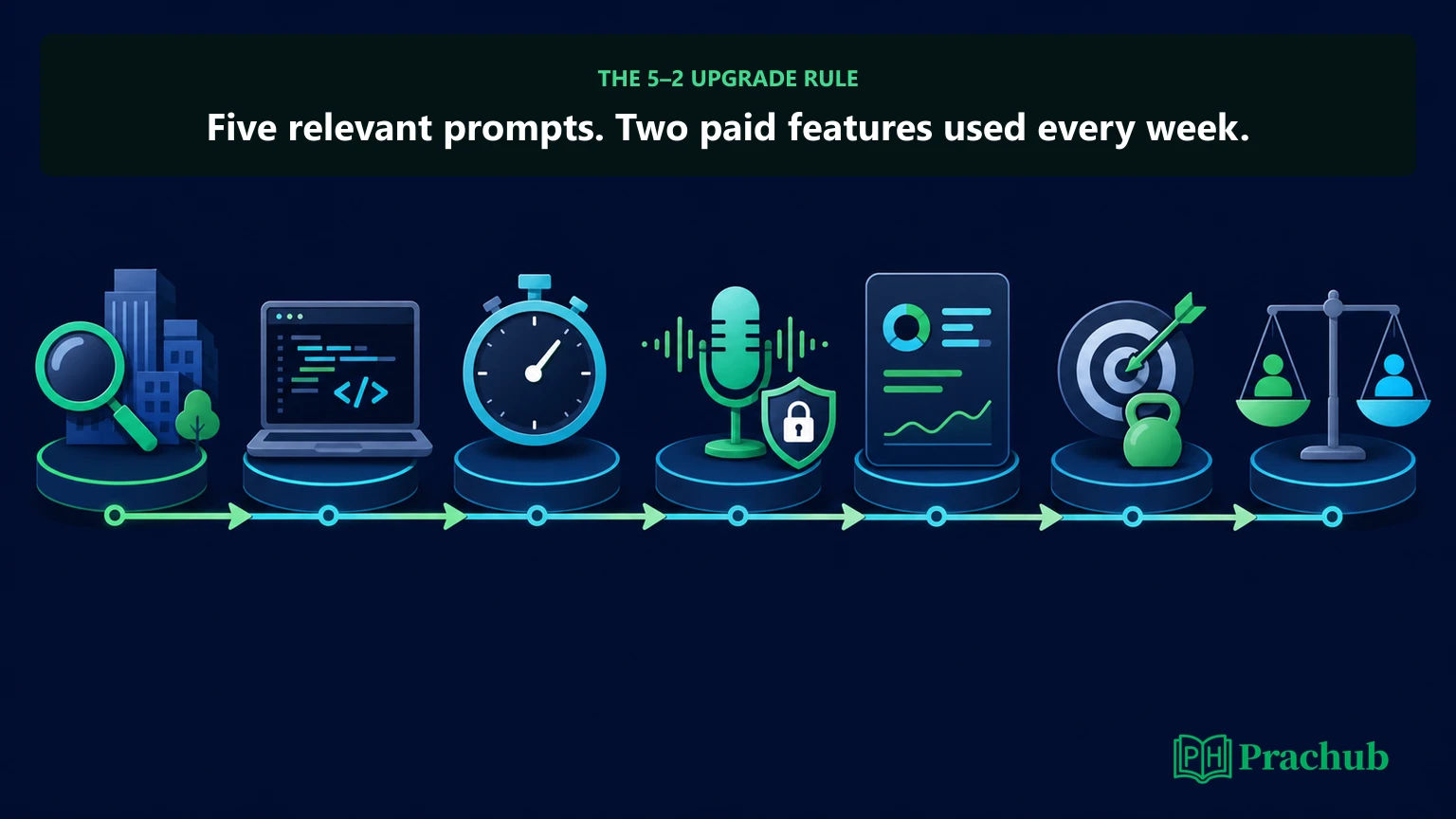
Illustration: a seven-day test for deciding whether a paid plan earns its place in your weekly routine.
Use the 5–2 upgrade rule: pay only if the free experience produces at least five highly relevant prompts and two paid features you expect to use every week.
- Day 1: Define one target company, role, level, location, and interview stage.
- Day 2: Sample at least ten relevant prompts; reject vague or mismatched entries.
- Day 3: Solve two questions under a realistic timer without reading the solutions first.
- Day 4: Compare any available feedback with a trusted solution; record missed errors and unsupported criticism.
- Day 5: Repeat one problem aloud, explaining assumptions, complexity, tests, and trade-offs.
- Day 6: Inspect only the paid features you would use; review privacy implications before uploading career data.
- Day 7: Upgrade only if the product saves preparation time or exposes a recurring weakness your current process misses.
Five questions for a balanced practice set
| Practice question | What it tests |
|---|---|
| Implement an LRU cache with follow-ups | Data structures; implementation and complexity |
| Design a Distributed Token-Bucket Rate Limiter | System design; capacity and consistency |
| Object-Oriented Design: Hotel Room Booking System | OOD; modeling and extensibility |
| Rank Departments by Student Count | SQL; aggregation and ranking |
| Walk through a project deep dive | Behavioral; decisions and impact |
These PracHub question-bank records are practice material, not a prediction of your exact assessment or interview.
Frequently Asked Questions
Is TrueInterview legitimate?
TrueInterview is an operating platform with public product pages, question content, legal policies, and paid plans. Its Terms identify TrueCode Technologies Inc. as the operator. That does not mean every candidate submission is independently verified, so evaluate individual records by relevance, date, and detail.
Is TrueInterview free?
Yes. The Pricing page lists a $0 Free tier with no card to start, public questions, timed mocks, starter AI usage, a job board and tracker, and a limited number of full interview reports per day. An account is required for some AI and progress features.
How much does TrueInterview cost in 2026?
As checked August 25, 2026, Pro cost $39 monthly, $89 quarterly, or $149 yearly. Insider cost $69 monthly, $159 quarterly, or $299 yearly. The lower advertised monthly figures are yearly equivalents, not month-to-month charges. Verify live pricing and taxes before subscribing.
Does TrueInterview use real interview questions?
The site labels its prompts and reports as candidate-reported. Its Terms say user content is not necessarily verified or guaranteed and disclaim access to confidential or reliably current company questions. Treat the material as directional practice evidence, not an official bank or prediction.
Is TrueInterview better than LeetCode or PracHub?
It depends on the task. TrueInterview joins company context, candidate reports, AI feedback, and job tools. LeetCode centers on algorithm practice, while PracHub offers focused interview-question discovery. Sample each against the same target instead of choosing by headline catalog size.
Final Verdict
TrueInterview is worth a free test for candidates preparing for a specific technical interview. Its public question workspace, timed mode, candidate reports, and broad technical categories can produce a useful study plan. The “real questions” label should still be read as candidate-reported practice material, not independently certified or current company content.
Pay only when the 5–2 upgrade rule is met. Pro fits repeated AI-assisted practice and career tools; Insider is the relevant upgrade if full company question banks are the deciding feature. Validate AI feedback, review every application output, and choose the shortest paid term that matches your actual preparation window.
Sources and Further Reading
Research note: Product features, prices, allowances, and public counts can change. This review reflects the signed-out pages and policies checked on August 25, 2026.
Corrections and updates: Send official evidence of a changed price, policy, or feature to support@prachub.com; PracHub will recheck the claim before revising this page.
Comments (0)