Unity Addressables Interview Questions: Trace Asset Handles Through Loading, Instantiation, and Release
Quick Overview
Trace Unity Addressables handles through shared loads, instantiation and scene exit, using an ownership ledger and late-completion release decisions. Primary references, original worked assets and explicit evidence boundaries support focused interview practice.
Unity Addressables interview questions are ownership questions disguised as loading questions. For every acquired operation, name the owner, the point ownership transfers, and the one matching release path. Copying a handle, destroying a GameObject and unloading an AssetBundle are different events. Treating them as synonyms is how a plausible scene transition becomes a leak or a premature unload.
Official Unity references below use Addressables 2.2. The shared-prefab ledger and late-completion example are original teaching assets; a local Python model checked their bookkeeping, but no Unity Editor or memory profiler was run. PracHub's reference-counted smart pointer exercise is useful ownership practice, with an important limit: Addressables operations and Unity objects are not C++ smart pointers.
Begin with three lifetimes instead of one memory number
The fictional game has a reusable enemy prefab, a lobby scene and a match scene. Both scenes may need the prefab during a transition. The prefab shares a bundle with another asset. When the lobby closes, the profiler's total memory does not immediately fall. Before calling this a leak, separate operation ownership, instantiated object lifetime and bundle residency.
Official fact: Unity's memory management reference describes reference counts for assets and bundles, matching loads with releases, and the difference between a released asset and memory actually being unloaded. Another live asset can retain the containing bundle.
That means two observations can both be true: your code released its acquisition correctly, and memory remains resident. It is also possible for memory to appear stable while your code keeps accumulating unreleased acquisitions. One process-memory sample cannot distinguish a leak from valid residency.
Ask the interviewer what evidence is available. An operation handle ledger answers who still owns a load. A scene hierarchy answers which instances remain. The Addressables profiler and memory tools answer different questions about operations, dependencies and resident content. Name the missing evidence before selecting a fix.
Walk the shared-prefab ownership ledger
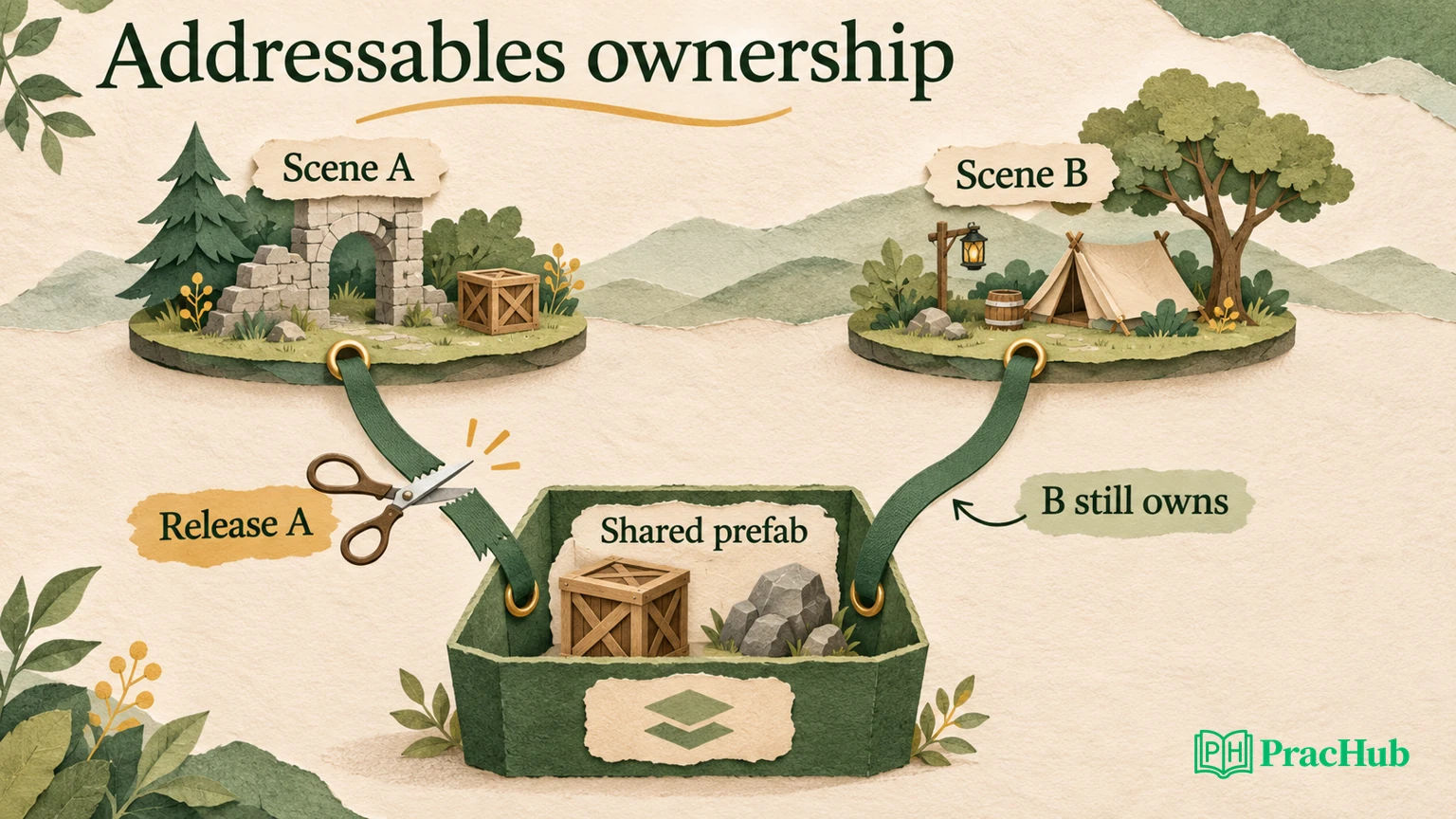
Suppose A and B independently call LoadAssetAsync<GameObject> for the same key. The provider may share underlying content, but each caller still needs a clear ownership obligation. The counts below represent owned acquisitions in this exercise, not an assertion about every internal dependency counter displayed by Unity.
| Event | Owner's obligation | Owned loads in the exercise |
|---|---|---|
| Lobby A loads the prefab | A must eventually release its acquisition | 1 |
| Match B loads the same prefab | B owns its separate acquisition | 2 |
| A copies its handle into another variable | No additional acquisition was created | 2 |
| A releases its owned load | B still needs the prefab | 1 |
| B releases its owned load | Neither scene retains that acquisition | 0 |
A copied handle struct does not add an acquisition. Two variables that refer to one operation do not automatically represent two independently acquired references. Releasing through both variables can over-release the same ownership. Conversely, forgetting the second caller's actual load leaves a real acquisition outstanding.
Use language that exposes this distinction: “This field is another reference to my handle” differs from “This component acquired its own load.” If a shared cache owns the acquisition, consumers need a cache-level lease contract. If each consumer acquires directly, each consumer needs its own matching release. Mixing those two designs makes the owner impossible to identify.
The Python ledger checked the sequence 1, 2, 2, 1, 0. It did not measure asset bytes or confirm a bundle unloaded. Its purpose is to catch inconsistent claims about how many obligations the application created.
Compare manual instantiation with InstantiateAsync
Loading a prefab and calling Unity's ordinary Object.Instantiate creates a clone from an already available object. Your application must keep the asset and its dependencies available for the clones that need them. Destroying a clone does not automatically discharge an unrelated load handle you retained elsewhere.
By contrast, the Addressables InstantiateAsync API represents an Addressables-managed instantiation operation. Its trackHandle option determines whether the instance object can be used to locate the tracked request for release. With tracking disabled, retain the operation handle rather than expecting the instance lookup to recover it.
| Creation approach | What to retain | Cleanup question |
|---|---|---|
| Load prefab, then ordinary Instantiate | Load ownership plus clone list | When are all dependent clones finished? |
| InstantiateAsync with tracking | A clear instance or operation owner | Which matching instance-release path is used? |
| InstantiateAsync without tracking | The returned operation handle | How is that handle retained until release? |
Do not combine several cleanup routes “to be safe.” Destroying and releasing through multiple independently written callbacks can duplicate cleanup. Choose the documented matching API for the operation and verify its behavior in the project's package version. Make ownership move through one path, even when multiple events can request disposal.
The distinction matters for pools. Returning an object to a pool usually means it may be reused; it does not necessarily mean the pool has ended its ownership. A pool teardown and a gameplay despawn are different events. State which event releases the asset acquisition and which only disables an instance.
Handle scene exit before asynchronous completion
The next failure does not require two scenes to load the same key. Scene A starts a load, the player leaves, and the load completes afterward. A completion callback can create an object for a dead owner, overwrite a newer scene's field, or abandon a successful handle.
The asynchronous loading documentation shows completion mechanisms and notes that already loaded content can complete in the same frame for some approaches. Therefore initialize ownership state before starting or subscribing to work. “It always finishes next frame” is not a safe application invariant.
The following is an ownership sketch for a LoadAssetAsync acquisition, not drop-in MonoBehaviour code:
capture this owner's generation
start one load and retain its handle
when the operation completes:
    if the owner was disposed or its generation changed:
        release this operation's owned handle once
        do not adopt the result
    else if the operation failed:
        record the failure
        release the owned operation according to its API contract
    else:
        transfer the handle into the owner's retained state
        create or expose content under that ownership
when retained ownership ends:
    remove dependent manual clones as required
    release the retained acquisition once
There are two disposal paths, but only one should own the release for any particular acquisition. A completed, adopted handle belongs to the retained owner. A completion rejected because the owner is obsolete stays with the pending-operation cleanup path. A generation token distinguishes old and new requests on a reused component.
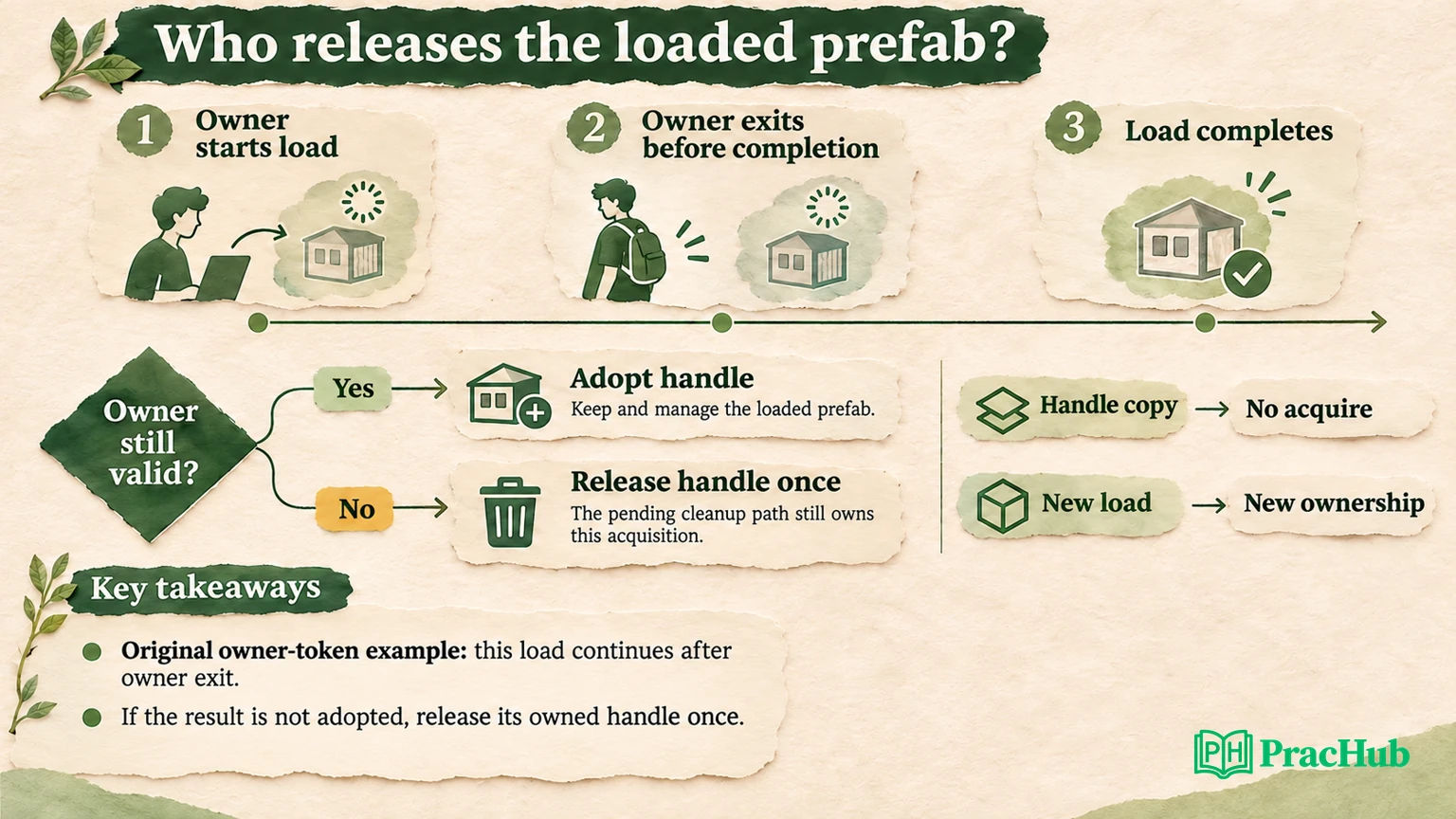
Calling a task cancellation token does not, by itself, prove that the underlying Addressables load was canceled and released. State which cancellation behavior the actual wrapper implements. If the operation continues, the completion still needs an ownership decision. This article's sketch chooses to observe completion and dispose of an unadopted result; it does not claim to abort downloading.
Diagnose a retained bundle without forcing an unload
Return to the transition. A releases its prefab load, B still needs the same content, and a third asset retains the bundle. Memory staying resident is expected under those conditions. Releasing B's handle early merely to make a graph decline would violate the application's ownership contract.
Build a small investigation table. Record the key, acquisition site, owner generation, completion status, adoption decision and release site. Then compare the application's ledger with profiler evidence. If the ledger is balanced but a bundle remains, inspect other retained assets and dependency relationships. If the ledger grows every transition, locate the unmatched acquisition first.
Also distinguish a leak from churn. Releasing the last user and immediately loading another asset that needs the same bundle can cause unload/reload work. Keeping a deliberate transition owner briefly can be reasonable if its lifetime is bounded and measured. “Never release” is not a valid optimization; “keep this transition lease until B adopts” is at least an explicit policy you can test.
Do not infer that reorganizing bundles always saves memory. Smaller bundles can reduce unrelated residency while increasing other overhead and content-management costs. In an interview, describe the dependency you observed and the experiment you would run before recommending a packaging change.
Design tests around ownership transitions
An application-level test plan should cover more than one successful load. Include normal adoption and teardown, two simultaneous consumers of the same key, scene exit before completion, failure before adoption, pooled instances, and repeated teardown signals. For each acquisition, assert exactly one owner or cleanup path is responsible at every stage.
Add a deliberately delayed completion so scene exit happens first. Then trigger another load on the same component before the older one finishes. Check that the old generation neither populates the new scene nor releases the new handle. These are different bugs, and a single disposed Boolean may not distinguish them.
In the actual Unity project, use the package's profiler and object inspection to confirm expected cleanup. Verify that no dependent manual clone is still using resources after its backing ownership ends. Repeat transitions enough to identify a trend, with comparable states and measurement points. A single low-memory observation after a manual cleanup command does not prove normal gameplay is correct.
The general Unity lifecycle article covers update loops and object lifecycle issues. Here, the added interview skill is following a specific asynchronous acquisition through adoption, sharing and release.
Make repeated cleanup requests harmless
The scene-exit callback, a load failure and a pool teardown may all request disposal. Give them one ownership record rather than three copies of release logic. A record can distinguish pending, adopted and released states, with a transition that transfers the release obligation exactly once. The implementation must also distinguish an old operation from the current operation on a reused component.
A useful review exercise is to interleave the events on paper: exit first, completion second, teardown third. Decide which event still owns the pending handle after each step. Repeat with completion first and exit second. Both orders should end with the acquisition released once, without releasing a different generation's handle.
Do not use this bookkeeping model to infer that a released GameObject can still be read safely. Ownership checks must happen before adopting or using the result. In a real Unity test, verify main-thread and callback constraints under the package's supported APIs. The local ledger checks the application's obligations, while the engine run must establish object validity and actual resource behavior.
Practice explaining the owner, not just the API name
These five verified PracHub questions provide broader ownership, resource and game-design practice. They are not five dedicated Addressables tasks. Transfer the lifetime reasoning while respecting differences between C++ destructors, runtime localization, game-state design and Unity's operation model.
| PracHub question | Topic-specific rehearsal |
|---|---|
| Implement a Thread-Safe Reference-Counted Smart Pointer in C++ | Transfer acquire/release ownership reasoning; C++ pointer mechanics differ from Addressables. |
| Implement a Unique Pointer and Vector | Explain a single owner and explicit transfer without treating handle copies as acquisitions. |
| Find and Fix C++ Ownership Bugs: Double Free, Shallow Copy, and Object Slicing | Use a double-cleanup counterexample while acknowledging the C++ runtime gap. |
| Design a Runtime Localization System | Track asset lifetime across a runtime content change; this is broader than prefab loading. |
| Design a Testable 2048 Game Engine | Explain how game-state transitions trigger resource ownership changes. |
Rehearse the reference-counted ownership question with the scene ledger. Explain why the copied handle adds no acquisition, why B survives A's release, and why a late completion still needs cleanup. Finish by saying which observations would distinguish an unmatched load from legitimate bundle residency.
Comments (0)