Unreal Gameplay Ability System Interview Questions: Trace Activation, Cost, Cancellation, and Predicted State
Quick Overview
Practice Unreal GAS interviews with a dash timeline covering activation, committed cost, cancellation, cleanup ownership and predicted-state reconciliation. Primary references, original worked assets and explicit evidence boundaries support focused interview practice.
Unreal Gameplay Ability System interview questions become concrete when you trace one activation through success, interruption and server disagreement. Separate permission to activate, committing cost and cooldown, ending execution, and reconciling predicted state. A canceled ability can stop moving while its committed cost remains valid; a locally responsive animation does not establish server acceptance.
Epic's documentation supplies the GAS concepts below. The dash is an original project-policy exercise, checked with a small local state model rather than an Unreal build or network simulation. Begin with PracHub's resource lifecycle design question to practice assigning ownership to each temporary effect and callback before naming more GAS classes.
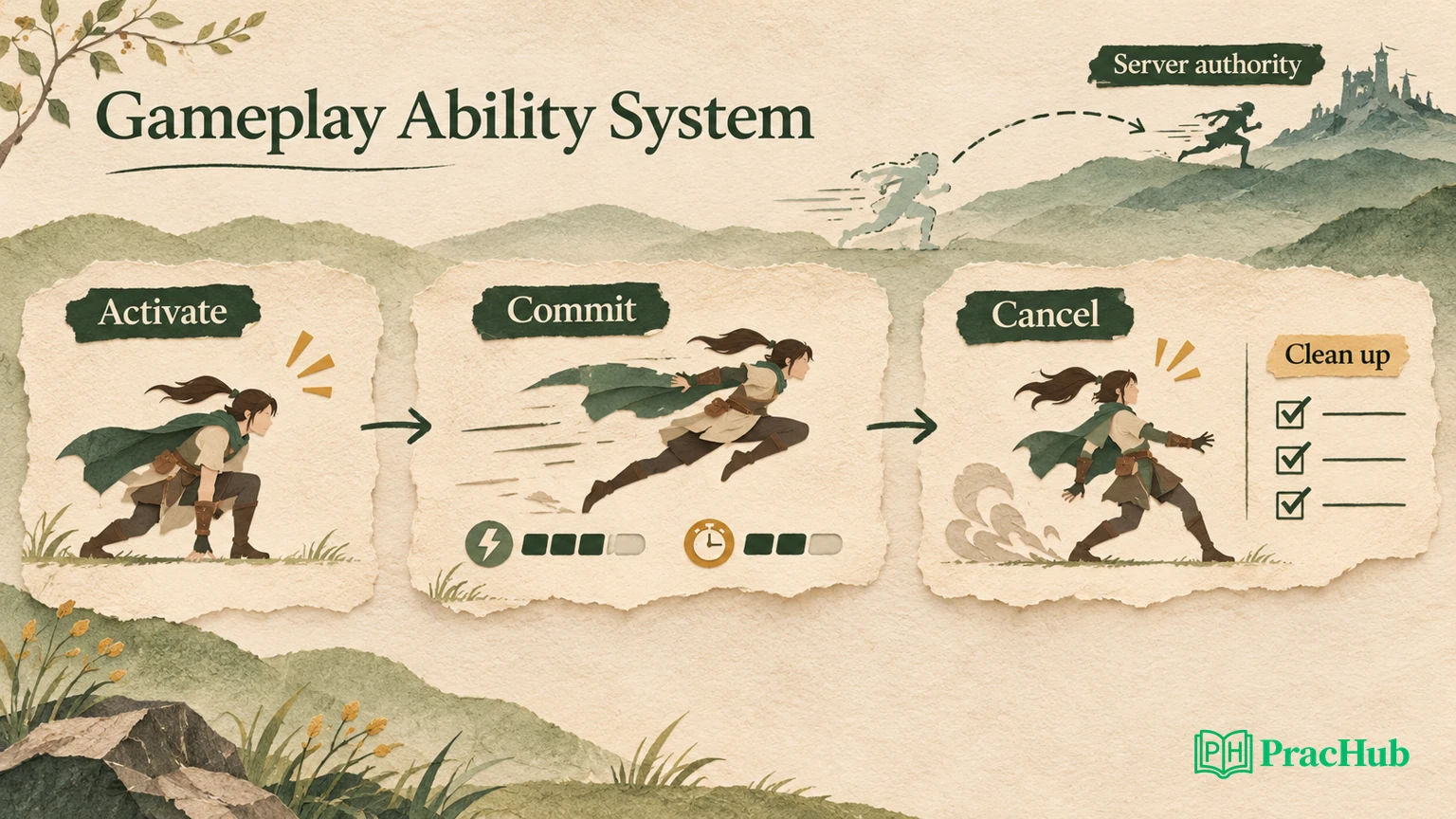
Define the dash before choosing its ability settings
The fictional dash moves a character forward, spends 20 stamina from an initial 100, and starts a cooldown. A stun can interrupt movement. The owning client may predict activation, while the server decides whether the action is accepted. The exercise's policy retains an accepted dash's cost and cooldown after an ordinary interruption.
Retaining cost after interruption is this exercise’s gameplay policy. Another game could refund part of a cost or use a different cooldown policy. The interviewer needs to know which policy you are implementing before evaluating cleanup or reconciliation.
Ask when cost should become committed: immediately when the ability starts, after selecting a direction, or when movement actually begins. Ask whether an early cancel differs from a late cancel. Also identify which effects are cosmetic, which change attributes and which affect authoritative position. One isDashing Boolean cannot represent cost, authority and resource ownership.
Official background: Epic's GAS overview describes ownership, execution state and coordination among abilities, attributes, effects and tasks. The exercise uses that separation to decide who creates and ends each piece of temporary state.
Trace activation checks and commitment separately
Epic's Gameplay Ability reference distinguishes activation checks, activation, CommitAbility, cancellation and ending. It identifies TryActivateAbility as the usual activation path and explains that committing applies configured costs and cooldowns. Merely entering custom activation logic is not the same event as successfully committing it.
For the dash, a useful pseudocode outline is:
on activation:
    validate the required target/direction data
    attempt the configured ability commitment
    if commitment fails:
        end this activation without starting movement
        return
    capture this activation's identity
    start owned movement/animation/wait tasks
    when completion or interruption occurs:
        clean up this activation's temporary resources
        end the ability through the appropriate path
This is a lifecycle sketch, not compilable C++ or a claim that one policy fits every instancing mode. In real code, follow the selected engine version's signatures and the project's ability conventions. State how failure reaches EndAbility, rather than leaving a return that silently keeps the ability active.
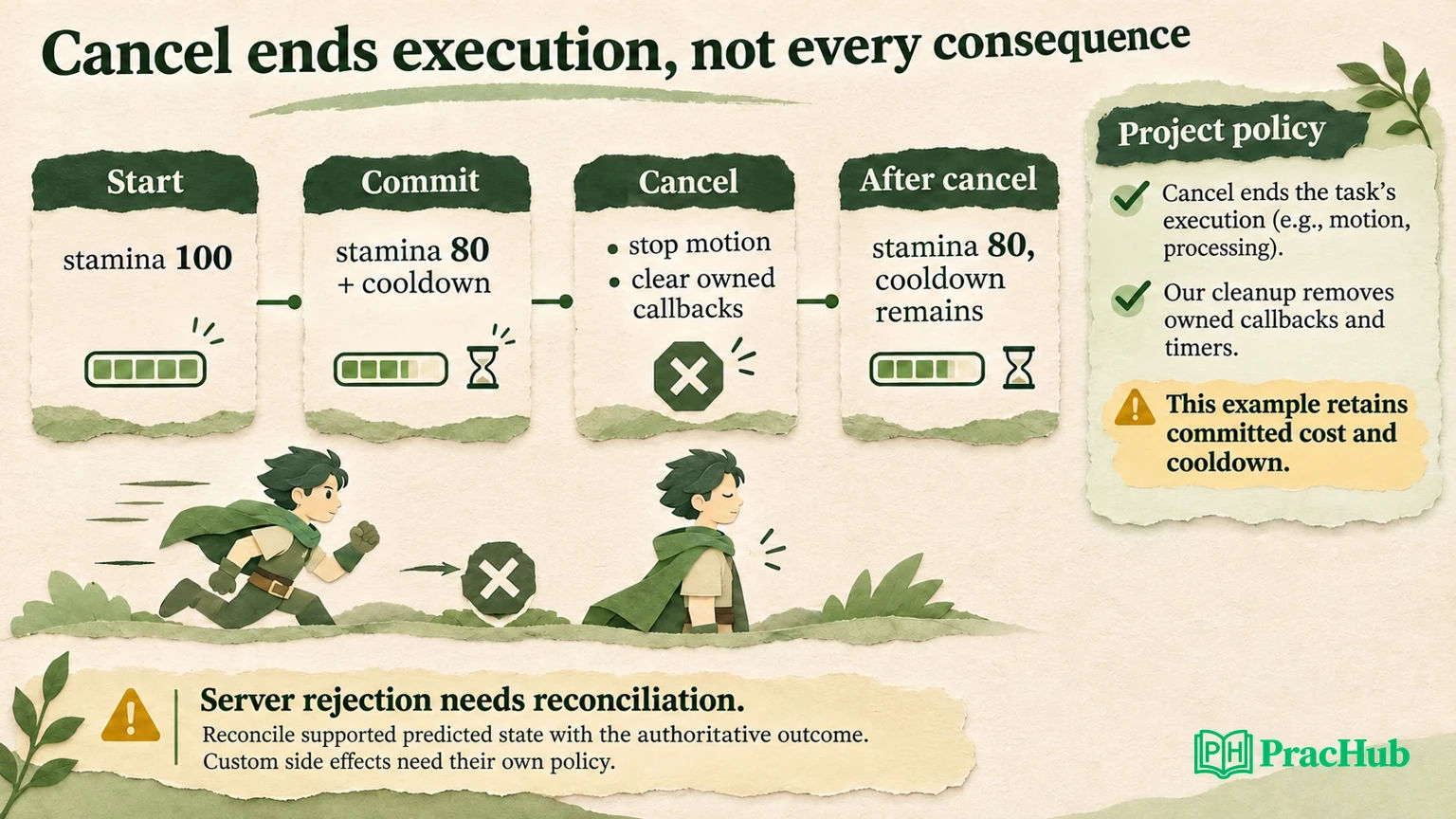
The local state model starts at 100, commits 20, then cancels execution. Its final stamina is 80 and its cooldown remains active under the declared policy. The calculation exposes a specific mistake: using “cancel” as a synonym for “undo everything that ever happened.”
Build a state timeline for the accepted ability
| Event | Execution | Stamina | Cooldown | Required ownership action |
|---|---|---|---|---|
| Before activation | Inactive | 100 | Not started | No dash resources owned |
| Activation accepted, commitment succeeds | Active | 80 | Started | Create and retain temporary resources |
| Stun interrupts the dash | Ending | 80 | Still active by policy | Stop movement and release owned callbacks |
| Ability fully ends | Inactive | 80 | Expires under its own policy | Leave no stale activation resources |
The table separates the ability's execution lifetime from the lifetime of a committed gameplay effect. Ending the ability does not imply every effect it applied should disappear. A cooldown intentionally outlives execution in this example. A temporary input-blocking tag owned only by the dash might need to disappear when execution ends.
If the interviewer asks for a refund, change the policy explicitly. Specify which cancellation reasons qualify, what amount is refundable, whether a refund is authoritative, and how repeated callbacks avoid applying it twice. Do not add 20 stamina in every cleanup function; cleanup may run for several reasons and must not create resources.
A useful follow-up is “What if commitment fails?” The answer should return to the first transition. Movement and cosmetic ownership should not proceed as though the committed path succeeded. Any setup performed before commitment needs its own cleanup decision.
Decide what cancellation actually cleans up
Epic documents cancellation as a route into ending, subject to whether an ability can be canceled. It also warns that an ability that never ends can continue blocking other actions. Therefore cancellation handling should be deliberate, and every normal completion path also needs to end the ability.
List the resources your dash creates. A montage-related task, a timer, an external delegate subscription, an input gate and a movement override may have different owners. “GAS cleans it up” is too broad unless you identify the object and documented lifetime involved.
| Resource | Proposed owner | End condition | Failure to check |
|---|---|---|---|
| Dash Ability Task | This activation | Task completion or ability end | A callback from an obsolete activation |
| External event subscription | Explicit subscription holder | Unsubscribe when ownership ends | Repeated callbacks after cancellation |
| Temporary movement override | Dash movement owner | Restore or remove on termination | Character remains in altered movement mode |
| Committed cooldown effect | Ability effect policy | Its configured expiration/removal | Cleanup accidentally removes a valid cooldown |
| Cosmetic cue | Cue/task policy | Matching end or correction | Duplicate or lingering presentation |
Official fact: Ability Tasks perform asynchronous work and end no later than the ability that owns them. That guarantee does not automatically cover arbitrary timers, raw subscriptions or unrelated objects your custom code creates.
A task's termination is also not proof that every external effect it initiated was reversed. If a custom task changes another system, document how termination interacts with that system. The resource table makes that contract reviewable before network timing makes the failure intermittent.
Handle an old callback during a new activation
Imagine activation 1 ends, then activation 2 begins on an ability instance that can be reused. A delayed callback from activation 1 arrives after the new dash starts. If it checks only the current isActive state, it can accidentally end activation 2 or clear its movement handle.
The original model uses a generation identity. A callback captures its activation's identity and acts only if it still owns the relevant state. The saved check confirms that callback 1 is ignored while generation 2 is current. This is application-level reasoning, not a substitute for understanding the selected GAS instancing policy.
captured_activation = current_activation
on delayed completion:
    if captured_activation != current_activation:
        return  # no ownership of the newer activation
    finish the resources owned by captured_activation
Also make termination idempotent: receiving both interruption and animation completion must not double-release one resource. Idempotence here means repeated cleanup requests converge to the same ended state. It does not authorize repeating a refund, damage application or inventory change.
Test this with explicit event ordering. Complete activation 1, start activation 2, then deliver the old callback. A happy-path test where every callback arrives immediately cannot expose this ownership bug.
Separate local prediction from authoritative acceptance
The Gameplay Ability reference describes Local Predicted execution as immediate local behavior with the server retaining final authority. Treat that as a responsiveness model, not a guarantee that every custom side effect is automatically reversible.
For the original dash, the client may begin presentation while awaiting the authoritative outcome. If the server rejects activation, reconcile the supported predicted state and stop presentation owned by that rejected activation. Identify how movement correction is handled by the movement/networking design; arbitrary actor movement cannot be assumed to roll back merely because it was initiated inside an ability.
Keep ordinary cancellation distinct from rejection. In the accepted-and-interrupted timeline, the dash legitimately spent stamina. In a rejected prediction, the client's provisional view must be reconciled with authoritative state. A blanket “always refund on cancel” mixes the two cases and can conflict with replication.
Ask which operations participate in the project's prediction mechanisms and which are custom irreversible actions. A local sound may need presentation cleanup; a server-side inventory consumption needs authoritative validation; a remote analytics event might be intentionally retained as an attempted action. Their correctness criteria differ.
The broader Unreal lifetime and replication article helps separate object reachability, authority and ownership. Those foundations still matter, but they do not replace a per-activation prediction and cleanup trace.
Present a test matrix that can falsify your design
Start with successful activation and normal completion, insufficient stamina at commitment, cancellation after commitment, and a repeated cancel request. Assert final stamina, cooldown, ability activity and temporary resource ownership separately. A test asserting only that the character stopped moving can miss a permanently blocked ability.
Add server disagreement, delayed completion and reactivation. Under a controlled network test, inspect both owning client and server state. Check that a rejected prediction does not leave presentation active, and that an accepted dash does not receive a duplicate cost from application code layered over configured effects.
Test role and instancing assumptions rather than assuming every actor follows the same path. A dedicated-server setup and a local host can reveal different mistakes. Record the engine/package version, selected execution policy and what was actually observed. This article's local model establishes none of those runtime outcomes.
Finally, ask what evidence would show that cleanup is incomplete: an active tag after execution, a delegate count that grows per dash, a movement mode that never restores, or a cooldown that disappears too early. Each symptom points to a different owner in the resource table.
Distinguish presentation cleanup from business effects
Add a fictional damage event to the dash and the ownership table becomes more demanding. Stopping a trail effect is a presentation cleanup action. Applying damage is a gameplay effect that needs an authority and duplication policy. Reusing the same generic cleanup callback for both does not make their reversal semantics equivalent.
Ask whether damage occurs once at a hit, continuously during movement, or only after a confirmed destination. Then identify how repeated collision callbacks or a rejected prediction affect that decision. The original stamina model does not answer these new questions; it deliberately checks only the declared cost, cooldown and temporary-execution policy.
This follow-up is useful because it exposes an overbroad claim early. If your explanation says every side effect disappears when the ability ends, ask how an accepted hit could remain part of the game state. If it says nothing is ever reverted, ask how a rejected local prediction is reconciled. A defensible design assigns each effect its own lifetime and authority, then tests the relevant event ordering in the engine.
Practice the lifecycle explanation with related questions
These verified PracHub records provide broader state-machine, game-design, ownership and feedback practice. They are not a dedicated GAS assessment bank or predicted employer prompts. Use the follow-ups to expose a concrete activation transition, while acknowledging the original question's different platform or scope.
| PracHub question | Topic-specific rehearsal |
|---|---|
| Multi-tenant resource allocator: entity model, lifecycle state machine, optimistic locking | Assign resources to one activation and make cleanup idempotent. |
| Design a Testable 2048 Game Engine | Distinguish game-state rules from framework lifecycle and persistence. |
| Coordinate a Fleet of Restaurant Robots | Discuss interacting actors and authoritative state; fleet control is not GAS prediction. |
| Find and Fix C++ Ownership Bugs: Double Free, Shallow Copy, and Object Slicing | Use stale ownership to explain a cleanup failure; C++ object bugs are a different runtime. |
| Discuss AI Use, Deadlines, Ambiguity, and Feedback | Explain how a changed requirement alters cost, cancellation and test evidence. |
Rehearse the resource lifecycle question with the dash timeline. Explain the accepted interruption first, then change the event to server rejection, then inject an old callback. The answer should preserve each resource's owner and avoid promising automatic reversal of arbitrary gameplay effects.
Comments (0)